Introduction: The King of the North Holds Its Ground
DLF’s Transformation into a Cash-Rich Realty Giant
Over the last three decades, India’s real-estate sector has gone through multiple boom-and-bust cycles. From the property expansion era of the early 2000s to the liquidity crisis after RERA and NBFC stress, very few developers managed to survive every phase while maintaining leadership. DLF is one of those rare companies. Today, the company is no longer viewed merely as a traditional real-estate developer. It has evolved into a financially disciplined, cash-rich real-estate powerhouse with strong premium housing demand and recurring rental income. The Q4 FY26 results announced on May 13, 2026, clearly show how DLF has fundamentally strengthened its balance sheet while continuing to dominate India’s luxury housing market.
The Biggest Story Behind the Numbers
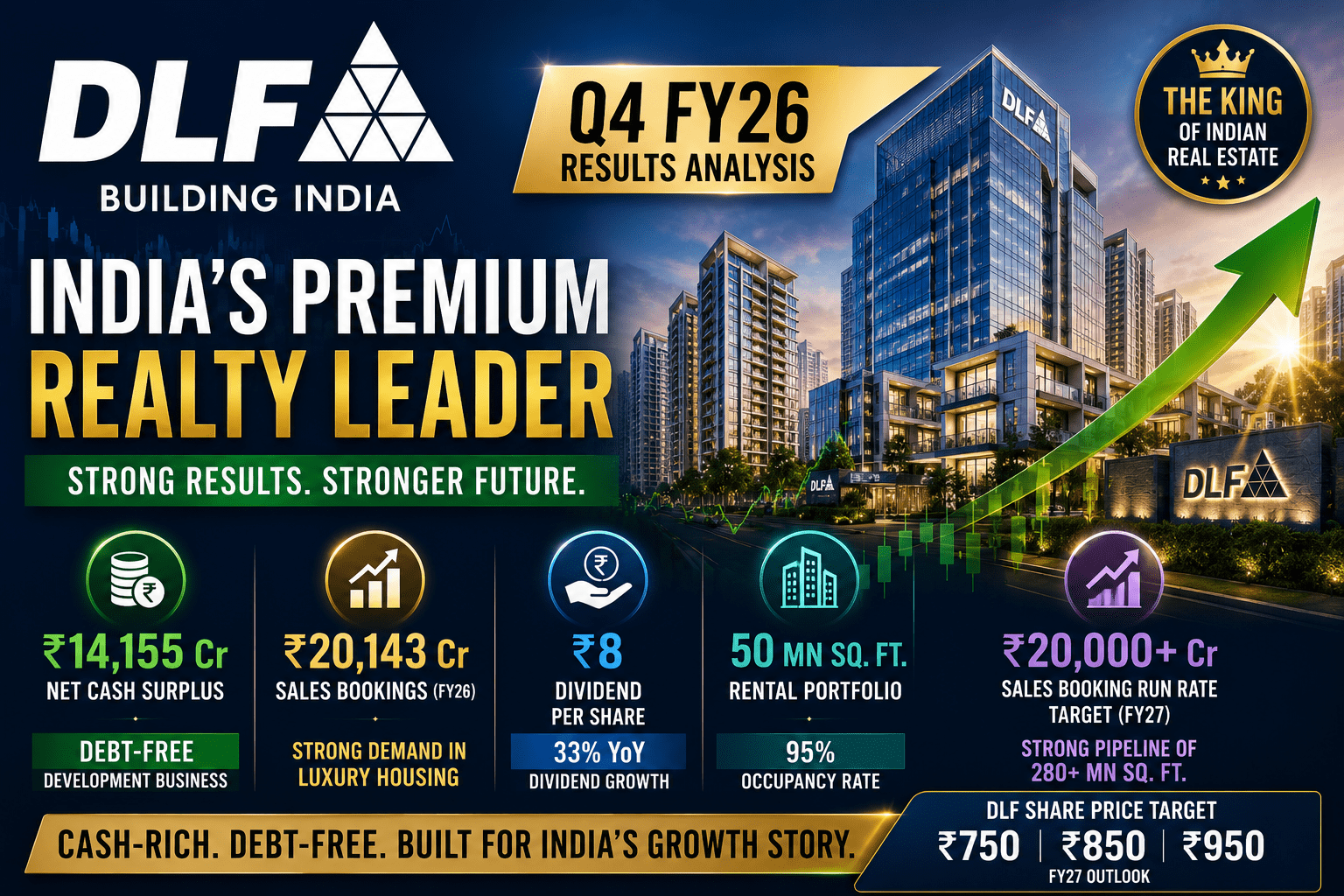
The biggest highlight from DLF’s FY26 performance is the company’s massive ₹14,155 crore net cash surplus in its development business. Historically, high debt levels were one of the biggest risks associated with Indian real-estate companies. Rising interest rates often damaged profitability and delayed project execution. DLF’s transition into a net cash surplus company therefore marks a historic milestone for the Indian real-estate sector. This transformation gives the company enormous financial flexibility to launch projects, acquire land, and withstand future economic slowdowns better than many competitors.
Market Reaction & Investor Sentiment
DLF shares closed around ₹574.15 on the NSE after the results announcement as investors weighed weaker quarterly revenue against strong annual bookings and balance-sheet strength. Although revenue declined due to a high base effect, the company still delivered annual sales bookings exceeding ₹20,000 crore, proving that premium housing demand in India remains structurally strong. Institutional investors continue showing interest in DLF because the company now combines strong cash generation with one of the most valuable luxury real-estate brands in India.
Q4 FY26 Actual Performance: The NSE Data Center
Revenue Performance & High Base Effect
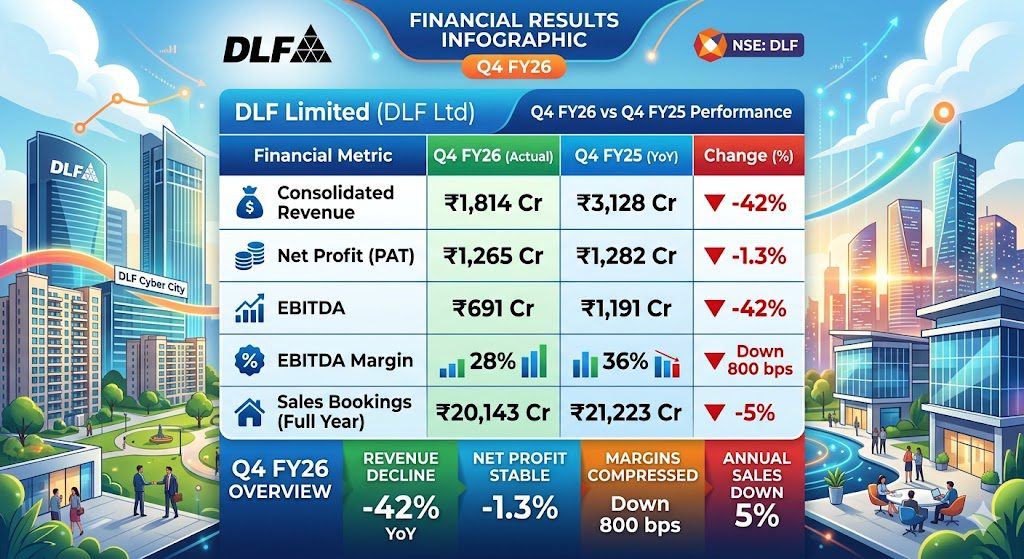
DLF reported consolidated revenue of ₹1,814 crore for Q4 FY26 compared to ₹3,128 crore during the same quarter last year, representing a decline of nearly 42% year-on-year. However, this sharp decline does not necessarily indicate weak demand. Real-estate companies recognize revenue based on project-completion milestones rather than actual booking activity. Because of this accounting structure, quarterly revenue can fluctuate significantly depending on construction progress and handover schedules. The decline therefore reflects timing differences and a very high base from the previous year rather than a structural slowdown in the business.
Profitability Remains Strong
Despite the lower revenue numbers, DLF managed to maintain stable profitability. Net Profit After Tax (PAT) came in at ₹1,265 crore compared to ₹1,282 crore in Q4 FY25, reflecting only a marginal decline of approximately 1.3%. This demonstrates the company’s ability to maintain strong pricing power and disciplined cost management even during quarters with uneven revenue recognition. The company’s focus on premium and luxury projects continues helping it protect margins better than many mass-market developers.
EBITDA & Margin Trends
EBITDA for the quarter stood at ₹691 crore compared to ₹1,191 crore in the same quarter last year. EBITDA margins also declined from 36% to 28%. Although this margin compression may initially concern traders, investors should understand that project mix and timing often influence quarterly margins in the real-estate business. DLF’s luxury portfolio still generates healthy profitability, but quarterly fluctuations remain normal in this industry. The more important point is that the company’s long-term financial structure remains significantly stronger than during previous real-estate cycles.
Full-Year Sales Bookings
For FY26, DLF reported annual sales bookings of ₹20,143 crore compared to ₹21,223 crore during FY25. While bookings declined slightly by around 5%, maintaining ₹20,000 crore-plus annual bookings in a high-interest-rate environment remains a strong achievement. It clearly proves that premium residential demand in India continues staying robust despite rising borrowing costs and global economic uncertainty.
Fundamental Analysis: Quality Over Quantity
Debt-Free Status Changes Everything
One of the most important developments for DLF investors is the company’s debt-free status within the development business. Historically, excessive leverage remained the biggest weakness for Indian real-estate companies. High debt amplified risks during downturns and forced developers to sell assets or delay projects. DLF’s current net cash surplus of more than ₹14,000 crore fundamentally changes the investment story. The company now possesses enormous financial flexibility, which significantly lowers risk for long-term shareholders.
Luxury Housing Is the Core Profit Engine
DLF’s biggest competitive advantage today lies in its dominance within India’s luxury and super-luxury housing segment. High-end projects continue generating strong demand from affluent buyers and NRIs despite economic uncertainty. Projects such as DLF Privana North generated bookings exceeding ₹11,000 crore, while The Dahlias contributed approximately ₹4,800 crore in bookings. These numbers clearly show that wealthy homebuyers continue preferring premium branded real-estate projects in major urban centers like Gurugram and Delhi NCR.
The Stability of DCCDL Rental Income
Another major strength within DLF’s business model is its rental portfolio through DLF Cyber City Developers (DCCDL). The company currently operates around 50 million square feet of rental assets with occupancy rates close to 95%. This recurring rental income provides stable cash flows and acts as a hedge against residential market volatility. Even if housing sales temporarily slow, DLF’s office spaces, retail centers, and commercial properties continue generating predictable revenue streams.
Shareholder Rewards: The Dividend Boost
₹8 Final Dividend Announcement
DLF’s board recommended a final dividend of ₹8 per share for FY26, reflecting management’s growing confidence in the company’s cash-generation capability. Dividend payouts in the real-estate sector are especially important because they indicate balance-sheet strength and sustainable cash flows. Investors often prefer developers capable of rewarding shareholders consistently while simultaneously expanding operations.
Dividend Growth Reflects Confidence
The ₹8 dividend represents approximately 33% growth compared to the previous year’s payout. This sharp increase clearly signals management confidence regarding future earnings visibility and operational stability. For long-term investors, rising dividends combined with capital appreciation create a strong wealth-compounding opportunity.
Technical Analysis: Finding the Floor at ₹550
Current Market Trend
From a technical perspective, DLF currently remains in a neutral-to-improving trend structure. After reversing a prolonged losing streak with a strong 16.5% rally during April, the stock experienced mild weakness in early May. However, broader technical signals continue indicating strong institutional support at lower levels.
Major Support Zones
The most important support range currently lies between ₹550 and ₹560. This zone has repeatedly acted as a strong accumulation area where buying interest emerges consistently. As long as DLF remains above this support band, the medium-term bullish structure remains intact. Long-term investors often view such support levels as strategic entry opportunities into fundamentally strong companies.
Immediate Resistance Levels
On the upside, immediate resistance currently stands near ₹585, while the next major hurdle lies around ₹610. A sustained breakout above ₹610 could potentially trigger stronger momentum toward higher targets. Technical traders are closely monitoring this zone because a breakout supported by strong volume may signal the beginning of the next major rally phase.
Positive Volume Structure
One encouraging technical signal is DLF’s positive volume balance. Even during short-term corrections, heavy selling pressure remains relatively limited. This indicates that institutional investors are continuing to hold positions instead of aggressively exiting the stock during temporary weakness.
Brokerage Sentiment & Targets
Analysts Remain Bullish on DLF
Most brokerage firms continue maintaining bullish outlooks on DLF following the Q4 FY26 results. Analysts remain optimistic because India’s premium housing market continues benefiting from rising urban wealth, aspirational demand, and limited supply of high-quality luxury projects.
Motilal Oswal’s Aggressive Target
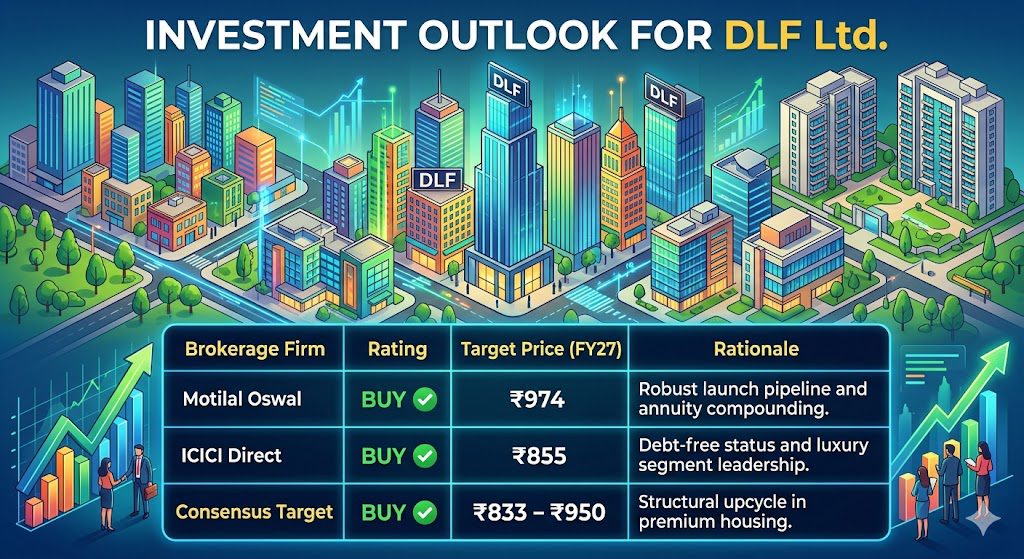
Motilal Oswal Financial Services currently maintains a “Buy” rating on DLF with a target near ₹974. The brokerage remains highly optimistic regarding DLF’s strong launch pipeline, recurring rental income, and premium housing leadership.
ICICI Direct’s Positive Outlook
ICICI Direct also maintains a bullish stance with targets around ₹855. Analysts believe DLF’s debt-free status and luxury housing dominance provide strong long-term competitive advantages.
Consensus Target Range
Overall brokerage consensus currently places DLF’s medium-term target range between ₹833 and ₹950. Analysts continue expecting India’s structural premium housing upcycle to remain supportive for DLF’s long-term growth trajectory.
Management Guidance: A ₹20,000 Crore+ Runway
FY27 Sales Booking Outlook
Management remains confident about sustaining annual sales bookings between ₹20,000 crore and ₹22,000 crore during FY27. This guidance indicates strong confidence regarding continued demand in the premium and luxury housing segment despite macroeconomic uncertainty.
Massive Development Pipeline
DLF currently possesses over 280 million square feet of development potential across multiple projects. The company continues focusing heavily on high-margin super-luxury developments that generate stronger profitability and cash-flow conversion. This massive project pipeline provides strong visibility for future earnings growth.
The 30-Year Analyst Verdict
For Long-Term Investors
DLF has successfully transformed itself from a debt-heavy cyclical developer into a cash-rich premium real-estate platform with stable recurring rental income and luxury pricing power. The company’s ₹14,155 crore cash surplus, strong annuity business, growing dividends, and premium housing leadership make it one of the strongest long-term real-estate investment opportunities in India today.
For Active Traders
For traders, DLF currently remains in a neutral-to-slightly-weak short-term trend. Momentum traders should ideally wait for a breakout above ₹610 before aggressively chasing upside targets. If the breakout occurs with strong volume support, the probability of a rally toward ₹750 increases significantly.
Conclusion & Engagement (CTA)
Final Word on DLF
DLF’s Q4 FY26 performance proves that financial discipline and premium market positioning can fundamentally change the future of a real-estate company. Despite temporary revenue volatility, the company now possesses one of the strongest balance sheets in the Indian real-estate sector. Luxury housing demand, recurring rental income, and massive development potential continue supporting long-term growth visibility.
DLF’s transformation into a cash-surplus real-estate giant marks one of the most important structural success stories in India’s property market over the last decade. For investors seeking exposure to India’s premium housing and urbanization boom, DLF remains one of the strongest blue-chip real-estate plays available today.
Investor Engagement CTA
Are you buying DLF for its ₹8 dividend and strong cash-rich balance sheet, or waiting for the ₹850–₹950 breakout story? Share your real-estate investment strategy in the comments below.