As Global Trade Fragments, Small and Mid-Sized Businesses Are Quietly Rewriting the Rules of International Payments
For decades, international trade has revolved around one dominant infrastructure: the U.S. dollar and the SWIFT banking network. Whether a small manufacturer in Germany was buying components from China or a Canadian importer was sourcing machinery from Southeast Asia, most cross-border payments eventually traveled through a chain of correspondent banks connected to dollar-clearing systems.
That model worked reasonably well in a world where global trade was highly centralized and businesses had limited alternatives. However, the international payment landscape is changing rapidly. Rising foreign exchange (FX) costs, growing geopolitical fragmentation, longer settlement chains, and new digital payment technologies are forcing businesses to rethink how they move money across borders.
Today, a growing number of small and medium-sized enterprises (SMEs) in the United States, Canada, the United Kingdom, and Europe are exploring alternative cross-border B2B payment rails that reduce costs, accelerate settlement, and improve cash-flow efficiency. Rather than participating in political debates about reserve currencies, these businesses are focused on a practical question: how can they pay suppliers faster while keeping more money on their balance sheets?
The answer increasingly lies beyond SWIFT.
Why Traditional Cross-Border Payment Rails Create Hidden Costs
| Cost Component | Typical Cost Range |
|---|---|
| Outgoing Wire Fee | $15 – $50 |
| Correspondent Bank Fees | $20 – $100 |
| FX Conversion Spread | 1.5% – 4.0% |
| Receiving Bank Charges | $10 – $50 |
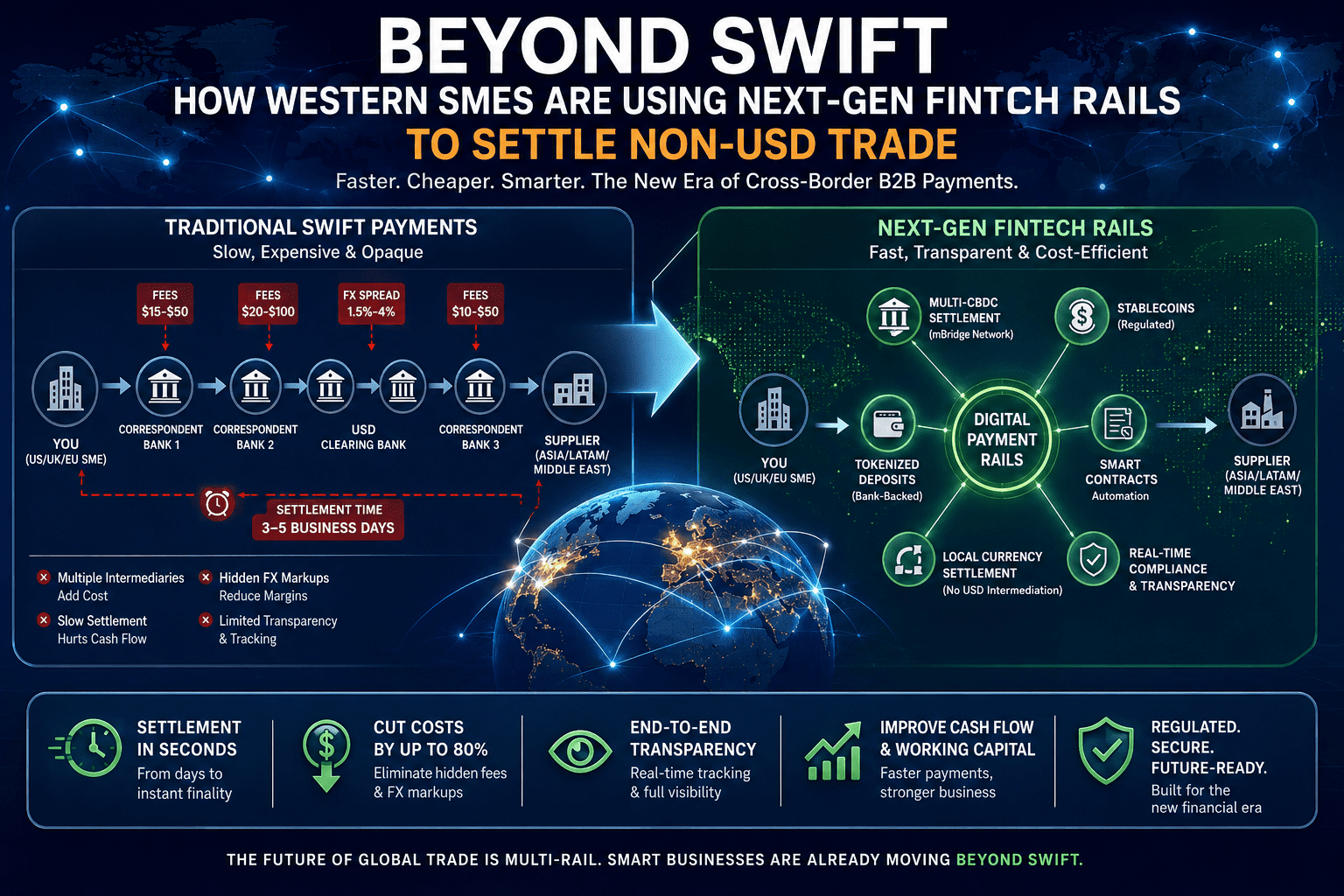
| Settlement Time | 3–5 Business Days |
| Total Estimated Cost | $1,500 – $4,500 |
Most business owners understand international wire transfer fees. What many fail to recognize are the hidden expenses embedded inside traditional correspondent banking networks.
When an American company sends money to a supplier in Thailand, Vietnam, Mexico, or the United Arab Emirates, the payment rarely moves directly between the two institutions. Instead, it often passes through several intermediary banks. Each intermediary may charge fees, apply foreign exchange spreads, perform compliance checks, and add settlement delays.
This process creates what many treasury professionals call the “hidden USD tax.”
For example, a European importer purchasing goods from a supplier in Indonesia may receive an invoice denominated in U.S. dollars even though neither party primarily operates in dollars. The Indonesian exporter converts local currency into dollars for pricing purposes, while the European buyer converts euros into dollars to make payment. Multiple currency conversions occur before settlement is completed.
The result is higher transaction costs, weaker pricing transparency, and reduced profit margins.
Settlement delays also create operational challenges. Traditional SWIFT transactions often require three to five business days for completion. During periods of market volatility, exchange rates can move significantly during that window, introducing additional uncertainty into procurement budgets and treasury forecasts.
For SMEs operating on tight margins, these inefficiencies can directly impact profitability.
The Global Financial Infrastructure Is Being Rebuilt
One of the most significant developments reshaping international finance is the migration toward the ISO 20022 messaging standard.
ISO 20022 is often described as the new language of global payments. Unlike older messaging systems, it allows richer data transmission, better automation, enhanced compliance reporting, and more efficient payment routing.
Financial institutions around the world are investing billions of dollars to modernize their infrastructure around this standard.
At the same time, digital money markets have expanded dramatically. Following major regulatory developments in North America and Europe, the global stablecoin and tokenized deposit ecosystem surpassed an estimated $300 billion in circulation during early 2026.
Growth of Regulated Digital Money Markets
| Year | Estimated Market Size |
|---|---|
| 2020 | $20 Billion |
| 2021 | $65 Billion |
| 2022 | $125 Billion |
| 2023 | $150 Billion |
| 2024 | $190 Billion |
| 2025 | $260 Billion |
| Early 2026 | $300+ Billion |
Several factors accelerated this growth:
- Regulatory clarity in major financial markets.
- Increased institutional adoption.
- Integration with commercial banking systems.
- Demand for faster cross-border settlement.
- Growth of programmable payment technologies.
In Europe, the implementation of the Markets in Crypto-Assets (MiCA) framework created a structured environment for regulated digital asset activity. In the United States, the passage of the GENIUS Act in 2025 established clearer rules for regulated payment stablecoins and digital settlement infrastructure.
Together, these developments transformed digital money from a speculative asset class into a practical tool for commercial transactions.
Project mBridge: A New Cross-Border Settlement Architecture
| Feature | Traditional SWIFT | Next-Gen Payment Rails |
|---|---|---|
| Settlement Speed | 3–5 Days | Seconds to Hours |
| Correspondent Banks | 3–5 | 0–1 |
| FX Conversion Layers | Multiple | Direct |
| Cost Transparency | Low | High |
| Real-Time Tracking | Limited | Full |
| Automation | Low | High |
| Working Capital Efficiency | Low | High |
Among the most closely watched developments in international finance is Project mBridge.
Unlike traditional payment networks, mBridge was designed as a multi-central bank digital currency (CBDC) platform that enables direct cross-border settlement between participating jurisdictions.
The platform focuses on wholesale transactions and allows participating institutions to exchange value in real time using digital versions of national currencies.
One of the most important milestones occurred when the Bank for International Settlements Innovation Hub stepped back from direct involvement, allowing participating central banks and financial institutions to continue commercial expansion independently.
The ecosystem now includes major financial centers such as China, Hong Kong, Thailand, the United Arab Emirates, and Saudi Arabia.
The significance of this development extends beyond governments and central banks.
What mBridge Means for Western SMEs
Many Western businesses assume these systems are only relevant to large multinational corporations.
That assumption is increasingly outdated.
While SMEs cannot directly access mBridge infrastructure, many of their suppliers, distributors, and financial service providers can.
Imagine a U.S.-based electronics importer sourcing components from manufacturers in China and the Gulf region. Traditionally, those transactions would likely move through dollar-clearing banks in New York before reaching their final destination.
Under emerging models, suppliers may instead receive settlement through regional digital currency infrastructure connected to mBridge.
The Western importer accesses these networks indirectly through:
- Multi-currency corporate wallets.
- Regional banking partners.
- Treasury management platforms.
- FinTech payment providers.
- Hong Kong-based settlement intermediaries.
This approach enables invoices to be settled directly in local currencies such as digital yuan (e-CNY) or digital dirhams without requiring multiple layers of dollar-based intermediation.
The result is faster settlement, lower FX costs, and greater payment transparency.
For companies with high-volume procurement operations in Asia and the Middle East, these efficiencies can generate meaningful savings over time.
Tokenized Deposits and Stablecoins Are Transforming Commercial Payments
One of the biggest misconceptions in financial markets is that all digital assets operate like speculative cryptocurrencies.
In reality, the modern commercial settlement ecosystem is increasingly built around regulated digital money instruments.
Tokenized deposits and regulated stablecoins represent digital versions of traditional money held within licensed financial institutions.
Unlike volatile cryptocurrencies, these instruments are designed to maintain stable value and operate within established regulatory frameworks.
Central banks across Europe and other developed economies increasingly favor a two-tier architecture.
Under this model:
- Central banks provide the wholesale settlement infrastructure.
- Commercial banks distribute digital financial products to businesses and consumers.
This structure preserves the role of traditional banks while enabling real-time settlement capabilities.
Projects such as the European Central Bank’s digital euro initiatives, the Bank of England’s digital payment research programs, and the BIS-led Project Agora demonstrate how programmable financial infrastructure is becoming a core component of modern commerce.
How an SME Can Build a Modern B2B Payment Stack
Many business owners assume advanced payment infrastructure is only accessible to large corporations with dedicated treasury departments.
That is no longer true.
Today, an SME can establish a modern international payment system using commercially available solutions.
The process typically begins with opening a multi-currency business account through regulated providers offering embedded banking capabilities.
Platforms such as Wise Business, Airwallex, and ConnectPay allow businesses to hold multiple currencies, manage international invoices, and access competitive foreign exchange pricing.
The next step involves integrating payment workflows into accounting and enterprise resource planning systems.
Once integrated, a supplier invoice can trigger automated payment instructions. Smart routing algorithms determine the most efficient settlement pathway, whether through local clearing rails, tokenized deposits, or regulated digital payment networks.
Instead of relying on a traditional international wire transfer, funds can move through domestic instant-payment systems such as:
- SEPA Instant in Europe.
- FedNow in the United States.
- RTP networks.
- Faster Payments in the UK.
The entire process can be completed within minutes rather than days.
For treasury teams, this means improved liquidity management, faster supplier relationships, and better visibility into cash positions.
The Rise of Specialized Clearing Houses in Canada and the UK
Another important trend reshaping global trade is the emergence of specialized non-bank financial institutions operating dedicated clearing ecosystems.
These organizations focus on specific trade corridors and currency pairs rather than attempting to serve the entire global market.
London and Toronto have become particularly important centers for this activity.
Traditional correspondent banking often requires payments to pass through multiple institutions before reaching their destination.
Specialized clearing houses seek to eliminate those layers.
Consider a Canadian manufacturer purchasing industrial components from Mexico.
Under conventional payment structures, Canadian dollars might first convert into U.S. dollars before being exchanged into Mexican pesos.
Each conversion introduces costs and potential delays.
A specialized clearing platform can directly match businesses with opposing currency needs.
If a Mexican exporter requires Canadian dollars while a Canadian importer needs Mexican pesos, the platform can facilitate direct matching without routing through U.S. dollar markets.
This closed-loop approach reduces costs while increasing efficiency.
For SMEs, the benefits are significant:
- Greater pricing transparency.
- Lower foreign exchange spreads.
- Same-day settlement.
- Reduced intermediary fees.
- Improved working capital management.
As international trade becomes increasingly regionalized, these specialized clearing ecosystems are expected to expand rapidly.
Comparing the New Generation of Payment Rails
When evaluating payment infrastructure, businesses should consider four critical factors: speed, cost, regulatory protection, and operational suitability.
Traditional SWIFT wires remain valuable for large, infrequent transactions involving established banking relationships. However, they often suffer from slow settlement and multiple hidden costs.
Multi-CBDC settlement models connected to systems like mBridge offer near-instant transaction processing and reduced dependence on dollar-based clearing mechanisms. They are particularly attractive for companies with significant sourcing activity in Asia and the Middle East.
Tokenized deposits and regulated stablecoin networks provide some of the fastest settlement capabilities available today. Supported by modern regulatory frameworks, they are increasingly suitable for technology companies, SaaS procurement, agile manufacturing operations, and digitally integrated supply chains.
Specialized clearing houses occupy a middle ground. They deliver strong cost savings and efficient settlement while maintaining familiar regulatory oversight structures in jurisdictions such as Canada and the United Kingdom.
Each option serves a different business objective, which is why treasury diversification is becoming a competitive advantage.
Why Treasury Strategy Is Becoming a Competitive Advantage
The concept of de-dollarization is often discussed in geopolitical terms.
For SMEs, however, the issue is far less ideological and far more practical.
Businesses are not abandoning the dollar because of politics. They are seeking operational efficiency.
Every unnecessary foreign exchange conversion reduces profit margins.
Every delayed payment increases working capital requirements.
Every intermediary bank introduces additional costs and compliance complexity.
Companies that modernize their treasury operations gain measurable advantages:
- Faster supplier payments.
- Improved cash-flow forecasting.
- Lower transaction expenses.
- Better foreign exchange management.
- Enhanced resilience against currency volatility.
In an increasingly fragmented global economy, payment flexibility may become just as important as supply-chain flexibility.
Organizations capable of settling transactions across multiple currencies and payment rails will be better positioned to adapt to changing trade conditions.
The Future of Cross-Border B2B Payments
The global financial system is entering a period of transformation comparable to the rise of internet banking two decades ago.
ISO 20022, tokenized deposits, regulated stablecoins, multi-CBDC platforms, and specialized clearing ecosystems are converging into a new generation of payment infrastructure.
For Western SMEs, this shift represents an opportunity rather than a threat.
Businesses that continue relying exclusively on traditional correspondent banking may face higher costs and slower settlement compared with competitors adopting modern alternatives.
The winners will not necessarily be the largest companies. Instead, they will be the firms that recognize payment efficiency as a strategic capability.
Cross-border trade is no longer solely about sourcing the best products or finding the lowest-cost suppliers. Increasingly, success depends on how efficiently money moves between trading partners.
Final Takeaway
The future of international commerce is becoming multi-rail, multi-currency, and increasingly programmable. While SWIFT remains an essential part of global finance, Western SMEs now have access to a growing range of alternatives that can reduce foreign exchange costs, accelerate settlement, and improve treasury performance.
Business owners, CFOs, procurement managers, and treasury teams should begin auditing their international payment infrastructure today. Review every international invoice, identify hidden correspondent banking costs, evaluate foreign exchange spreads, and explore emerging payment networks that align with your trade corridors.
Potential SME Savings from Payment Rail Modernization
| Annual International Payment Volume | Estimated Savings |
|---|---|
| $250,000 | $2,500 – $7,500 |
| $500,000 | $5,000 – $15,000 |
| $1 Million | $10,000 – $30,000 |
| $5 Million | $50,000 – $150,000 |
| $10 Million | $100,000 – $300,000 |
The companies that optimize their cross-border payment strategy today will be better positioned to protect margins, strengthen supplier relationships, and compete effectively in the next era of global trade.