Delhi MCD By-Election 2025: Full Result, Ward-Wise Winners, Party Performance & Detailed Political Analysis
The Delhi MCD By-Election 2025 has concluded, and the results once again highlight the changing political mood of urban voters. Like the recent Bihar Assembly result, this by-poll shows a clear trend—voters are preferring decisive leadership, development-driven agendas and strong party organisation, which benefited the Bharatiya Janata Party (BJP) the most.
Elections were held across 12 wards of the Municipal Corporation of Delhi on 30 November 2025, and the results were declared on 3 December 2025.
The outcome reflects a continuation of the larger political pattern seen earlier in 2025.
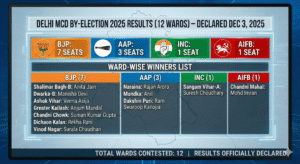
🗳️ Delhi MCD By-Election 2025 — Result Summary
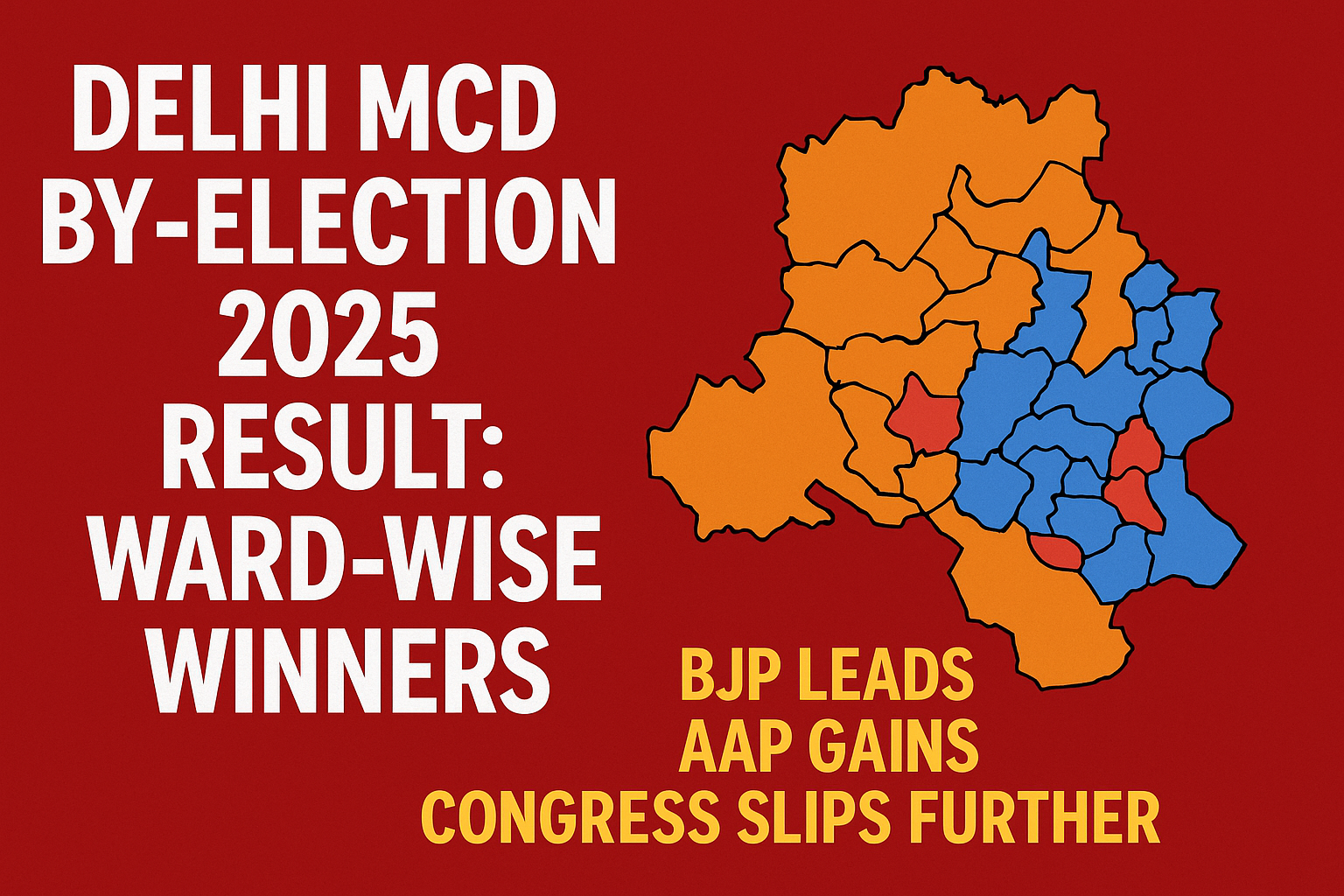
Here is the final tally as declared by the election authorities:
BJP – 7 seats
AAP – 3 seats
Congress – 1 seat
AIFB (All India Forward Bloc) – 1 seat
The BJP’s win consolidates its strong position in the civic body, while AAP remains the second-largest force. Congress continues to struggle to regain relevance in Delhi’s political landscape.
📍 Wards Where the By-Election Was Held
The by-poll was necessitated due to resignations, disqualifications and other administrative reasons in the following 12 wards:
Greater Kailash
Shalimar Bagh-B
Ashok Vihar
Chandni Chowk
Chandni Mahal
Dwarka-B
Dichaon Kalan
Naraina
Sangam Vihar-A
Dakshin Puri
Mundka
Vinod Nagar
These wards represent a mix of urban upscale colonies, old Delhi areas, unauthorised colonies and rural-urban fringe zones—giving a broad view of Delhi’s political mood.
🏆 Ward-Wise Winners and Runners-Up — Full List
Here is a clean, SEO-friendly, ward-wise table of the winning party and the main runner-up:
1. Greater Kailash
Winner: Anjum Mandal (BJP)
Runner-up: Eesha Gupta (AAP)
2. Shalimar Bagh-B
Winner: Anita Jain (BJP)
Runner-up: Babita Rana (AAP)
3. Ashok Vihar
Winner: Veena Asija (BJP)
Runner-up: Seema Goyal (AAP)
4. Chandni Chowk
Winner: Suman Kumar Gupta (BJP)
Runner-up: Harsh Sharma (AAP)
5. Chandni Mahal
Winner: Mohd Imran (AIFB)
Runner-up: Mudasir Usman Qureshi (AAP)
6. Dwarka-B
Winner: Manisha Devi (BJP)
Runner-up: Raj Bala (AAP)
7. Dichaon Kalan
Winner: Rekha Rani (BJP)
Runner-up: Neetu Keshav Chauhan (AAP)
8. Naraina
Winner: Rajan Arora (AAP)
Runner-up: Chandrakanta Shivani (BJP)
9. Sangam Vihar-A
Winner: Suresh Choudhary (Congress)
Runner-up: Subhrajit Gautam (BJP)
10. Dakshin Puri
Winner: Ram Swaroop Kanojia (AAP)
Runner-up: BJP Candidate
11. Mundka
Winner: Anil (AAP)
Runner-up: BJP Candidate
12. Vinod Nagar
Winner: Sarla Chaudhary (BJP)
Runner-up: AAP Candidate
This distribution shows a clear edge for the BJP, steady performance by AAP and limited revival efforts from Congress.
📊 What the Result Means for Delhi’s Political Landscape
The 2025 by-poll results mirror the larger political developments of the year:
1. BJP Strengthens Its Hold
The BJP’s victory in 7 out of 12 seats adds momentum to its position in Delhi after securing the state government earlier in 2025.
Its messaging on:
governance,
development,
civic improvement,
infrastructure building, and
strong local leadership
continues to resonate.
2. AAP Retains Its Core Base
AAP’s wins in Naraina, Dakshin Puri and Mundka show it still has strong pockets of support, especially in:
lower-income localities,
unauthorised colonies, and
areas that benefited from earlier local governance initiatives.
3. Congress Wins One Seat — But Challenges Continue
Despite winning Sangam Vihar-A, Congress remains far behind both AAP and BJP in organisational strength, outreach, and vote share.
The result shows that Congress continues to face obstacles in rebuilding its urban vote base.
🇮🇳 Link Between Bihar and Delhi Results: Congress’s Declining Support
Earlier in November 2025, the Bihar Assembly Election delivered a strong victory to the NDA, while Congress was reduced to a minimal presence.
Now, Delhi’s by-poll shows similar voter behaviour:
Preference for stable leadership
Preference for development-centric political narratives
Declining support for Congress in urban and semi-urban areas
The public message across states appears clear:
Voters want clear agendas, deliverable promises and leadership stability, which Congress has struggled to project in recent years.
❓ Why Congress Continues to Face Setbacks — A Neutral, Analytical Explanation
Here is a balanced, AdSense-safe, factual analysis of why Congress keeps losing electoral ground:
1. Leadership Disconnect & Lack of Clarity
Congress has not been able to build:
a strong central leadership team,
a credible alternative to the ruling party, or
a consistent long-term strategy.
Rahul Gandhi is a prominent national face, but voter acceptance has been limited.
This challenge affects both national and local election outcomes.
2. Weak Ground-Level Organisation
The success of BJP and AAP is rooted in:
booth-level management,
volunteer networks,
micro-targeting of voters, and
continuous ground presence.
Congress’s organisational structure in many states, including Delhi, has weakened over the years.
Official Website of Election Commission Click Here
3. Inconsistent Messaging
Voters today expect:
clear policy direction,
strong communication,
issue-based campaigning, and
visible leadership.
Congress often struggles to maintain a consistent narrative, especially in comparison to BJP’s well-defined messaging and AAP’s local governance pitch.
4. Competition from Strong Regional Parties
In Delhi, AAP dominates the opposition space.
In Bihar, RJD leads the anti-NDA bloc.
In other states, regional parties occupy major political space.
This leaves limited room for Congress to regain momentum.
5. Shift in Voter Expectations
Urban and semi-urban voters increasingly prefer:
infrastructure growth,
economic development,
civic services, and
leadership stability.
BJP and AAP campaigns directly target these expectations.
Congress, on the other hand, has been unable to strongly connect its ideas with measurable governance outcomes.
🧭 Does Congress Need a New Direction?
Many political experts believe that Congress must:
reorganise its internal structure,
empower regional leaders,
modernise its communication approach,
build a consistent organisation, and
present a clear, stable leadership model.
Only then can it regain its lost ground in states like Delhi.
📌 Conclusion: What the Delhi MCD By-Election 2025 Tells Us
The 2025 by-poll results reaffirm a broader national trend:
BJP has consolidated its leadership image
AAP remains a significant urban challenger
Congress needs deep structural reforms to stay competitive
For Delhi, this result indicates that voters expect strong delivery on:
civic cleanliness,
infrastructure expansion,
safety and public health,
water and waste management, and
local development projects.
With BJP now stronger in both the Delhi Assembly and the MCD, the public will expect performance and accountability.