Introduction: The Backbone of Digital India
Expert Hook
In 1995, networking in India was still a developing concept. Internet access was limited to a small number of businesses, dial-up modems were painfully slow, and networking hardware was considered a niche technology product. Over the last three decades, India has transformed into one of the world’s largest digital economies, powered by broadband connectivity, cloud infrastructure, enterprise data centers, and now the rapid rollout of 5G technology. Throughout this transformation, D-Link (India) Limited has remained one of the most recognized networking brands in the country. The company evolved from a traditional networking hardware seller into a major supplier of routers, enterprise switches, wireless devices, surveillance systems, and telecom infrastructure solutions that now support India’s digital backbone.
The Big Story
D-Link India’s Q4 FY26 results have become a major talking point in the Indian stock market because the company delivered its highest-ever quarterly revenue performance. Revenue from operations crossed the ₹440 crore mark for the first time in company history, reflecting powerful demand across consumer networking devices, enterprise connectivity solutions, and telecom infrastructure products. At a time when India’s digital transformation is accelerating due to 5G expansion, smart offices, cloud adoption, and growing internet penetration, D-Link India appears to be benefiting directly from this structural growth cycle. The strong topline growth has strengthened investor confidence in the company’s long-term growth story.
The “Retail Treat”
While margins faced pressure during the quarter, management rewarded shareholders aggressively through one of the biggest dividend announcements in the small-cap technology sector this year. The company announced a combined dividend payout of ₹27.50 per share, including a special dividend, which significantly boosted investor sentiment. For retail investors searching for quality dividend-paying technology stocks, this announcement has made DLINKINDIA one of the most attractive names in the networking sector. The combination of stable earnings, strong cash reserves, and generous shareholder rewards has created a positive narrative around the stock despite near-term operational challenges.
Q4 FY26 Performance: The “Actuals” (NSE Audited Data)
Revenue Growth
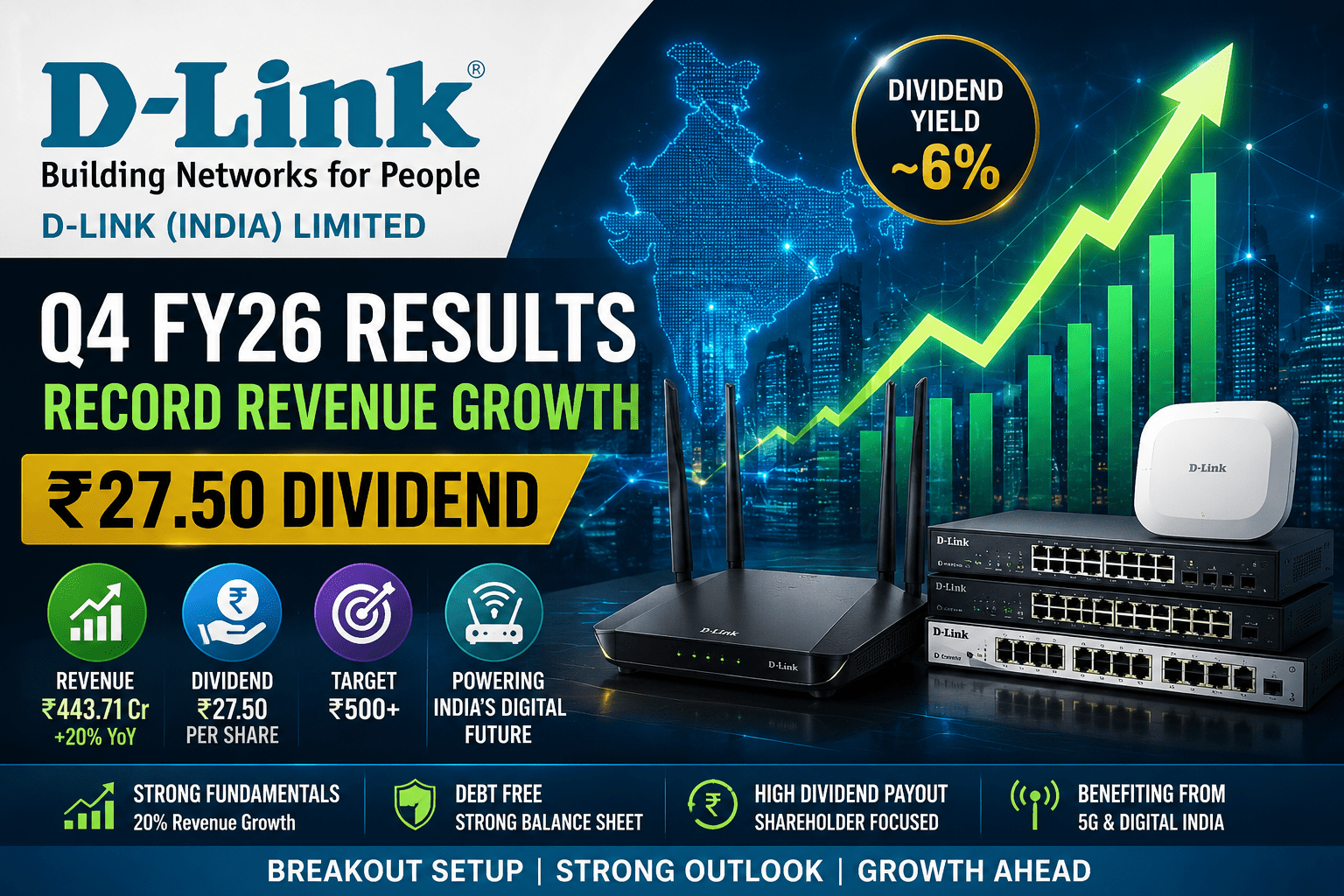
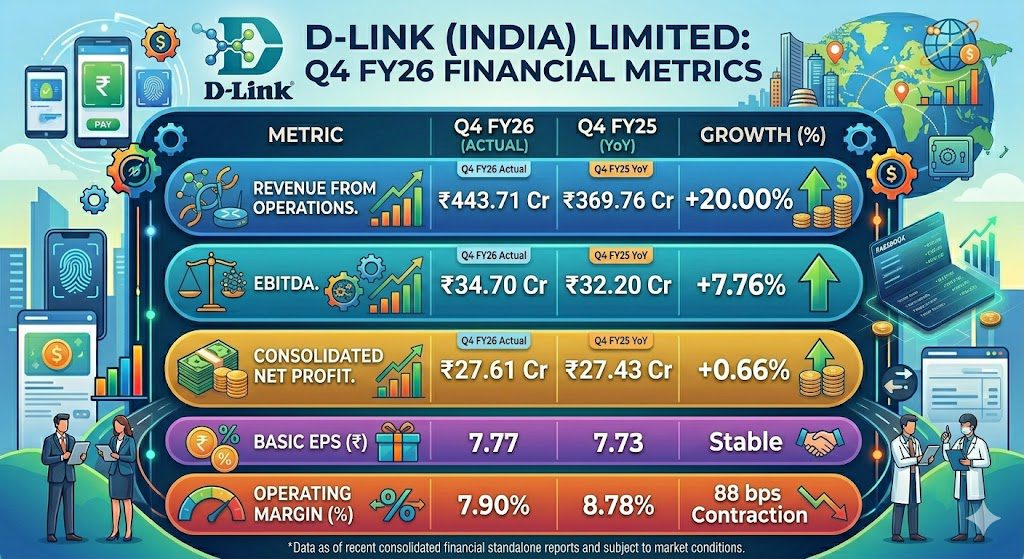
D-Link India reported consolidated revenue from operations of ₹443.71 crore in Q4 FY26 compared to ₹369.76 crore in Q4 FY25, representing an impressive 20% year-on-year growth. This strong increase in sales highlights rising demand for networking products across both consumer and enterprise markets. The expansion of India’s digital infrastructure ecosystem, increasing broadband penetration, work-from-home trends, and enterprise networking upgrades have all contributed to this remarkable revenue performance. Crossing the ₹440 crore quarterly revenue milestone demonstrates that the company is successfully capitalizing on India’s growing need for high-speed connectivity solutions.
Net Profit Stability
Despite the sharp rise in revenue, net profit after tax remained largely stable at ₹27.61 crore versus ₹27.43 crore during the same quarter last year. While some investors initially expected stronger profit growth, the flat earnings indicate that the company faced rising operational costs and pricing pressures during the quarter. However, maintaining profitability stability despite global supply chain volatility and intense market competition is still considered a positive sign for a hardware-focused technology company. Earnings per share also remained steady at ₹7.77, showing that the company continues to generate consistent shareholder value.
EBITDA Performance
EBITDA for Q4 FY26 increased to ₹34.70 crore from ₹32.20 crore in Q4 FY25, reflecting growth of approximately 7.7% year-on-year. Although EBITDA expanded, the growth rate remained lower than revenue growth because operating expenses increased at a faster pace. The rise in logistics costs, component prices, and competitive pricing strategies impacted operational profitability. Nevertheless, the increase in EBITDA indicates that the company continues to scale operations effectively while managing cost pressures reasonably well.
EBITDA Margin Compression
One of the key concerns in the quarterly performance was the decline in EBITDA margins. Margins fell from 8.76% in Q4 FY25 to 7.87% in Q4 FY26, representing a contraction of 89 basis points. This suggests that while demand for networking products remains strong, the company is facing pressure from rising input costs and aggressive competition within the networking hardware industry. Margin compression has become a common challenge for technology hardware businesses globally, especially those dependent on imported components and semiconductor supply chains. Investors will closely monitor whether D-Link India can improve margins in coming quarters through higher localization and benefits from government incentive schemes.
Fundamental Analysis: Growth vs Margin Compression
Revenue Masterclass
The biggest strength in D-Link India’s Q4 FY26 performance is undoubtedly its revenue growth. A 20% jump in sales reflects robust demand across multiple business segments, including routers, enterprise networking solutions, switches, wireless devices, and surveillance products. India’s digital economy is rapidly expanding, and businesses are increasingly investing in faster and more secure networking infrastructure. The ongoing rollout of 5G services is also creating fresh opportunities for networking companies. D-Link India appears well-positioned to benefit from this trend because of its established distribution network, strong brand recognition, and diversified product portfolio. The company’s ability to consistently grow revenue in a competitive market shows operational resilience and strong market demand.
The Margin Challenge
Although revenue growth remained exceptional, profitability margins came under pressure during the quarter. EBITDA margins declined due to higher component costs, pricing competition, and rising operational expenses. Global semiconductor supply chains continue to experience cost volatility, which affects networking equipment manufacturers directly. Additionally, the Indian networking market has become increasingly competitive, forcing companies to offer aggressive pricing to maintain market share. This creates pressure on operating profitability even when sales volumes are rising sharply. Investors should understand that the current margin weakness does not necessarily indicate business deterioration, but it remains a key factor that management must address in future quarters.
Dividend Bonanza
The most exciting announcement for shareholders was the company’s decision to recommend a combined dividend of ₹27.50 per share, including a ₹20 final dividend and a ₹7.50 special dividend. At the current share price near ₹466, the dividend yield stands close to 6%, which is extremely attractive for a technology-oriented small-cap stock. Such a large payout indicates that D-Link India possesses strong cash reserves and a healthy balance sheet. The company’s debt-free position gives it financial flexibility to reward shareholders generously while continuing to invest in future growth opportunities. For income-focused investors, the stock has now emerged as a compelling dividend play within the Indian technology sector.
Regulatory Watch
One important issue investors must continue monitoring is the ongoing customs-related dispute involving royalty payments. The company is contesting a customs demand of approximately ₹6.11 crore. Although the amount is not large enough to materially impact the company’s financial stability, legal and regulatory matters often create uncertainty in the market. Investors generally prefer businesses with clean compliance records, especially when evaluating long-term investment opportunities. At present, the issue appears manageable, but future developments related to the case will remain an important watch point for shareholders.
Technical Analysis: The Breakout Setup
Current Price Action
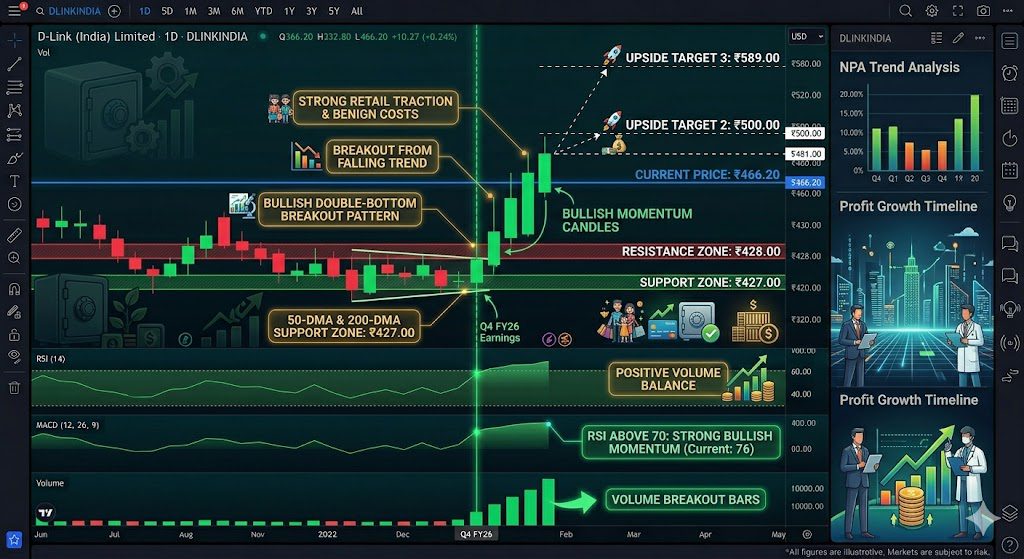
As of May 8, 2026, D-Link India shares were trading around ₹466 and witnessing strong bullish momentum after the Q4 FY26 results announcement. The combination of record revenues and a large dividend payout attracted significant buying interest from both retail and institutional investors. The stock has shown relative strength compared to many other small-cap technology names, indicating improving market sentiment toward the company.
Double Bottom Breakout
Technically, DLINKINDIA has successfully broken out from a “Double Bottom” formation, which is widely considered a bullish reversal pattern in technical analysis. The critical breakout level was around ₹428, and the stock managed to sustain above this resistance with healthy trading volumes. This breakout indicates that buyers are gaining control over price action and that the stock may be entering a new upward trend. Positive chart patterns often attract momentum traders, further strengthening near-term bullish sentiment.
Key Support Zone
The ₹427 level has now become a crucial support area for the stock because it coincides with both the 50-day and 200-day moving averages. If the stock remains above this zone, the bullish structure is likely to remain intact. Traders and investors will closely monitor this support area because a sustained breakdown below it could weaken short-term momentum. However, as long as prices stay above this level, the overall technical outlook remains positive.
Resistance and Target Levels
On the upside, the immediate resistance zone lies near ₹481, followed by the psychologically important ₹500 mark. If bullish momentum continues and dividend-related buying remains strong, the stock could eventually attempt a re-test of its 52-week high near ₹589. Technical traders are particularly optimistic because breakout patterns combined with strong earnings often lead to sustained upward trends in mid-cap and small-cap stocks.
RSI Momentum Signal
The Relative Strength Index (RSI) for DLINKINDIA is currently above 70, indicating strong momentum.
RSI=100−1001+RSRSI = 100 – \frac{100}{1 + RS}
An RSI above 70 generally suggests that a stock may be entering overbought territory. This does not necessarily mean the rally will end immediately, but it signals that short-term consolidation or profit booking may occur before the next major upward move. Investors should therefore remain optimistic but cautious in the near term.
Management Guidance & Corporate Actions
AGM Date
D-Link India has scheduled its Annual General Meeting for August 10, 2026. During this meeting, shareholders will formally vote on the proposed dividend payout. The AGM will be closely watched by investors because it may also provide management commentary regarding future growth plans, operational challenges, and margin improvement strategies. Dividend-focused investors are especially interested in the final confirmation of payout timelines and record dates.
PLI Scheme Tailwinds
One of the long-term positives for D-Link India is its participation in India’s Production Linked Incentive (PLI) scheme for telecom and networking products. The PLI initiative is designed to encourage domestic manufacturing and reduce India’s dependence on imported electronics and networking hardware. As domestic production scales up, the company may benefit from government incentives, lower production costs, and improved operating efficiencies. Over the next few years, these benefits could potentially support margin expansion and improve overall profitability.
Labor Code Provisions
The company has also proactively recognized approximately ₹2.44 crore in employee benefit obligations related to India’s upcoming labor code changes. This reflects prudent corporate governance and management’s willingness to prepare early for regulatory transitions. Investors generally view proactive compliance measures positively because they reduce the risk of sudden financial shocks in the future.
Brokerage Sentiment & Targets (The Re-rating View)
MarketsMojo View
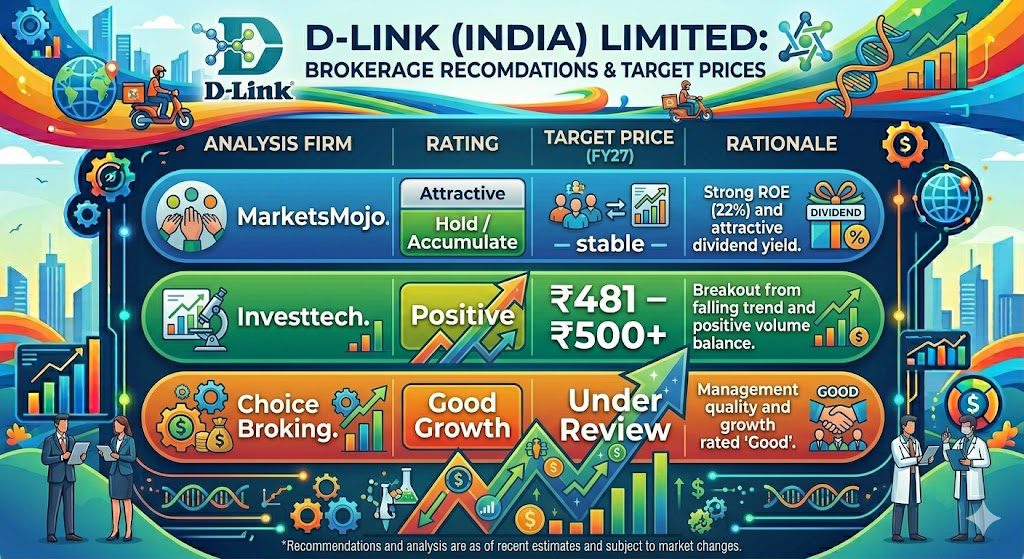
According to MarketsMojo, D-Link India continues to look attractive due to its strong Return on Equity of approximately 22% and healthy dividend yield. The platform views the stock as suitable for a “Hold” or “Accumulate” strategy, especially for long-term investors seeking stable cash-generating businesses. The debt-free balance sheet and consistent profitability further strengthen the company’s investment appeal.
Investtech Outlook
Investtech maintains a positive outlook on DLINKINDIA after the technical breakout from its previous falling trend. Analysts believe that strong volume activity and improving momentum indicators support the possibility of a move toward the ₹481–₹500 range in the near term. Technical traders remain optimistic as long as the stock maintains support above the breakout zone.
Choice Broking Perspective
Choice Broking has highlighted D-Link India’s management quality and business growth potential as key positives. While the brokerage is still reviewing updated target prices after the latest quarterly results, its broader outlook on the company remains constructive. Analysts believe India’s expanding digital infrastructure ecosystem could continue supporting long-term growth for networking equipment companies like D-Link India.
The “30-Year” Analyst Verdict
For the Long-Term Investor
For long-term investors, D-Link India increasingly appears to be a high-quality cash-generating small-cap business. The company operates in a sector that is directly linked to India’s digital future, including broadband expansion, 5G infrastructure, enterprise networking, and smart connectivity solutions. Its debt-free balance sheet, healthy return ratios, strong dividend payouts, and established market presence make it an attractive option for patient investors. Even though margins are currently under pressure, the company’s long-term structural growth opportunities remain intact.
For the Active Trader
For short-term traders and swing investors, the technical trend currently favors the bulls. The stock’s breakout above ₹428 has strengthened momentum, and buying interest remains strong due to the dividend announcement. Traders may look for buying opportunities during short-term corrections toward the ₹440–₹450 range while targeting ₹480–₹500 on the upside. However, given the elevated RSI levels, some consolidation is possible before the next major upward move.
Conclusion & Engagement (CTA)
Final Word
D-Link India’s Q4 FY26 results highlight a company that is benefiting strongly from India’s expanding digital infrastructure ecosystem. Record revenues, stable profitability, a debt-free balance sheet, and a massive ₹27.50 dividend payout have made the company one of the standout performers this earnings season. Although operating margins remain under pressure, investors currently appear more focused on the company’s revenue momentum and shareholder-friendly capital allocation strategy. If India’s networking and telecom infrastructure boom continues, D-Link India could remain a major beneficiary over the coming years.
Investor Engagement
Are you investing in D-Link (India) Limited mainly for its massive dividend yield, or do you believe the technical breakout could push the stock beyond ₹500 in FY27? Share your view on India’s networking sector and your DLINKINDIA investment strategy in the comments below.