Scope Outline
Container Corporation of India Limited announced its Q4 FY26 results on May 25, 2026, and the numbers presented a mixed but strategically important picture for investors tracking India’s logistics and railway infrastructure sector. While the company reported a moderate decline in quarterly net profit, the broader operational performance remained relatively stable, and several long-term growth drivers continue supporting the company’s structural investment story. For investors focused on railway logistics, multimodal cargo transportation, PSU dividend stocks, and infrastructure modernization themes, the latest results provide important insight into where India’s largest container logistics operator is heading over the next few years.
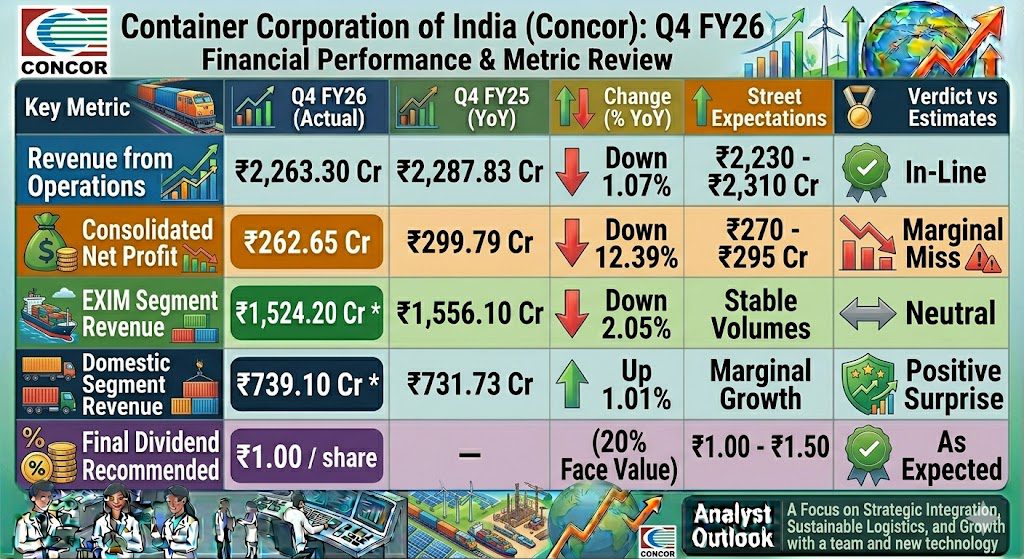
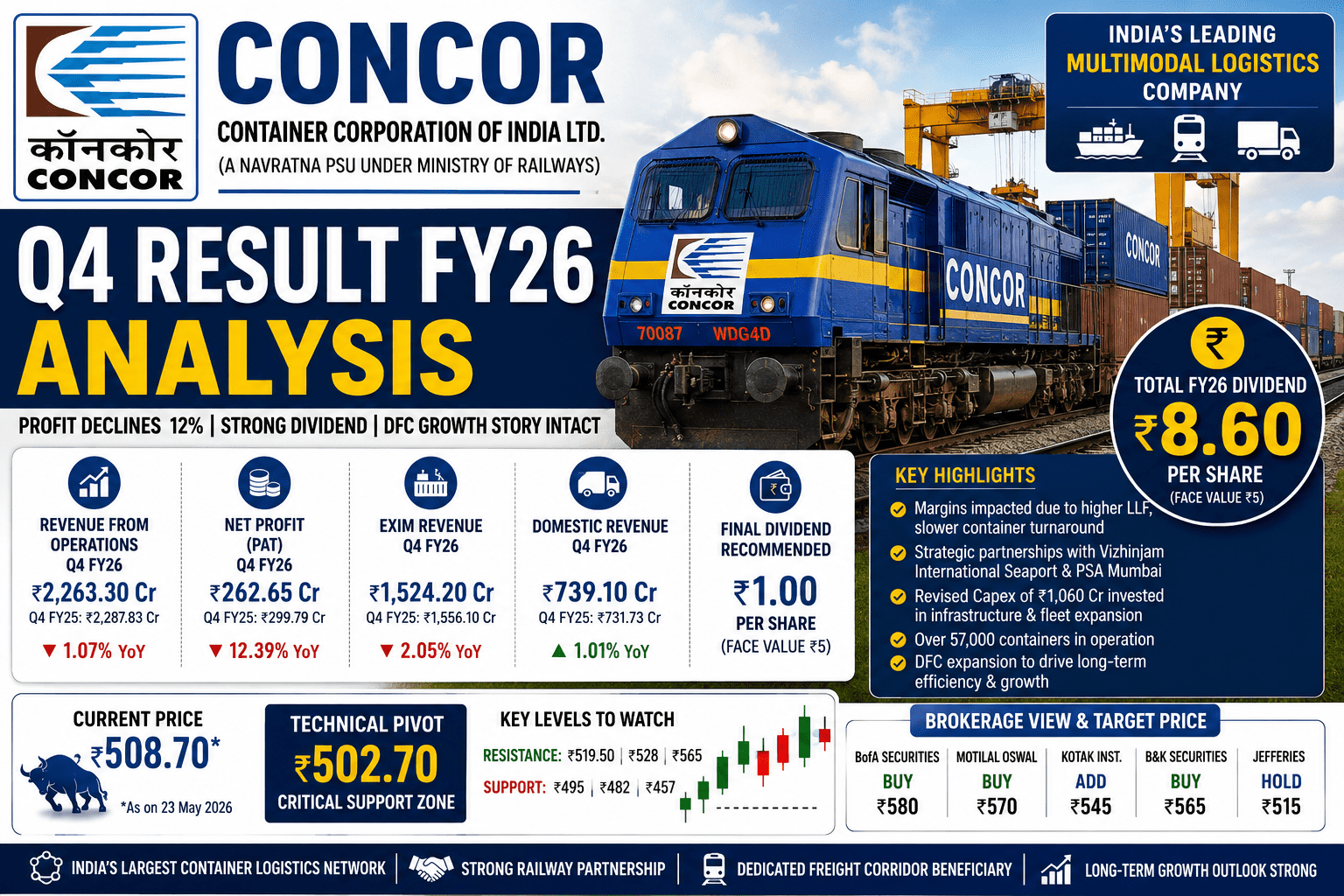
The company reported revenue from operations of ₹2,263.30 crore during Q4 FY26 compared to ₹2,287.83 crore during the same quarter last year, reflecting a marginal year-on-year decline of 1.07%. Despite global trade disruptions, container logistics volatility, and temporary cargo movement challenges, the revenue performance remained broadly stable and in line with market expectations. This indicates that the company’s core operational engine continues functioning efficiently even during periods of broader economic uncertainty.
At the profitability level, consolidated net profit after tax declined to ₹262.65 crore compared to ₹299.79 crore during Q4 FY25, representing a fall of approximately 12.39%. Although the profit numbers slightly missed analyst expectations, the decline was not severe enough to damage the company’s long-term structural outlook. The earnings pressure mainly reflected rising operational costs, higher land license fees payable to Indian Railways, and increased depreciation expenses associated with recent infrastructure expansion investments.
One of the biggest strengths of Container Corporation of India Limited remains its dominant position within India’s multimodal logistics ecosystem. The company operates one of the country’s largest integrated freight transportation networks, including Inland Container Depots (ICDs), Container Freight Stations (CFSs), rail container operations, and port connectivity infrastructure. This network strategically connects India’s manufacturing clusters, industrial hubs, ports, and logistics corridors, creating a nationwide freight transportation ecosystem that very few competitors can replicate.
The company’s strongest long-term competitive advantage continues to be its close operational integration with Indian Railways. This relationship allows CONCOR to maintain large-scale nationwide freight connectivity while benefiting directly from India’s ongoing railway modernization and logistics infrastructure expansion. As the government continues investing aggressively in rail freight corridors, cargo modernization, and transportation efficiency improvements, CONCOR remains naturally positioned to benefit from these structural developments.
One of the most important long-term catalysts for the company is the operationalization of India’s Dedicated Freight Corridors (DFCs), especially the Western DFC connecting industrial regions directly with Jawaharlal Nehru Port (JNPT). The Dedicated Freight Corridor system is expected to significantly improve cargo turnaround time, reduce congestion, increase freight efficiency, and strengthen rail-based logistics competitiveness against road transportation. Over time, these improvements could materially improve CONCOR’s operational productivity and long-term profitability profile.
Segment-wise, the company’s export-import (EXIM) logistics business continued remaining the primary revenue engine during FY26. The EXIM segment generated approximately ₹1,524.20 crore during Q4 FY26 compared to ₹1,556.10 crore during the previous year. On a full-year basis, EXIM revenues crossed ₹6,008 crore, clearly showing that India’s export-import cargo movement remains structurally healthy despite temporary global trade fluctuations.
The domestic cargo logistics segment also delivered relatively stable performance. Domestic operational revenue increased slightly to ₹739.10 crore compared to ₹731.73 crore during the same quarter last year. Full-year domestic revenue crossed ₹3,050 crore, highlighting resilient internal freight transportation demand across India’s manufacturing and industrial economy. This diversification between EXIM and domestic cargo operations provides important revenue stability for the company.
The primary reason behind the quarterly profit decline was margin pressure arising from rising cost structures. Land license fees payable to Indian Railways increased during the period, while slower global container turnaround cycles and higher logistics expenses also compressed margins. Additionally, the company has been aggressively investing in infrastructure expansion and fleet modernization, which increased depreciation charges during FY26 and affected short-term profitability.
Management deployed a major portion of its revised ₹1,060 crore capital expenditure plan during FY26. These investments focused on expanding logistics infrastructure, increasing high-speed freight rake capacity, and enlarging the company’s container fleet beyond 57,000 units. While these expansion initiatives temporarily increased costs, they are expected to strengthen long-term operational scalability and freight handling capabilities.
Another major positive for investors remains CONCOR’s exceptionally strong dividend profile. The company recommended a final dividend of ₹1 per equity share on a face value of ₹5. Combined with the three interim dividends already distributed during FY26 — ₹1.60, ₹2.60, and ₹3.40 — the total annual dividend payout now stands at ₹8.60 per share compared to ₹8 during FY25. This represents one of the strongest dividend payout profiles among PSU logistics and infrastructure companies in India, making the stock particularly attractive for long-term income-focused investors.
From a valuation perspective, the stock currently trades near the ₹508–₹510 range after correcting from earlier premium levels. Many analysts now believe the valuation appears significantly more balanced relative to the company’s intrinsic network value, long-term freight infrastructure importance, and dividend strength. Compared to the speculative excesses previously seen across railway and infrastructure stocks, CONCOR’s current valuation framework appears much healthier.
From a technical analysis perspective, the stock currently remains within an important consolidation zone ahead of potential directional movement following the earnings report. The critical short-term pivot level currently stands near ₹502.70.
y=502.70y=502.70y=502.70
This region has historically acted as a strong institutional accumulation zone. Immediate support levels currently remain near ₹495, ₹482, and ₹457 respectively, while major resistance zones remain visible near ₹519.50, ₹528, and ₹565. A decisive breakout above ₹528 could potentially restart medium-term bullish momentum, while failure to hold the ₹495–₹502 region may trigger additional consolidation pressure.
Management’s future outlook remains highly ambitious. The company continues focusing aggressively on improving cargo efficiency through Dedicated Freight Corridor integration and strategic logistics partnerships. Recent agreements with Vizhinjam International Seaport and PSA Mumbai aim to expand rail-based cargo processing and increase container throughput capacity. These partnerships could significantly improve long-term cargo handling capabilities and logistics integration.
The company’s long-term FY29 growth vision also remains highly ambitious. Management aims to achieve annual revenues of nearly ₹15,000 crore while handling more than 10 million TEUs (Twenty-foot Equivalent Units) by FY29. This aggressive roadmap reflects strong confidence in India’s long-term logistics, manufacturing, export, and freight transportation growth potential.
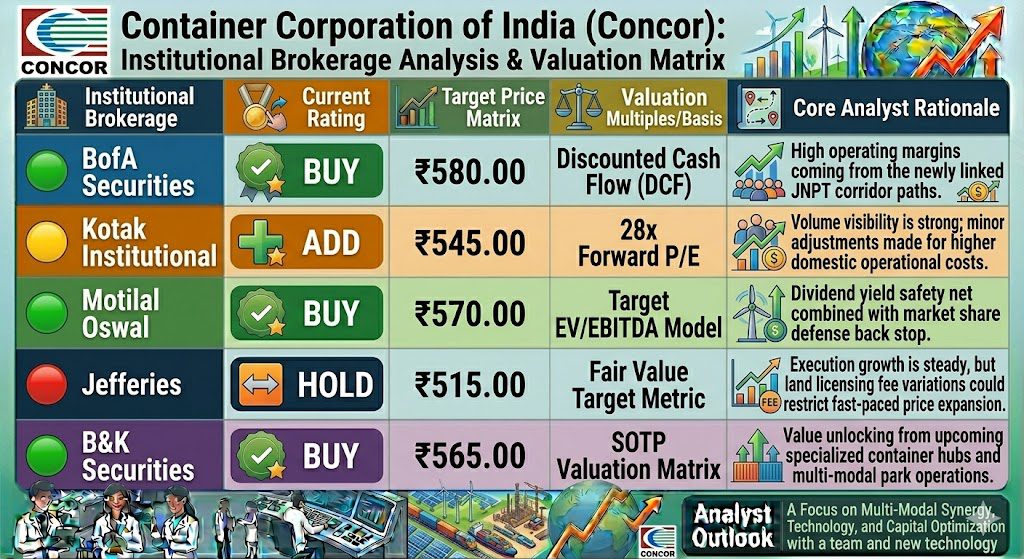
Institutional brokerages continue maintaining largely constructive long-term outlooks on the stock despite the temporary profit decline. BofA Securities maintained a BUY rating with a target price of ₹580, while Motilal Oswal assigned a target near ₹570 because of CONCOR’s strong dividend profile and DFC-related growth opportunities. Kotak Institutional, B&K Securities, and Jefferies also highlighted the company’s logistics dominance, strategic infrastructure advantage, and freight modernization tailwinds as important long-term positives.
Overall, the Q4 FY26 earnings report from Container Corporation of India Limited reflects a company experiencing temporary margin pressure rather than structural business weakness. The moderate 12% decline in quarterly profit was mainly driven by rising operational costs and expansion-related depreciation, while the core logistics business remained stable. With India’s Dedicated Freight Corridor system becoming operational, freight modernization accelerating, strategic port partnerships expanding, and the company continuing to dominate India’s rail-based container logistics ecosystem, CONCOR still appears well-positioned as one of the strongest long-term logistics infrastructure plays in the Indian stock market.