Introduction: The Depository King’s Paradox
If you rewind to the mid-1990s, the idea of holding shares in electronic form felt futuristic. Paper certificates ruled the market, settlements were slow, and retail participation was limited. Fast forward to 2026, and India has witnessed a complete transformation—thanks largely to institutions like Central Depository Services Limited (CDSL).
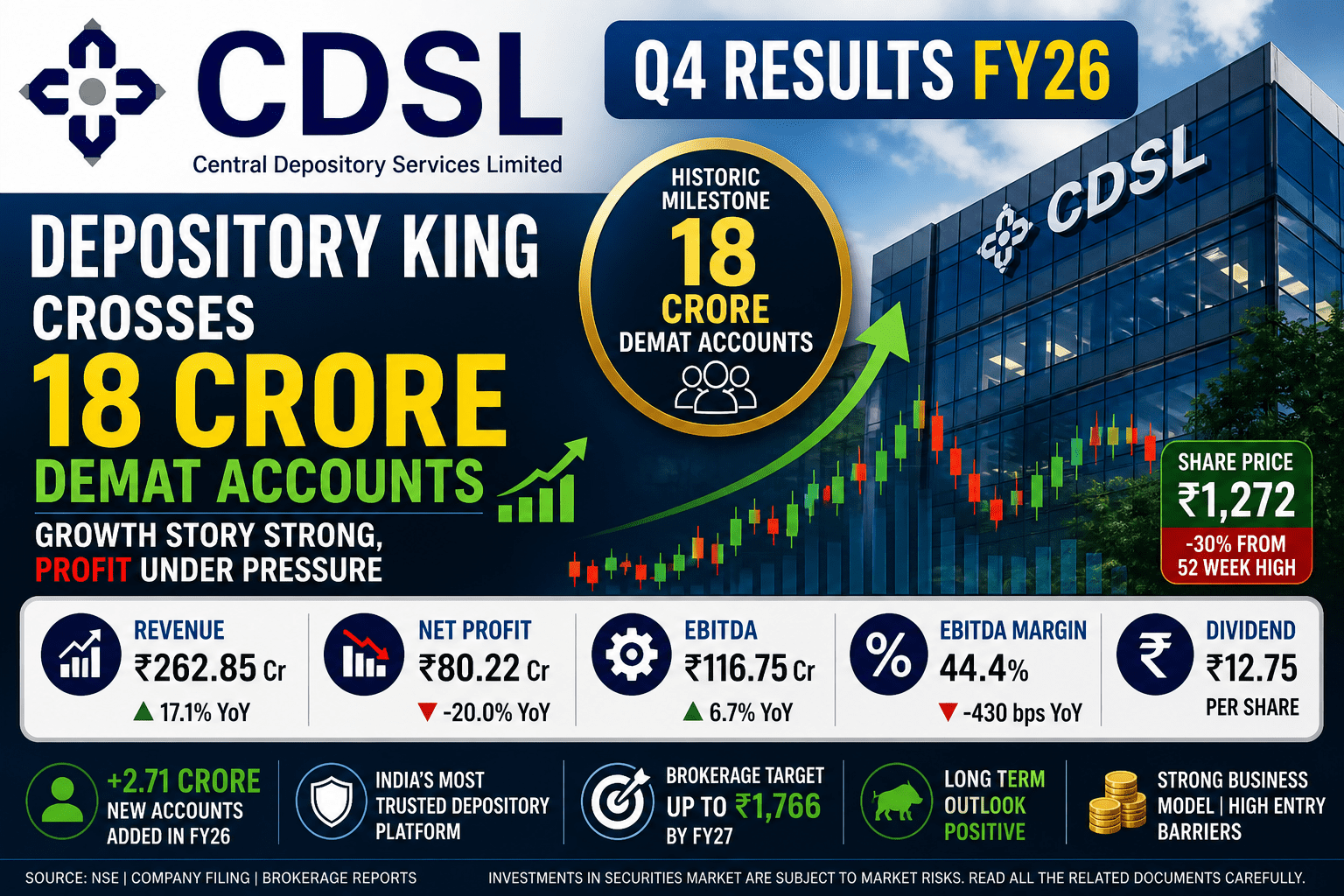
Today, CDSL is not just a market infrastructure entity—it is the backbone of India’s retail investing revolution. The Q4 FY26 results, announced on May 2, 2026, highlight a fascinating paradox. On one hand, the company has achieved a historic operational milestone by crossing 18 crore active demat accounts. On the other, it has reported a 20% decline in net profit, raising questions about margins and cost structures.
The headline achievement cannot be overstated. CDSL added 2.71 crore new accounts in FY26 alone, reflecting a massive structural shift in how Indian households allocate their savings. Equity investing is no longer limited to metros—it is spreading deep into Tier-2 and Tier-3 cities.
However, markets are forward-looking. Despite strong growth, the stock is currently trading near ₹1,272, almost 30% below its 52-week high of ₹1,800. This indicates that investors are weighing growth versus profitability, trying to understand whether the margin pressure is temporary or structural.
Q4 FY26 Actual Financial Scorecard (NSE Published Data)
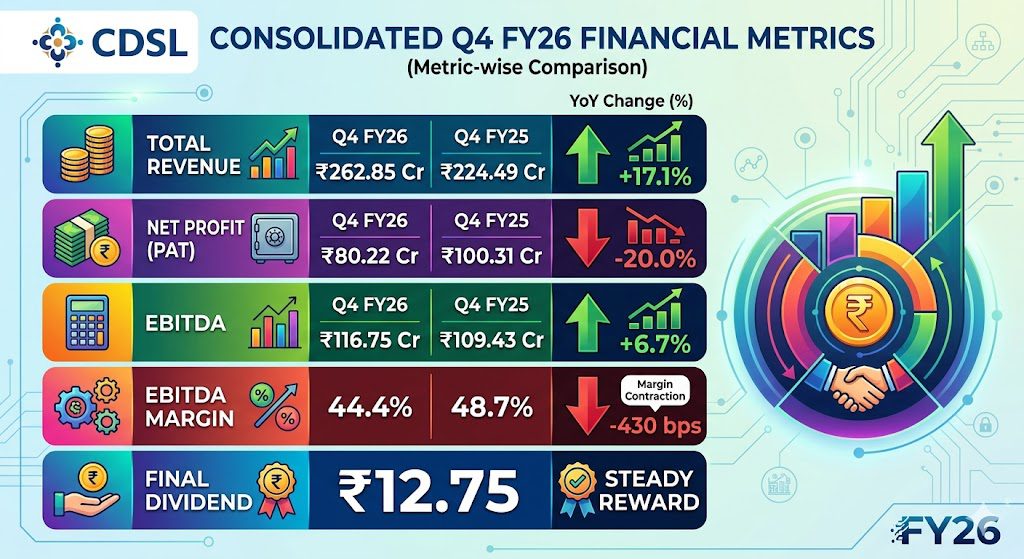
The financial performance of CDSL in Q4 FY26 reflects a company that is scaling rapidly but facing cost pressures. Total revenue came in at ₹262.85 crore, up from ₹224.49 crore in Q4 FY25, marking a strong 17.1% year-on-year growth.
However, net profit stood at ₹80.22 crore, compared to ₹100.31 crore last year, representing a 20% decline. This divergence between revenue and profit is the key theme of this quarter.
EBITDA increased modestly to ₹116.75 crore, up from ₹109.43 crore, reflecting a 6.7% growth. But margins came under pressure, with EBITDA margin declining from 48.7% to 44.4%, a contraction of 430 basis points.
Despite the profit decline, the company has maintained shareholder confidence by recommending a final dividend of ₹12.75 per share. This signals that management remains confident about long-term cash flow generation.
Overall, the numbers tell a clear story—strong top-line growth supported by rising investor participation, but short-term pressure on profitability due to increased costs.
Fundamental Analysis: Scale vs. Margin Compression
To understand CDSL’s current phase, you need to step back and look at the broader picture. This is not just a company story—it is a reflection of India’s financialization journey.
The Operational Moat
The addition of 2.71 crore demat accounts in a single year is a staggering achievement. It shows that more Indians are entering the equity markets than ever before. This trend is driven by multiple factors—digital onboarding, rising financial literacy, and easy access to trading platforms.
CDSL benefits directly from this trend because every new investor requires a demat account. This creates a powerful network effect, where growth feeds on itself.
The Margin Squeeze
So why did profits fall despite strong revenue growth?
The answer lies in investment for scale. Managing over 18 crore accounts requires significant spending on technology, cybersecurity, compliance, and infrastructure. These costs have increased sharply in FY26.
In simple terms, CDSL is spending today to ensure that its platform remains secure, reliable, and scalable for the future. While this impacts margins in the short term, it strengthens the company’s long-term competitive position.
Market Stability and Reliability
Despite global uncertainties and geopolitical tensions, India’s market infrastructure has remained stable. This reliability is critical, especially when millions of new investors are entering the system.
CDSL’s ability to handle this scale without major disruptions reinforces its reputation as a trusted market infrastructure provider.
Technical Analysis: The Multi-Month Demand Zone
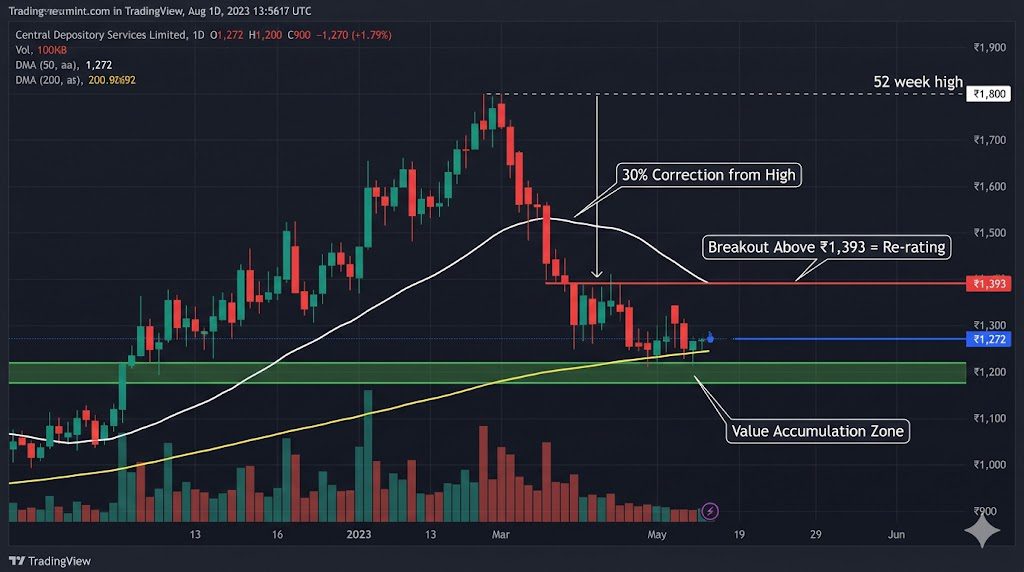
From a technical perspective, CDSL’s stock is currently in a correction phase, having fallen more than 30% from its 52-week high of ₹1,800. However, this correction has brought the stock into what many analysts consider a value zone.
The major support range lies between ₹1,180 and ₹1,220, which has historically acted as a strong demand area. Institutional investors often look at such zones for accumulation.
On the upside, the immediate resistance level is around ₹1,393, which also aligns with the average analyst target price. A breakout above this level could trigger a fresh upward move.
The Relative Strength Index (RSI) is currently near oversold territory, suggesting that much of the negative sentiment around margin pressure may already be priced in.
This setup indicates a classic “base-building phase,” where the stock consolidates before its next major move.
Brokerage Sentiment & Targets (The Path to ₹1,700)
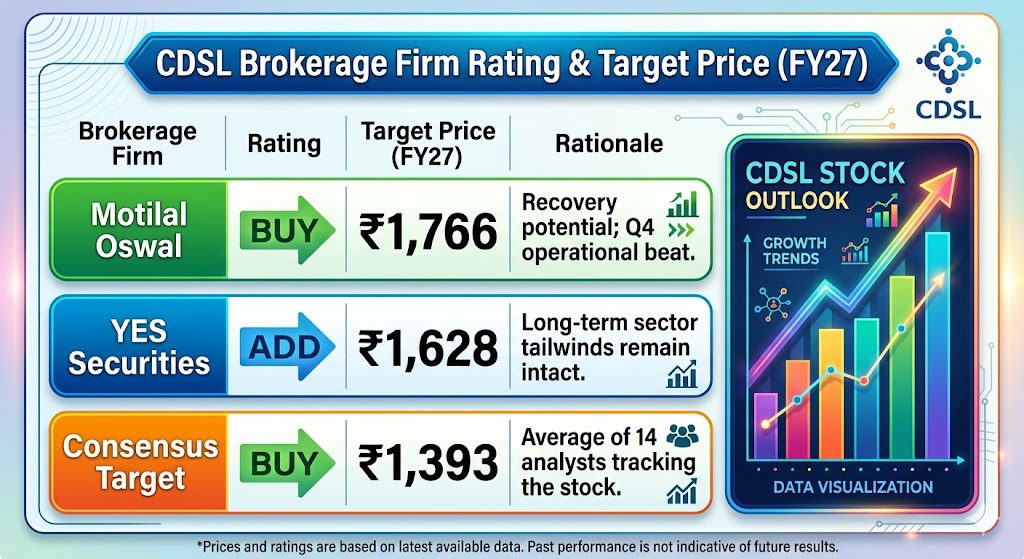
Brokerages remain optimistic about CDSL’s long-term prospects, despite the short-term profit dip.
- Motilal Oswal has a “Buy” rating with a target price of ₹1,766, citing recovery potential and strong operational performance.
- YES Securities has given an “Add” rating with a target of ₹1,628, highlighting long-term growth drivers in the depository sector.
- The consensus target price stands at ₹1,393, based on estimates from multiple analysts.
These targets suggest that while the market is cautious in the short term, the long-term outlook remains positive.
Management Guidance: Investing in the Future
The management’s commentary provides valuable insight into the company’s strategy going forward.
Tech-First Approach
CDSL is committed to investing in technology and human resources to ensure that its platform remains secure and efficient. In an era of rising cyber threats, this is not optional—it is essential.
Building Investor Trust
The company’s focus remains on maintaining stability and reliability, even in the face of global uncertainties. This is crucial because trust is the foundation of any financial infrastructure.
By prioritizing long-term stability over short-term profitability, CDSL is positioning itself as a durable and resilient business.
The “30-Year” Analyst Verdict
From a long-term perspective, CDSL remains a structural compounder. The milestone of 18 crore demat accounts is not just a number—it represents a fundamental shift in India’s savings behavior.
The current profit dip is a temporary challenge, driven by increased investments rather than declining demand. For long-term investors, this phase could present an opportunity to accumulate a high-quality business at relatively attractive valuations.
For traders, the stock offers a favorable risk-reward setup near the ₹1,200 level, with potential upside toward ₹1,450–₹1,700 in the medium term.
Conclusion & Engagement (CTA)
CDSL’s Q4 FY26 results highlight a company at an important crossroads. On one side, it is achieving record-breaking growth and expanding its user base at an unprecedented pace. On the other, it is facing short-term margin pressure due to increased investments.
With 17% revenue growth, a ₹12.75 dividend, and a historic 18 crore account milestone, the fundamentals remain strong. The key question is whether the market will reward this growth before margins recover.
So, what’s your take? Are you buying CDSL for its long-term dominance in India’s capital markets, or are you waiting for profitability to improve?
Let’s discuss the future of India’s depository ecosystem in the comments—because this is one story that is far from over.