Introduction: The Rebirth of the Giant
There was a time when the Bombay Stock Exchange was known mainly for its iconic trading floor and traditional open-outcry trading culture. In the 1990s, investors saw BSE as the historic heart of Indian capital markets, but not necessarily as the fastest-growing exchange in the country. Over the years, competition intensified, technology evolved, and the market structure changed dramatically. Many analysts believed BSE would struggle to compete in the modern digital era. However, the latest Q4 FY26 results from BSE have completely changed that narrative.
Today, BSE is no longer just a legacy exchange. It has reinvented itself into a technology-driven financial platform that is aggressively expanding in derivatives, SME listings, mutual fund distribution, and index-related products. The company’s performance for FY26 shows that this transformation is not temporary momentum but part of a larger structural growth story.
The Q4 FY26 earnings announced on May 7, 2026, have delivered one of the strongest scorecards in the history of the exchange. Net profit surged 61% year-on-year to ₹797 crore, while revenue from operations jumped nearly 85%. These numbers clearly show how rapidly BSE is scaling its platform business and monetizing India’s rising retail participation in financial markets.
Investors have already started rewarding the stock. Ahead of the results, BSE shares closed near ₹3,963.60 on the NSE and have delivered almost 80% returns over the last one year. The company is increasingly being viewed as one of the strongest “capital market infrastructure” plays in India.
As Indian equity participation continues to rise and derivatives trading volumes hit record highs, BSE appears to be entering a completely new growth phase.
Q4 FY26 Financial Scorecard (Actual NSE Data)
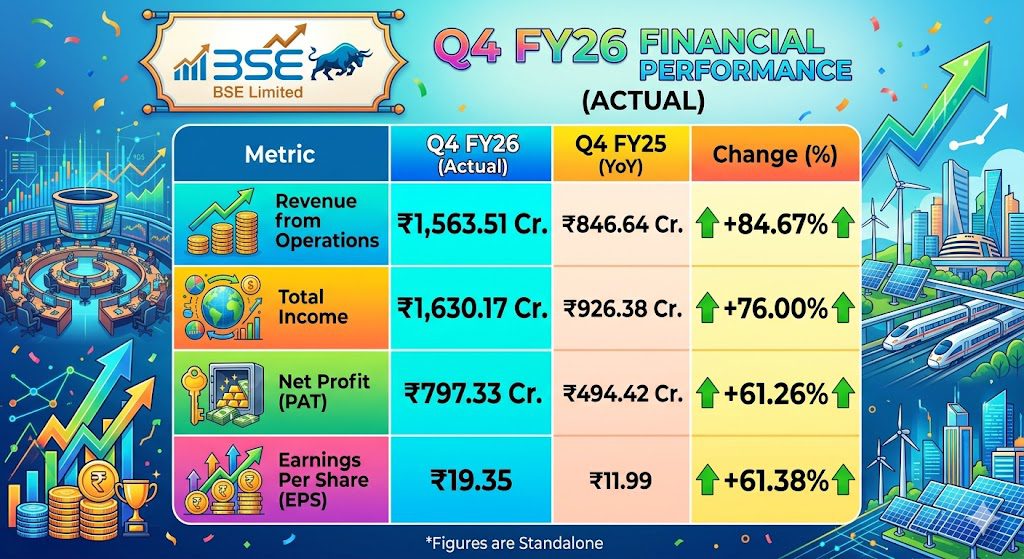
The financial performance of BSE Ltd during Q4 FY26 reflects explosive operational growth across multiple business segments. The exchange reported consolidated audited revenue from operations of ₹1,563.51 crore compared to ₹846.64 crore in the same quarter last year. This represents a remarkable 84.67% year-on-year increase.
Total income for the quarter stood at ₹1,630.17 crore, rising 76% from ₹926.38 crore in Q4 FY25. Such strong revenue expansion demonstrates the rapid increase in trading activity, derivatives participation, and platform monetization across BSE’s ecosystem.
The biggest highlight, however, was profitability. Net profit after tax (PAT) surged to ₹797.33 crore compared to ₹494.42 crore a year ago, reflecting a 61.26% jump. Earnings Per Share (EPS) also increased sharply from ₹11.99 to ₹19.35, showing substantial improvement in shareholder earnings.
| Metric | Q4 FY26 | Q4 FY25 | YoY Change |
|---|---|---|---|
| Revenue from Operations | ₹1,563.51 Cr | ₹846.64 Cr | +84.67% |
| Total Income | ₹1,630.17 Cr | ₹926.38 Cr | +76.00% |
| Net Profit (PAT) | ₹797.33 Cr | ₹494.42 Cr | +61.26% |
| Earnings Per Share (EPS) | ₹19.35 | ₹11.99 | +61.38% |
These results clearly indicate that BSE’s business model is benefiting enormously from India’s booming capital market activity. Higher trading participation directly improves transaction-based revenue, making exchanges highly scalable businesses during strong market cycles.
Fundamental Analysis: The Derivatives & SME Moat
Derivatives Segment Is Becoming the Biggest Growth Engine
One of the biggest reasons behind BSE’s explosive growth is its rapid expansion in the equity derivatives segment. The exchange reported average daily turnover of nearly ₹245 trillion in Q4 FY26, more than doubling compared to the previous year.
This is an extremely important development because derivatives trading generates large transaction-based revenues for exchanges. Historically, BSE lagged behind in this segment, but the latest numbers indicate that the exchange is finally gaining meaningful market share.
India’s growing retail investor base is also contributing heavily to derivatives growth. With millions of new traders entering the market through digital platforms, options and futures volumes have expanded significantly over the last two years. BSE appears to be benefiting strongly from this trend.
The derivatives business is especially attractive because it creates a powerful network effect. Higher liquidity attracts more traders, which further increases volumes and revenue generation. If BSE continues gaining traction in derivatives, it could become one of the strongest long-term growth drivers for the company.
SME Platform Leadership Strengthens Market Position
Another major pillar of BSE’s growth story is its dominance in the SME listing ecosystem.
During FY26, BSE ranked first globally in terms of the number of IPO listings. The exchange facilitated 255 new listings, raising a record ₹1.8 lakh crore. This achievement highlights the growing importance of India’s SME sector and BSE’s leadership position within it.
Small and medium enterprises increasingly prefer BSE’s SME platform because of its streamlined listing process and strong investor participation. As India’s startup and manufacturing ecosystem continues expanding, this segment could become a significant long-term revenue opportunity.
The SME platform also strengthens BSE’s overall market ecosystem by attracting emerging companies early in their growth cycle. Many successful SMEs eventually transition into larger listed companies, creating a long-term business pipeline for the exchange.
Transaction Charges Revenue Surges Sharply
BSE’s transaction charge revenue has emerged as one of the strongest indicators of its growing market activity.
Revenue from transaction charges alone jumped 114% year-on-year to ₹1,311 crore. This extraordinary increase reflects the massive surge in trading activity across derivatives, equities, and other market products.
For stock exchanges, transaction revenue is one of the most scalable and profitable income streams. Once technology infrastructure is established, additional trading volumes can significantly boost profits without proportionately increasing costs.
This explains why BSE’s profit growth is accelerating faster than revenue growth.
StAR Mutual Fund Platform Expands Nationwide
BSE’s StAR Mutual Fund platform is another underrated growth driver that investors should closely watch.
The platform now operates in 721 cities across India, reflecting deep expansion into smaller towns and semi-urban markets. Revenue from the mutual fund business grew approximately 24% year-on-year, showing healthy adoption trends.
India’s mutual fund industry is still underpenetrated compared to developed markets. As financial literacy improves and SIP investments continue rising, platforms like StAR MF could witness long-term structural growth.
This diversification beyond trading revenue also makes BSE’s overall business model stronger and more resilient.
Technical Analysis: Resistance and Rebound Zones
RSI Indicates Short-Term Overbought Conditions
From a technical analysis perspective, BSE stock remains in a strong bullish trend, but momentum indicators suggest caution in the near term.
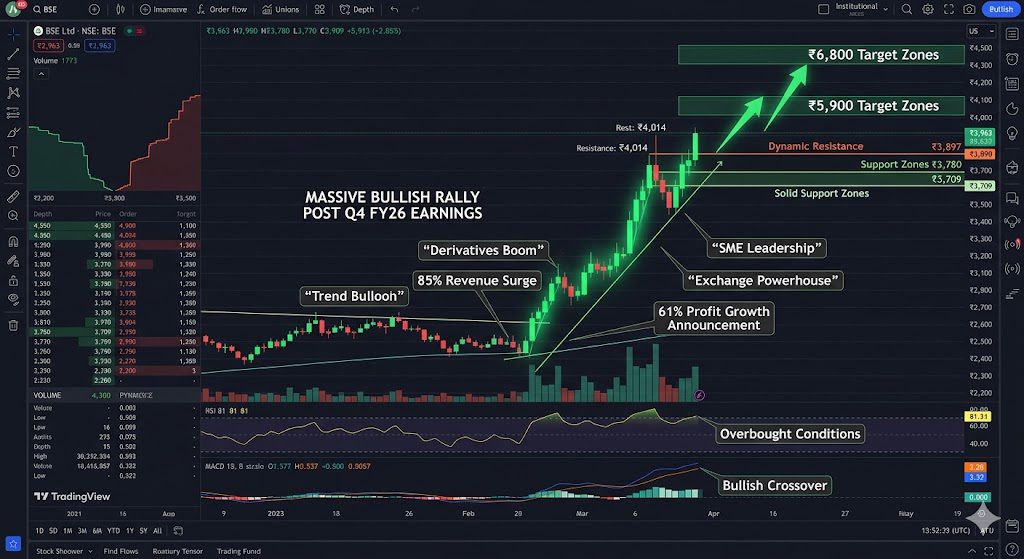
The Relative Strength Index (RSI) on daily charts is currently near 81, which generally signals overbought conditions. Stocks trading at such high RSI levels often witness temporary cooling-off periods or short-term profit booking before resuming their trend.
This does not necessarily mean the long-term bullish structure is broken. Instead, it suggests that traders should avoid chasing the stock aggressively at current levels.
Important Support Levels
According to NSE pivot data, the first major support level for the stock is around ₹3,780, while the second key support zone lies near ₹3,709.
These levels are important because strong corrections toward support zones often create better risk-reward entry opportunities for medium-term investors.
If broader market conditions remain stable, these support levels may attract institutional buying interest.
Resistance Levels Investors Must Watch
On the upside, immediate resistance levels are visible near ₹3,897 and ₹4,014.
A decisive breakout above ₹4,014 could potentially trigger another strong momentum rally in the stock. However, considering the current overbought conditions, short-term consolidation may occur before such a move.
Investors should remember that BSE carries a Beta of 1.57, making it significantly more volatile than the broader market. This volatility can create both rapid upside opportunities and sharp short-term corrections.
Safer Entry Strategy for Traders
For traders looking to enter the stock, waiting for pullbacks toward the ₹3,700–₹3,800 zone may offer a safer entry opportunity.
Buying quality momentum stocks after temporary corrections often improves risk management and reduces emotional decision-making during volatile rallies.
Given the strong structural growth story, many long-term investors may view such corrections as accumulation opportunities rather than signs of weakness.
Corporate Action: Dividend & Record Date
₹10 Final Dividend Announced
BSE Ltd has announced a final dividend of ₹10 per equity share for FY26, rewarding shareholders after a year of exceptional financial performance.
Dividend announcements are often viewed positively by investors because they signal management confidence in future cash flow generation and business stability.
Record Date and Payment Timeline
The company has fixed July 10, 2026, as the record date for determining eligible shareholders.
The dividend payment is expected to be completed on or before September 17, 2026.
For income-focused investors, the dividend adds another layer of attractiveness to the stock, especially considering the company’s strong profitability and cash-generating ability.
Brokerage Sentiment & Targets: The Road to FY27
Market analysts remain highly optimistic about the future growth potential of BSE.
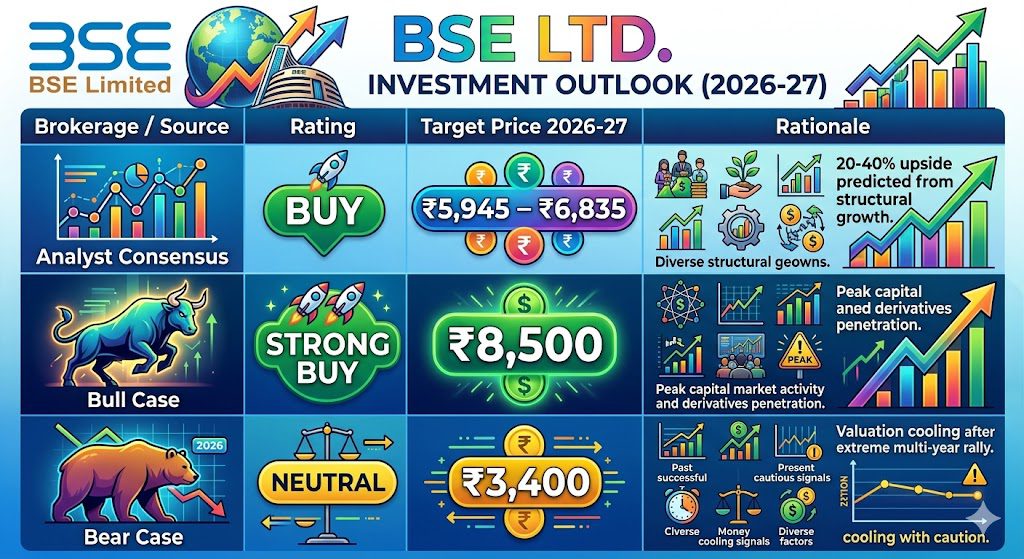
According to analyst consensus estimates, the stock carries target projections between ₹5,945 and ₹6,835 over FY26–FY27, implying strong upside potential from current levels.
Bullish analysts believe that India’s rapidly expanding capital market participation, derivatives growth, and SME ecosystem could continue driving strong earnings momentum for BSE.
Some aggressive bull-case projections even suggest long-term targets near ₹8,500 if market activity remains exceptionally strong.
However, bearish analysts warn that valuations have already expanded significantly after the stock’s massive rally over the last few years. Some neutral estimates place downside support closer to ₹3,400 if broader market sentiment weakens.
Overall, market sentiment remains strongly positive, but investors should remain prepared for volatility.
Management Guidance: A Landmark Year
CEO Highlights Technological Resilience
BSE CEO Sundararaman Ramamurthy described FY26 as a “landmark year” for the exchange.
Management emphasized technological resilience, innovation, and platform scalability as key priorities going forward. This is particularly important because financial exchanges increasingly operate as technology businesses rather than traditional trading venues.
The ability to handle massive transaction volumes with low latency and high reliability has become critical for long-term competitiveness.
Strategic Push Into Index Business
One of the most important strategic developments during FY26 was BSE’s acquisition of control over BSE Index Services Pvt Ltd.
This move signals the company’s aggressive push into high-margin index products and related financial services. Globally, index businesses are extremely profitable because they generate recurring licensing revenue from ETFs, passive funds, and derivatives products.
As passive investing grows in India, BSE’s index-related business could become a major future profit center.
The “30-Year” Analyst Verdict
For Long-Term Investors
BSE is increasingly becoming one of the strongest “capital market infrastructure” stories in India.
As long as retail participation in Indian financial markets continues rising, the exchange business model remains highly attractive. More investors, more traders, and more listed companies directly benefit exchanges through higher transaction and platform revenues.
BSE’s dominance in SME listings, rapid derivatives expansion, and strong mutual fund ecosystem create multiple long-term growth engines.
For patient investors, the company represents a direct way to participate in the long-term growth of India’s financialization trend.
For Short-Term Traders
For traders, caution is necessary in the near term because the RSI indicates heavily overbought conditions.
Momentum remains bullish, but sharp rallies are often followed by temporary corrections or sideways consolidation phases.
Instead of chasing prices after a massive run-up, traders may find better opportunities during pullbacks toward the ₹3,700–₹3,800 support zone.
The long-term trend remains positive, but disciplined entry timing is important given the stock’s volatility.
Conclusion & Engagement (CTA)
BSE Ltd has delivered one of the strongest quarterly performances in its recent history. A 61% jump in net profit, 85% revenue growth, booming derivatives volumes, and record SME activity together highlight the scale of transformation underway at the exchange.
India’s oldest stock exchange is no longer just a legacy institution. It is rapidly evolving into a diversified financial infrastructure powerhouse benefiting from the country’s expanding capital markets ecosystem.
With strong earnings momentum, rising retail participation, growing derivatives market share, and aggressive technology-driven expansion, BSE’s long-term growth story remains highly compelling.
The key question now is whether the stock can sustain its momentum toward the ₹6,800+ target zone over the next few years.
Are you holding BSE for the ₹10 dividend, or are you betting on India’s long-term “Exchange War” growth story? Share your views in the comments and join the discussion on the future of India’s capital markets.