Introduction: The Cooling Titan’s Resilience
Over the last three decades, India’s consumer durables industry has transformed dramatically. In the mid-1990s, owning an air conditioner was considered a luxury reserved mainly for wealthy households in metropolitan cities. Today, in 2026, cooling products have become an essential part of daily life across urban, semi-urban, and even rural India. Rising temperatures, increasing disposable incomes, urbanization, and changing lifestyle patterns have permanently changed the Indian cooling industry.
Among the companies leading this transformation, Blue Star has emerged as one of the strongest and most trusted names in the Indian air conditioning and commercial cooling market. The company’s Q4 FY26 results, announced on May 7, 2026, clearly show why Blue Star remains one of the most important long-term growth stories in India’s consumer durables sector.
Despite facing unseasonal rains, softer initial summer demand, and aggressive price hikes during the quarter, Blue Star delivered its highest-ever quarterly revenue performance. For experienced market observers, this result highlights not only operational resilience but also the company’s growing pricing power and market leadership.
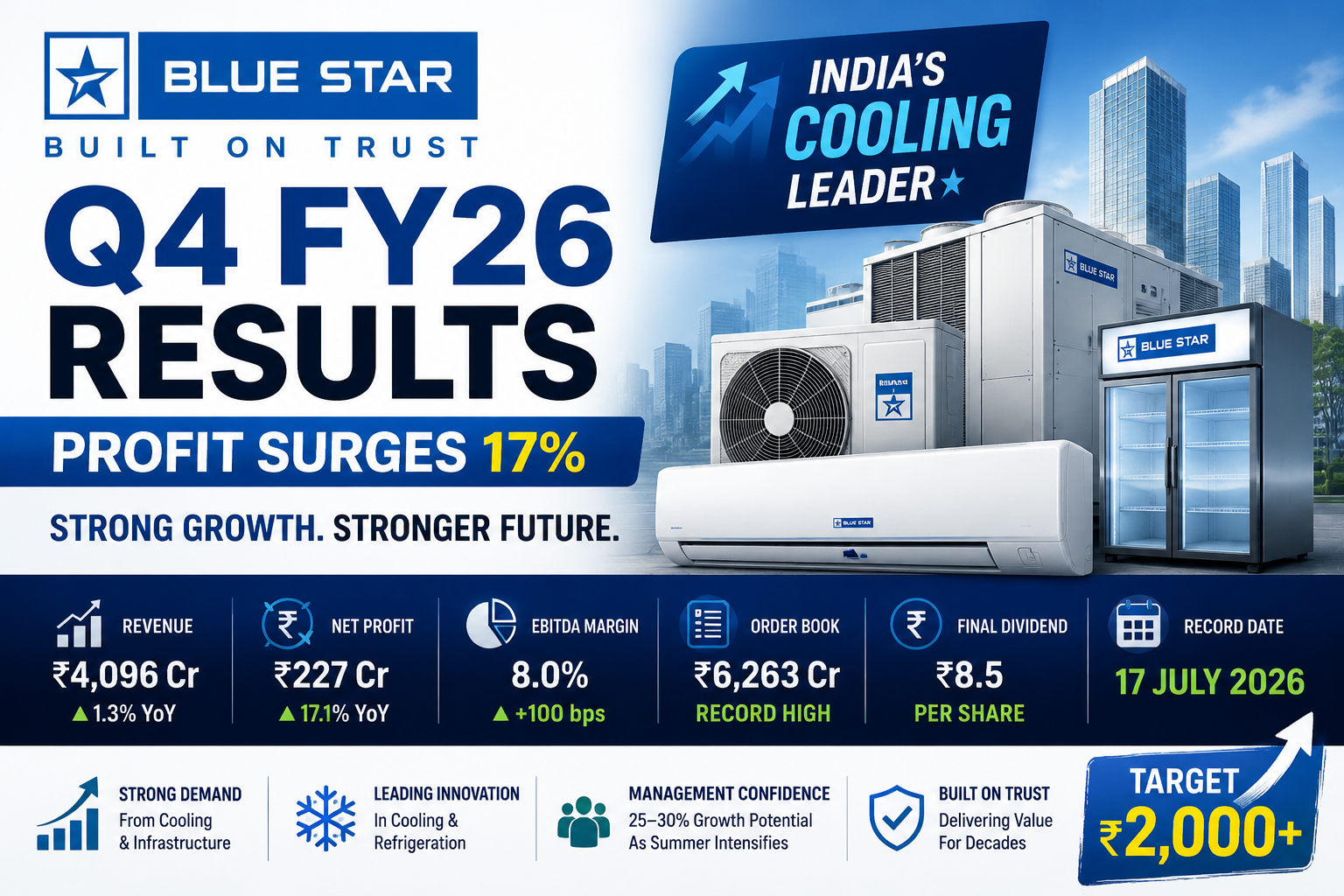
Blue Star reported a strong 17.1% year-on-year rise in consolidated net profit to ₹227.18 crore during Q4 FY26. Revenue crossed the ₹4,000 crore mark for the quarter, while EBITDA margins improved significantly to 8%. The company also reported a record order book of ₹6,263 crore, giving investors strong visibility into future revenue growth.
The market responded positively to the results. Blue Star shares closed near ₹1,806.60 on the NSE, holding firm despite broader market volatility. Investors are increasingly recognizing that Blue Star is no longer just a seasonal air-conditioner company. It is becoming a structural beneficiary of India’s long-term cooling and infrastructure growth story.
Q4 FY26 Financial Scorecard (Actual Data)
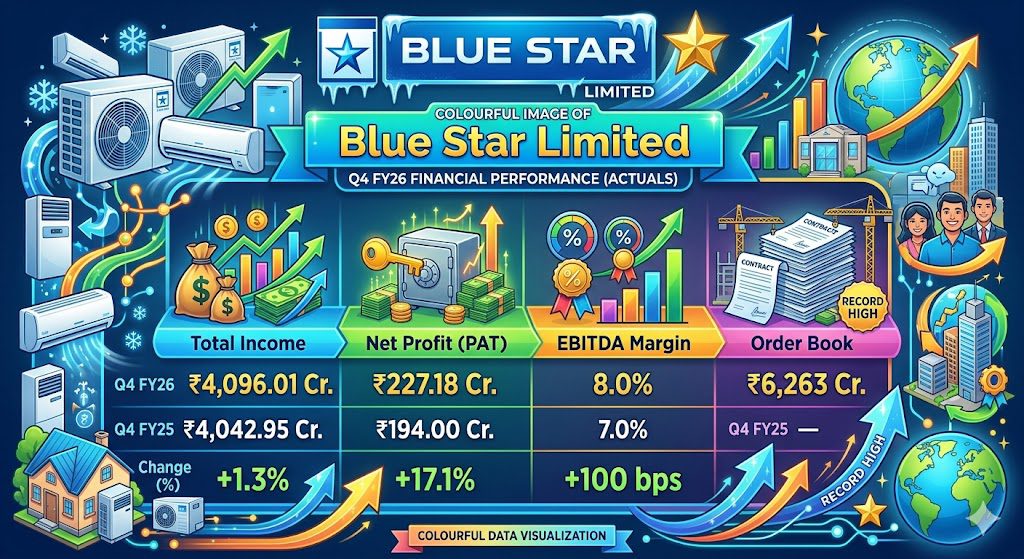
Blue Star delivered a stable and healthy quarterly performance despite challenging seasonal conditions. Total income during Q4 FY26 stood at ₹4,096.01 crore compared to ₹4,042.95 crore in the same quarter last year, representing a modest but important 1.3% year-on-year growth.
While revenue growth appeared relatively moderate, profitability improved significantly. Net profit increased sharply to ₹227.18 crore from ₹194 crore in Q4 FY25, reflecting a strong 17.1% increase. The profit expansion demonstrates the company’s improving operational efficiency and better pricing strategy.
One of the most important highlights was the improvement in EBITDA margins, which expanded from 7% to 8%. In the consumer durables industry, margin expansion during a difficult demand environment is often a sign of strong brand strength and pricing power.
Another major positive was the company’s record order book of ₹6,263 crore. This order pipeline provides strong visibility for FY27 revenues, especially from infrastructure, commercial refrigeration, healthcare, and institutional projects.
For long-term investors, the Q4 FY26 scorecard confirms that Blue Star is successfully balancing both growth and profitability while strengthening its market position in India’s rapidly expanding cooling sector.
Fundamental Analysis: The “Volume vs. Value” Battle
The Pricing Power Strategy
One of the boldest decisions taken by Blue Star during FY26 was implementing nearly 13% price hikes across various product categories. Normally, such aggressive price increases can negatively impact demand, especially when weather conditions are weak.
The beginning of the summer season witnessed unseasonal rainfall in several parts of India, temporarily reducing cooling demand. However, despite these challenges, Blue Star still managed to improve profitability and margins.
This indicates that the company’s “value strategy” is beginning to work effectively. Customers appear increasingly willing to pay premium prices for trusted cooling brands with better energy efficiency, technology, and after-sales service.
For long-term investors, pricing power is one of the most important characteristics of a quality consumer brand because it allows companies to protect margins even during inflationary periods.
Segment Diversification Beyond Room ACs
While Blue Star is widely known for residential air conditioners, the company’s business model has become far more diversified over the years. The commercial refrigeration segment continues to perform strongly, supported by rising demand from pharmaceutical companies, retail chains, hospitals, and cold-storage infrastructure projects.
India’s rapid growth in organized retail, food logistics, and healthcare infrastructure is creating massive long-term opportunities for commercial cooling solutions. Blue Star’s strong engineering expertise gives it a competitive advantage in these specialized segments.
This diversification also reduces the company’s dependence on purely seasonal residential AC demand, making the business model more stable and resilient over time.
Record Order Book Visibility
Perhaps the strongest long-term indicator in the results was the record order book of ₹6,263 crore. This provides excellent revenue visibility for future quarters.
A large portion of the order pipeline is linked to infrastructure projects, healthcare facilities, institutional buildings, and commercial real estate developments. India’s ongoing urbanization and infrastructure expansion continue to create strong demand for centralized cooling systems and refrigeration solutions.
For investors, the record order book significantly reduces uncertainty around future growth because it effectively creates a built-in revenue pipeline for FY27 and beyond.
Technical Analysis: Navigating the Multi-Year Highs
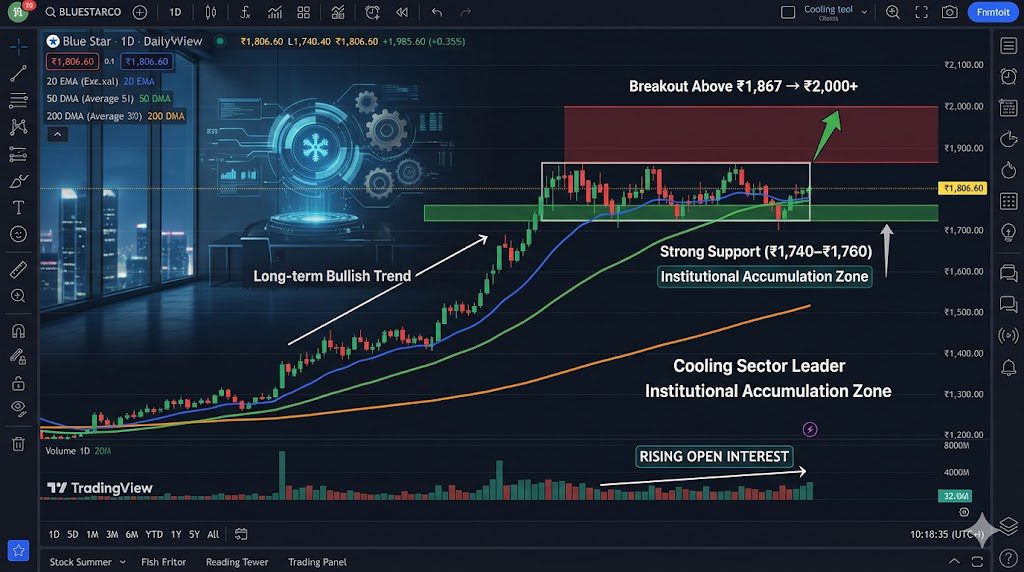
From a technical perspective, Blue Star remains one of the strongest long-term performers in the consumer durables sector. The stock has generated approximately 328% returns over the last five years, reflecting sustained investor confidence in the company’s growth story.
Currently, the stock is consolidating after a strong 13.5% monthly rally. Such consolidation phases are common after sharp upward moves and often help create a stronger base for future trends.
The most important support zone currently lies between ₹1,740 and ₹1,760. Derivative market data shows a sharp increase in open interest around these levels, suggesting that institutional traders are building defensive positions near support zones.
On the upside, the immediate resistance level stands near ₹1,867, which also represents the previous peak zone. A decisive breakout above this level could potentially trigger another rally toward the psychological ₹2,000 mark.
Technical indicators also remain supportive. The recent 15% rise in open interest suggests that large institutional participants are actively taking directional positions after the earnings announcement. Historically, rising open interest combined with stable prices often signals trend continuation.
For traders, the technical structure continues to favor a “buy on dips” strategy as long as the stock remains above the ₹1,740 support zone.
Dividend & Shareholder Rewards
Blue Star’s board recommended a final dividend of ₹8.5 per equity share for FY26. While the dividend yield itself may not appear extremely high compared to traditional PSU companies, the consistency of payouts remains an important positive indicator for investors.
The company has announced July 17, 2026, as the record date for dividend eligibility. Consistent dividend payments are often viewed by long-term investors as a sign of management confidence in future cash flows and earnings stability.
In growth-oriented consumer businesses, steady dividend payouts also reflect disciplined capital allocation and strong operational cash generation.
Management Guidance: The 150-Million-Household Dream
Strong Growth Outlook
Blue Star management remains highly optimistic about long-term growth opportunities in India’s cooling sector. Co-Managing Director B Thiagarajan has projected annual growth potential of nearly 25–30% as air-conditioner penetration continues rising across India.
Currently, India still has relatively low AC penetration compared to many global markets. Rising temperatures, improving electricity access, and increasing middle-class incomes could drive massive demand growth over the next decade.
Management believes the company is well-positioned to capitalize on this long-term structural trend.
Margin Challenges in FY27
Despite the optimistic growth outlook, management has also remained transparent about potential challenges in FY27. Rising inventory levels and aggressive competitive pricing across the cooling industry could create temporary margin pressure during the coming fiscal year.
This cautious guidance reflects management’s balanced approach and realistic assessment of industry conditions.
Leadership Stability
Another positive development was the reappointment of B Thiagarajan as Managing Director through May 2027. Leadership continuity is particularly important during periods of rapid expansion because it ensures strategic consistency and operational stability.
For investors, experienced leadership remains one of Blue Star’s strongest intangible strengths.
Brokerage Sentiment & Targets: The Path to ₹2,000
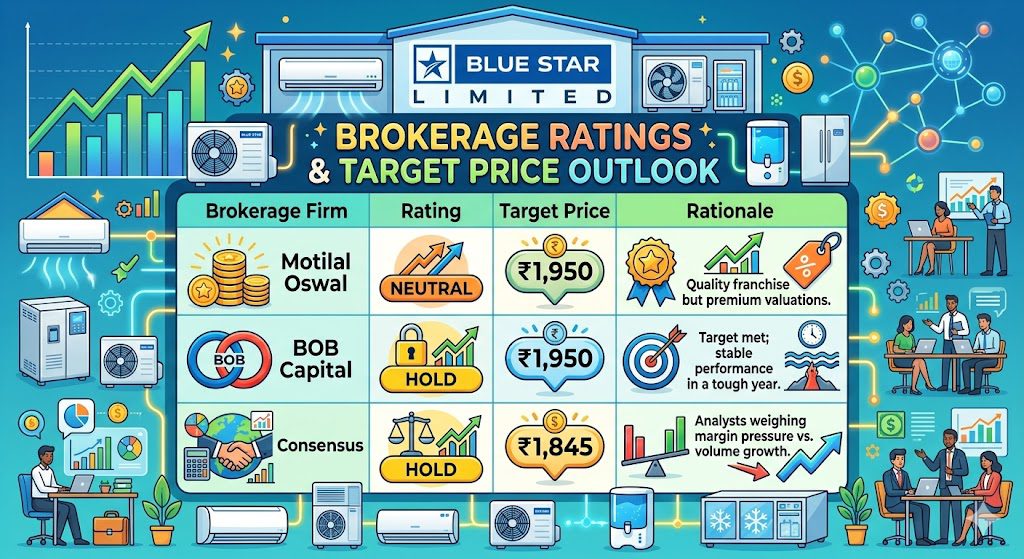
Brokerage firms remain broadly constructive on Blue Star despite concerns regarding premium valuations. Motilal Oswal has maintained a “Neutral” rating with a target price near ₹1,950, citing strong business quality but expensive valuations.
BOB Capital has also maintained a “Hold” recommendation with similar targets around ₹1,950, highlighting stable performance despite difficult seasonal conditions.
Consensus estimates remain near ₹1,845 as analysts balance margin concerns against strong long-term growth opportunities in India’s cooling sector.
The broader market continues viewing Blue Star as one of the highest-quality consumer durables companies in India, particularly because of its strong brand, diversified business model, and infrastructure-linked growth opportunities.
The “30-Year” Analyst Verdict
From a long-term investment perspective, Blue Star is no longer simply a summer-driven air-conditioner stock. It has evolved into a structural play on India’s premiumization, urbanization, and infrastructure growth themes.
Yes, the stock currently trades at relatively expensive valuations with a PE multiple near 95x. However, premium-quality businesses often continue commanding higher valuations when long-term growth visibility remains strong.
The company’s strong ROE near 18%, improving margins, expanding order book, and diversified business model continue supporting its long-term investment case.
For investors, Blue Star remains a “buy-on-dips” quality compounder within the consumer durables space.
For traders, the stock remains highly attractive because of increasing derivative activity and strong technical momentum. As long as the ₹1,740–₹1,760 support zone remains intact, bullish momentum could continue toward ₹2,000 levels.
Conclusion & Engagement Strategy
Blue Star’s Q4 FY26 results demonstrate the strength of a company that continues delivering growth despite challenging market conditions and weather disruptions. Record quarterly revenue, improving margins, a strong dividend payout, and a massive order book all highlight the company’s long-term resilience.
India’s cooling industry is entering a structural growth phase driven by rising temperatures, urbanization, and changing consumer lifestyles. Blue Star appears strongly positioned to remain one of the biggest beneficiaries of this long-term transformation.
The key question for investors now is whether the company can continue balancing premium pricing with strong volume growth while defending margins in an increasingly competitive cooling market.