1. Introduction
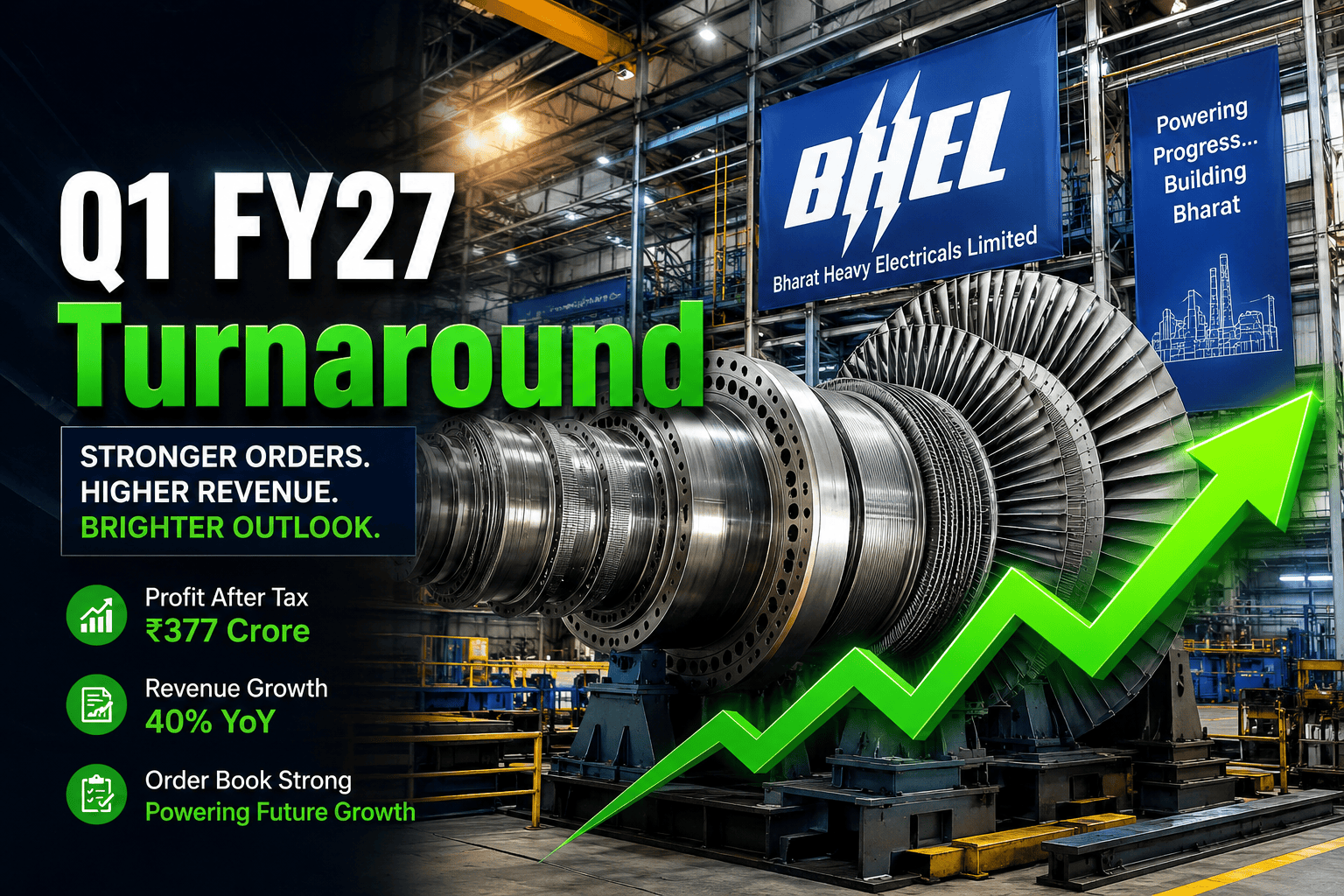
The Indian capital goods sector has witnessed a defining moment this earnings season. Bharat Heavy Electricals Limited (BHEL), a cornerstone of India’s power infrastructure, has delivered a stunning financial turnaround in its Q1 FY27 results. Shaking off the shadows of previous fiscal challenges, BHEL successfully transformed a steep net loss of Rs. 454.89 Crore in Q1 FY26 into a robust standalone net profit of Rs. 381.91 Crore for the quarter ended June 30, 2026. Driven by surging execution in its core Power segment, which generated Rs. 5,919.50 Crore in revenue, the public sector behemoth has firmly signaled a return to operational efficiency. How should retail and institutional investors interpret these numbers? This comprehensive analysis decodes the data, the underlying business drivers, and the path ahead for BHEL.
2. Executive Summary
For investors seeking a rapid overview, here are the critical takeaways from BHEL’s Q1 FY27 earnings report:
Massive Profit Turnaround: BHEL reported a standalone net profit of Rs. 381.91 Crore, completely reversing a net loss of Rs. 454.89 Crore from the same quarter last year.
Surging Revenue: Standalone revenue from operations hit Rs. 7,697.72 Crore in Q1 FY27, up substantially from Rs. 5,486.91 Crore in Q1 FY26.
Power Segment Dominance: The Power division remains the backbone of the company, contributing Rs. 5,919.50 Crore to the top line this quarter.
Industry Segment Resilience: The Industry segment posted revenues of Rs. 1,778.22 Crore and a positive segment result (profit before tax & finance cost) of Rs. 242.61 Crore.
Contained Finance Costs: Finance costs for the quarter were well-managed at Rs. 139.88 Crore.
Consolidated Alignment: Consolidated Net Profit mirrored the standalone strength, coming in at Rs. 376.71 Crore.
Receivable Risks: BHEL holds an overdue amount of Rs. 196 Crore (USD 23 million) stuck in Sudan, which currently remains unprovided for in the P&L.
Maintained Credit Strength: The company retained top-tier “CARE A1+” and “Ind A1+” ratings for its Commercial Paper.
3. Company Snapshot
Bharat Heavy Electricals Limited (BHEL) is a premier engineering and manufacturing enterprise owned by the Government of India. As one of the largest capital goods manufacturers in the country, BHEL operates primarily across two broad segments:
Power: Supplying core equipment (boilers, turbines, generators) and turnkey solutions for thermal, hydro, and nuclear power projects.
Industry: Catering to transportation, defense, aerospace, renewable energy, and industrial systems.
BHEL plays a pivotal role in fulfilling India’s growing energy and infrastructure demands. Note: While exact market capitalization fluctuates daily with the NSE/BSE, the fundamental scale of BHEL’s asset base remains massive, with standalone total assets reported at Rs. 76,645.74 Crore as of June 30, 2026.
4. Q1 FY27 Financial Highlights
Analyzing the unaudited standalone financial results approved by the Board of Directors on July 16, 2026, BHEL showcased exceptional top-line and bottom-line recovery.
Key Metrics (Standalone):
Revenue from Operations: Rs. 7,697.72 Crore.
Other Income: Rs. 230.80 Crore.
Total Income: Rs. 7,928.52 Crore.
Cost of Materials & Services: Rs. 5,839.29 Crore.
Employee Benefits Expense: Rs. 1,506.33 Crore.
Profit Before Tax (PBT): Rs. 512.90 Crore.
Net Profit (PAT): Rs. 381.91 Crore.
Basic & Diluted EPS: Rs. 1.10 (not annualised).
Understanding the Numbers: The numbers indicate strong execution. The transition to a Rs. 512.90 Crore Profit Before Tax from a massive deficit showcases that operating leverage is kicking in. The cost of materials inherently rose alongside increased revenue, but improved absorption of fixed costs—like employee benefits—aided margin expansion.
5. YoY & QoQ Comparison
Q1 FY27 vs Q1 FY26 (Year-over-Year)
The YoY comparison highlights the cyclical recovery and accelerated execution of the company.
Revenue Growth: Revenue from operations jumped to Rs. 7,697.72 Crore from Rs. 5,486.91 Crore in the corresponding quarter last year.
Profitability Shift: A standalone net loss of Rs. 454.89 Crore in Q1 FY26 transformed into a robust net profit of Rs. 381.91 Crore in Q1 FY27.
Segment Rebound: The Power segment’s result (profit before tax and finance cost) surged to Rs. 562.81 Crore, a stark contrast to the Rs. 510.00 Crore loss reported in Q1 FY26.
Q1 FY27 vs Q4 FY26 (Quarter-over-Quarter)
Historically, Q4 is often the strongest quarter for Indian PSU capital goods companies due to year-end billing cycles, making sequential comparisons slightly asymmetrical.
Revenue Moderation: Standalone revenue decreased from Rs. 12,310.37 Crore in Q4 FY26 to Rs. 7,697.72 Crore in Q1 FY27.
Profit Moderation: Standalone PAT dropped from Rs. 1,282.68 Crore in Q4 FY26 to Rs. 381.91 Crore in Q1 FY27.
Analytical Take: This sequential dip is seasonal and expected in the infrastructure sector. The actual health metric is the immense YoY growth.
6. Management Commentary & Disclosures
While comprehensive earnings call transcripts often follow the initial result declaration, BHEL’s official disclosures to the exchanges provide critical insights:
International Receivables Issue: Management disclosed an ongoing issue regarding Rs. 196 Crore (USD 23 million) stuck with a customer, STPG (formerly NEC Sudan). The company considers this amount “good” despite the ongoing crisis in Sudan. Crucially, management noted that if a provision were made for this, the impact on Profit Before Tax would be a reduction of Rs. 177 Crore (net of Expected Credit Loss provision).
Corporate Governance: BHEL disclosed that there is currently no Independent Director on the Board of BHEL. Consequently, the constitution of the Audit Committee is not in line with Regulation 18 of SEBI Listing Regulations, 2015. The results were therefore directly placed and approved in the Board Meeting.
Credit Ratings: The company successfully retained its stellar short-term credit ratings: “CARE A1+” by CARE Edge Ratings and “Ind A1+” by India Ratings & Research for its Commercial Paper.
7. Business Segment Analysis
Power Segment
Q1 FY27 Revenue: Rs. 5,919.50 Crore.
Q1 FY27 Segment Result (PBIT): Rs. 562.81 Crore.
Analysis: As the traditional cash cow, the Power segment drove the company’s return to profitability. Moving from a Rs. 510.00 Crore loss in Q1 FY26 to a positive Rs. 562.81 Crore result demonstrates vastly improved execution margins and likely a better pricing environment on completed milestones. Standalone segment assets for Power stand at Rs. 50,247.59 Crore.
Industry Segment
Q1 FY27 Revenue: Rs. 1,778.22 Crore.
Q1 FY27 Segment Result (PBIT): Rs. 242.61 Crore.
Analysis: The Industry segment remains highly profitable and provides crucial diversification away from thermal power dependency. The segment maintains a healthy asset base of Rs. 10,257.69 Crore on a standalone basis.
8. Order Book & Growth Pipeline (Editorial Assessment)
(Note: Explicit Q1 FY27 ending order book figures are typically detailed in the subsequent investor presentation; however, the revenue run-rate provides an undeniable proxy). The jump to Rs. 7,697.72 Crore in quarterly revenue indicates robust order execution. The Indian government’s continued thrust on capacity addition, particularly in base-load thermal power to meet peak demand deficits, keeps BHEL heavily engaged. The pipeline remains buoyed by the transition towards efficient supercritical thermal plants and investments in defense and railways through the Industry segment.
9. Fundamental Analysis
Based on the key financial information disclosed for Q1 FY27 (Standalone), BHEL presents a fascinating fundamental picture:
Net Worth: Rs. 26,846.29 Crore.
Current Ratio: 1.60. This indicates a comfortable liquidity position, where current assets adequately cover short-term liabilities.
Debt-to-Equity Ratio: 0.10. BHEL remains a highly de-leveraged entity, minimizing financial risk in high interest rate environments.
Operating Profit Ratio: 6.55%. A solid improvement, pulling out of negative territory reported in the same quarter last year.
Net Profit Ratio: 4.96%.
Inventory Turnover Ratio: 2.47 (Annualised).
Trade Receivables Turnover Ratio: 3.61 (Annualised).
Earnings Per Share (EPS): Rs. 1.10 for the quarter.
Educational Note: P/E (Price-to-Earnings) and EV/EBITDA require the live market price at the time of reading, but evaluating the fundamental metrics above shows a balance sheet with low leverage and recovering margins.
10. Technical Market View (Educational)
Disclaimer: Technical analysis is educational and reflects probabilities based on historical price action, not certainties.
When a major PSU turns a massive loss into a profit, market sentiment typically turns heavily bullish in the short to medium term.
Trend: Investors generally look for breakouts above prior resistance zones following such earnings surprises.
Volume: A spike in institutional volume often accompanies a turnaround quarter, indicating accumulation.
Moving Averages: A stock moving past its 50-day and 200-day moving averages (Golden Cross) post-earnings is viewed favorably by swing traders.
11. Industry Analysis
The heavy electrical equipment and capital goods sector is currently in a “capex supercycle.” Driven by national infrastructure pipelines, competitors and peers alike are seeing inflated order books. BHEL’s unique monopoly-like status in domestic boiler-turbine-generator (BTG) manufacturing positions it uniquely. Government policies mandating domestic procurement for PSU power companies act as strong protective moats.
12. Macroeconomic Analysis
BHEL’s balance sheet is inherently linked to India’s macroeconomic health.
GDP & Energy Demand: An economy growing at ~6.5-7% demands massive power, directly benefiting BHEL’s core segment.
Interest Rates: BHEL’s ultra-low Debt-Equity ratio of 0.10 largely insulates it from the negative impacts of high RBI repo rates.
Geopolitics: The company is not entirely immune to global shocks, as evidenced by the Rs. 196 Crore tied up in Sudan due to the ongoing crisis.
13. Data & Evidence
Financial Highlights Table (Standalone Q1 FY27)
| Metric | Q1 FY27 (Jun ’26) | Q1 FY26 (Jun ’25) | Q4 FY26 (Mar ’26) |
| Revenue from Operations | Rs. 7697.72 Cr | Rs. 5486.91 Cr | Rs. 12310.37 Cr |
| Total Expenses | Rs. 7415.62 Cr | Rs. 6279.78 Cr | Rs. 10842.69 Cr |
| Profit/(Loss) Before Tax | Rs. 512.90 Cr | Rs. (607.43) Cr | Rs. 1719.80 Cr |
| Net Profit/(Loss) | Rs. 381.91 Cr | Rs. (454.89) Cr | Rs. 1282.68 Cr |
| EPS (Rs) | 1.10 | (1.31) | 3.68 |
Key Ratios Table (Q1 FY27 Annualised)
| Ratio | Q1 FY27 (Jun ’26) |
| Current Ratio | 1.60 |
| Debt-Equity Ratio | 0.10 |
| Operating Profit Ratio | 6.55% |
| Net Profit Ratio | 4.96% |
| Inventory Turnover | 2.47 |
14. Expert Perspectives
While specific broker upgrades will flood the market in the coming days, standard institutional equity perspectives dictate that capital goods stocks are re-rated when execution risk declines. BHEL’s ability to convert its order book into Rs. 7,697.72 Crore in standalone quarterly revenue proves execution capability. The shift to a positive operating profit ratio of 6.55% will likely prompt analysts to revise their FY27 EPS estimates upward.
15. Risks
Understanding the downside is crucial for professional investing.
Execution & Receivables Risks:
Geopolitical Exposures: The Rs. 196 Crore overdue from Sudan (STPG) highlights the risks of international contracts in unstable regions. If BHEL is forced to write this off, it would shave Rs. 177 Crore directly off the Profit Before Tax.
Corporate Governance Delay: The lack of an Independent Director and a non-compliant Audit Committee according to SEBI regulations might raise red flags for stringent ESG and institutional funds.
Macro Risks:
Raw Material Inflation: Steel and copper volatility can compress margins in fixed-price contracts.
Scenario Analysis:
Best-Case: Margins expand further into double digits; the Sudan receivable is recovered; order inflow from thermal expansions surges.
Base-Case: Steady state execution with operating margins holding around 6-7%.
Worst-Case: Macro slowdown halts new orders; international receivables go completely bad, forcing significant P&L provisions.
16. Future Outlook
The long-term outlook for BHEL appears structurally robust. India’s mandate to balance renewable energy with base-load thermal stability ensures BHEL’s order book remains healthy. Investors should closely monitor the company’s ability to maintain its operating profit ratio, which currently stands at an encouraging 6.55%. The diversification via the Industry segment (Defense, Rail, Renewables) will dictate BHEL’s evolution from a pure-play power proxy to a holistic industrial giant.
17. Investor Takeaways
For Long-Term Investors & SIP Allocators: BHEL’s low debt-to-equity (0.10) and significant net worth (Rs. 26,846.29 Crore) provide a massive margin of safety. The return to profitability underscores fundamental strength.
For Swing Traders: The dramatic turnaround from a massive YoY loss to a profit is a classic catalyst for price momentum. Watch resistance levels for breakout signals.
For Beginners: Understand that heavy electrical businesses are cyclical. Q1 and Q4 numbers will always look drastically different due to the nature of project billing.
18. Editorial Opinion (Clearly Labeled)
EDITORIAL OPINION: BHEL’s Q1 FY27 results are undeniably impressive on a YoY basis. Turning a nearly Rs. 455 Crore loss into a Rs. 382 Crore profit in just four quarters is a testament to management’s focus on execution. However, a cautious investor must not ignore the corporate governance footnote. The absence of an Independent Director, leading to a non-compliant Audit Committee under SEBI rules, is an administrative lapse that a company of BHEL’s stature should swiftly rectify. Furthermore, the unprovided Rs. 196 Crore Sudan receivable hangs as a slight Damocles sword over future quarterly profits. While the core operations are firing on all cylinders, management needs to tighten the administrative and risk-provisioning aspects to secure unshakeable institutional trust.
19. Conclusion
Bharat Heavy Electricals Limited (BHEL) has delivered a robust Q1 FY27, marked by standalone revenue of Rs. 7,697.72 Crore and a net profit of Rs. 381.91 Crore. Propelled by its core Power segment, the company has successfully reversed the negative trajectory of Q1 FY26. While operational metrics and debt ratios look exceptional, investors must keep a watchful eye on pending international receivables and SEBI governance compliances over the next few quarters.