Company Introduction: The Three Pillars of BEML’s Business Moat
BEML Limited, formerly known as Bharat Earth Movers Limited, is one of India’s most strategically important public sector engineering companies. Established in 1964, the company has evolved from a heavy equipment manufacturer into a diversified industrial powerhouse serving critical sectors such as defense, mining, construction, railways, and metro transportation. Over the decades, BEML has built a strong reputation as a trusted supplier to the Government of India, Indian Armed Forces, metro rail corporations, and major infrastructure developers. Its manufacturing facilities located in Bengaluru, Kolar Gold Fields (KGF), Mysore, and Palakkad form one of the largest engineering networks among Indian public sector enterprises.
The first pillar of BEML’s competitive advantage lies in its Mining and Construction Equipment division. The company manufactures a wide range of heavy earthmoving machinery, including dump trucks, excavators, bulldozers, wheel loaders, and motor graders. These machines play a vital role in India’s mining operations, road construction projects, coal extraction activities, and large-scale infrastructure development. With the government’s continued focus on highways, smart cities, industrial corridors, and mining expansion, BEML remains an important beneficiary of India’s infrastructure growth story.
The second pillar is the Defense and Aerospace segment. BEML serves as a critical supplier to the Indian Armed Forces by manufacturing specialized military vehicles, missile launcher platforms, armored recovery vehicles, bridge-laying systems, and tactical mobility solutions. As India accelerates its defense indigenization efforts under the Atmanirbhar Bharat initiative, BEML is positioned to benefit from rising domestic procurement of defense equipment. The company’s expertise in military engineering and strategic mobility systems provides it with a strong competitive moat that is difficult for private competitors to replicate.
The third pillar of BEML’s business is its Rail and Metro division. The company has emerged as a major participant in India’s railway modernization and urban transportation projects. BEML manufactures metro coaches, railway maintenance equipment, rolling stock components, and advanced transportation solutions. The company’s involvement in Vande Bharat train programs, metro rail expansions, and urban mobility projects offers long-term growth opportunities as India continues investing heavily in transportation infrastructure.
Earnings Post-Mortem: Why Profits Crumbled Despite Record Revenues
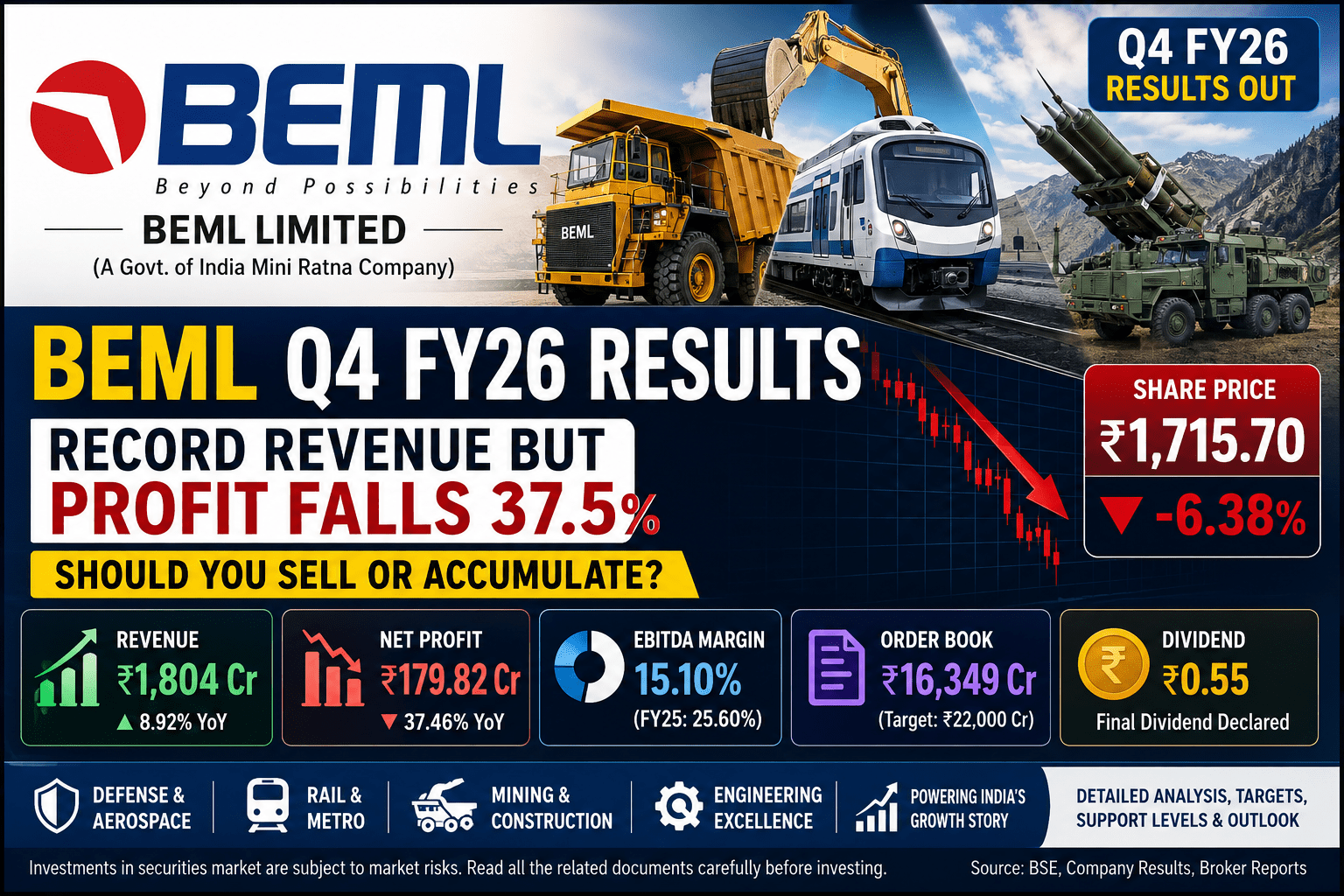
At first glance, BEML’s Q4 FY26 earnings appear contradictory. The company reported its highest-ever quarterly revenue, yet profits declined sharply. This disconnect between revenue growth and earnings performance explains why investors reacted negatively to the results announcement.
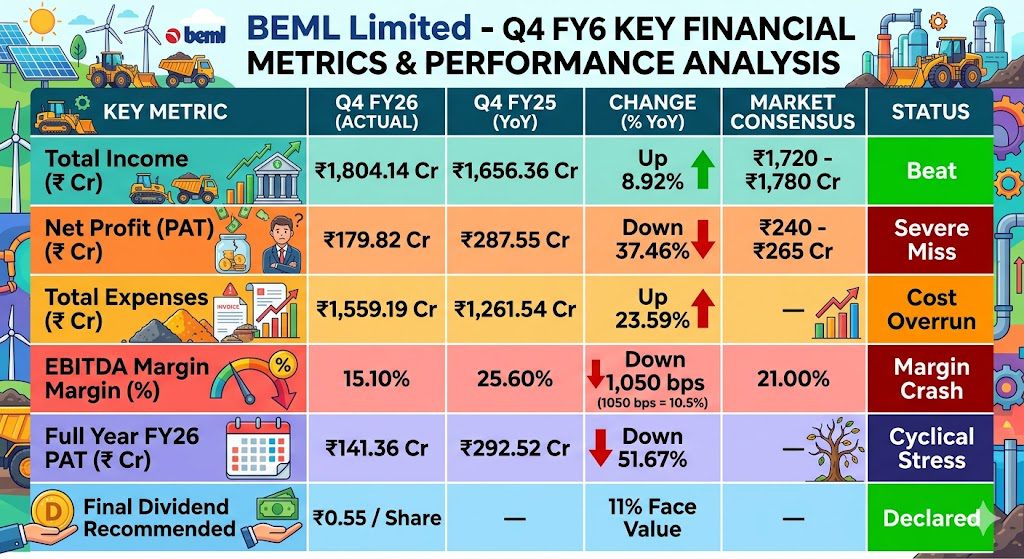
The revenue story was undeniably strong. Total income for the quarter increased to ₹1,804.14 crore compared with ₹1,656.36 crore during the same period last year, representing growth of approximately 8.92%. The increase was primarily driven by accelerated deliveries of rail systems, defense equipment, and mining machinery. Management successfully executed a large number of orders during the final quarter of the fiscal year, helping revenue exceed analyst expectations and reach a record quarterly level.
Unfortunately, revenue growth was overshadowed by an even faster rise in costs. Total expenditure surged to ₹1,559.19 crore from ₹1,261.54 crore in the previous year, representing a substantial increase of nearly 23.6%. Rising raw material prices, higher subcontracting expenses, logistics costs, and project execution expenditures significantly impacted profitability. The pace of cost growth far exceeded revenue growth, creating severe pressure on margins.
The most alarming metric was EBITDA margin compression. Operating margins collapsed from 25.6% during Q4 FY25 to just 15.1% during Q4 FY26. This decline of approximately 1,050 basis points illustrates how rapidly cost inflation eroded profitability. For companies like BEML that operate under long-term fixed-price contracts, rising input costs can become particularly damaging because price increases cannot always be passed on to customers immediately.
Defense contracts present a unique challenge in this regard. Many defense and infrastructure projects are awarded at predetermined prices. If execution timelines extend and raw material costs rise during project completion, profit margins can shrink dramatically. This appears to have been one of the primary reasons behind BEML’s earnings disappointment during the quarter.
As a result of these pressures, net profit fell sharply to ₹179.82 crore compared with ₹287.55 crore reported during Q4 FY25. The 37.46% decline was significantly worse than market expectations and triggered the sharp sell-off witnessed in the stock following the results announcement.
Dividend Strategy: Balancing Shareholder Returns and Growth Investments
Despite the sharp decline in earnings, BEML’s board maintained its commitment to rewarding shareholders. The company recommended a final dividend of ₹0.55 per share based on a face value of ₹5 per share. This comes in addition to the second interim dividend of ₹2.30 per share already declared during the financial year.
While the total dividend payout may not appear exceptionally high, it sends an important signal regarding management’s confidence in the company’s long-term financial position. Maintaining dividends during periods of earnings pressure demonstrates that management continues to believe in the sustainability of future cash flows.
For investors seeking stable returns from public sector enterprises, dividend continuity often serves as an indicator of financial resilience. Although BEML’s profitability has come under pressure, the company’s willingness to continue shareholder distributions suggests that management views the current challenges as manageable rather than structural.
Fundamental Analysis: Order Book Concerns and Long-Term Growth Visibility
One of the most important areas of concern emerging from the earnings report is the company’s order book position. Earlier in the fiscal year, management had guided toward an ambitious order book target of approximately ₹22,000 crore. However, BEML concluded FY26 with an order book of ₹16,349 crore.
The shortfall of nearly ₹5,650 crore has raised questions among investors regarding future growth visibility. Order books are particularly important for engineering and capital goods companies because they provide a roadmap for future revenue generation. When order inflows fall short of expectations, investors often become concerned about future business momentum.
It is important to note that the lower order book does not necessarily indicate weak demand. Government procurement cycles, defense contract approvals, railway tender timelines, and infrastructure project clearances often experience delays. Nevertheless, the gap between management guidance and actual order-book realization creates uncertainty regarding revenue growth over the next few years.
Another noteworthy development is the sharp increase in research and development spending. BEML’s R&D expenditure increased approximately 150% to ₹251 crore during FY26. From a strategic perspective, this is encouraging because indigenous technology development is becoming increasingly important within India’s defense and transportation sectors.
However, there is also a financial trade-off. Approximately ₹191 crore remains tied up in Capital Work-in-Progress (CWIP), meaning a substantial portion of capital is currently locked in projects that have not yet started generating returns. While these investments may strengthen BEML’s future competitiveness, they also affect current cash-flow efficiency and profitability metrics.
Valuation has become another key discussion point. With a market capitalization of approximately ₹14,290 crore and full-year net profit declining to ₹141.36 crore, the stock’s trailing earnings multiple appears elevated. This partly explains why investors responded aggressively to the earnings disappointment. The market is effectively reassessing how much premium it is willing to assign to BEML’s future growth potential.
Technical Analysis: Key Trading Levels After the Earnings Shock
From a technical perspective, Friday’s trading session significantly weakened BEML’s chart structure. Following the earnings announcement, the stock witnessed aggressive selling throughout the day. Shares declined from an intraday high of ₹1,864 to a low of ₹1,693 before settling at ₹1,715.70.
The most important technical level for traders is the primary pivot zone near ₹1,757.50. The stock must reclaim and sustain above this level to neutralize the immediate bearish trend. Until that happens, short-term momentum remains negative.
On the downside, ₹1,693 represents the first major support level. This corresponds to Friday’s intraday low and will likely be closely watched by traders during the upcoming sessions. A breakdown below this support could trigger additional selling pressure toward the next support zone around ₹1,640.
If broader market sentiment weakens further, the stock may eventually test the major long-term support level near ₹1,355. While this remains a distant scenario, it represents an important structural floor for long-term investors.
Resistance levels are currently positioned near ₹1,780, ₹1,832.60, and ₹1,864. Any recovery rally will likely face selling pressure near these zones until investor confidence improves.
Management Guidance and Strategic Realignment
Looking ahead, management remains focused on several strategic initiatives that could shape BEML’s future growth trajectory. One of the most important opportunities involves the execution of Vande Bharat Sleeper train programs. These high-value railway contracts have the potential to contribute significantly to revenue growth during FY27 and FY28.
The defense segment also continues offering substantial opportunities. India’s emphasis on indigenous military manufacturing is creating demand for missile carrier systems, armored mobility vehicles, specialized defense equipment, and tactical transport solutions. BEML remains well positioned to benefit from these trends because of its long-standing relationships with defense agencies and proven engineering capabilities.
A positive development from a governance perspective is the extension of Managing Director and CEO Udai Singh’s tenure for an additional three years beginning September 15, 2026. Leadership continuity often plays an important role during periods of operational restructuring and strategic transformation. Investors generally view such stability favorably, particularly when companies are navigating margin pressures and execution challenges.
Financial Analyst Target Matrix
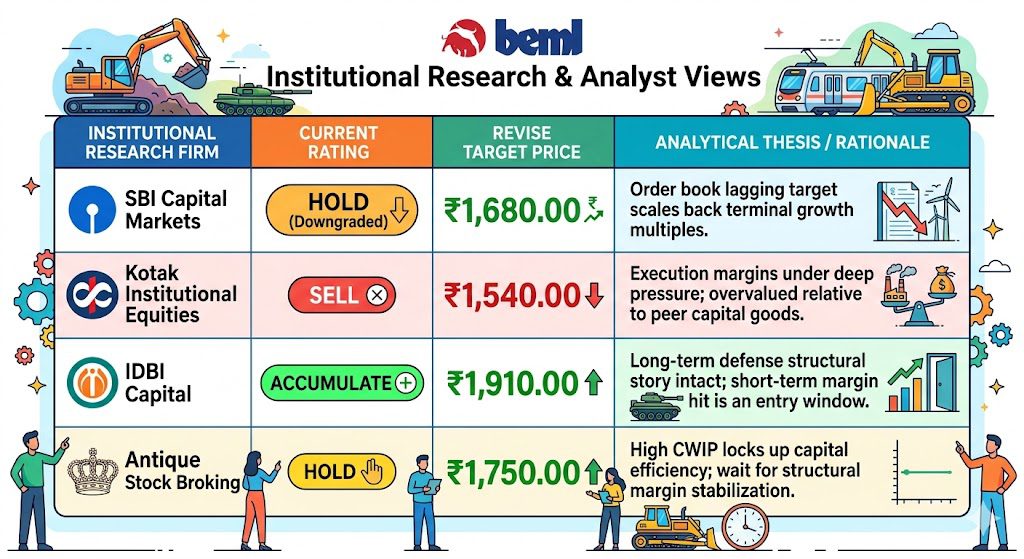
Brokerage opinions following the results announcement have become increasingly mixed. SBI Capital Markets downgraded the stock to Hold and assigned a target price of ₹1,680, citing weaker-than-expected order-book growth and slower earnings momentum. Kotak Institutional Equities adopted a more bearish stance with a Sell rating and a target price of ₹1,540, arguing that margin pressures remain significant and valuations continue to appear demanding.
On the other hand, IDBI Capital maintained an Accumulate recommendation with a target price of ₹1,910. The brokerage believes that BEML’s long-term exposure to defense manufacturing, rail modernization, and infrastructure development remains attractive despite near-term earnings weakness. Antique Stock Broking retained a Hold recommendation with a target price of ₹1,750, preferring to wait for evidence of margin stabilization before becoming more constructive on the stock.
The divergence among brokerage views highlights the uncertainty surrounding BEML’s near-term earnings outlook. While long-term structural growth drivers remain intact, investors are seeking clearer signs of profitability recovery before assigning higher valuations.
The Veteran’s Verdict: Investors vs Traders Playbook
For long-term investors, the latest results should be viewed as a warning sign rather than a reason to abandon the investment thesis altogether. India’s infrastructure expansion, defense modernization, metro rail development, and railway upgrades remain multi-year growth themes that directly support BEML’s business model. However, margin recovery and order-book expansion must improve before the stock can regain sustained upward momentum. Investors may consider gradual accumulation if the stock approaches the ₹1,550–₹1,640 support zone.
For traders, the outlook remains considerably more cautious. The stock has entered a short-term bearish phase following the earnings disappointment. Attempting to buy aggressively immediately after a major earnings-driven breakdown can be risky. Traders should wait for either a successful defense of the ₹1,693 support level or a decisive recovery above the ₹1,757 pivot zone before considering fresh long positions.
Ultimately, BEML’s Q4 FY26 results reveal a company with strong strategic assets and long-term opportunities but facing meaningful operational challenges. The future of the stock will depend less on revenue growth and more on management’s ability to restore margins, improve execution efficiency, and rebuild investor confidence.