Scope Outline
Introduction: The New Benchmark in Public Sector Banking
India’s banking industry has changed dramatically over the last three decades. In the 1990s, public sector banks were often seen as slow-moving institutions struggling with high bad loans, operational inefficiencies, and limited technological capabilities. Private banks dominated investor confidence because they were viewed as more efficient, modern, and profitable. However, the banking landscape in 2026 looks very different. Several PSU banks have undergone major balance-sheet cleanups, embraced digital banking, strengthened governance standards, and improved profitability. Among these transformed lenders, BANKBARODA has emerged as one of the strongest turnaround success stories in India’s financial sector.
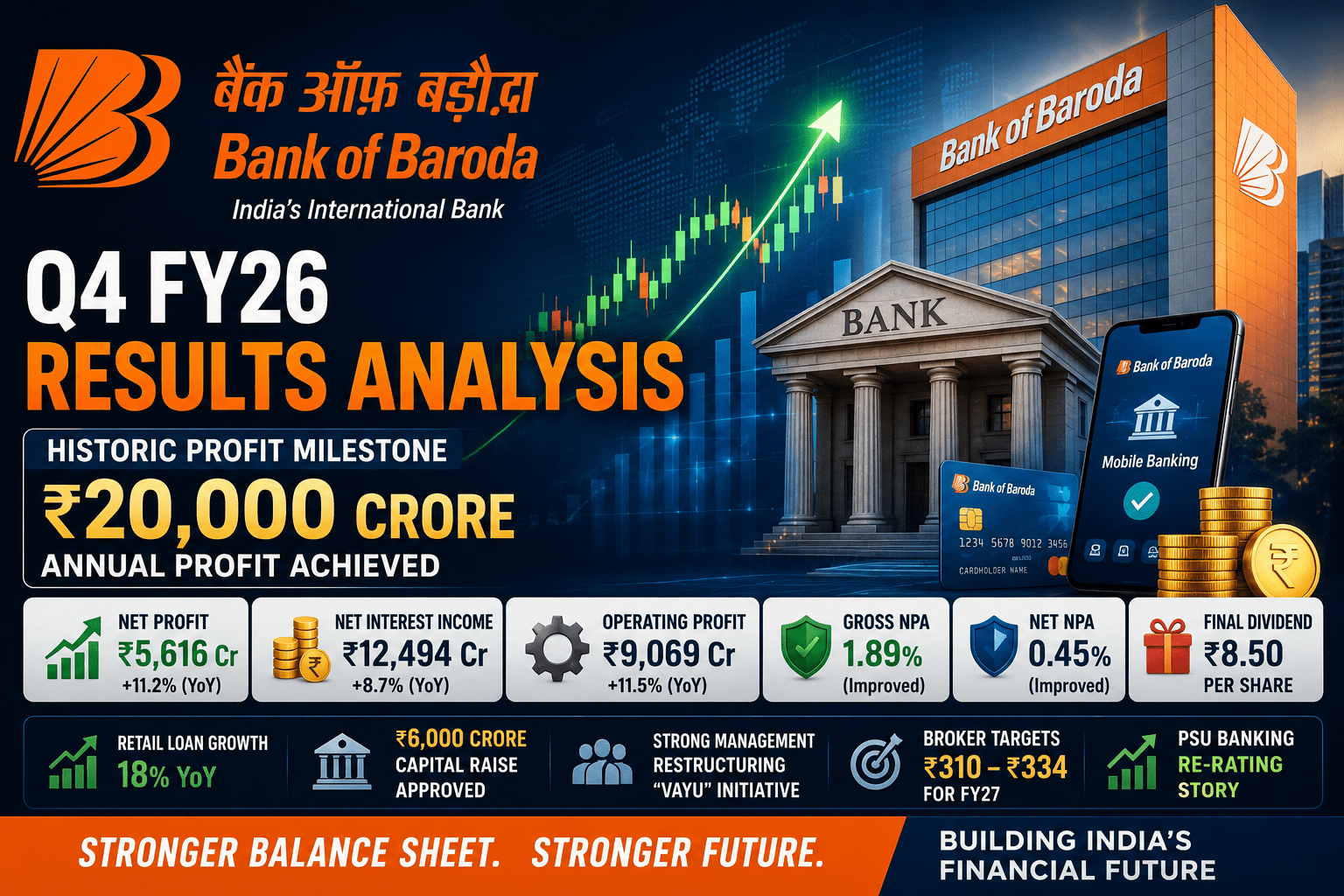
On May 9, 2026, Bank of Baroda announced its Q4 FY26 results, and the numbers clearly demonstrated how far the bank has evolved. For the first time in its history, the bank officially crossed the massive ₹20,000 crore annual profit milestone. This achievement represents more than just a financial record — it signals the arrival of Bank of Baroda as a serious large-scale banking powerhouse capable of competing aggressively within India’s modern banking ecosystem.
The stock settled near ₹263.90 on the NSE following the results announcement as investors balanced strong earnings against broader market volatility. Despite short-term fluctuations, the overall sentiment toward the bank remains positive because investors are increasingly recognizing its improving asset quality, retail lending expansion, and stable profitability.
The most important takeaway from the Q4 FY26 results is that Bank of Baroda is no longer simply surviving the banking cycle — it is actively shaping its next phase of long-term growth.
Q4 FY26 Performance: The “Hard Numbers” (NSE Actuals)
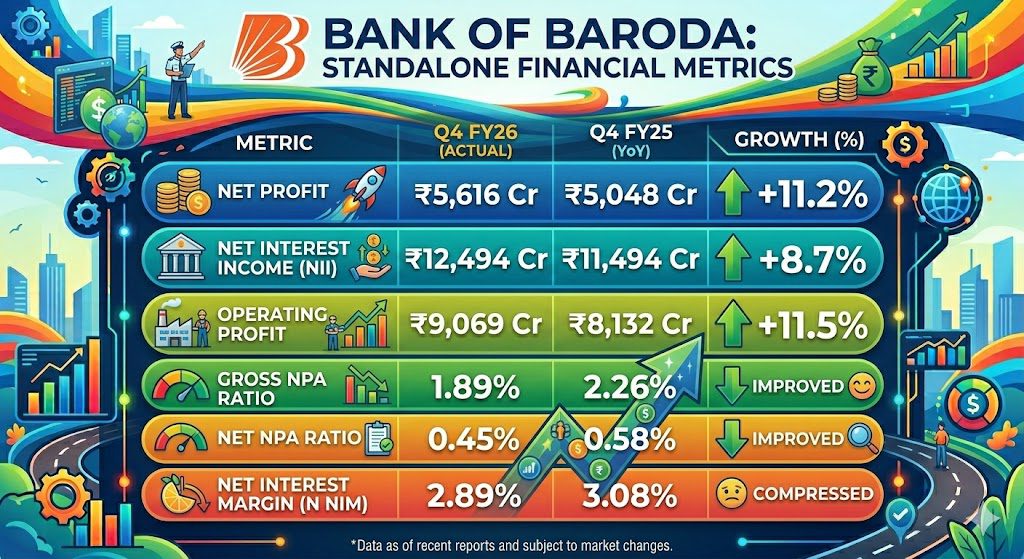
Bank of Baroda delivered another strong quarterly performance during Q4 FY26 supported by healthy loan growth, improving operational efficiency, and significantly better asset quality.
Standalone net profit increased to ₹5,616 crore compared to ₹5,048 crore during Q4 FY25, reflecting solid year-on-year growth of 11.2%. The bank continues demonstrating stable earnings momentum even amid a challenging interest-rate environment.
Net Interest Income (NII), one of the most important profitability indicators for banks, rose to ₹12,494 crore compared to ₹11,494 crore in the same quarter last year. This represented healthy growth of 8.7%, supported by strong loan growth and stable lending activity.
Operating profit also remained strong at ₹9,069 crore compared to ₹8,132 crore a year earlier, reflecting growth of 11.5%. The improvement indicates stronger operational discipline and better cost management.
The biggest positive surprise came from asset quality improvement. Gross NPA declined sharply to 1.89% compared to 2.26% last year, while Net NPA improved further to 0.45% from 0.58%.
These numbers are among the strongest asset quality metrics reported by a public sector bank in recent years.
| Financial Metric | Q4 FY26 | Q4 FY25 | Growth |
|---|---|---|---|
| Standalone Net Profit | ₹5,616 Cr | ₹5,048 Cr | +11.2% |
| Net Interest Income | ₹12,494 Cr | ₹11,494 Cr | +8.7% |
| Operating Profit | ₹9,069 Cr | ₹8,132 Cr | +11.5% |
| Gross NPA | 1.89% | 2.26% | Improved |
| Net NPA | 0.45% | 0.58% | Improved |
The financial performance clearly shows that Bank of Baroda is successfully balancing growth and risk management while strengthening the quality of its balance sheet.
Fundamental Deep-Dive: Growth vs. Margins
Asset Quality Has Become a Major Competitive Strength
One of the biggest reasons investors are becoming increasingly optimistic about BANKBARODA is the dramatic improvement in asset quality.
Gross NPA has now fallen to just 1.89%, which represents a multi-year low for the bank. Net NPA has also improved significantly to 0.45%.
This is extremely important because public sector banks historically struggled with stressed assets and weak recovery cycles. Today, Bank of Baroda’s balance sheet appears far cleaner and more stable compared to previous years.
Lower bad loans reduce provisioning pressure, improve profitability visibility, and increase investor confidence regarding future earnings sustainability.
What makes this improvement even more significant is that the bank’s asset quality metrics are now competitive with several private sector banks — something that would have seemed impossible a decade ago.
Retail Lending Continues Fueling Growth
The bank’s credit growth remains another major highlight from the Q4 FY26 results.
Global advances increased approximately 16.2% year-on-year to ₹14.29 lakh crore. This growth was driven mainly by strong retail loan demand across several categories including auto loans, mortgage loans, personal loans, MSME financing, and consumer banking.
Organic retail loans alone surged nearly 18% year-on-year.
Retail lending is strategically important because it typically provides:
- Better yield opportunities
- More diversified risk exposure
- Lower concentration risk
- Stronger long-term stability
Bank of Baroda’s growing retail franchise is helping reduce dependence on large corporate loan cycles while improving overall portfolio quality.
Net Interest Margins Remain Stable
One area closely monitored by banking investors remains Net Interest Margins (NIMs).
The bank reported NIM of approximately 2.89% during Q4 FY26. Although margins declined slightly compared to last year, the sequential stabilization remains encouraging.
Across the banking industry, rising deposit costs and changing interest-rate conditions continue putting pressure on margins. However, Bank of Baroda’s ability to maintain relatively stable NIMs despite industry-wide pressure indicates improving operational resilience and effective liability management.
If margin stability continues through FY27, profitability growth could remain healthy over the medium term.
₹6,000 Crore Capital Raise Strengthens Future Expansion
The board has also approved a massive ₹6,000 crore capital raise to support future business expansion and credit growth opportunities.
This fundraising is strategically important because it improves the bank’s capital adequacy while providing additional financial flexibility for future lending growth.
India is expected to witness strong expansion across infrastructure, manufacturing, green energy, and retail lending sectors over the next several years. Bank of Baroda clearly intends to participate aggressively in this next phase of India’s credit growth cycle.
Strong capital reserves also strengthen investor confidence regarding the bank’s long-term growth sustainability.
Shareholder Rewards: The Dividend Story
₹8.50 Dividend Reflects Strong Financial Confidence
Bank of Baroda continues rewarding shareholders through healthy dividend payouts.
The board has recommended a final dividend of ₹8.50 per equity share for FY26. For investors seeking stable income-generating banking stocks, consistent dividend payouts remain an important attraction within PSU banking names.
The payout also reflects management’s confidence regarding profitability, balance-sheet strength, and future earnings stability.
Important Dividend Dates for Investors
The bank has announced the following important dates for dividend eligibility:
- Record Date: June 5, 2026
- Ex-Dividend Date: June 5, 2026
Investors holding shares before the ex-dividend date will qualify for the dividend payout.
Dividend announcements often act as important sentiment boosters for PSU banking stocks because they signal healthy cash flow generation and strong capital management.
Dividend Yield Remains Attractive
At the current stock price near ₹263.90, the dividend yield works out to approximately 3.2%.
Within India’s banking sector, this remains relatively attractive, especially considering the bank’s improving profitability, strong asset quality, and stable growth outlook.
Dividend-paying PSU banks often attract long-term institutional investors during periods of economic expansion and improving credit cycles.
Technical Analysis: Navigating the ₹260 Floor
The Stock Remains in Consolidation Mode
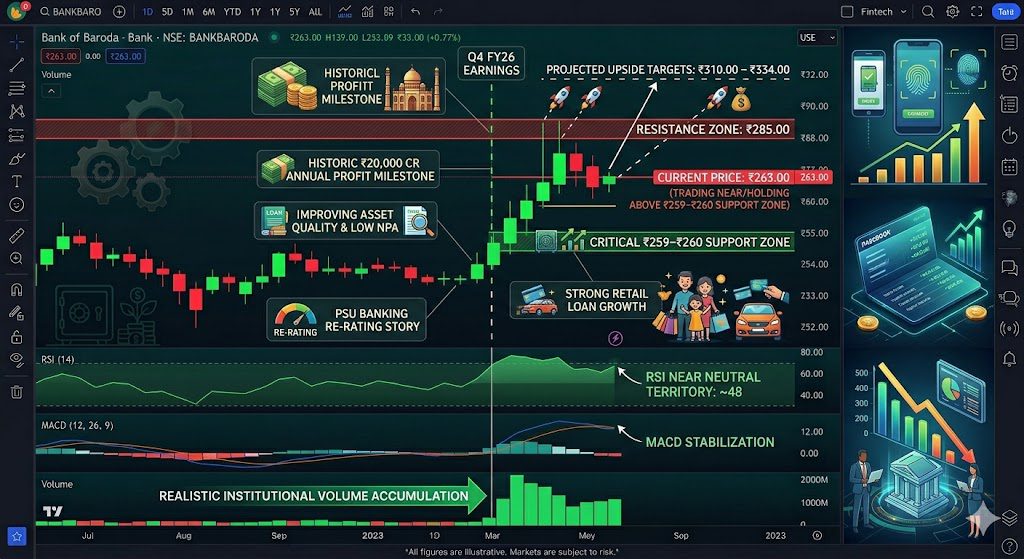
From a technical analysis perspective, BANKBARODA is currently consolidating after touching a 52-week high of ₹325.50 earlier this year.
The recent pullback reflects broader market volatility and temporary profit booking following a strong rally across PSU banking stocks.
Despite short-term weakness, the broader long-term trend structure remains positive.
₹259–₹260 Is a Critical Support Zone
The most important support zone currently lies between ₹259 and ₹260.
This range has repeatedly acted as a strong buying zone during previous corrections and remains psychologically important for traders and investors.
As long as the stock sustains above this support range, the broader bullish trend is likely to remain intact.
Long-term investors often monitor such support zones for fresh accumulation opportunities.
Resistance Near ₹285 Could Trigger Fresh Momentum
On the upside, immediate resistance remains near ₹285.
A decisive daily close above this level could potentially trigger fresh bullish momentum toward ₹310 and beyond.
Technical traders are closely monitoring this zone because breakout confirmation often attracts momentum buying from institutional participants.
RSI Indicates Near-Term Consolidation
Current RSI indicators suggest a neutral-to-negative short-term bias. However, long-term moving averages continue supporting the broader bullish structure.
This technical setup generally indicates temporary consolidation rather than a major trend reversal.
For experienced investors, consolidation phases often create attractive long-term entry opportunities within fundamentally strong stocks.
Brokerage Sentiment & Targets: The Re-Rating View
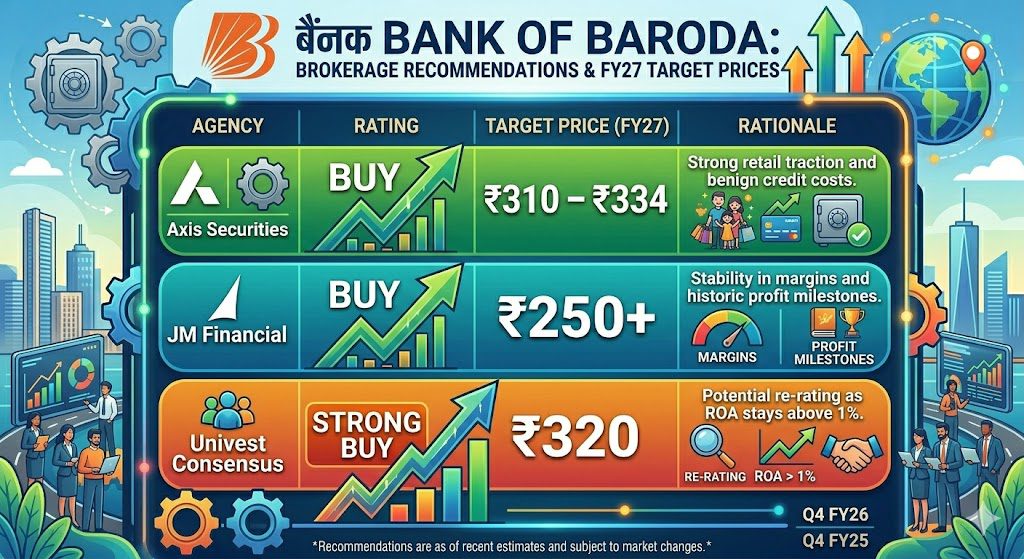
Institutional brokerages remain optimistic regarding Bank of Baroda’s long-term growth outlook following its strong FY26 performance.
| Brokerage Firm | Rating | Target Price | Rationale |
|---|---|---|---|
| Axis Securities | BUY | ₹310 – ₹334 | Retail growth & lower credit costs |
| JM Financial | BUY | ₹250+ | Margin stability & profit milestone |
| Univest Consensus | STRONG BUY | ₹320 | Potential valuation re-rating |
Most analysts believe the bank’s improving Return on Assets (ROA), strong retail loan growth, lower NPAs, and stable profitability could support further valuation expansion during FY27.
If operational execution continues improving, the stock may continue attracting strong institutional investor interest over the coming years.
Management Guidance: Strategic “Vayu” Restructuring
Leadership Restructuring Signals Aggressive Modernization
One of the most important strategic developments inside Bank of Baroda is the ongoing “Vayu” restructuring initiative.
The bank recently implemented extensive senior management restructuring aimed at improving operational efficiency, optimizing subsidiaries, and strengthening retail banking execution.
This reflects management’s broader intention to modernize the organization and improve execution speed across key business verticals.
Leadership restructuring often becomes an important catalyst for operational transformation within large financial institutions.
Lower Credit Cost Guidance Reflects Growing Confidence
Management has also revised credit cost guidance downward for FY27.
This reflects growing confidence regarding:
- Recovery pipelines
- Asset quality stability
- Collection efficiency
- Lower stress formation
Reduced credit costs directly improve profitability because banks need to allocate fewer resources toward bad-loan provisions.
This is another major reason why analysts remain optimistic regarding the bank’s future earnings outlook.
The “30-Year” Analyst Verdict
For Long-Term Investors
For long-term investors, Bank of Baroda increasingly appears to be a high-quality banking compounder rather than a short-term cyclical PSU trade.
Crossing the ₹20,000 crore annual profit milestone proves that the bank now possesses:
- Scale
- Operational stability
- Strong retail growth
- Cleaner balance-sheet dynamics
- Sustainable profitability
The combination of improving asset quality, attractive dividends, retail loan expansion, and stronger operational execution creates a compelling long-term investment story.
Within India’s PSU banking sector, Bank of Baroda now stands among the strongest transformation stories.
For Active Traders
For active traders, the stock is currently approaching an important support zone near ₹255–₹260.
If broader market sentiment stabilizes, this zone could potentially provide attractive swing-trading opportunities targeting ₹280–₹310 levels.
However, traders should continue monitoring:
- Banking sector sentiment
- Interest-rate expectations
- Margin trends
- Technical breakout confirmation
Momentum above ₹285 would significantly strengthen the bullish case.
Conclusion & Engagement (CTA)
Bank of Baroda has delivered another strong quarterly performance that highlights the remarkable transformation taking place within India’s PSU banking sector.
A historic ₹20,000 crore annual profit milestone, improving asset quality, stable margins, strong retail lending growth, and a ₹6,000 crore expansion war chest together position the bank strongly for the next credit cycle.
The biggest story is not simply the profit growth — it is the transformation of the bank itself.
BANKBARODA is increasingly evolving from a traditional PSU lender into a modern, efficient, retail-focused banking powerhouse capable of competing aggressively within India’s rapidly changing financial sector.
The key question now is whether the market will fully reward this transformation with a major valuation re-rating during FY27 and beyond.