Introduction: The ₹5 Lakh Crore Rubicon
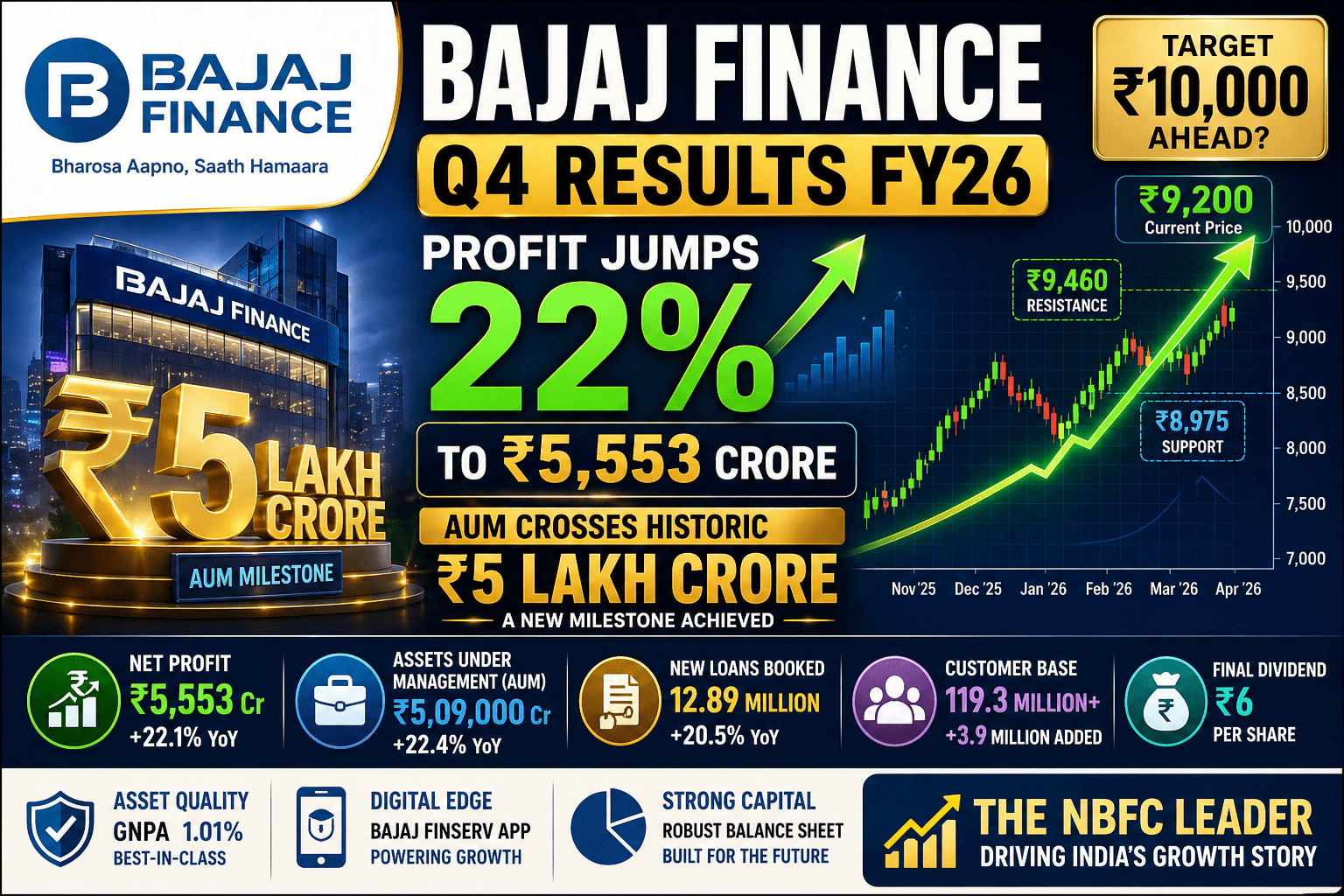
Over the last three decades, the Indian NBFC sector has evolved from a fragmented lending space into a powerful engine of consumption growth. In that journey, Bajaj Finance has consistently stayed ahead of the curve. Today, as it crosses the massive ₹5.09 lakh crore AUM milestone, the company has entered a completely new league. This is no longer just a lender—it is a financial ecosystem serving millions across India. The Q4 FY26 results reinforce this transformation, with net profit rising 22% to ₹5,553 crore. What stands out is not just the size, but the consistency with which the company is scaling. At a current market price near ₹9,200, the stock reflects renewed investor confidence as it moves closer to its next phase of growth.
Q4 FY26 Financial Scorecard: The Power of 22
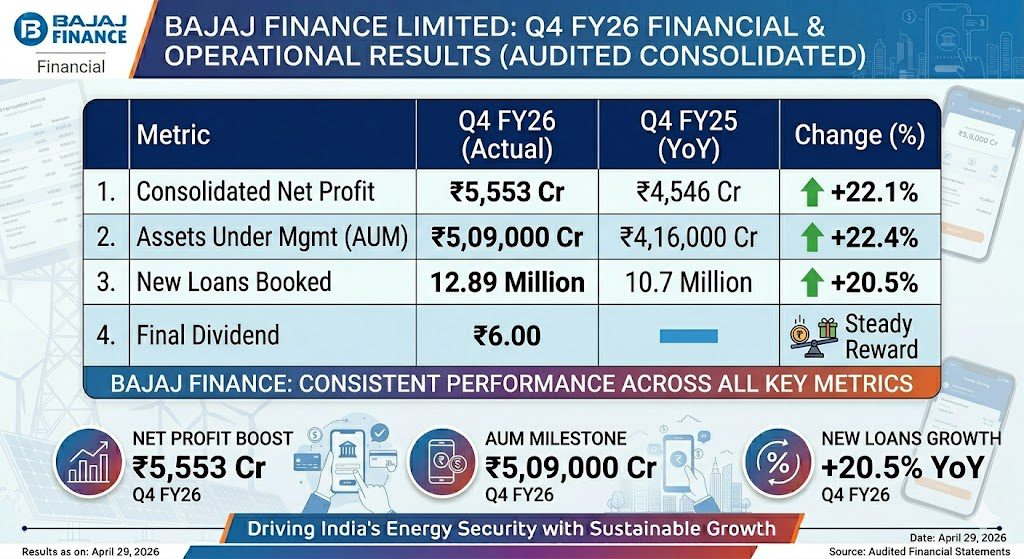
The Q4 FY26 numbers highlight Bajaj Finance’s ability to maintain strong growth momentum across all key parameters. Net profit increased to ₹5,553 crore from ₹4,546 crore in the same quarter last year, registering a solid 22.1% growth. At the same time, Assets Under Management expanded to ₹5,09,000 crore from ₹4,16,000 crore, showing a 22.4% increase and marking a historic milestone. The company also booked 12.89 million new loans during the quarter, compared to 10.7 million a year ago, reflecting robust demand across its product segments. Additionally, the board announced a final dividend of ₹6 per share, balancing shareholder rewards with reinvestment for future expansion.
Fundamental Analysis: The Ecosystem Moat
Customer Franchise: Scale Like No Other
One of the strongest pillars of Bajaj Finance’s success is its unmatched customer franchise. The company now serves over 119.3 million customers and added nearly 3.9 million new customers in just one quarter. This rapid expansion highlights its ability to penetrate deeper into India’s consumption-driven economy. More importantly, this scale provides a powerful advantage in cross-selling products, reducing acquisition costs, and building long-term customer relationships. In essence, Bajaj Finance is not just growing its loan book—it is building a financial ecosystem around its customers.
Asset Quality Masterclass: Risk Under Control
In an environment where unsecured lending has faced regulatory scrutiny, Bajaj Finance has maintained exceptional asset quality. The Gross NPA stands at just 1.01%, which is remarkable for a company operating at such a large scale. This demonstrates the strength of its risk management framework, powered by advanced analytics and disciplined underwriting. Maintaining NPAs at this level while growing aggressively is a clear indicator of operational excellence and sets the company apart from many peers in the NBFC sector.
Operating Leverage: Digital Edge Driving Efficiency
Another key driver of Bajaj Finance’s performance is its digital ecosystem. Platforms like the Bajaj Finserv app have significantly improved customer engagement while reducing operational costs. As more customers transact digitally, the company benefits from improved efficiency and lower cost-to-income ratios. This is where operating leverage plays a crucial role—higher volumes are achieved without a proportional increase in costs, leading to better profitability. This digital-first approach is one of the biggest competitive advantages for Bajaj Finance.
Technical Analysis: The Breakout Zone
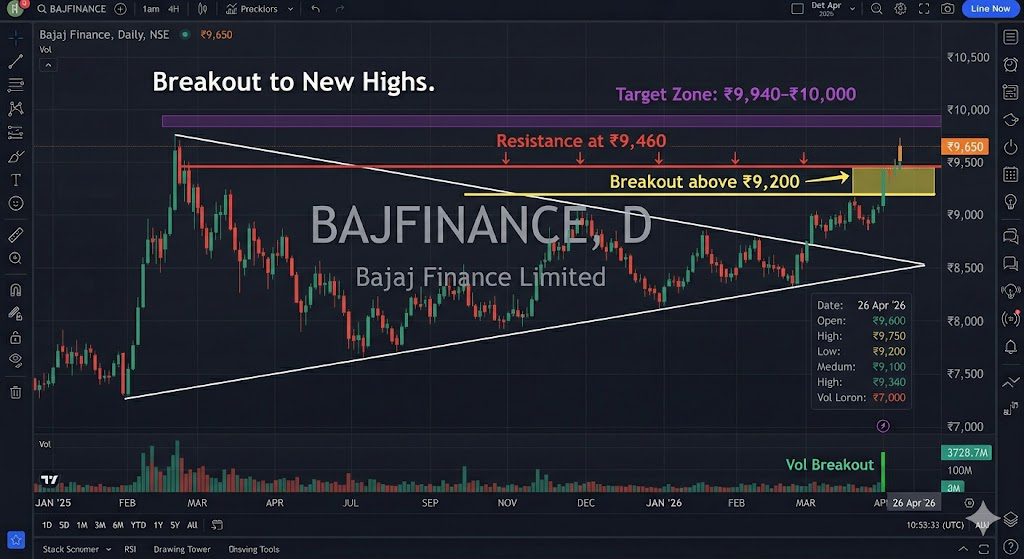
From a technical standpoint, Bajaj Finance has recently shown strong bullish signals. The stock has broken out of a symmetrical triangle pattern on the weekly chart, which typically indicates the start of a new uptrend. The ₹8,975 level has emerged as a strong support zone, acting as a reliable “buy on dip” level during recent corrections. On the upside, ₹9,460 remains the immediate resistance, and a breakout above this level could push the stock toward ₹9,940 and higher. The RSI is currently around 58, suggesting that there is still room for further upside before the stock enters overbought territory. Overall, the technical setup supports a continuation of the bullish trend.
Dividend & Shareholder Rewards
The Payout: Consistency Over Aggression
Bajaj Finance has recommended a final dividend of ₹6 per share for FY26. While the yield may not be as high as some PSU stocks, the consistency of payouts reflects the company’s stable financial position. It also signals management’s commitment to maintaining shareholder returns while continuing to invest in growth opportunities.
The Message: Growth First Strategy
The broader message behind the dividend policy is clear—Bajaj Finance is prioritizing growth. With a target of reaching ₹6 lakh crore AUM, the company is reinvesting a significant portion of its earnings into expanding its business. This growth-first strategy ensures long-term value creation, even if short-term dividend yields remain modest.
Management Guidance: The Path to FY27
AUM Outlook: Sustaining High Growth
Management has guided for a 25–28% AUM growth trajectory in FY27, reflecting confidence in the underlying demand for consumer credit. This growth is expected to be driven by India’s expanding middle class, increasing consumption, and rising financial inclusion. Such consistent growth guidance reinforces Bajaj Finance’s position as a leader in the NBFC space.
Product Diversification: New Growth Engines
To sustain this growth, the company is actively diversifying its product portfolio. Segments like car loans, microfinance, and new vehicle financing are expected to become key growth drivers. By expanding into these areas, Bajaj Finance is reducing its dependence on traditional segments and opening up new revenue streams.
Brokerage Sentiment & Targets: The Re-Rating View
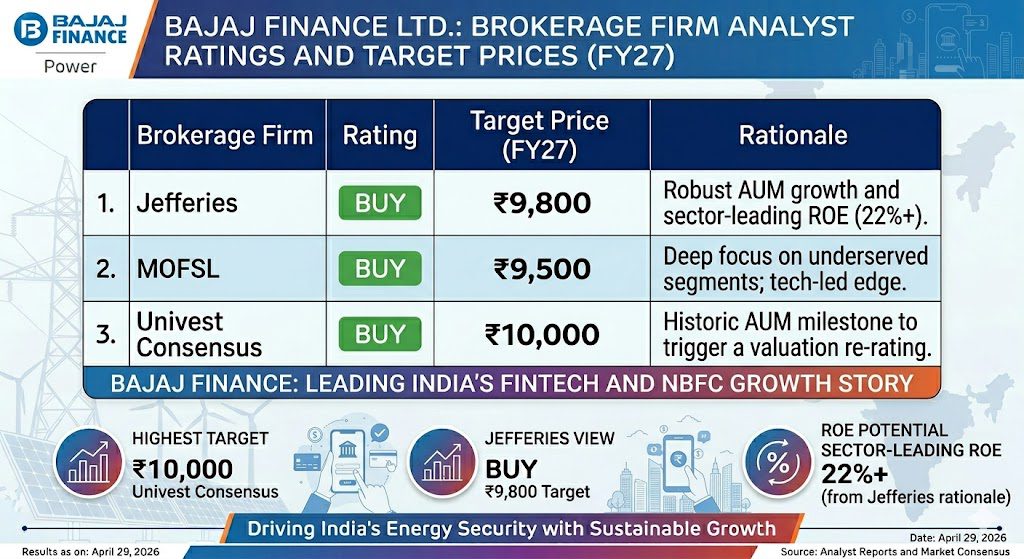
Brokerage firms remain highly optimistic about Bajaj Finance’s future prospects. Jefferies has maintained a “BUY” rating with a target price of ₹9,800, citing strong AUM growth and superior return on equity. Motilal Oswal Financial Services has set a target of ₹9,500, highlighting the company’s technology-driven advantage. The broader market consensus suggests a potential target of ₹10,000, driven by continued growth and possible valuation re-rating.
The “30-Year” Analyst Verdict
For Long-Term Investors
For long-term investors, Bajaj Finance remains one of the most reliable wealth creation stories in India’s financial sector. Its combination of strong growth, high-quality management, and consistent execution makes it a core portfolio holding. The company’s ability to scale without compromising on asset quality is a rare strength that supports long-term confidence.
For Traders
For traders, the stock is currently in a bullish phase, supported by strong technical indicators. The breakout pattern and rising momentum suggest further upside potential. With proper risk management, traders can take advantage of the current trend for short- to medium-term gains.
Conclusion: Entering the Mega-Scale Era
Bajaj Finance has clearly entered a new phase of growth. Crossing the ₹5 lakh crore AUM milestone, delivering 22% profit growth, and maintaining strong asset quality all point toward a company that is operating at peak efficiency. This is not just growth—it is disciplined, scalable, and sustainable growth. As the company continues to expand its ecosystem, it is well-positioned to remain a leader in India’s NBFC sector.
What’s Your View? (CTA)
Do you believe Bajaj Finance can reach the ₹10,000 mark and sustain its leadership, or do you think rising competition could slow it down? Share your thoughts and let’s discuss where this NBFC giant is headed next. 🚀