Introduction: The “Fortress” Quarter
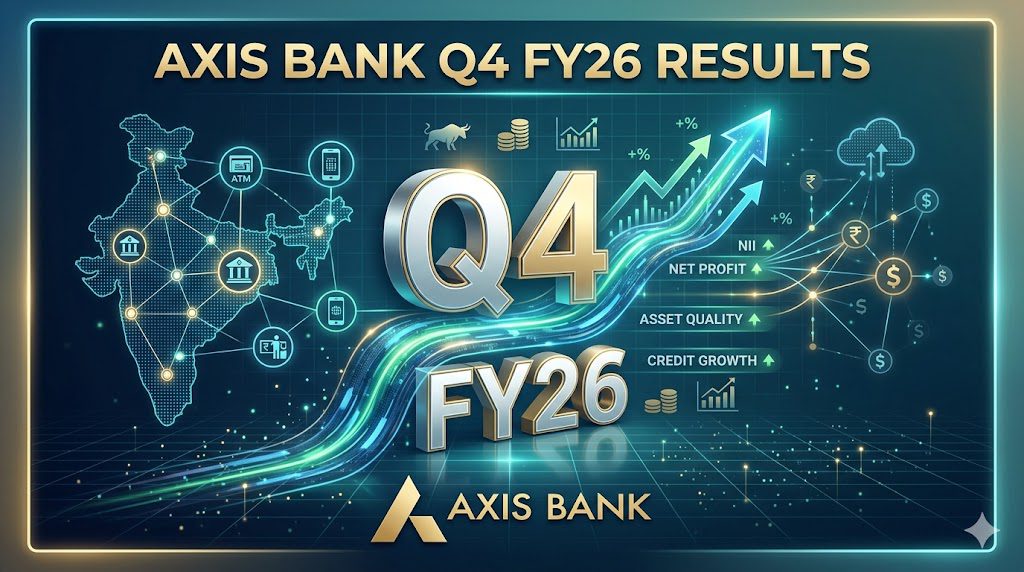
Would you prefer a bank that shows slightly higher profits today, or one that prepares itself for uncertain times ahead? That’s the exact choice Axis Bank made in its Q4 FY26 results. At first glance, the numbers might look underwhelming. The bank reported a net profit of ₹7,071 crore, which is almost flat compared to last year. But the real story lies beneath the surface.
The bank has created a massive ₹2,001 crore contingency buffer—essentially a safety net for potential global risks. This is not a sign of weakness. In fact, it’s a sign of strength. It shows that the management is thinking ahead and prioritizing long-term stability over short-term gains.
In the current market environment, where global uncertainties like geopolitical tensions and trade disruptions are rising, such a move can be seen as a “fortress strategy.” The stock is currently trading around ₹1,110, still about 20% below its 52-week high. This gap suggests that the market may not have fully priced in the strength of this balance sheet yet.
Q4 FY26 Financial Scorecard: Stability Over Flamboyance
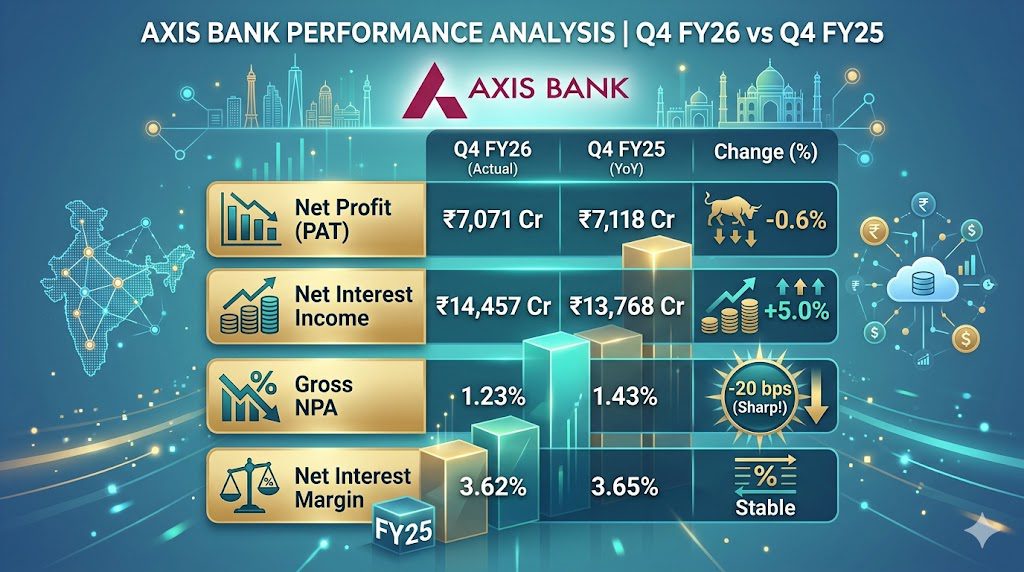
Axis Bank’s financial performance in Q4 FY26 reflects stability rather than aggressive growth. The net profit stood at ₹7,071 crore, slightly lower than ₹7,118 crore last year, marking a marginal decline of 0.6%. However, this dip is largely due to the additional provisioning buffer, not because of any weakness in core operations.
Net Interest Income (NII), which is the backbone of a bank’s earnings, grew by 5% to ₹14,457 crore. This steady growth shows that the bank’s lending business is performing well.
One of the most impressive metrics is asset quality. The Gross NPA ratio improved significantly to 1.23%, down from 1.43% last year. This sharp improvement highlights the bank’s strong risk management practices.
Net Interest Margin (NIM) remained stable at 3.62%, indicating that the bank has managed to maintain profitability despite rising funding costs.
Overall, the financial scorecard shows a bank that is focused on stability, efficiency, and long-term strength.
Fundamental Analysis: The “Citi” Synergy Kicks In
Integration Milestone Driving Growth
The acquisition of Citibank India Consumer Business is now starting to show real results. Axis Bank has successfully integrated this business, and the benefits are becoming visible in its earnings.
One of the key drivers is fee income, which has seen strong growth. This is largely due to the addition of over 15 million premium credit card customers from Citi. These customers typically have higher spending capacity, which boosts fee-based income and improves overall profitability.
Provisioning Strategy: Playing It Safe
The ₹2,001 crore contingency buffer is one of the most talked-about aspects of this quarter. But it’s important to understand that this is a proactive measure.
Global factors such as US trade policies and tensions in West Asia could impact economic activity. Instead of waiting for problems to arise, Axis Bank has chosen to prepare in advance.
This approach reduces future risk and strengthens the balance sheet. In simple terms, the bank is choosing safety today to avoid surprises tomorrow.
Asset Quality: A New Benchmark
Axis Bank’s Gross NPA of 1.23% is among the lowest in its history. This is a significant achievement, especially considering the challenges the banking sector faced in the past decade.
This improvement shows that the bank has successfully cleaned up its loan book and moved away from the bad loan issues that affected it in the mid-2010s.
For investors, this is a strong positive signal.
Technical Analysis: The ₹1,000 Floor
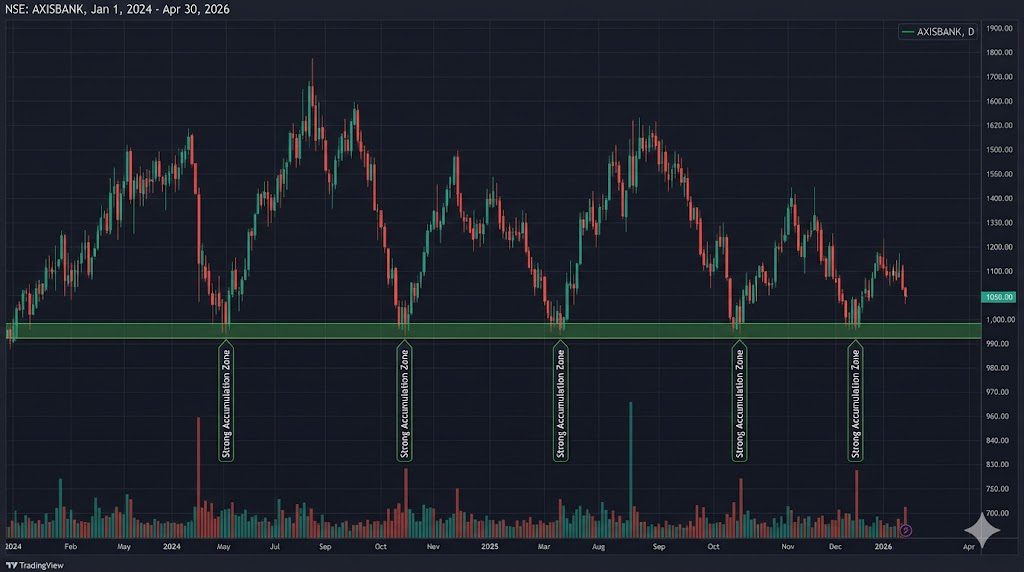
From a technical perspective, Axis Bank’s stock is currently in an accumulation phase. The ₹980–₹1,050 range has emerged as a strong support zone over the past few years.
At the current price of around ₹1,110, the stock is trading near the middle of this range, suggesting limited downside risk.
On the upside, ₹1,180 is a key resistance level, which also aligns with the 50-day EMA. A breakout above this level could trigger a strong rally toward ₹1,340, which is close to its previous highs.
Another important factor is valuation. With a Price-to-Book ratio of around 2.0x and a P/E ratio of 14x, Axis Bank is currently one of the most attractively valued large-cap private banks. This valuation gap often narrows after strong and stable results like this.
Corporate Actions: Rewards & Resilience
Axis Bank has announced a final dividend of ₹1 per share for FY26. While the dividend yield is not very high, it reflects the bank’s consistent approach to rewarding shareholders.
In addition, the board has approved raising up to ₹35,000 crore through debt instruments. This capital will be used to support future growth, especially in retail and corporate lending.
This combination of dividend payouts and capital raising shows a balanced approach—rewarding investors while preparing for expansion.
Brokerage Sentiment & Targets: The Post-Result View
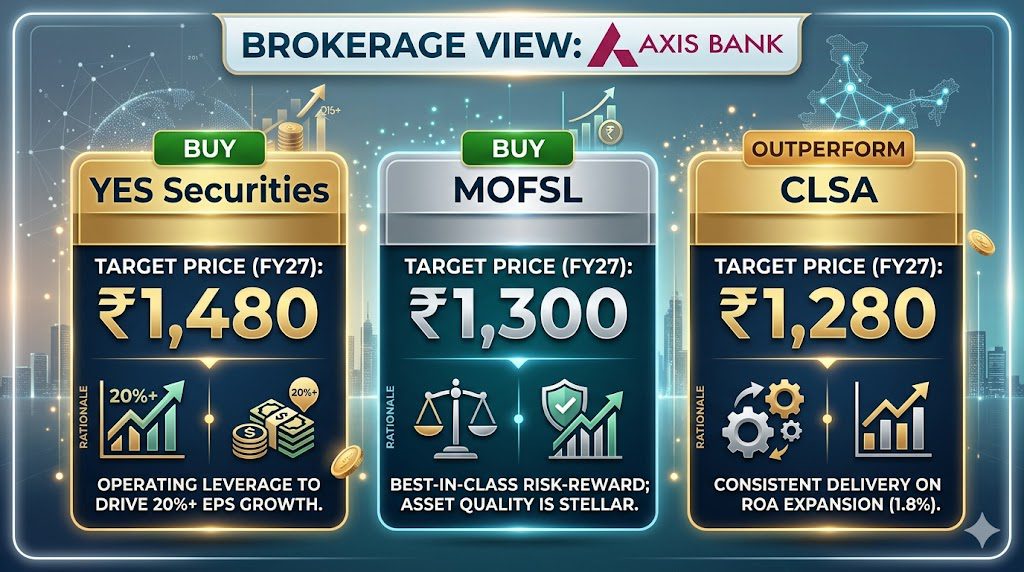
Brokerages remain largely bullish on Axis Bank, highlighting its strong fundamentals and growth potential.
Motilal Oswal Financial Services has given a “BUY” rating with a target price of ₹1,300, citing strong asset quality and attractive valuation.
CLSA has an “Outperform” rating with a target of ₹1,280, focusing on consistent return on assets (RoA) expansion.
Meanwhile, YES Securities has set a higher target of ₹1,480, expecting operating leverage to drive earnings growth.
The consensus view suggests that the stock has a strong upside potential of 15–30% from current levels.
Management Guidance & The Road to FY27
Focus on Resilient Growth
Under the leadership of Amitabh Chaudhry, Axis Bank is focusing on building a resilient and sustainable business.
The bank is targeting a return on equity (ROE) of around 18% by FY27–28, which would place it among the top performers in the sector.
Growth Drivers for the Future
Retail lending is expected to remain the main growth driver, currently accounting for about 55% of the loan book. Within retail, secured products like home loans are likely to see strong demand.
This focus on secured lending reduces risk while ensuring steady growth.
The “30-Year” Analyst Verdict
For Long-Term Investors
For long-term investors, Axis Bank’s Q4 FY26 results represent a management masterclass. By sacrificing short-term profits to build a stronger balance sheet, the bank has positioned itself as one of the safest bets in the sector.
In a volatile global environment, such stability is extremely valuable.
For Traders
For traders, the current price of around ₹1,110 offers an attractive risk-reward setup. The downside appears limited to ₹980, while the upside could extend to ₹1,300 or higher.
This makes it an interesting opportunity for short- to medium-term trades.
Conclusion: Strength Over Speed
Axis Bank’s Q4 FY26 results remind us that in banking, strength matters more than speed.
While profit growth may have slowed temporarily, the bank has significantly improved its balance sheet, asset quality, and risk management.
In the long run, these factors are far more important than short-term earnings fluctuations.
What’s Your View? (CTA)
Are you buying Axis Bank for its ₹1,480 target, or do you prefer other private banks for stability?
Share your thoughts and let’s discuss your investment strategy for FY27.