When investors think about long-term wealth creators in the Indian stock market, a few names immediately come to mind. Among them, Asian Paints has consistently occupied a special place. For decades, the company has been viewed as a proxy for India’s housing, renovation, and consumption growth story. Whether it is a new home being built in a metropolitan city or a repainting project in a small town, chances are high that an Asian Paints product is involved somewhere in the process.
That is why the company’s Q4 FY26 results have generated significant excitement among investors.
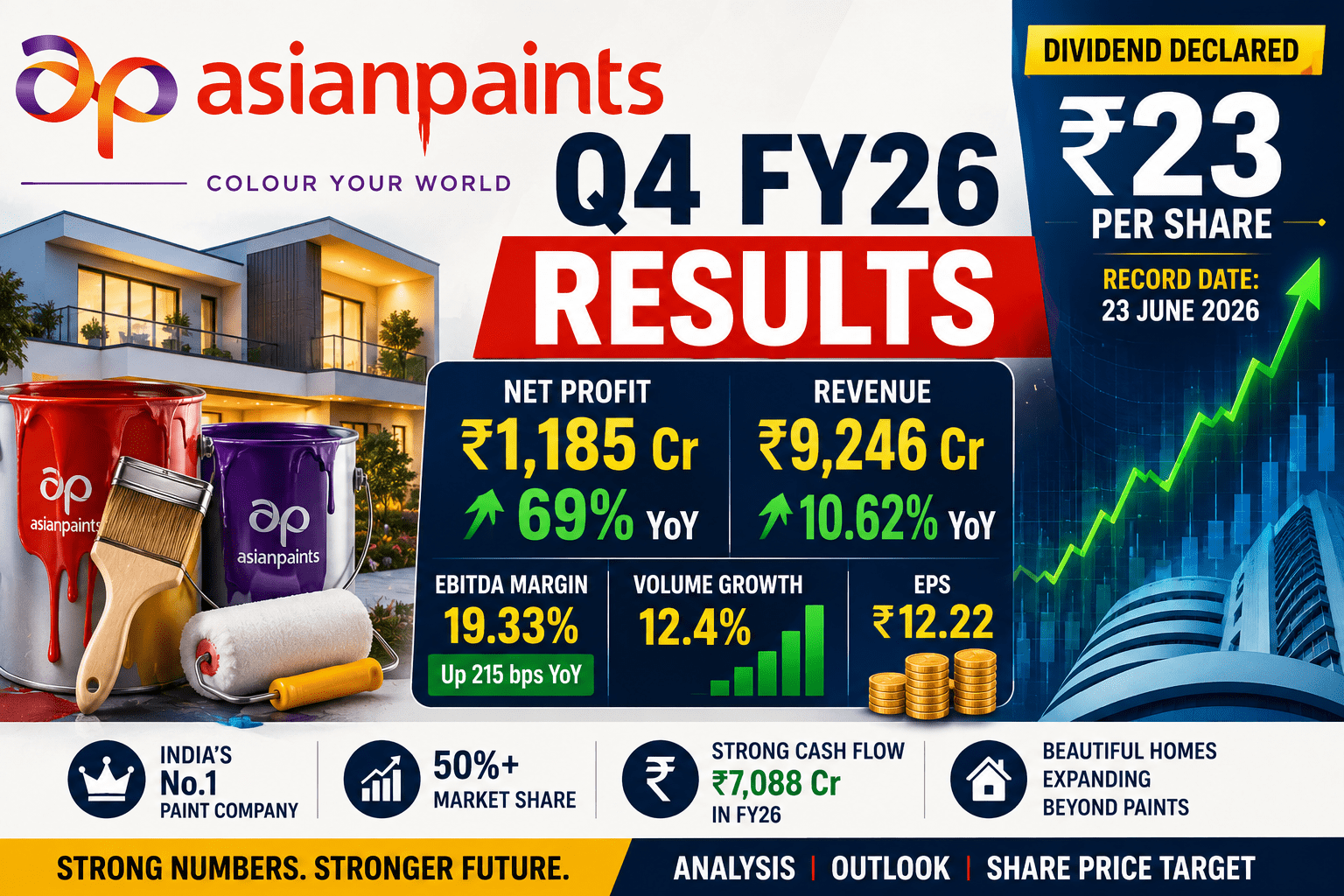
Despite facing multiple challenges, including volatile crude oil prices, supply chain disruptions, and uncertainties arising from the ongoing West Asia conflict, Asian Paints delivered one of its strongest quarterly performances in recent years. The company reported a remarkable 69% jump in net profit, exceeded analyst expectations across major financial metrics, announced a generous dividend payout, and demonstrated once again why it remains the undisputed leader of India’s decorative paints industry.
For investors, traders, and market observers, the latest earnings report provides important clues about the company’s future growth trajectory. Let’s break down the numbers and understand what they mean for shareholders.
Asian Paints Q4 FY26 Financial Performance: A Strong Beat Across the Board
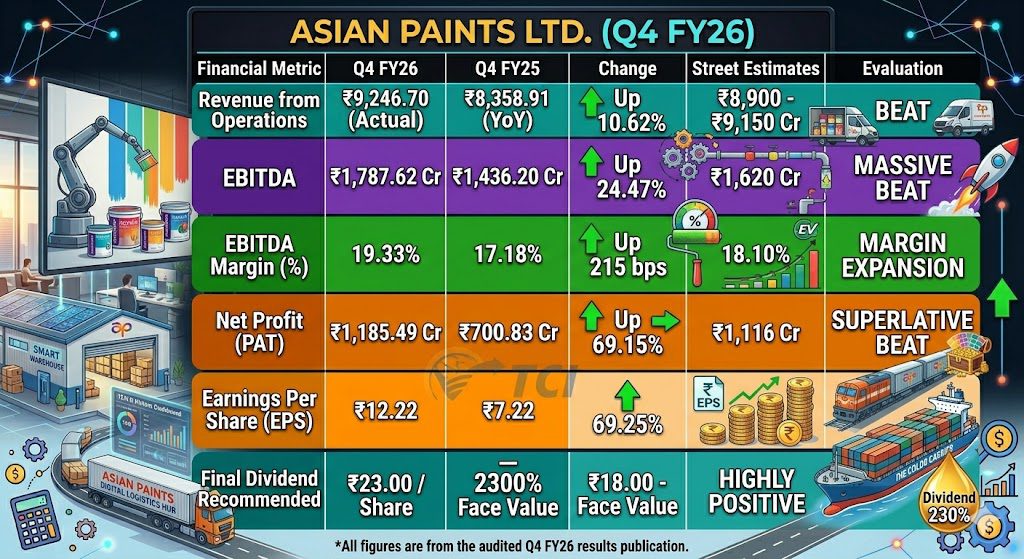
Asian Paints reported revenue from operations of ₹9,246.70 crore during Q4 FY26 compared to ₹8,358.91 crore during the same quarter last year. This represents healthy year-on-year growth of approximately 10.62%, comfortably exceeding most analyst estimates. Revenue growth remained broad-based and was supported by strong decorative paint demand, premium product sales, and continued expansion across multiple business segments.
Operational profitability was even more impressive. EBITDA increased to ₹1,787.62 crore compared to ₹1,436.20 crore during Q4 FY25, representing growth of approximately 24.47%. More importantly, EBITDA margins expanded significantly from 17.18% to 19.33%, reflecting margin expansion of 215 basis points.
The biggest surprise came from the bottom line. Net profit surged to ₹1,185.49 crore compared to ₹700.83 crore during the previous year. This extraordinary increase of 69.15% comfortably surpassed analyst expectations and demonstrated the company’s ability to convert revenue growth into substantial earnings expansion. Earnings per share also rose sharply to ₹12.22 from ₹7.22 during the same quarter last year.
To reward shareholders, the board recommended a final dividend of ₹23 per equity share. Combined with the interim dividend of ₹4.50 already paid during FY26, total dividend payout for the year reaches ₹27.50 per share, maintaining the company’s reputation as one of India’s most shareholder-friendly businesses.
Company Profile: Why Asian Paints Remains India’s Consumption Champion
Asian Paints is far more than a paint manufacturer. Over several decades, the company has built one of the strongest consumer brands in India while creating an unmatched distribution network that spans urban, semi-urban, and rural markets.
Today, Asian Paints controls more than half of India’s organized decorative paint market, making it one of the most dominant businesses in any consumer category. Its leadership is not simply the result of brand recognition but rather a combination of manufacturing scale, dealer relationships, supply chain excellence, and continuous innovation.
Over the last few years, management has also transformed the company from a paint manufacturer into a broader home décor and home improvement platform. Through its Beautiful Homes ecosystem, the company now offers modular kitchens, bath fittings, premium lighting solutions through White Teak, waterproofing products, and uPVC windows via Weatherseal.
This diversification strategy allows Asian Paints to deepen customer relationships and increase revenue generated from every home improvement project.
What Drove the Massive 69% Profit Growth?
The headline number that captured investor attention was undoubtedly the 69% increase in net profit. However, understanding the drivers behind this growth is essential for evaluating future sustainability.
The first major contributor was volume growth. The domestic decorative business recorded volume growth of approximately 12.4%, indicating strong demand recovery across multiple regions. This is particularly important because volume growth reflects genuine consumer demand rather than price increases alone.
The company also reported value growth of approximately 10.2% within its decorative segment. Demand remained healthy in both repainting and new construction categories, while premium products continued gaining market share.
Premiumization has become one of Asian Paints’ most important growth engines. Consumers are increasingly shifting toward higher-quality paints, textures, waterproofing solutions, and specialty coatings. Management indicated that recently launched products contributed nearly 17% of overall revenues during the quarter, highlighting the success of its innovation strategy.
The Margin Expansion Story: The Real Earnings Hero
While revenue growth was impressive, the true highlight of the quarter was margin expansion.
Paint manufacturing remains heavily dependent on crude oil derivatives, petrochemical inputs, titanium dioxide, and various imported raw materials. Consequently, the industry is highly sensitive to commodity price fluctuations.
Despite these challenges, Asian Paints expanded EBITDA margins by 215 basis points, reaching 19.33%.
This achievement reflects exceptional execution across procurement, logistics, manufacturing, and inventory management. The company successfully mitigated raw material inflation through strategic sourcing, operational efficiency improvements, and better product mix management.
Higher-margin premium products also contributed positively. As consumers increasingly choose premium paint categories, the company’s profitability improves even if overall industry growth remains moderate.
For investors, margin expansion often matters more than revenue growth because it directly impacts earnings and cash flow generation.
Dividend Bonanza: A Reward for Shareholders
One of the most attractive aspects of Asian Paints as an investment has always been its consistent dividend policy.
For FY26, the company announced a final dividend of ₹23 per share. Combined with the interim dividend of ₹4.50 paid earlier, shareholders will receive a total dividend of ₹27.50 per share for the financial year.
The record date for the final dividend has been fixed as June 23, 2026, while eligible shareholders are expected to receive payments on or after July 13, 2026.
The dividend payout reflects management’s confidence in the company’s future cash generation capabilities. Even after rewarding shareholders generously, Asian Paints retains ample resources for expansion and strategic investments.
Cash Flow Strength: The Hidden Power Behind the Business
While investors often focus on revenue and profit figures, cash flow remains one of the most important indicators of business quality.
Asian Paints reported operating cash flow of ₹7,088.18 crore during FY26 compared to ₹4,423.96 crore during FY25. This represents extraordinary growth of more than 60%.
Strong cash flow provides multiple advantages.
First, it allows the company to fund capacity expansion without relying heavily on external debt.
Second, it strengthens balance-sheet flexibility during uncertain economic periods.
Third, it supports dividend payments and future acquisitions.
Many companies can report accounting profits, but relatively few generate cash flow at the scale Asian Paints consistently delivers.
Valuation Analysis: Is the Stock Still Expensive?
One concern frequently raised by investors involves valuation.
Historically, Asian Paints has traded at premium valuation multiples compared to most Indian companies. Investors have been willing to pay this premium because of the company’s exceptional track record, market leadership, and predictable earnings growth.
Over the past year, concerns regarding rising competition and crude oil prices led to valuation compression. The stock’s Price-to-Earnings ratio declined from nearly 85x to around 60x.
Although 60x earnings remains expensive compared to the broader market, it appears more reasonable when viewed in the context of Asian Paints’ dominant market position, strong cash flow generation, and consistent profit growth.
For long-term investors, quality businesses often deserve premium valuations.
Technical Analysis: Important Price Levels for Traders
Following the earnings announcement, Asian Paints closed near ₹2,701.30, gaining approximately 1.10%.
Technical charts currently display a rounding-bottom formation, which many analysts consider a bullish reversal pattern. Institutional buying activity has also increased over the past month, indicating improving market sentiment.
The most important short-term pivot level currently stands at ₹2,724.
A decisive breakout above this level could trigger additional buying momentum toward ₹2,745 and eventually ₹2,810.
On the downside, immediate support exists near ₹2,660. Stronger support levels remain visible near ₹2,612 and ₹2,500.
The Relative Strength Index (RSI) has started moving higher and is currently exiting neutral territory. If momentum continues strengthening, traders could witness further upside during the coming weeks.
Management Outlook: Navigating Competition and Global Uncertainty
Managing Director and CEO Amit Syngle maintained a balanced outlook regarding future growth.
Management acknowledged that geopolitical tensions in West Asia remain a risk because disruptions in shipping routes and petrochemical supply chains could influence raw material costs.
However, the company remains confident in its ability to manage these challenges through scale advantages, diversified sourcing networks, and operational flexibility.
The company also highlighted strong performance across industrial coatings, automotive coatings, and protective coatings segments. Automotive coatings grew more than 15%, while protective coatings expanded approximately 20.9%, demonstrating that growth is not limited solely to decorative paints.
Brokerage Targets and Institutional View
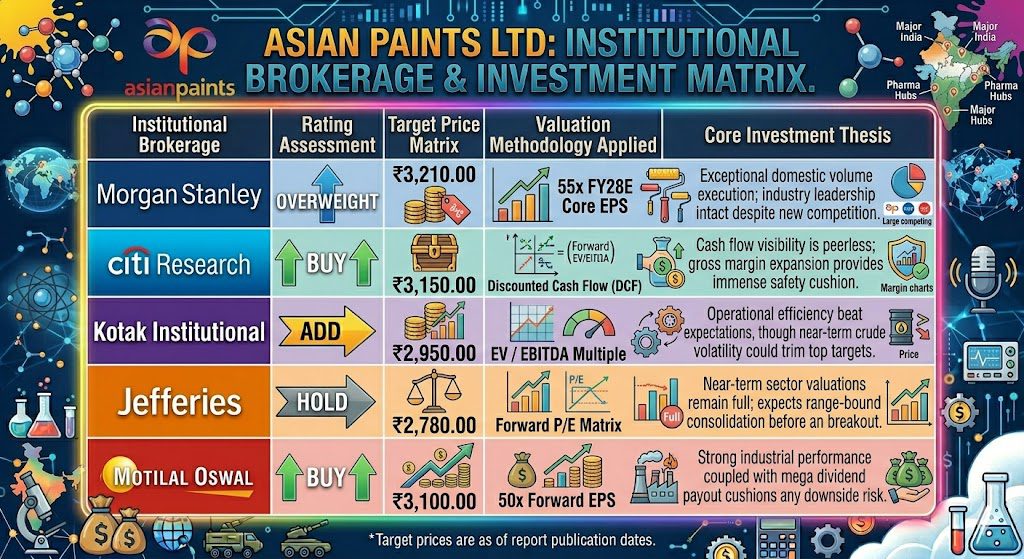
Several major brokerages revised their outlooks following the earnings announcement.
Morgan Stanley maintained an Overweight rating with a target price of ₹3,210. Citi Research reiterated its Buy rating with a target near ₹3,150. Motilal Oswal also retained a Buy recommendation and projected a target price of ₹3,100. Kotak Institutional maintained an Add rating with a target of ₹2,950, while Jefferies adopted a more cautious Hold stance with a target near ₹2,780.
The consensus target price across major brokerages stands near ₹3,038, suggesting meaningful upside potential from current levels.
Final Verdict: Buy, Hold, or Sell?
Asian Paints has once again demonstrated why it remains one of India’s highest-quality businesses.
The latest results decisively counter the argument that increased competition would severely damage profitability. Instead, the company delivered double-digit volume growth, significant margin expansion, record profits, and exceptional cash flow generation.
For long-term investors, Asian Paints continues to represent a classic compounder. Its dominant market position, strong brand equity, expanding home décor ecosystem, and consistent cash flow generation make it one of the most attractive consumption plays in India.
For short-term traders, the key level remains ₹2,724. A breakout above this resistance zone could trigger fresh momentum toward higher targets.
Overall, Q4 FY26 was not merely a good quarter for Asian Paints—it was a powerful reminder that quality businesses often emerge stronger from periods of uncertainty. With strong execution, expanding margins, generous dividends, and improving growth visibility, Asian Paints remains firmly positioned as India’s paint king and one of the stock market’s most reliable long-term wealth creators.