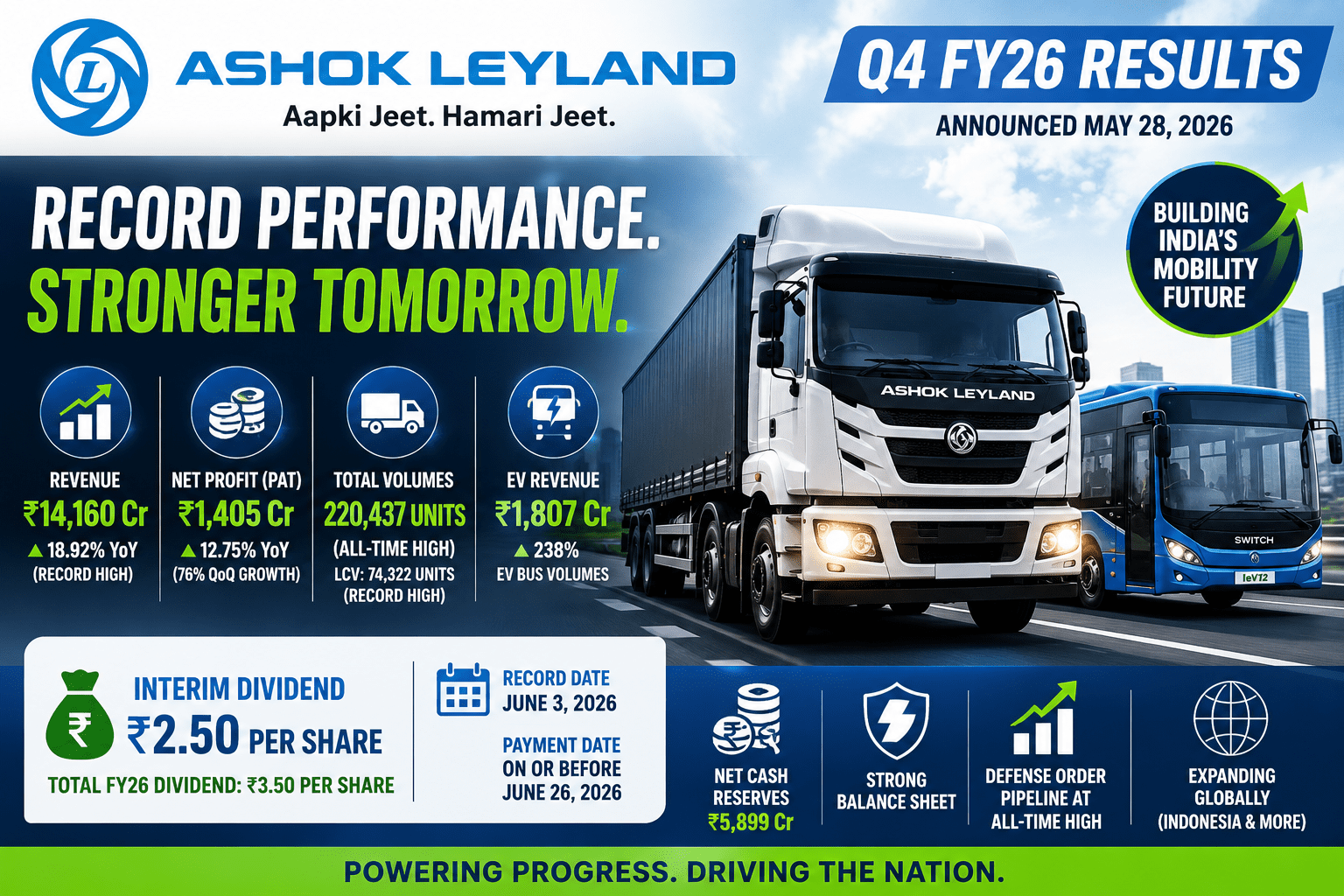
Ashok Leyland Limited announced its Q4 FY26 earnings on May 28, 2026, and the numbers clearly confirmed that India’s commercial vehicle sector is once again entering a powerful expansion phase. The Hinduja Group flagship delivered record quarterly revenue, strong double-digit profit growth, healthy operating margins, rising cash reserves, and rapid electric vehicle expansion through its EV arm Switch Mobility. For investors, the latest results were not just another quarterly update — they reflected the growing strength of India’s infrastructure, logistics, freight movement, and industrial economy.
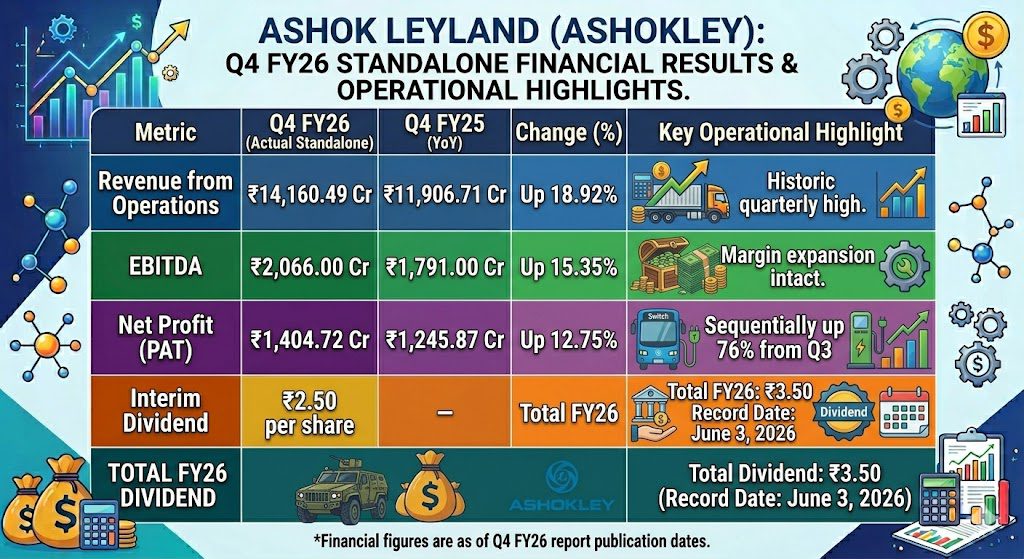
The company reported standalone revenue from operations of ₹14,160.49 crore during Q4 FY26 compared to ₹11,906.71 crore during the same quarter last year, reflecting exceptional year-on-year growth of approximately 18.92%. This became the highest quarterly revenue ever reported by the company and highlighted the sharp recovery in commercial vehicle demand across medium and heavy commercial vehicles (M&HCVs), buses, and logistics transportation systems. The strong revenue growth also suggests that infrastructure activity, industrial transportation, mining operations, and freight movement across India remain highly active despite global macroeconomic uncertainty.
Operational performance remained equally impressive. EBITDA increased to ₹2,066 crore compared to ₹1,791 crore during Q4 FY25, representing healthy growth of approximately 15.35%. Despite broader auto-sector raw material pressures and inflationary cost environments, the company successfully maintained strong operating discipline and preserved healthy profitability margins. This operational efficiency continues strengthening investor confidence regarding the management’s execution capability.
Net profit after tax surged to ₹1,404.72 crore compared to ₹1,245.87 crore during Q4 FY25, reflecting strong year-on-year growth of approximately 12.75%. However, one of the most important details inside the results was the sharp sequential profit jump. During Q3 FY26, the company had reported PAT of nearly ₹796 crore, meaning Q4 profits surged approximately 76% sequentially. This dramatic improvement reflects stronger year-end demand, improved fleet utilization, higher operational efficiency, and accelerated commercial vehicle order execution during the quarter.
One of the biggest operational achievements during FY26 was the company’s record vehicle volume performance. Annual volumes touched an all-time high of 220,437 units, surpassing even the previous peak recorded during FY19. This milestone is extremely important because it confirms that India’s commercial vehicle industry has fully recovered from earlier economic disruptions and supply-chain pressures. The Light Commercial Vehicle (LCV) segment also achieved record annual volumes of 74,322 units, supported by rising e-commerce logistics activity, last-mile transportation demand, and expanding urban distribution networks.
Another major positive for shareholders was the dividend announcement. The board declared a second interim dividend of ₹2.50 per equity share, taking the total FY26 dividend payout to ₹3.50 per share. The company confirmed June 3, 2026, as the record date, while dividend payments are expected to be completed on or before June 26, 2026. Management also clarified that no additional final dividend will be announced for FY26 beyond the current interim distributions.
From a broader industry perspective, Ashok Leyland Limited continues remaining one of India’s strongest listed plays on infrastructure growth and freight expansion. The company holds a dominant market position in the Medium and Heavy Commercial Vehicle (M&HCV) segment, especially across buses and heavy-duty trucks. Whenever infrastructure investment rises, industrial freight movement accelerates, or logistics demand expands, commercial vehicle companies like Ashok Leyland generally become direct beneficiaries. This is one of the key reasons institutional investors closely monitor the sector as an economic growth indicator.
From a balance-sheet perspective, the company delivered another major positive surprise. Net cash reserves expanded sharply to ₹5,899 crore by the end of FY26 compared to ₹4,242 crore during the previous year. This strong cash position significantly improves the company’s financial flexibility and gives management the ability to aggressively invest in electric mobility, manufacturing capacity expansion, global market penetration, and future research & development initiatives. Strong cash generation also reduces financial risk and improves long-term shareholder confidence.
One of the most exciting long-term developments for the company is the rapid scaling of its electric vehicle subsidiary, Switch Mobility. During FY26, EV revenues more than doubled to ₹1,807 crore, while electric bus volumes surged approximately 238%. This growth remains strategically important because India’s electric commercial vehicle ecosystem is still at a very early stage. As government-backed urban transport electrification programs expand across Indian cities, Switch Mobility could gradually emerge as one of the company’s most important long-term growth engines. Rising adoption of electric buses by state transport corporations and smart-city mobility projects could create a major structural opportunity over the coming decade.
Importantly, the company also absorbed a one-time charge of approximately ₹308 crore linked to upcoming labor code implementation changes. This means the company’s underlying operational profitability is actually stronger than what the headline earnings numbers initially suggest.
Management commentary during the earnings release also remained highly optimistic. Chairman Dheeraj Hinduja and Managing Director Shenu Agarwal highlighted that the company’s defense order pipeline currently remains at an all-time high. India’s increasing focus on domestic defense manufacturing and military mobility modernization could eventually become another powerful revenue driver for Ashok Leyland. The company is also expanding internationally into markets like Indonesia in order to diversify geographical exposure and reduce dependence on domestic cyclicality.
Management further emphasized that premiumization strategies, better pricing discipline, operational scale advantages, and input cost management helped the company maintain FY26 EBITDA margins near 13%, despite broader industry volatility. This demonstrates improving business quality and stronger operational resilience.
From a technical analysis perspective, the stock currently trades within the ₹215–₹227 zone and remains positioned near a critical breakout region.
The most important short-term technical pivot currently stands near ₹232.
y=232y=232
A decisive breakout above this level could potentially trigger strong bullish momentum and short-covering activity toward higher resistance levels. Immediate resistance zones currently remain near ₹232, ₹246, and ₹250 respectively, while important support levels remain visible near ₹215, ₹197, and ₹175.
Short-term traders are likely to monitor whether the stock can sustain momentum above ₹232 after the earnings announcement. A successful breakout could significantly improve near-term market sentiment across the commercial vehicle sector.
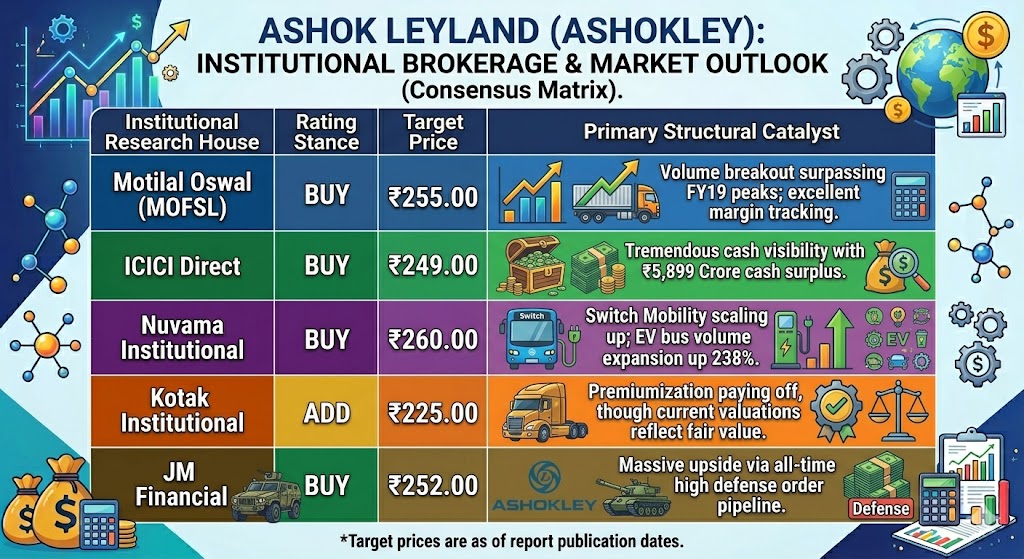
Institutional brokerages continue maintaining positive long-term outlooks on the company. Motilal Oswal maintained a BUY rating with a target price near ₹255 because of record volume growth and stable margins. ICICI Direct assigned a BUY rating with a target near ₹249 due to strong cash reserves and healthy profitability trends. Nuvama Institutional projected one of the highest targets near ₹260 because of rapid EV scaling and Switch Mobility growth. JM Financial also maintained a BUY rating near ₹252 because of the expanding defense business pipeline, while Kotak Institutional retained an ADD rating near ₹225.
Overall, the Q4 FY26 earnings report from Ashok Leyland Limited reflected one of the strongest operational performances within India’s commercial vehicle sector in recent years. Record revenue, strong profit growth, rising cash reserves, EV expansion, robust freight demand, and improving operational execution all continue strengthening the long-term investment thesis. As India’s infrastructure, logistics, industrial manufacturing, and transportation ecosystem continue expanding, Ashok Leyland remains strongly positioned as one of the biggest structural beneficiaries of the country’s long-term economic growth cycle.