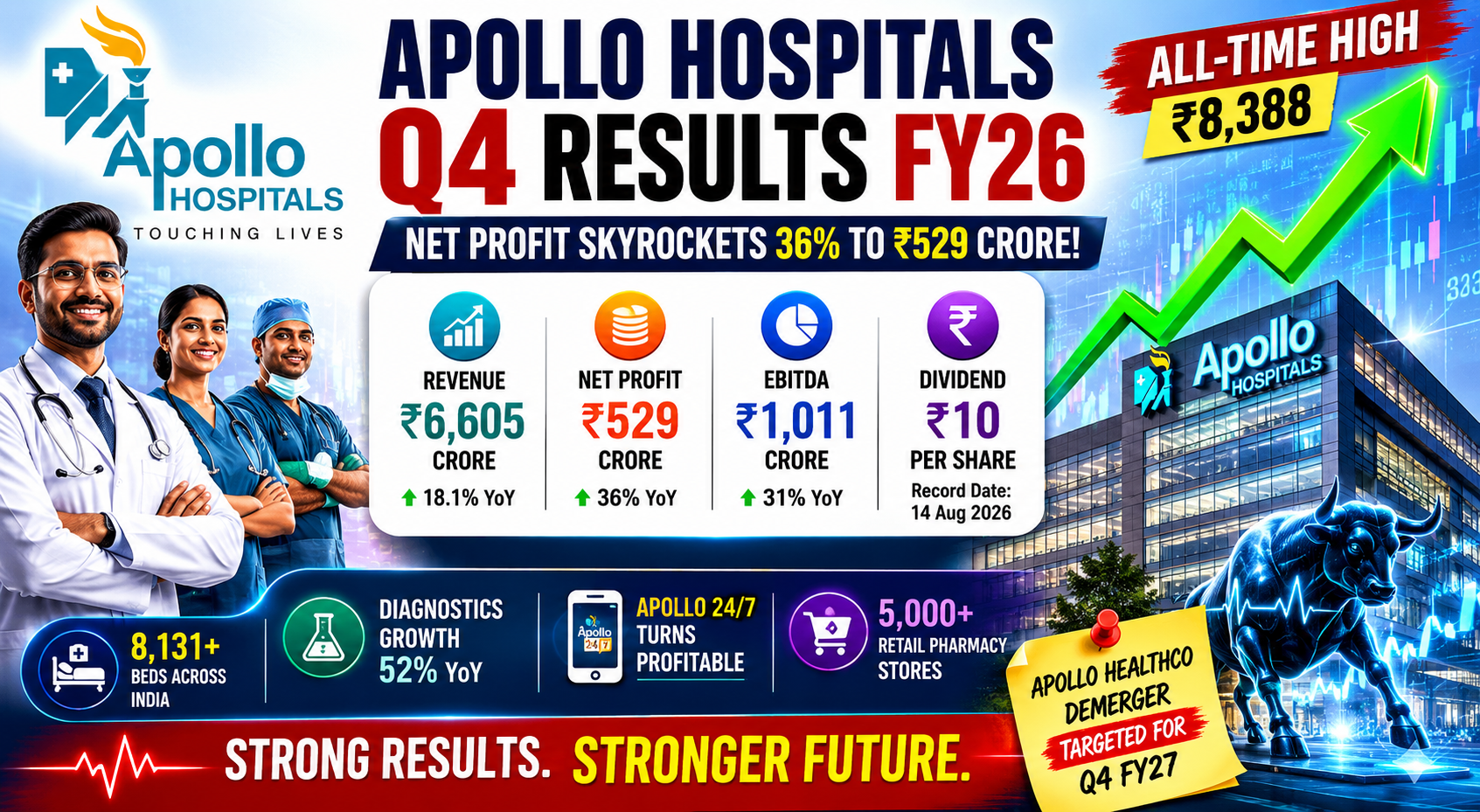
If you’ve been holding shares of Apollo Hospitals Enterprise Limited, your portfolio likely witnessed one of its strongest sessions of the year. After the company announced its Q4 FY26 earnings on May 20, 2026, investors rushed aggressively into the stock the very next morning. Apollo Hospitals shares surged nearly 9.6% intraday and touched a fresh all-time high near ₹8,388 before stabilizing around ₹8,351.50. The market reaction was not driven by hype alone. The company delivered one of the strongest healthcare earnings performances seen in India this quarter, with powerful revenue growth, sharp margin expansion, accelerating diagnostics demand, and a major turnaround in its digital-health ecosystem.
The latest quarterly results clearly show that Apollo Hospitals is no longer just India’s largest private hospital chain. The business has evolved into a fully integrated healthcare ecosystem that combines premium hospitals, diagnostics, retail pharmacies, digital healthcare delivery, preventive care, and technology-enabled healthcare infrastructure under one umbrella. This integrated business model is now creating strong operating leverage across multiple segments simultaneously, which is exactly why institutional investors turned aggressively bullish after the earnings announcement.
Apollo Hospitals Q4 FY26 Financial Performance Snapshot
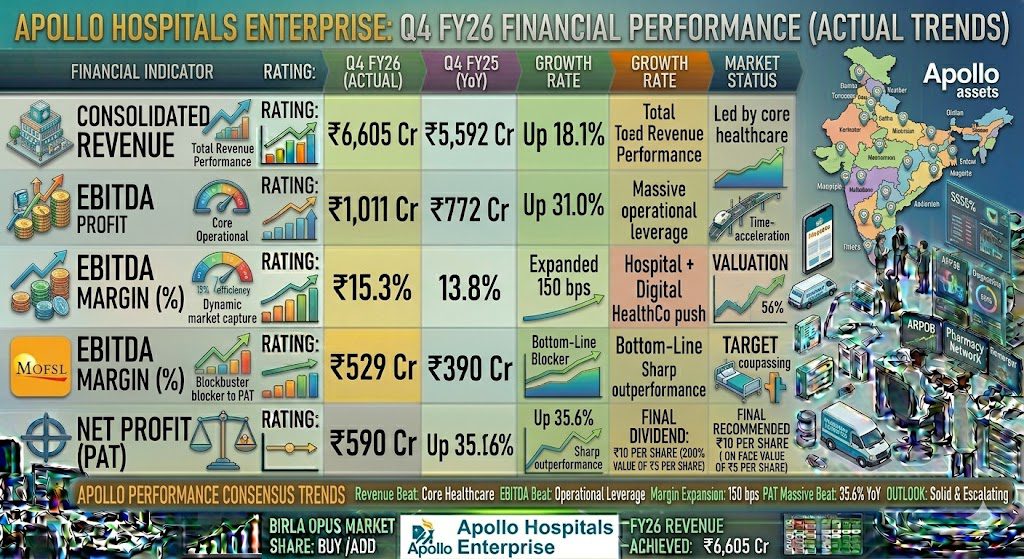
Apollo Hospitals Enterprise Limited reported consolidated revenue of ₹6,605 crore during Q4 FY26 compared to ₹5,592 crore in the corresponding quarter last year, reflecting strong year-on-year growth of 18.1%. The revenue performance comfortably exceeded most analyst estimates and highlighted robust growth across healthcare services, diagnostics, and digital pharmacy operations.
EBITDA increased sharply to ₹1,011 crore compared to ₹772 crore during Q4 FY25, registering exceptional growth of 31%. EBITDA margins expanded significantly to 15.3% from 13.8% last year, reflecting strong operating leverage across the healthcare ecosystem.
The most important headline number came from profitability. Net profit after tax surged sharply to ₹529 crore compared to ₹390 crore during Q4 FY25, reflecting explosive growth of 35.6%. The earnings performance comfortably beat Street expectations and immediately triggered fresh institutional buying in the stock.
The Board of Directors also recommended a final dividend of ₹10 per equity share for FY26, representing 200% of face value based on the company’s ₹5 face-value structure.
The broader financial performance clearly indicated that Apollo Hospitals is now entering a stronger profitability cycle where revenue growth, margin expansion, and digital-health monetization are all improving simultaneously.
Company Introduction: The Structural Moat of Apollo Hospitals
Apollo Hospitals Is Far More Than a Hospital Business
Apollo Hospitals Enterprise Limited occupies a unique position inside India’s healthcare industry because it operates one of the country’s most deeply integrated healthcare ecosystems. Founded by renowned cardiologist Dr. Prathap C. Reddy, the company currently operates more than 8,131 beds across India and maintains leadership positions across tertiary healthcare, oncology, organ transplants, robotic surgeries, diagnostics, pharmacies, and digital-health delivery.
Unlike standalone hospital operators, Apollo benefits from multiple interconnected business engines that feed customers into one another. Its core hospital business focuses on high-value tertiary care procedures such as cardiac surgeries, oncology treatment, robotic surgery, and organ transplants. Apollo Health & Lifestyle operates diagnostics chains, preventive healthcare systems, dental clinics, and specialty-care centers. Meanwhile, Apollo HealthCo combines the Apollo 24/7 digital-health platform with a nationwide retail pharmacy network consisting of more than 5,000 stores.
This integrated ecosystem creates a powerful competitive moat because it improves customer retention, increases recurring revenue opportunities, and strengthens long-term profitability across the entire healthcare value chain.
Q4 FY26 Earnings Analysis: Why Profitability Exploded
Operating Leverage Became the Biggest Growth Driver
The single biggest reason Apollo Hospitals delivered such explosive profit growth during Q4 FY26 was operating leverage. Revenue increased by approximately 18%, but EBITDA surged 31% while net profit jumped nearly 36%. This gap is strategically important because it shows the company’s existing infrastructure is now generating significantly higher profitability as occupancy levels and patient throughput continue rising.
Healthcare businesses usually become substantially more profitable once bed occupancy, diagnostics volumes, surgical throughput, and pharmacy sales cross certain operational thresholds. Apollo now appears to have entered exactly that phase.
Core Hospital Business Continued Delivering Strong Growth
Apollo’s hospital segment remained the company’s primary profit engine during the quarter. Hospital revenue increased approximately 16% year-on-year to ₹3,268 crore. Operating margins within the hospital business remained extremely healthy at 23.9%.
Bed occupancy improved further to 68%, reflecting rising patient inflows and stronger procedural intensity across key facilities. Management highlighted especially strong growth in high-value specialties such as robotic surgeries, oncology treatment, cardiac procedures, lung transplants, and organ transplants.
This is extremely important because advanced specialty procedures generate significantly higher profitability compared to routine healthcare services. The company’s Average Revenue Per Occupied Bed also continued rising steadily, indicating stronger pricing power and improving premium healthcare positioning.
Diagnostics Business Delivered Exceptional Momentum
Apollo’s diagnostics ecosystem delivered one of the strongest growth performances within India’s healthcare sector this quarter. Under the Apollo Health & Lifestyle structure, diagnostics revenue surged approximately 52% year-on-year.
This explosive growth strongly indicates that Apollo is rapidly capturing organized market share from standalone diagnostics competitors. Diagnostics businesses are strategically valuable because they generate stable recurring cash flows while simultaneously acting as feeder channels for higher-margin hospital procedures.
The rapid growth within diagnostics therefore strengthens both revenue visibility and long-term profitability quality.
Apollo HealthCo Became the Biggest Structural Surprise
The biggest long-term surprise within the earnings report came from Apollo HealthCo. Revenue from the pharmacy-plus-digital-health ecosystem increased approximately 20% year-on-year to ₹2,848 crore.
More importantly, the digital-health business sharply reduced cash burn and reported a positive PAT of ₹107 crore compared to near break-even levels last year.
This turnaround is critically important because investors had long questioned whether Apollo’s aggressive digital-health investments could eventually become sustainably profitable. The latest numbers strongly suggest that Apollo 24/7 and the pharmacy ecosystem are now approaching operational scale advantages.
This development could become one of the company’s largest future valuation catalysts.
Dividend Announcement & Shareholder Rewards
Apollo Hospitals Declared ₹10 Final Dividend
The Board of Apollo Hospitals Enterprise Limited recommended a final dividend of ₹10 per equity share for FY26.
The official record date has been fixed for Friday, August 14, 2026. Subject to shareholder approval during the upcoming Annual General Meeting scheduled for August 25, 2026, dividend payments are expected to reach shareholder bank accounts on or before September 10, 2026.
The dividend declaration reinforced management’s confidence regarding future earnings visibility and long-term cash-flow sustainability.
Fundamental Analysis: Why Apollo Commands Premium Valuation
Apollo Hospitals Is a Structural Scarcity Asset
At current market prices near ₹8,351, Apollo Hospitals Enterprise Limited commands a market capitalization of approximately ₹1.19 lakh crore. The stock currently trades near a trailing Price-to-Earnings multiple of roughly 66.5x.
Although this valuation initially appears expensive compared to traditional businesses, premium healthcare infrastructure remains a structural scarcity asset in India.
The country continues facing low hospital-bed penetration, rising healthcare spending, increasing insurance adoption, aging demographics, growing lifestyle diseases, and rapidly expanding premium healthcare demand.
This creates a powerful long-duration secular growth opportunity for organized healthcare leaders like Apollo Hospitals.
Institutional Ownership Remains Extremely Strong
Another major positive for Apollo Hospitals is the quality of its shareholder base. Promoters continue holding approximately 29.3% stake in the company.
Foreign Institutional Investors hold nearly 30.6%, while Domestic Institutional Investors also maintain substantial ownership positions.
This strong institutional participation reflects long-term confidence around Apollo’s integrated healthcare ecosystem and future digital-health monetization opportunities.
Full-Year FY26 Earnings Reinforced Long-Term Growth Visibility
For the full FY26 fiscal year, Apollo Hospitals reported net profit growth of approximately 34% to ₹1,942 crore.
The earnings trajectory is now gradually catching up with the stock’s premium valuation multiple. As operating leverage improves further across hospitals, diagnostics, and digital-health businesses, long-term profitability could continue compounding steadily.
Technical Analysis: Trading Map for Apollo Hospitals Share Price
Stock Has Entered Blue-Sky Breakout Territory
Following the earnings announcement, Apollo Hospitals shares rallied nearly 9.66% in a single trading session and closed near ₹8,351.50.
Technically, the stock has now completely cleared its previous resistance zones and entered what traders call a “blue-sky breakout” structure. This means there are no major historical resistance levels directly overhead.
₹8,388 Remains the Key Immediate Resistance Zone
The fresh lifetime high near ₹8,388 remains the most important short-term resistance level.
If the stock decisively sustains above this region during upcoming trading sessions, momentum traders may quickly target the psychological ₹8,500 zone.
Institutional buying activity often accelerates sharply once large-cap stocks enter clean breakout territory.
₹8,080 Becomes the Most Important Support Floor
If short-term profit booking emerges after the sharp rally, the previous breakout zone near ₹8,080 will likely act as a strong support floor.
This level also aligns closely with the stock’s 20-day EMA structure.
For swing traders, any healthy retracement toward the ₹8,150–₹8,200 zone may create fresh buying opportunities.
A disciplined stop-loss below ₹7,980 remains important to manage downside risk.
Forward Guidance & The Next Big Growth Catalyst
Apollo Plans Aggressive Bed Expansion
Group CFO Krishnan Akhileswaran confirmed that Apollo Hospitals plans to add another 1,500 operational beds over the next 12–18 months.
The expansion will focus primarily on core metro regions including Hyderabad and Sonarpur in Kolkata.
Once completed, Apollo’s total operational capacity is expected to cross the important 10,000-bed milestone.
This expansion will significantly strengthen long-term revenue-generation capability.
Apollo 24/7 Demerger Could Become Transformational
The biggest long-term catalyst discussed during the earnings interaction came from Chairman Dr. Prathap C. Reddy.
Management confirmed that the structural demerger and potential public listing of the pharmacy-plus-digital-health business remains targeted for Q4 FY27.
This upcoming value-unlocking event could become transformational for Apollo Hospitals shareholders because digital-health businesses generally command significantly higher valuation multiples compared to traditional hospital operators.
If Apollo HealthCo receives standalone technology-platform valuations after listing, it could substantially increase the group’s overall market value.
Apollo HealthCo Revenue Ambitions Remain Aggressive
Management additionally guided that Apollo HealthCo is tracking toward an annualized revenue run rate of approximately ₹25,000 crore by Q4 FY27.
This target highlights the massive scale ambitions behind the company’s digital-health and pharmacy ecosystem.
Institutional Radar: Brokerage Ratings & Target Prices

Institutional brokerages reacted strongly positively following Apollo Hospitals’ earnings performance.
HSBC Holdings plc maintained a BUY recommendation with a target price of ₹9,200, citing strong pharmacy-network scaling and improving operating margins.
Elara Securities maintained an ACCUMULATE recommendation with a target price of ₹8,850 because diagnostics operating leverage is accelerating faster than expected.
Nuvama Wealth Management retained a BUY recommendation with a target price of ₹9,100, highlighting the upcoming Apollo HealthCo demerger catalyst.
Motilal Oswal Financial Services maintained a BUY rating with a target price of ₹8,700 because Average Revenue Per Occupied Bed continues improving structurally.
Jefferies maintained a HOLD recommendation with a target price of ₹8,250 while cautioning that current valuations leave limited room for operational disappointments.
The broader institutional consensus target currently stands near ₹8,820, implying further upside potential even after the stock’s sharp rally.
Final Verdict: Buy, Hold, or Sell?
Long-Term Investors Can Continue Accumulating
For long-term strategic investors, Apollo Hospitals Enterprise Limited remains one of India’s strongest secular healthcare compounders.
The company combines premium hospital infrastructure, rapid diagnostics expansion, a massive pharmacy ecosystem, digital-health monetization opportunities, strong operating leverage, and expanding institutional ownership.
The digital-health ecosystem turning sustainably profitable fundamentally changes Apollo’s long-term cash-flow profile.
Any broader market correction toward the ₹8,100 region could continue attracting strong long-term institutional accumulation.
Swing Traders Should Wait for Mild Cooling-Off
For short-term traders, the stock currently appears heavily overextended after the sharp 9.6% breakout rally.
Aggressively chasing momentum near all-time highs may expose traders to temporary profit-booking volatility.
A more disciplined strategy may involve waiting for a mild retracement toward the ₹8,150–₹8,200 zone before considering fresh long entries.
Final Conclusion
Apollo Hospitals delivered one of the strongest healthcare earnings performances of Q4 FY26. Explosive profit growth, strong hospital margins, diagnostics acceleration, digital-health profitability improvements, and aggressive future expansion plans collectively strengthened the company’s long-term investment narrative.
More importantly, Apollo’s pharmacy-plus-digital-health ecosystem is finally evolving from a cash-consuming growth engine into a potentially massive value-unlocking business.
If management successfully executes the planned Apollo HealthCo demerger while sustaining current operational momentum, Apollo Hospitals Enterprise Limited could remain one of India’s most powerful long-duration healthcare compounders over the next decade.