1. Introduction
The Indian steel sector stands at a critical juncture, balancing robust domestic infrastructure demand against volatile global commodity prices and aggressive Chinese exports. Against this complex macroeconomic backdrop, JSW Steel Limited has delivered its financial results for the first quarter of the fiscal year 2026-27 (Q1 FY27), ending June 30, 2026.
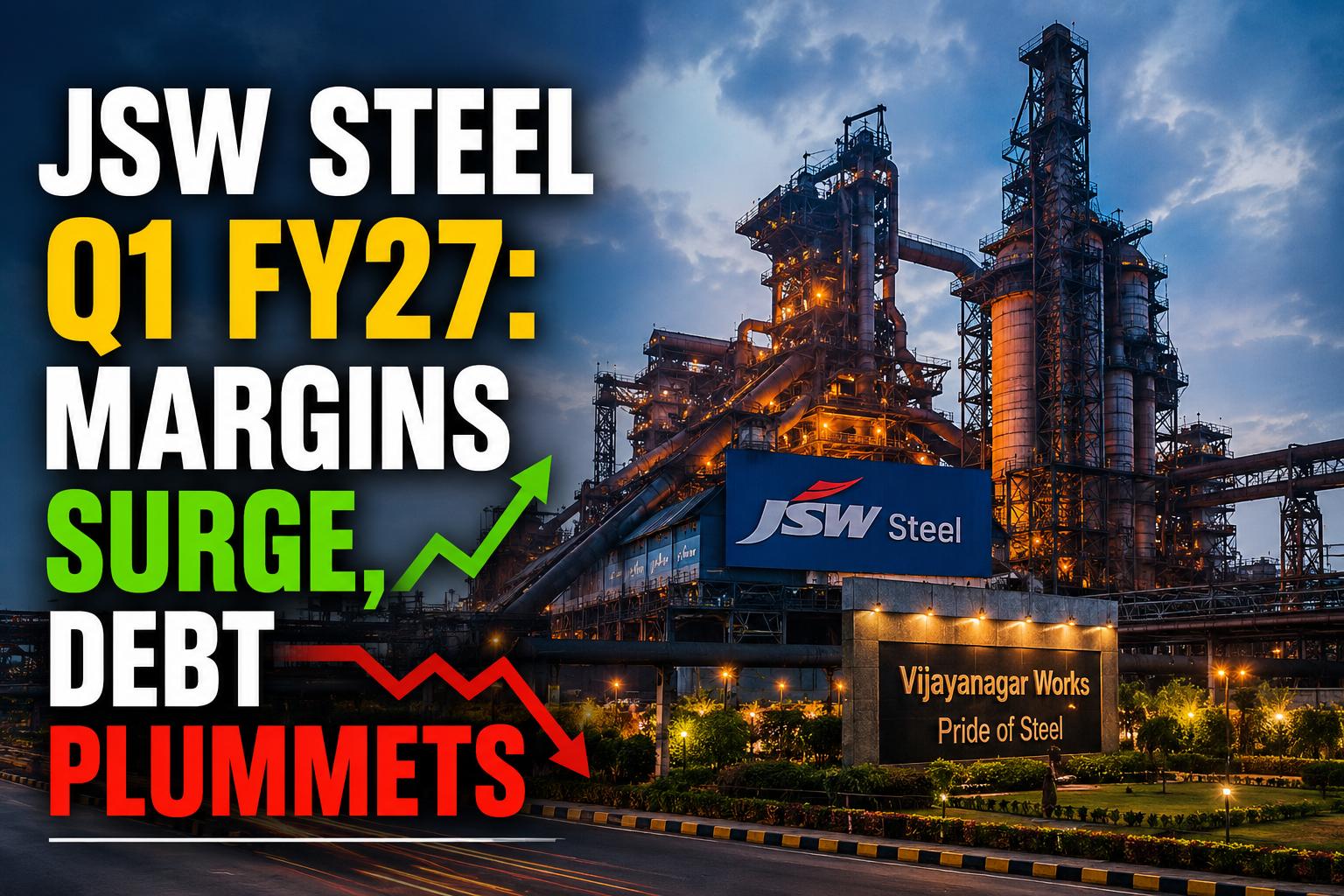
Demonstrating significant operational resilience, the flagship company of the USD 25 billion JSW Group reported a massive consolidated Revenue from Operations of ₹47,364 crores and a Net Profit after Tax (PAT) of ₹4,696 crores. Beyond the headline numbers, the true story of this quarter lies in the company’s aggressive deleveraging—reducing net debt by ₹7,713 crores—and its strategic capacity expansions aimed at reaching 54.8 million tonnes per annum (MTPA) over the next four years.
For retail investors, institutional funds, and market analysts, JSW Steel’s Q1 FY27 performance offers a masterclass in managing operating leverage, optimizing product mix, and navigating global supply chain shifts. This comprehensive analysis breaks down the verified data to uncover what is driving JSW Steel’s profitability and what it means for the future of Indian infrastructure.
2. Executive Summary (Q1 FY27)
Here are the top 10 key takeaways from JSW Steel’s Q1 FY27 earnings report:
Robust Topline Growth: Consolidated Revenue from Operations reached ₹47,364 crores, marking a 19% Year-on-Year (YoY) increase on a proforma basis.
Record Sales Volume: The company achieved its best-ever Q1 saleable steel sales of 6.25 million tonnes, up 4% YoY.
Strong Operating Margins: Adjusted EBITDA stood at ₹9,373 crores (up 32% YoY proforma), translating to a healthy EBITDA margin of 19.8%.
Massive Debt Reduction: Net Debt was slashed by ₹7,713 crores during the quarter, bringing the total down to ₹46,157 crores.
Healthy Balance Sheet: Net Debt to Equity improved to a highly comfortable 0.42x, while Net Debt to EBITDA stood at 1.46x.
Production Resilience: Crude steel production hit 6.59 million tonnes (up 3% YoY), achieving 94% capacity utilization in India despite a planned shutdown of the BF-3 unit at Vijayanagar.
Aggressive Capex: The company spent ₹4,869 crores on capital expenditure in Q1, maintaining its massive ₹22,000–₹24,000 crores guidance for FY27.
Subsidiary Turnarounds: Overseas operations showed marked improvement, with the Ohio (USA) facility commissioning its Vacuum Tank Degasser and reporting positive EBITDA.
Strategic Joint Ventures: The deconsolidation of Bhushan Power and Steel Limited (BPSL) was formalized as JFE Steel Corporation acquired a 25% stake in JSW JFE Kalinga.
Domestic Demand Strength: Indian finished steel consumption grew 8.3% YoY to 41.57 million tonnes, providing a strong tailwind for JSW’s domestic sales.
3. Company Overview & Strategic Positioning
JSW Steel is the flagship business of the diversified JSW Group. Over the past three decades, it has evolved from a single manufacturing unit into India’s leading integrated steel company.
Current Capacity and Expansion Vision: Currently, JSW Steel boasts a combined crude steel capacity of 37.9 MTPA (including 4.5 MTPA through the JSW JFE Steel JV). The company is executing a bold growth phase to scale this combined capacity to 54.8 MTPA over the next four years.
The Vijayanagar Crown Jewel: The company’s manufacturing facility located in Vijayanagar, Karnataka, is already the largest single-location steel-producing facility in India, currently operating at 19.5 MTPA. Ongoing expansions aim to increase this site’s capacity to approximately 25 MTPA by FY30, which would crown it as the world’s largest steel plant.
Technological Edge: JSW Steel maintains a strategic collaboration with Japan’s JFE Steel, granting it access to state-of-the-art technologies for producing high-value special steel products used across construction, automotive, electrical, and appliance sectors.
Key Takeaway for Investors: JSW Steel is not just riding the commodity cycle; it is actively expanding its baseline capacity to capture India’s infrastructure boom while upgrading its product mix to higher-margin, specialized steel.
4. Q1 FY27 Financial Results Snapshot
To accurately assess the financial growth, it is crucial to note an accounting change. Because Bhushan Power and Steel Limited (BPSL) was deconsolidated effective March 27, 2026, JSW Steel has provided Q1 FY26 and Q4 FY26 figures on a Proforma (PF) basis (excluding BPSL) to ensure an apples-to-apples YoY and QoQ comparison.
Consolidated Financial Highlights (₹ in Crores, unless stated)
| Metric | Q1 FY27 | Q4 FY26 (PF)* | QoQ Change | Q1 FY26 (PF)* | YoY Change |
| Crude Steel Production | 6.59 MT | 6.48 MT | +2% | 6.38 MT | +3% |
| Saleable Steel Sales | 6.25 MT | 7.07 MT | -12% | 6.03 MT | +4% |
| Revenue from Operations | ₹47,364 | ₹46,624 | +2% | ₹39,880 | +19% |
| Reported EBITDA | ₹9,383 | ₹7,566 | +24% | ₹6,816 | +38% |
| Adjusted EBITDA | ₹9,373 | ₹8,643 | +8% | ₹7,106 | +32% |
| Adj. EBITDA per Tonne | ₹14,990 | ₹12,232 | +23% | ₹11,783 | +27% |
| Adj. EBITDA Margin | 19.8% | 18.5% | +130 bps | 17.8% | +200 bps |
| Net Profit After Tax (PAT) | ₹4,696 | N/A (Proforma) | – | ₹2,209 (Reported) | +112% (Reported) |
(Note: Adjusted EBITDA excludes FX gains/losses on long-term borrowings net of intercompany receivables.)
Standalone Financial Highlights (Indian Operations)
| Metric | Q1 FY27 | Q4 FY26 (PF)* | QoQ Change | Q1 FY26 (PF)* | YoY Change |
| Production | 6.35 MT | 6.32 MT | +0.3% | 6.14 MT | +3% |
| Sales | 6.02 MT | 6.94 MT | -13% | 5.78 MT | +4% |
| Revenue from Operations | ₹42,894 | ₹44,217 | -3% | ₹37,243 | +15% |
| Adjusted EBITDA | ₹9,096 | ₹8,504 | +7% | ₹6,913 | +32% |
| Adj. EBITDA Margin | 21.2% | 19.2% | +200 bps | 18.6% | +260 bps |
Key Takeaway for Investors: The standout metric is the EBITDA per tonne, which surged 27% YoY to ₹14,990. This indicates that despite producing slightly more steel, the company is making significantly more profit on every single tonne sold, driven by better pricing and cost controls.
5. Key Operational Highlights
Production Resilience Amidst Planned Maintenance
Consolidated production for Q1 FY27 was 6.59 million tonnes (MT), representing a 3% YoY and 2% QoQ increase. Impressively, if we exclude the impact of the BF-3 (Blast Furnace 3) unit at Vijayanagar—which was taken offline during the quarter for a capacity upgradation—production volumes actually increased by a massive 15% YoY.
Sales and Product Mix Optimization
JSW Steel recorded its best-ever Q1 sales at 6.25 MT, up 4% YoY.
Focus on Value-Added Products: The company aggressively pushed its Flats and Value-Added & Special Products (VASP), which saw sales growth of 9% and 8% respectively.
Sectoral Demand: Sales to Institutional, Auto, Renewable, and Appliances sectors hit record Q1 highs.
Domestic vs. Export: Domestic sales stood at 5.34 MT (up 1% YoY). Institutional sales volume hit 3.72 MT (up 5% YoY), counterbalancing lower retail sales caused by channel de-stocking. Exports reached 0.68 MT, a sharp 46% YoY increase, contributing 11% to total sales from Indian operations.
Did You Know? Retail channel de-stocking usually happens when distributors anticipate a drop in prices or when monsoon seasons approach, causing them to clear existing inventory rather than buy new stock from manufacturers.
6. Detailed Financial Analysis
Understanding the mechanics behind JSW Steel’s Q1 FY27 profitability requires a deep dive into its cost structures and operating leverage.
Revenue Drivers
The consolidated revenue of ₹47,364 crores was primarily driven by higher sales realizations. Even though total sales volume dropped 12% QoQ (from 7.07 MT to 6.25 MT), revenue increased by 2% QoQ (from ₹46,624 crores to ₹47,364 crores). This mathematical divergence clearly illustrates that JSW Steel was able to command significantly higher prices for its steel products during the quarter.
Margin Trends and Cost Structure
The Adjusted EBITDA margin expanded to 19.8% on a consolidated basis and an impressive 21.2% for the standalone Indian operations.
The Positives: Margins were propelled by the aforementioned higher sales realizations.
The Headwinds: The margin expansion was partially offset by elevated coking coal prices and other input costs during the quarter.
Debt Profile and Cash Generation
Perhaps the most bullish signal for long-term investors is the company’s aggressive deleveraging.
Net Debt Reduction: JSW Steel reduced its Net Debt by a staggering ₹7,713 crores in a single quarter, bringing the total Net Debt down to ₹46,157 crores as of June 30, 2026.
Leverage Ratios: This debt repayment strengthened the balance sheet considerably. The Net Debt to Equity ratio improved to 0.42x (down from 0.51x in Q4 FY26), and the Net Debt to EBITDA ratio improved to 1.46x (down from 1.81x in Q4 FY26).
A Net Debt to EBITDA ratio below 2.0x is generally considered very healthy for a capital-intensive industry like steel manufacturing, signaling strong free cash flow generation and low default risk.
7. Subsidiary Performance Breakdown
JSW Steel’s global and domestic subsidiaries reported strong turnarounds and solid profitability in Q1 FY27, proving that the company’s growth is broad-based.
1. JSW Vijayanagar Metallics Ltd. (JVML)
Production & Sales: Produced 1.12 MT of crude steel and sold 1.14 MT.
Financials: Revenue stood at ₹7,032 crores with an Adjusted EBITDA of ₹1,821 crores.
Performance: Adjusted EBITDA skyrocketed 138% YoY, driven by the ramping up of operations and higher sales realizations. The unit delivered a standalone PAT of ₹1,223 crores.
2. JSW Steel Coated Products
Production & Sales: Produced 1.15 MT and sold 1.11 MT of GI/GL, Tin, CRCA, and other saleable products.
Financials: Revenue was ₹9,991 crores with an Adjusted EBITDA of ₹698 crores (up 25% YoY due to higher realizations). Net profit for the quarter was ₹354 crores.
3. USA – Ohio Operations
Milestone: Commissioned the Vacuum Tank Degasser project in Q1, enabling the production of higher-grade steel, particularly API grades.
Performance: Produced 266,418 net tonnes of slabs (74% capacity utilization). Sales volumes hit 161,598 net tonnes of slabs and 94,451 net tonnes of HRC.
Financials: Reported positive EBITDA of US$ 4.80 million, significantly higher QoQ as the previous quarter faced shutdowns for caster upgradation.
4. USA – Plate & Pipe Mill (Texas)
Performance: Produced 147,827 net tonnes of Plates (58% utilization) and 18,575 net tonnes of Pipes (14% utilization).
Financials: Generated an EBITDA of US$ 11.07 million, improving QoQ primarily due to higher volumes and better realisations for Plates.
5. Italy Operations
Performance: The rolled long products facility produced 54,489 tonnes (down 43% QoQ due to an annual rail mill shutdown in May) and sold 79,802 tonnes.
Financials: Despite lower production, it reported an EBITDA of EUR 7.05 million, higher QoQ due to improved sales volumes (clearing inventory) and realisations.
8. Macroeconomic & Industry Analysis
A steel company’s performance is deeply tethered to global and domestic macroeconomic currents. JSW Steel’s Q1 FY27 report provides a detailed view of the operating environment.
The Global Context
IMF Forecasts: The International Monetary Fund (IMF) slightly lowered its 2026 global growth forecast to 3.0% but upgraded 2027 to 3.4%, indicating confidence in medium-term growth.
United States: Economic growth is being supported by strong AI-related investments and healthy consumer spending backed by tax refunds.
Eurozone: Higher energy inflation forced the European Central Bank (ECB) to tighten monetary policy, which weighed on growth, though easing energy prices may provide future support.
China: The Chinese dynamic remains complex. While manufacturing is expanding due to strong exports, the domestic property market, retail sales, and fixed asset investments remain weak. Consequently, China’s steel production fell 3.9% YoY between January and May 2026, and domestic consumption dropped 4.0%. Crucially, Chinese steel exports remained elevated, posing a persistent threat of cheap steel flooding global markets.
The Indian Context
Economic Resilience: India remains the world’s fastest-growing major economy. The RBI forecasts a GDP growth of 6.6% for FY27.
Robust Steel Demand: Indian finished steel consumption was exceptionally strong in Q1 FY27, growing 8.3% YoY to 41.57 million tonnes. Demand is driven by public capex, automotive, commercial real estate, data centers, and maritime sectors.
Net Importer Status: A crucial industry shift occurred in Q1. Indian steel imports increased by roughly 400,000 tonnes QoQ, while exports fell by 290,000 tonnes QoQ. This dynamic caused India to return to a net importer position for the quarter.
Myth vs Fact
Myth: High global interest rates will destroy Indian steel demand.
Fact: Despite global tightening, Indian steel consumption grew 8.3% YoY in Q1 FY27, driven by domestic infrastructure spending and strong automotive sales.
9. Management Commentary & Capex Updates
JSW Steel is in the midst of a massive capital expenditure super-cycle. The management provided clear updates on how the ₹4,869 crores spent in Q1 FY27 is being deployed. Total capex guidance for FY27 remains between ₹22,000 and ₹24,000 crores.
Key Project Updates:
Vijayanagar BF-3 Expansion: The capacity expansion of Blast Furnace 3 from 3.0 MTPA to 4.5 MTPA was completed, and the furnace was lit up in June 2026. It has already ramped up to over 80% capacity and will contribute incremental volumes starting in Q2 FY27.
Dolvi Phase-III: The expansion from 10 MTPA to 15 MTPA is progressing well with civil works and equipment erection underway. Completion is targeted for September 2027.
JSW Utkal (Odisha): Two pellet plants (8 MTPA each) are on track for FY28 commissioning, while the 5 MTPA steel capacity will be ready by FY30. A 30 MTPA slurry pipeline by JSW Infrastructure is expected by end-FY27.
JVML-Vijayanagar (Brownfield): A 5 MTPA expansion is in the equipment ordering phase, targeted for FY30.
Rayalaseema (Andhra Pradesh): Groundbreaking was conducted on July 3rd for a 1 MTPA Electric Arc Furnace (EAF) and Structural Mill at Kadapa. Commissioning is slated for FY29.
Downstream Enhancements: The company is adding 0.44 MT of capacity across downstream projects in Vijayanagar, Khopoli, and Rajpura. This includes enhanced capabilities for high-strength coated steel at Khopoli and a new Rail capability added to the 1 MTPA Structural mill in Raigarh.
Corporate Amalgamation
The proposed acquisition of BMM Ispat Limited (BMMIL) via a Scheme of Amalgamation (announced May 14, 2026) is progressing. The scheme is awaiting clearance from the Competition Commission of India (CCI) and subsequent NCLT approval. Management expects to complete the amalgamation by Q4 FY27.
10. Stock Market Context & Analyst View
Disclaimer: This section contextualizes the financial data; it does not constitute financial advice.
The financial results reported by JSW Steel for Q1 FY27 present a fundamentally strong case. The market generally reacts favorably to two specific metrics found in this report: expanding margins and aggressive debt reduction.
Bullish Arguments Based on Data:
Operating Leverage: The ability to increase EBITDA per tonne by 27% YoY to ₹14,990 demonstrates excellent pricing power and cost management.
Deleveraging: Reducing net debt by over ₹7,700 crores in a single quarter de-risks the balance sheet, ensuring the massive ₹24,000 crore capex plan can be funded without over-leveraging the company.
Volume Visibility: The successful ramp-up of Vijayanagar BF-3 guarantees incremental volume growth in the coming quarters.
Bearish Arguments / Monitoring Points:
Input Costs: Management noted that coking coal prices and other input costs offset some of the margin gains. Volatility in coal remains a persistent risk.
India as a Net Importer: With China exporting elevated volumes of steel, the fact that India became a net importer in Q1 implies that domestic prices could face downward pressure if cheap foreign steel floods the market.
11. Valuation & Balance Sheet Analysis
While specific stock prices fluctuate daily, the balance sheet health of JSW Steel as of June 30, 2026, provides a clear picture of fundamental valuation metrics:
Debt to Equity: At 0.42x, the company is utilizing a conservative mix of equity and debt.
Net Debt to EBITDA: Standing at 1.46x, this ratio is exceptionally healthy for a steel manufacturer. It indicates that the company generates enough operating profit in roughly 1.5 years to pay off its entire net debt.
Interest Service Coverage Ratio (Standalone): Reported at 4.97x for the quarter (not annualized), indicating the company earns nearly five times its interest obligations, reflecting immense financial safety.
Current Ratio (Consolidated): Stood at 1.15x, indicating sufficient short-term assets to cover short-term liabilities.
12. Key Risks to Monitor
Investors evaluating JSW Steel should keep the following risks in mind, as highlighted by the macroeconomic context of the report:
Chinese Export Dumping: China’s domestic steel consumption is falling due to its property crisis, but its production hasn’t fallen as fast. This results in elevated exports. If this cheap steel bypasses tariffs and enters India, it could hurt JSW’s domestic pricing power.
Raw Material Volatility: Steel margins are highly sensitive to coking coal and iron ore prices. Any geopolitical shock disrupting supply chains could squeeze the 19.8% EBITDA margins reported this quarter.
Monsoon Impact: Management noted that a below-normal monsoon is a key downside risk for rural demand, which drives two-wheeler and tractor sales (key consumers of steel).
Execution Risk on Mega-Projects: The company is juggling multiple multi-billion dollar expansions (Dolvi, Utkal, Vijayanagar). Delays or cost overruns could impact future cash flows.
13. Future Outlook & Decarbonization Goals
The outlook for JSW Steel is intertwined with India’s infrastructure narrative. With the RBI projecting 6.6% GDP growth and public capex remaining robust, domestic demand is highly visible. The resolution of Middle East conflicts could also unlock reconstruction-led export demand.
Sustainability & Decarbonization:
JSW Steel is not just expanding; it is attempting to do so sustainably.
The company aims to reduce $CO_{2}$ emissions by 42% by 2030 and achieve carbon neutrality by 2050.
Its SEED (Sustainable Energy Environment & Decarbonisation) project won the Climate Action Platinum prize at the Global ESG Awards.
Over 80% of domestic crude steel production is now covered under Responsible Steel™ Certified Sites.
14. Investor Takeaways
For Long-Term Investors: JSW Steel’s journey from 37.9 MTPA to 54.8 MTPA provides a clear roadmap for volume growth over the next four years. Combined with a rapidly deleveraging balance sheet (Net Debt/EBITDA at 1.46x) and strategic upgrades to produce high-value API grades and coated products, the company is structurally positioned to generate long-term compounding value.
For Swing / Short-Term Traders: Traders should monitor global steel prices and Chinese export data. The upcoming Q2 FY27 results will feature the incremental volume from the newly lit BF-3 at Vijayanagar, which could serve as a positive earnings catalyst. However, watch out for margin compression if coking coal prices spike.
15. Conclusion
JSW Steel’s Q1 FY27 financial results deliver a resounding message of operational excellence. By achieving a 19.8% consolidated EBITDA margin and reducing net debt by over ₹7,700 crores, the company has fortified its balance sheet against global volatility. While challenges like cheap Chinese exports and fluctuating raw material costs remain, JSW Steel’s relentless focus on capacity expansion, value-added products, and aggressive deleveraging makes it a formidable proxy for India’s ongoing infrastructure boom.