1. Executive Snapshot
The Catalyst: On July 9, 2026, Bloomberg revolutionized the global fixed-income landscape by facilitating the first fully electronic trade of Indian Government Bonds (IGBs) via the Bloomberg Terminal. This breakthrough directly connects Foreign Portfolio Investors (FPIs) to the Reserve Bank of India’s (RBI) Negotiated Dealing System-Order Matching (NDS-OM) platform.
Geopolitical Implications: This marks a decisive step in India’s strategy to internationalize the Rupee and reduce reliance on US Dollar hegemony. By opening its $1.4 trillion sovereign debt market to frictionless global capital, New Delhi is positioning the Indian macro-economy as the premier anchor of stability in the Indo-Pacific.
Geoeconomic Consequences: With over ₹3.21 lakh crore ($38 billion) already flowing into India’s Fully Accessible Route (FAR) bonds, this digital plumbing eliminates manual execution friction. It accelerates capital inflows, fundamentally lowering the cost of capital for Indian infrastructure and manufacturing build-outs essential to the “China Plus One” supply chain realignment.
Bond Market Reaction: India’s 10-year sovereign yield has stabilized around 6.71%, offering a highly attractive real yield compared to US Treasuries and Japanese Government Bonds (JGBs). The frictionless trading environment is compressing credit spreads and flattening the yield curve as long-duration institutional capital enters the market.
Currency Movement: Sustained FPI debt inflows provide profound structural support for the Indian Rupee (INR), which the RBI continues to manage meticulously to prevent excessive appreciation that could harm export competitiveness.
2. Powerful Introduction
In the high-stakes theater of global finance, true tectonic shifts rarely announce themselves with a single headline. But on July 9, 2026, a quiet technological milestone on the Bloomberg Terminal signaled the irreversible arrival of a new financial superpower. For the first time, a fully electronic, frictionless trade of an Indian Government Bond (IGB) was executed by State Street Investment Management, bypassing archaic manual workflows to connect directly to India’s sovereign debt clearinghouse.
Why should global investors, policymakers in Washington, and central bankers in Frankfurt care about a trading workflow upgrade in Mumbai?
Because the sovereign bond market is the bedrock upon which national power is built. A nation cannot project geopolitical strength, secure critical supply chains, or internationalize its currency without a deep, liquid, and globally integrated debt market. By removing the final operational frictions for Foreign Portfolio Investors (FPIs), India is effectively opening the floodgates to hundreds of billions of dollars in passive and active global capital. Coupled with recent tax exemptions on sovereign debt and back-to-back inclusions in JPMorgan and Bloomberg Emerging Market indices, India is no longer just the world’s fastest-growing major economy—it is aggressively bidding to become the world’s next great safe-haven asset class.
3. Timeline of Financial Integration
Tracking India’s meticulous, decade-long campaign to globalize its sovereign debt:
October 2014: Initial, ultimately stalled discussions between the RBI and Euroclear regarding offshore settlement of Indian debt, highlighting early hesitation over “hot money” risks.
March 2020: The RBI introduces the Fully Accessible Route (FAR), removing foreign investment caps on designated government securities.
September 2023: JP Morgan announces the inclusion of Indian G-Secs into its Government Bond Index-Emerging Markets (GBI-EM), triggering billions in front-running inflows.
January 2025: Bloomberg indices officially begin phasing in India FAR bonds into the Bloomberg Emerging Market Local Currency Government Index.
April 1, 2026: The Indian government implements a landmark ordinance exempting capital gains and interest income tax for FIIs investing in G-Secs, removing the final regulatory hurdle for index trackers.
July 9, 2026: Bloomberg activates its fully electronic workflow connecting international FPIs directly to the NDS-OM platform.
4. Background
To understand the magnitude of this shift, one must view India’s debt market through the lens of historical financial sovereignty. For decades, the Reserve Bank of India (RBI) operated with a fortress mentality. Scarred by the 1991 balance of payments crisis and observing the devastating capital flights of the 1997 Asian Financial Crisis, New Delhi strictly limited foreign ownership of its sovereign debt.
However, the geopolitical realities of the 2020s necessitated a pivot. To finance a multi-trillion-dollar infrastructure overhaul and transition into a global manufacturing hub, domestic savings alone were insufficient. The government needed to lower its borrowing costs. Simultaneously, global capital was starved for yield and diversification. With China’s debt market becoming uninvestable for many Western institutions due to geopolitical tensions, and Japanese bonds grappling with the Bank of Japan’s complex exit from negative rates, India emerged as the most compelling macroeconomic story of the decade.
5. What Happened?
The Event: Bloomberg formally launched its electronic trading workflow for Indian Government Bonds, integrated seamlessly with the Clearing Corporation of India Ltd’s (CCIL) Negotiated Dealing System-Order Matching (NDS-OM).
The Mechanics: Previously, foreign investors looking to buy Indian sovereign debt had to engage in a cumbersome, manual process involving emails, phone calls to domestic partner banks, and delayed price discovery. Now, FPIs can place, monitor, execute, and allocate trades with a single click on the Bloomberg Terminal.
Why Now? This infrastructure upgrade follows a massive influx of foreign capital. With India’s weight in global bond indices rising to 10%, passive funds are mandated to buy Indian debt. Furthermore, the April 2026 tax exemptions on FAR bonds turbocharged active management interest. Bloomberg’s move is a commercial response to overwhelming institutional demand for frictionless execution in a market where FPIs already hold over ₹3.75 lakh crore.
6. Geopolitical Analysis
The electronification of India’s bond market is not merely a financial plumbing upgrade; it is a geopolitical weapon.
Great-Power Competition: As the US-China strategic rivalry fractures the global economy, nations are weaponizing capital. By integrating its sovereign debt into the global financial architecture on its own terms (retaining domestic clearing rather than relying on Euroclear), India asserts strategic autonomy. It attracts Western capital without surrendering regulatory sovereignty.
De-Dollarization and the Rupee: India is actively pushing for the internationalization of the Rupee (INR). New Delhi has slashed its holdings of US Treasuries from $242 billion to $181 billion while expanding Rupee-denominated trade settlements with Russia, the UAE, and ASEAN nations. A liquid, easily accessible sovereign bond market is the missing puzzle piece. If foreign nations accumulate Rupees through bilateral trade, they need a safe, yield-bearing asset in which to park those reserves. Indian G-Secs, accessible via Bloomberg, serve precisely this function, slowly eroding the US Dollar’s exorbitant privilege.
Key Takeaway: The internationalization of India’s bond market provides the essential financial infrastructure required to support a multipolar currency regime in the Global South.
7. Geoeconomic Analysis
Lowering the Cost of Capital: When foreign capital buys domestic debt, bond yields fall. Lower sovereign yields translate to lower borrowing costs across the entire Indian economy—from state-owned infrastructure giants building ports and rail corridors to private manufacturers setting up semiconductor fabs.
Supply Chain Realignment: India’s industrial policy relies heavily on drawing supply chains away from China. However, building world-class logistics requires cheap, long-term capital. By tapping into global pension funds and sovereign wealth funds via frictionless bond trading, India is essentially crowdfunding its industrial revolution at highly competitive global rates.
Fiscal Discipline as a Geoeconomic Tool: Unlike many emerging markets, India has maintained a strict fiscal consolidation glide path. By exposing its debt to the ruthless discipline of global bond vigilantes, the Modi administration is binding the hands of future governments, ensuring macroeconomic stability remains a permanent fixture of Indian policy.
8. Global Bond Market Analysis
For fixed-income professionals, the Indian bond market represents a rare combination of scale, yield, and stability.
Yield Curve Dynamics: India’s 10-year yield currently sits at roughly 6.71%. For a fast-growing economy with inflation anchored around 3.93%, this offers a compelling real yield of nearly 280 basis points.
Duration Risk & Safe-Haven Flows: As developed markets face persistent fiscal deficits and the US Treasury market grapples with term premium volatility, Indian debt is increasingly viewed as a non-correlated diversifier. The influx of foreign money into 15-year, 30-year, and 40-year FAR bonds indicates a willingness by global funds to take on long-duration exposure in India.
Liquidity Conditions: The Bloomberg integration fundamentally alters liquidity. Algorithmic and high-frequency trading in Indian debt will narrow bid-ask spreads, making it cheaper to enter and exit massive block trades.
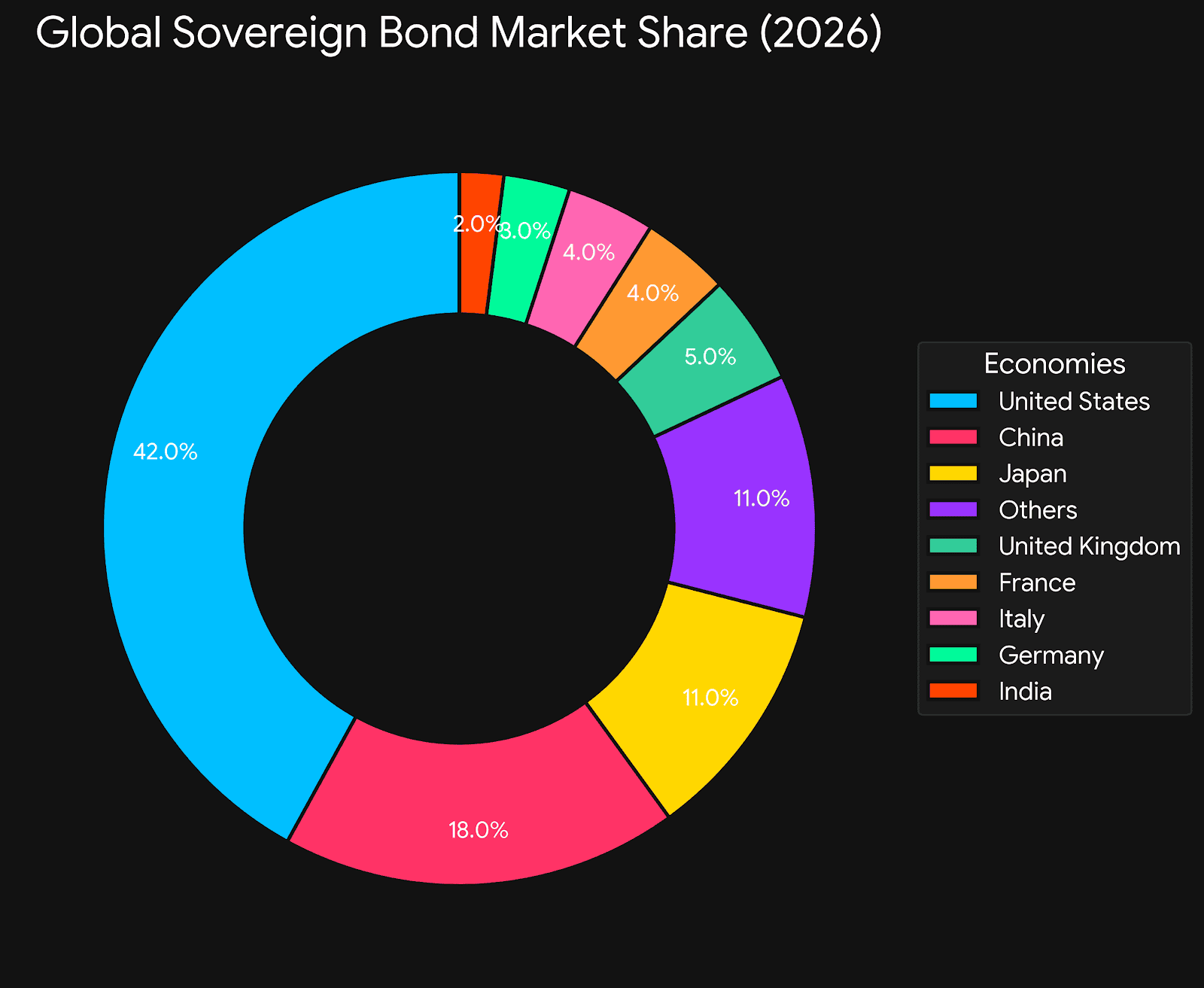
To visualize how India’s yields compare globally, explore this interactive yield comparison tool:
Bond Market Explainer: What are FAR Bonds?
The Fully Accessible Route (FAR) is a specific class of Indian Government Securities completely free of foreign investment limits. As of mid-2026, FAR bonds represent roughly 6.74% of India’s outstanding debt but command the vast majority of foreign inflows, acting as the primary conduit for global capital into India.
9. Central Bank Perspective
The electronification of the bond market creates a complex trilemma for the Reserve Bank of India (RBI).
Managing the Inflow: Billions of dollars rushing into bonds puts immense upward pressure on the Rupee. The RBI must continuously intervene, buying dollars and selling Rupees to prevent extreme currency appreciation that would decimate Indian exports. This is evident in India’s forex reserves swelling to $674.19 billion by July 2026.
Sterilization: When the RBI buys dollars, it injects Rupees into the domestic system, threatening to stoke inflation. To counter this, the RBI must conduct open market operations to mop up excess liquidity.
Monetary Policy Transmission: A deeper, more liquid bond market heavily populated by foreign investors means the RBI’s interest rate decisions will transmit much faster through the economy. However, it also means Indian yields will become more sensitive to US Federal Reserve policy shifts, marginally reducing the RBI’s absolute independence.
10. Currency Market Analysis
The sustained inflow of FPI capital into G-Secs structurally alters the USD/INR dynamic.
Historically, the Rupee has faced chronic depreciation pressure due to India’s current account deficits (driven by oil imports). However, capital account surpluses generated by bond inflows act as a massive counterweight. While the RBI explicitly avoids targeting a specific exchange rate, it enforces a “managed float,” heavily smoothing volatility.
If foreign capital continues to pour into the Bloomberg-facilitated bond market, we can expect the Rupee to exhibit unusually low volatility compared to peer emerging market currencies like the Brazilian Real or the South African Rand. This currency stability, in turn, creates a self-fulfilling prophecy, attracting even more unhedged foreign capital into Indian bonds.
11. Commodity & Equity Market Impact
Commodity Markets: A stronger, stable Rupee acts as a natural hedge against imported inflation, particularly for crude oil and gold. As India’s borrowing costs fall, massive capital expenditure programs in green energy and infrastructure will accelerate, driving localized super-cycles in structural commodities like copper and steel.
Equity Markets: The bond market leads the equity market. As sovereign yields compress, the risk-free rate used in equity valuation models drops, automatically expanding the price-to-earnings (P/E) multiples of Indian equities. Furthermore, domestic institutional investors (like LIC and local mutual funds), traditionally the biggest buyers of G-Secs, will be crowded out by foreign capital. This domestic capital will inevitably move up the risk curve, flooding into Indian mid-cap and large-cap equities, providing structural support to the Sensex and Nifty 50.
12. Data Analysis
To quantify the sheer scale of the Indian bond market transformation, consider the following metrics tracking foreign participation and macroeconomic stability in mid-2026:
| Indicator | Current Value (July 2026) | Significance |
| India 10Y Yield | 6.71% | Offers massive positive real yield compared to US/EU. |
| Inflation Rate | 3.93% | Firmly within the RBI’s 2%-6% target band. |
| Total FPI Holding in G-Secs | ₹3.75 Lakh Crore ($45B) | Rapid acceleration post-index inclusion. |
| FAR Bond Stock Share | 6.74% | Represents the unrestricted portion available to globals. |
| Forex Reserves | $674.19 Billion | Provides massive ammunition for RBI to defend the Rupee. |
Source: RBI, Trading Economics, PIB Factsheet (July 2026 Data).
13. Country-by-Country Analysis
United States: Washington views India’s financial rise favorably as a democratic counterweight to China, though the Treasury Department closely monitors India’s bilateral Rupee trade architecture and its accumulation of physical gold over US Treasuries.
China: Beijing recognizes the threat. As foreign capital rotates out of the structurally slowing Chinese economy into India, China loses its monopoly as the undisputed growth engine of Asia.
Japan: Japanese institutional investors, traditionally ultra-conservative, are heavily evaluating Indian debt. With JGB yields still relatively low despite BoJ normalization, Indian G-Secs offer Japanese pensions desperately needed demographic-matching yields.
European Union: European ESG funds are particularly interested in India’s issuance of Sovereign Green Bonds (SGrBs) within the FAR framework, channeling European capital directly into India’s solar and wind infrastructure.
14. Stakeholder Analysis
Global Asset Managers: Benefit massively. The Bloomberg integration eliminates operational friction, lowering trading costs and minimizing settlement errors.
Indian Government: The primary beneficiary. High demand for debt means New Delhi can finance its fiscal deficit at lower interest rates, freeing up budget space for capital expenditure rather than interest payments.
Indian Corporations: Benefit from the “crowding in” effect. As foreign money buys government debt, domestic banks have more liquidity to lend to private corporations at lower interest rates.
Retail Consumers: Lower overall interest rates translate to cheaper home mortgages and auto loans, spurring domestic consumption.
15. Expert Perspectives & Reality Check
The Consensus View: “India joining global indices and integrating with platforms like Bloomberg is more than a milestone—it’s a green light for global investors,” notes Lakshmi Iyer, CEO of Investment & Strategy at Kotak Alternate Asset Managers. It proves macroeconomic stability and diversifies the investor base.
The Reality Check (Myth vs. Fact):
Myth: The Indian bond market will immediately rival the US Treasury market in depth.
Fact: While growing rapidly, India’s bond market is $1.4 trillion compared to the $27+ trillion US Treasury market. India is a high-yield diversifier, not an immediate replacement for the global reserve asset.
Myth: Foreign money means India loses control of its economy.
Fact: The RBI maintains strict caps (6% for general G-Secs) and a formidable $674B forex reserve. This is a highly controlled, calculated opening, not a reckless deregulation.
16. Future Scenarios
Base Case (65% Probability):
Steady, structural inflows continue at a pace of $30-$40 billion annually over the next five years. The RBI successfully sterilizes the inflows, keeping the Rupee stable. The 10-year yield gradually compresses toward 6.00%, driving a multi-year bull market in both Indian credit and equities.
Best Case (20% Probability):
India secures entry into the FTSE Russell World Government Bond Index and Euroclear settlement negotiations succeed by 2027. Capital inflows exceed $60 billion annually. The Rupee structurally appreciates, wiping out imported inflation and accelerating India’s timeline to becoming a $10 trillion economy.
Worst Case (15% Probability):
A massive global risk-off event (e.g., kinetic conflict in the Taiwan Strait) triggers a severe liquidity crunch. “Hot money” rapidly exits Indian FAR bonds. The RBI is forced to burn through $100 billion of reserves to stabilize the Rupee, and borrowing costs spike temporarily, delaying infrastructure targets.
17. Editorial Analysis: The Price of Admission
Editorial Commentary
India is crossing the Rubicon. By connecting the Bloomberg Terminal directly to the NDS-OM, the Modi administration and the RBI are signaling unparalleled confidence in the resilience of the Indian economy. For three decades, India shielded its debt market out of fear of capital flight. Today, it is weaponizing its macroeconomic stability to attract global capital.
However, globalization is a double-edged sword. Foreign capital is inherently mercenary; it chases risk-adjusted returns and flees at the first sign of trouble. By inviting global portfolio investors into the core of its financial system, India is willingly subjecting its fiscal policies to the judgment of global bond vigilantes in New York, London, and Singapore. The government can no longer afford populist fiscal slippages. The electronic bridge built by Bloomberg ensures that any policy misstep in New Delhi will be instantly punished by capital flight executed in milliseconds.
India has traded absolute financial isolation for cheaper capital and global influence. It is a necessary gamble for a rising superpower, but one that demands flawless macroeconomic execution going forward.
18. Conclusion
The execution of the first fully electronic Indian Government Bond trade on the Bloomberg Terminal on July 9, 2026, will be remembered not as a technological footnote, but as a geopolitical inflection point. It is the moment the plumbing of global finance formally adapted to accommodate India’s rise. Over the coming years, this frictionless pathway will channel hundreds of billions of dollars into the subcontinent, financing the roads, ports, and power grids of the 21st century’s most vital economy. For global investors, ignoring Indian sovereign debt is no longer an option; it is an active portfolio error. The world’s financial center of gravity is shifting east, and the Bloomberg Terminal just laid down the fiber-optic cable to prove it.