Introduction
For over a decade, the strategic community has watched a frustrating paradox unfold in the Indo-Pacific: Australia, home to the world’s largest known uranium reserves, and India, a rapidly industrializing behemoth desperate for clean baseload power, remained deadlocked over nuclear trade. Despite a foundational civil nuclear cooperation pact signed in 2014, the administrative gears remained jammed by strict Australian safeguards and international non-proliferation anxieties.
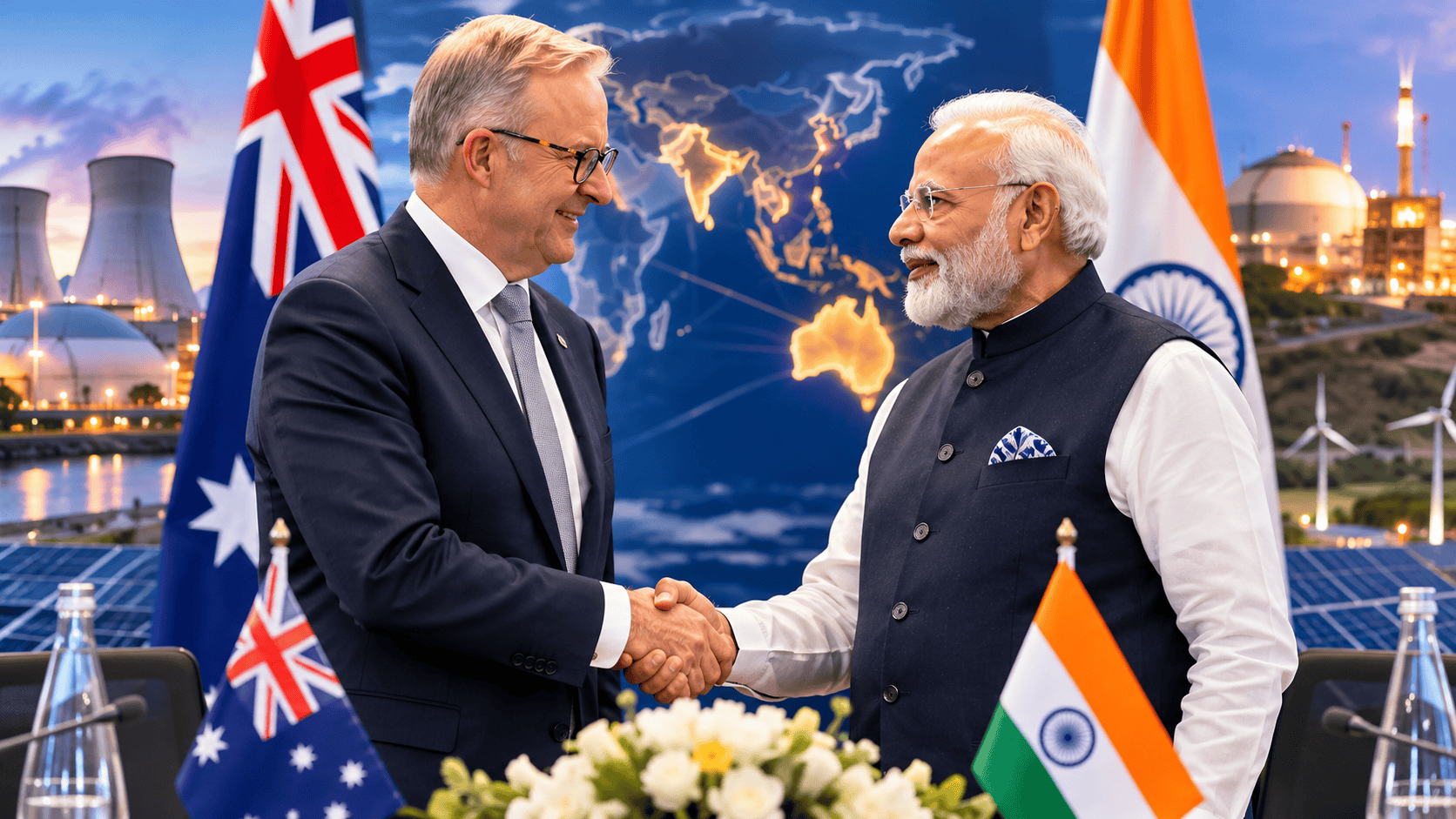
On July 9, 2026, the diplomatic gridlock finally shattered in Melbourne.
During the third Australia-India Annual Summit, Prime Ministers Narendra Modi and Anthony Albanese signed the definitive administrative arrangements enabling the long-term, commercial export of Australian uranium to India. Ostensibly, it is an energy agreement designed to feed India’s voracious economic engine and help it transition away from fossil fuels. But scratch beneath the surface of the “clean energy” rhetoric, and a profound geoeconomic realignment reveals itself.
This deal is not just about yellowcake. It is the crystallization of a new geopolitical architecture in the Indo-Pacific. Driven by the mutual necessity to counter an increasingly assertive China, insulate supply chains from Russian disruptions, and build economic resilience, the Canberra-New Delhi axis has officially moved from a partnership of convenience to a comprehensive strategic alliance.
As India aggressively scales its nuclear capacity—aiming for a staggering 100 gigawatts by 2047—and Australia seeks to diversify its export markets away from Beijing’s economic coercion, the 2026 uranium accord serves as the linchpin of a broader defense, maritime, and technological convergence. This analysis breaks down the true cost, the hidden motives, and the global reverberations of the Indo-Pacific’s most consequential deal of the year.
Complete Article
Background: The 12-Year Waiting Game
To understand the magnitude of the Melbourne breakthrough, one must look at the historical friction between the two nations. Australia has historically been a staunch proponent of the Nuclear Non-Proliferation Treaty (NPT), a pact India famously refused to sign, arguing it was inherently discriminatory. For decades, this ideological divide made uranium trade impossible.
The first thaw occurred in 2008 when the Nuclear Suppliers Group (NSG) granted India a rare waiver to participate in global nuclear commerce, acknowledging New Delhi’s impeccable non-proliferation record despite being a non-NPT state. By 2014, Australia formally ended its ban on uranium exports to India. Yet, the devil remained in the details. Canberra’s strict tracking requirements—demanding to monitor exactly where its nuclear material ended up to ensure it never touched weapons programs—clashed with India’s complex bureaucratic separation of civilian and military facilities.
Fast forward to 2026, and the strategic calculus has shifted dramatically. The war in Ukraine exposed the fragility of global energy markets and highlighted the risks of relying on Russian nuclear fuel. Meanwhile, India’s domestic energy demands have skyrocketed. The Indian government recently enacted the Shanti Act (Sustainable Harnessing and Advancement of Nuclear Energy for Transforming India), a revolutionary reform that ended the state monopoly on nuclear power, allowing up to 49% private and foreign equity in civilian projects.
India currently generates around 8.88 GW of nuclear power across 25 operational reactors, accounting for a mere 3% of its electricity. To hit its 2070 net-zero targets and fuel its expanding manufacturing base and data centers, New Delhi has set a mandate: 22 GW by 2032, and an astonishing 100 GW by 2047. That requires a mountain of uranium—and a partner they can trust.
What Happened in Melbourne?
The July 9 summit delivered far more than a uranium supply contract. It was a multifaceted strategic package. Alongside the nuclear administrative arrangement, the two nations unveiled:
A New Defense and Security Declaration: Expanding joint military exercises and prioritizing information-sharing.
Maritime Security Collaboration Roadmap: Integrating the Indian Coast Guard with Australia’s Maritime Border Command.
Critical Minerals Corridor: Securing supply chains for rare earths crucial to the energy transition.
Technology and Cybersecurity Pacts: Aimed at protecting regional data networks.
CECA Expedited: A commitment to fast-track the Comprehensive Economic Cooperation Agreement.
Albanese framed the deal through the lens of economic opportunity for the Australian resources sector, while Modi emphasized the “fresh momentum” it gives to India’s clean energy objectives. However, the subtext of the joint statement—which explicitly noted shared concerns over “geostrategic uncertainty, and threats to regional peace and stability”—left no doubt about the geopolitical undercurrents.
Why It Matters: The Geopolitical Impact
The Australia-India uranium deal is a classic example of geoeconomics—using economic instruments to achieve geopolitical goals.
1. The China Factor and Quad Consolidation:
Beijing’s shadow loomed large over the Melbourne summit. China’s rapid military modernization and its aggressive posture in the South China Sea and along the Line of Actual Control (LAC) have forced regional powers to rethink their non-alignment strategies. By locking in a reliable energy source from a Quad partner, India is actively reducing its strategic vulnerabilities. For Australia, pulling India closer into a web of defense and resource dependencies ensures New Delhi remains a robust counterweight to Chinese hegemony in Asia.
2. Bypassing Russian Reliance:
Historically, Russia has been a primary supplier of enriched uranium to India. The 2026 deal provides New Delhi with a critical off-ramp. While India will not abandon Moscow overnight, diversifying its fuel sourcing to Australia builds a firewall against potential Western secondary sanctions and insulates the Indian grid from geopolitical shocks originating in Eastern Europe.
3. Elevating India’s Global Stature:
By finalizing this deal, Australia implicitly validates India’s status as a responsible, de facto nuclear weapons state with a trustworthy civilian program. It signals to international investors that India’s nuclear sector—now open to private capital via the Shanti Act—is a safe and lucrative frontier.
The Economic and Trade Impact
The economic arithmetic of this deal is staggering. India is already Australia’s fifth-largest trading partner, with two-way trade hitting A$50 billion in 2025 (heavily reliant on coal). The introduction of uranium into the trade mix, coupled with the critical minerals corridor, alters the quality of the trade relationship from transactional to structural.
For Australia:
Australia holds about one-third of global uranium reserves but is only the fourth-largest producer due to state-level mining bans. The promise of massive, long-term Indian contracts provides a powerful incentive for Australian state governments to rethink mining moratoriums. The Minerals Council of Australia has already labeled this an “immense opportunity” that will spur billions in domestic mining infrastructure investments.
For India:
Energy security is the prerequisite for economic growth. As India positions itself as a “China + 1” manufacturing hub and experiences a boom in AI data centers, power outages or fuel shortages are unacceptable risks. Securing stable uranium prices through long-term Australian contracts protects India from the spot-market volatility that plagues fossil fuels. Furthermore, with the Shanti Act in play, private giants like Tata Power, Adani Green, and Reliance Industries now have the regulatory clarity and the raw material assurance needed to invest heavily in Small Modular Reactors (SMRs).
Defense and Security Perspective
Energy security and national security are inextricably linked. The uranium deal serves as the connective tissue for a deeper military alliance. The simultaneous signing of the defense declaration and the maritime security roadmap is not a coincidence.
As India’s civil nuclear program scales up with Australian fuel, it frees up India’s limited domestic uranium reserves for its strategic weapons program—a reality not lost on strategic planners in Beijing or Islamabad. Though the Australian uranium is strictly monitored by the IAEA for civilian use only, the fungibility of resources inherently boosts India’s overall nuclear flexibility.
Furthermore, the maritime agreement linking the Indian Coast Guard and the Australian Maritime Border Command creates a unified surveillance architecture stretching from the Indian Ocean to the Pacific. This interoperability ensures that the sea lines of communication—through which this very uranium will be transported—remain open and secure against adversarial naval blockades.
Global Supply Chain and Technology Implications
We are witnessing the bifurcation of global supply chains. The U.S. and its allies are actively attempting to decouple critical technologies and minerals from Chinese control. The Australia-India Critical Minerals Corridor, signed alongside the uranium deal, is a vital piece of this puzzle.
Australia possesses vast quantities of lithium, cobalt, and rare earths, while India possesses the labor force, refining potential, and massive domestic market. By integrating their supply chains, the two nations are building a “trust-based” ecosystem that can bypass Chinese processing bottlenecks. When combined with the nuclear agreements, this guarantees that the foundational elements of the 21st-century economy—clean energy, advanced manufacturing, and strategic minerals—are kept within the purview of allied democracies.
Country-Wise Winners and Losers
The Winners:
India: Secures a massive, reliable fuel source for its 100 GW energy transition; bolsters its standing as a responsible global power; attracts foreign investment into its newly privatized nuclear sector.
Australia: Unlocks a lucrative export market; diversifies away from Chinese economic reliance; strengthens a critical defense partnership in the Indo-Pacific.
The United States / The Quad: Sees two of its most important Indo-Pacific partners deepen their structural ties, creating a stronger unified front against Chinese expansionism without requiring direct U.S. financial intervention.
The Losers:
China: Watches a primary regional rival secure long-term energy independence while simultaneously deepening military interoperability with a key U.S. ally.
Russia: Faces a long-term erosion of its market share in the Indian nuclear fuel sector, losing a crucial lever of influence over New Delhi’s strategic autonomy.
Pakistan: Views the fungibility of India’s uranium supply with alarm, perceiving a shift in the South Asian nuclear balance as India expands both its civilian capacity and its strategic stockpile (recently estimated to have grown from 180 warheads in 2025 to 190 in 2026).
Data Tables
Table 1: India’s Nuclear Expansion Targets (The Road to 100 GW)
| Metric | Current Status (2025-2026) | Medium-Term Goal (2032) | Long-Term Vision (2047) |
| Installed Capacity | ~8.88 GW | 22.48 GW | 100 GW |
| Operational Reactors | 25 | ~35+ | 100+ |
| Share of Power Grid | ~3% | ~8% | ~15-20% |
| Policy Framework | State Monopoly (NPCIL) transitioning via Shanti Act | Public-Private Partnerships (up to 49% FDI) | Fully integrated private/state ecosystem |
| Primary Fuel Source | Domestic, Russia, Kazakhstan | Diversified (Australia, Canada, US, Russia) | Diversified, plus indigenous Fast Breeder tech |
Table 2: Comparative Geopolitical Impact of the Deal
| Domain | Impact on India | Impact on Australia | Strategic Consequence for Indo-Pacific |
| Energy Security | Bypasses spot market volatility; enables base-load green transition. | Opens a multi-billion dollar, decades-long export pipeline. | Reduces the region’s reliance on Middle Eastern fossil fuels and Russian nuclear fuel. |
| Defense Ties | Upgrades maritime domain awareness via joint Coast Guard operations. | Secures the western flank of the Indo-Pacific through Indian naval power. | Consolidates the Quad’s military interoperability; signals unified deterrence. |
| Supply Chains | Secures raw materials for EV batteries and tech manufacturing. | Shifts resource dependency away from China toward a trusted partner. | Creates a “friend-shored” ecosystem for critical minerals and nuclear technology. |
Timeline
The Long Road to the 2026 Nuclear Deal
2008: The Nuclear Suppliers Group (NSG) grants India a unique waiver to engage in global nuclear trade despite being a non-NPT state.
2014: Australia officially lifts its long-standing diplomatic ban on exporting uranium to India.
2015: Australia and India sign a foundational Civil Nuclear Cooperation Agreement, though exports fail to materialize due to strict tracking safeguards.
2021: The AUKUS pact is announced; Australia shifts its strategic posture aggressively toward countering China, viewing India as a vital puzzle piece.
2022: The India-Australia Economic Cooperation and Trade Agreement (ECTA) is signed, expanding bilateral trade horizons.
2025 (Feb): India introduces the Shanti Act, ending the state monopoly on nuclear power and allowing 49% private/foreign investment.
2025 (April): India’s Ministry of Power outlines a formal roadmap to scale nuclear capacity from ~7 GW to 100 GW by 2047.
2026 (July 9): PM Modi and PM Albanese sign the administrative arrangements in Melbourne, unlocking commercial uranium exports and deepening defense ties.
SWOT Analysis of the Deal
Strengths:
Establishes a secure, long-term supply of high-grade uranium for India’s 100 GW target.
Provides a massive economic boost to Australia’s mining sector.
Solidifies the Quad alliance through deep economic and energy interdependence.
Weaknesses:
Australian domestic politics and state-level mining bans could slow production scaling.
India’s bureaucratic red tape could delay the implementation of private sector investments under the Shanti Act.
Opportunities:
Accelerates the development of Small Modular Reactors (SMRs) through joint technological research.
Paves the way for the Comprehensive Economic Cooperation Agreement (CECA) and deeper tech sharing.
Allows both nations to dominate the Indo-Pacific critical minerals supply chain.
Threats:
Retaliatory economic measures or increased naval pressure from China.
Potential delays in port and maritime infrastructure required to safely transport nuclear materials.
Domestic environmental opposition in Australia regarding expanded uranium mining.
Risk Matrix
| Risk Factor | Probability | Impact | Mitigation Strategy |
| Australian State Mining Bans Restricting Supply | Medium | High | Federal pressure on states; leveraging the massive economic windfall of Indian contracts as an incentive. |
| Chinese Geopolitical Pushback | High | Medium | Deepening joint maritime patrols; reliance on broader Quad defense frameworks. |
| Logistical/Transport Disruptions | Low | High | Implementing the new Maritime Security Collaboration Roadmap for secure sea routes. |
| India Failing to Attract Private Nuclear Capital | Low | Medium | Strict adherence to the Shanti Act; offering tax concessions and green power classification to investors. |
Future Outlook
What Happens in the Next 6 Months?
Expect a flurry of corporate activity. Australian mining giants like BHP and Paladin Energy will begin preliminary contract negotiations with the Nuclear Power Corporation of India Limited (NPCIL). Simultaneously, we will see the first joint maritime border patrols under the new Coast Guard agreement.
What Happens in 1 to 3 Years?
The first commercial shipments of Australian uranium will arrive at Indian ports. The Comprehensive Economic Cooperation Agreement (CECA) will likely be finalized. India’s private sector (Tata, Reliance) will break ground on the first generation of privately-backed Small Modular Reactors (SMRs) using the newly secured fuel pipeline.
What Happens in 5 to 10 Years?
India will surpass the 22 GW milestone, fundamentally altering its power grid mix. Australia will likely overtake Canada and approach Kazakhstan in global uranium export dominance. The Indo-Pacific will see a hardened, highly integrated security architecture where Indian and Australian militaries operate seamlessly, creating a formidable barrier to any unilateral alteration of the regional status quo by China.
Expert Opinion Summary
Pradeep Taneja, University of Melbourne: Points out that India has been heavily importing from Russia, but the disruptions caused by the Ukraine war have necessitated a more secure, trusted source like Australia. He views the deal as a masterstroke in supply chain diversification.
Tania Constable, Minerals Council of Australia: Hails the deal as an “immense opportunity” for the Australian resources sector, noting that Australia must rapidly boost its production capabilities to meet India’s aggressive 100 GW target.
Strategic Analysts (CSIS/Brookings): Consensus suggests that the true value of the deal is not the uranium itself, but the “trust architecture” it builds. By intertwining their most sensitive sectors (nuclear energy and defense), Canberra and New Delhi are locking themselves into a long-term strategic marriage designed to outlast political cycles and counter Beijing.
Key Takeaways
The 12-Year Deadlock is Broken: The 2026 administrative agreement finally operationalizes the 2014 civil nuclear pact, allowing commercial uranium flow from Australia to India.
Fueling the 100 GW Dream: India desperately needs this fuel to achieve its mandate of 100 GW of nuclear capacity by 2047, aided by the privatization efforts of the new Shanti Act.
Beyond Energy—A Defense Pact: The deal was signed alongside sweeping defense, maritime security, and critical mineral agreements, signaling a unified front against regional instability.
Bypassing Russia and China: The agreement allows India to diversify away from Russian nuclear fuel while helping Australia reduce its economic reliance on China.
A Win for the Quad: The deep economic integration of two major Quad partners strengthens the entire alliance’s deterrence capability in the Indo-Pacific.
Conclusion: Final Verdict
The 2026 Australia-India uranium deal is a watershed moment in modern geopolitics. It proves that shared strategic anxieties—specifically regarding an aggressive China and an unstable Russia—can overcome deeply entrenched bureaucratic and ideological differences.
By unlocking the flow of uranium, Australia is essentially pouring high-octane fuel into the engine of the Indian economy. In return, India provides Australia with a massive, reliable market and a powerful military ally on the western edge of the Indo-Pacific. This is not merely a transaction of minerals; it is the drafting of a new security architecture. As global supply chains fracture and re-form along geopolitical fault lines, the Canberra-New Delhi axis stands as a testament to the new reality of the 21st century: energy security, economic resilience, and national defense are now, undeniably, the exact same thing.
FAQ (10)
1. What is the 2026 Australia-India uranium deal?
It is a finalized administrative arrangement allowing Australia to commercially export uranium to India for purely civilian nuclear power generation, ending a 12-year bureaucratic deadlock.
2. Why couldn’t Australia sell uranium to India before 2026?
Despite a 2014 agreement, strict Australian safeguards regarding the tracking of nuclear material clashed with India’s domestic protocols. These administrative hurdles were finally resolved in July 2026.
3. Does this deal involve nuclear weapons?
No. The uranium is strictly for civilian energy use and is monitored under International Atomic Energy Agency (IAEA) safeguards to prevent diversion to military programs.
4. What is India’s nuclear energy target?
India aims to scale its nuclear power capacity from roughly 8.8 GW in 2026 to 22 GW by 2032, and 100 GW by 2047 to achieve its net-zero emission goals.
5. How does this affect China?
It strengthens two major Quad allies (India and Australia) economically and militarily, reducing their vulnerabilities and creating a stronger unified counterweight to China’s regional dominance.
6. What is the Shanti Act?
Enacted in early 2025, the Shanti Act allows up to 49% private and foreign equity in India’s civilian nuclear sector, ending the state monopoly and accelerating expansion.
7. How will this impact the global uranium market?
It secures a massive, long-term buyer for Australia, likely spurring new mining investments, while reducing India’s reliance on Russian and spot-market uranium.
8. What else did Modi and Albanese sign in Melbourne?
They signed 18 pacts, including a defense and security declaration, a maritime security collaboration roadmap, and a critical minerals supply chain partnership.
9. Will Australian uranium be used in Small Modular Reactors (SMRs)?
Yes, India’s 2025-26 budget heavily funds the R&D of Bharat Small Reactors, and Australian uranium will be a key feedstock for these future projects.
10. Is India a member of the NPT?
No, India is not a signatory to the Non-Proliferation Treaty, which made this deal historically difficult until the NSG granted India a waiver in 2008.