Ashok Leyland Q2 FY2025-26: Steady Performance Amid Cost Pressures
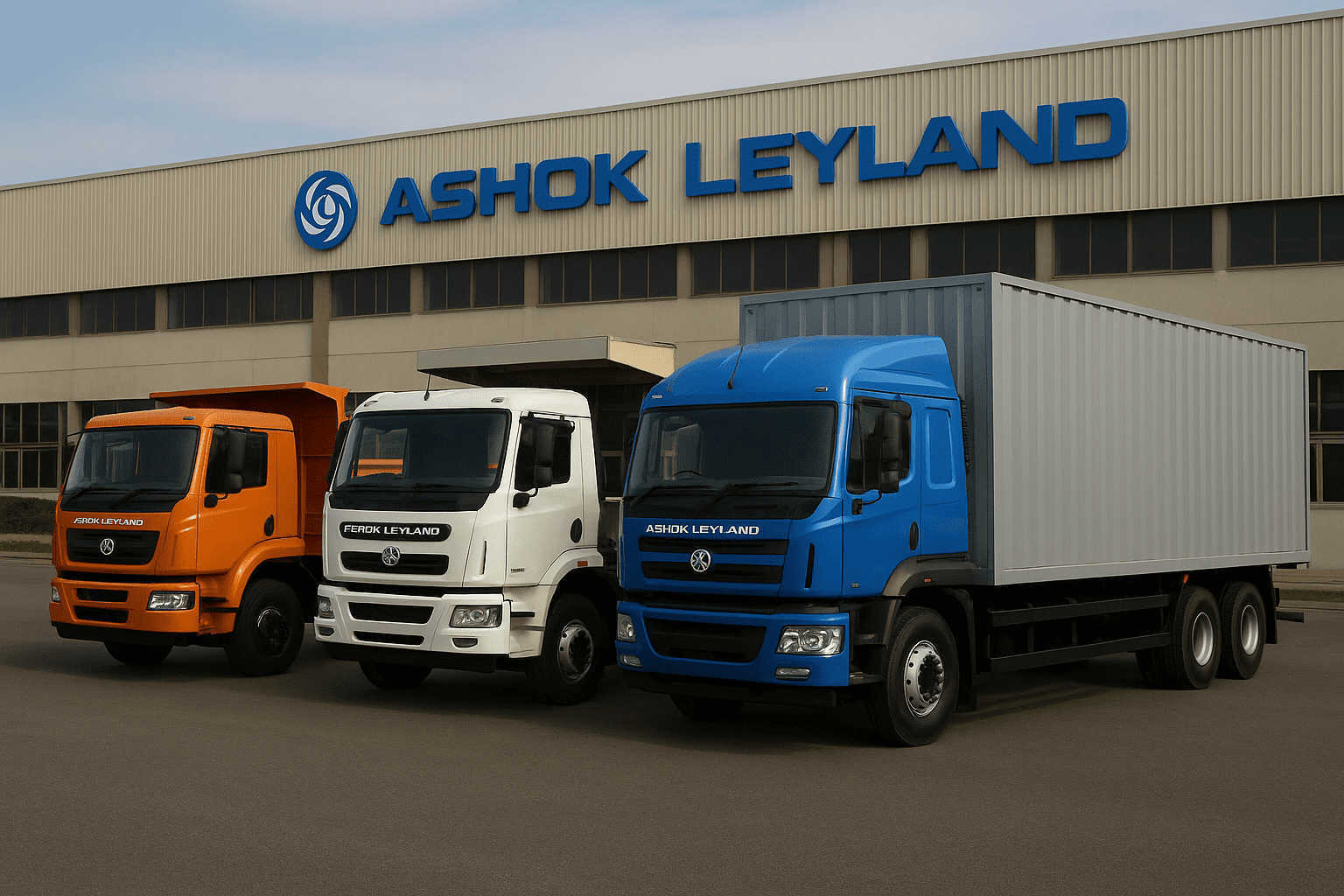
Ashok Leyland Ltd, India’s second-largest commercial vehicle manufacturer and a flagship of the Hinduja Group, announced its Q2 FY2025-26 results showcasing strong operational resilience, double-digit volume recovery, and a steady profit performance.
For the quarter ended September 30, 2025, the company reported a revenue of ₹9,588 crore, up 9% year-on-year compared to ₹8,769 crore in Q2 FY2024-25. The growth was supported by healthy medium and heavy commercial vehicle (MHCV) demand, an uptick in light commercial vehicle (LCV) sales, and improved realizations across key product lines.
Net profit (PAT) stood at ₹771 crore, almost flat YoY, mainly due to one-time exceptional expenses related to litigation settlements and higher raw-material costs. However, underlying operating performance remained robust with EBITDA margins expanding to ~12.1%, reflecting better product mix, cost control, and higher capacity utilization.
📊 Quarterly Comparison — Ashok Leyland Financial Performance
| Parameter (₹ crore) | Q2 FY2025-26 (Jul–Sep 2025) | Q1 FY2025-26 (Apr–Jun 2025) | Q2 FY2024-25 (Jul–Sep 2024) |
|---|---|---|---|
| Revenue from Operations | 9,588.18 | 8,724.51 | 8,768.83 |
| Net Profit (PAT) | 771.06 | 611.0 | 770.10 |
| EBITDA Margin (%) | 12.1 % | 11.5 % | 11.6 % |
| Exceptional Items | ₹ 49 crore expense | — | ₹ 117 crore gain |
| EPS (₹) | 2.64 | 2.09 | 2.63 |
Sources: Company filing, BSE disclosures & market summaries (November 2025).
Revenue Drivers: CV Market Resilience & Aftermarket Strength
The company’s top-line growth was driven by a combination of volume increase and better price realization in the domestic market. The MHCV segment, which forms the backbone of Ashok Leyland’s business, benefited from infrastructure spending and logistics demand, while the LCV segment saw improved retail traction.
Export volumes also saw a modest rise, contributing ~10 % of total revenue. The aftermarket business, which includes spares and service, grew ~18 % YoY, helping stabilize margins even when input costs remained elevated.
“We continue to focus on enhancing customer experience, expanding service reach, and leveraging technology for operational efficiency,” said Shenu Agarwal, Managing Director & CEO of Ashok Leyland, in the Q2 results statement.
Operating Margin Improvement and Cost Discipline
Ashok Leyland’s EBITDA for Q2 FY26 improved both sequentially and YoY, reaching ~₹1,159 crore, compared to ~₹1,018 crore in Q2 FY25. The EBITDA margin of ~12.1 % reflects consistent improvement through a leaner cost structure, lower warranty costs, and higher contribution from premium truck models.
Operating expenses increased moderately due to higher steel, rubber, and logistics costs, but the company effectively offset much of this impact through price optimization and procurement efficiency.
Exceptional Items and Flat PAT Explained
Despite improved operating metrics, PAT remained at ₹771 crore, similar to the previous year’s ₹770 crore, primarily due to non-recurring adjustments.
In Q2 FY26, the company recognized a one-time litigation expense of ₹49 crore, whereas the same quarter in FY25 included an exceptional investment revaluation gain of ₹117 crore. Adjusting for these items, core profitability improved by ~15 % YoY.
Management emphasized that the company’s focus on cash conservation and debt reduction has resulted in one of the strongest balance sheets in the industry, with net debt-to-EBITDA below 1x.
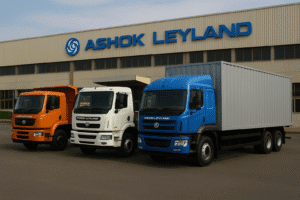
Segmental Insights: MHCV & LCV Performance
MHCV Trucks: Revenue grew ~8 % YoY, supported by demand from construction, infrastructure, and mining sectors. The recently launched Boss LE and Partner Super models received strong market response.
Buses: Domestic bus demand remained stable, with fresh orders from state transport undertakings. Export bus sales recovered slightly, driven by orders from Africa & Middle East.
LCV Segment: Volumes grew 6 % YoY. The Dost & Bada Dost range continued to dominate their categories with double-digit market share.
Aftermarket: High-margin spares and service revenue rose 18 %, accounting for ~13 % of total turnover.
Management Guidance for H2 FY2025-26
Management expressed optimism for H2 FY26, citing continued government focus on infrastructure, replacement demand, and expanding electric mobility initiatives.
Key points from management commentary:
🚛 Demand Outlook: Replacement demand expected to drive MHCV sales; Q3 & Q4 volumes could rise 5–8 % sequentially.
💰 Margins: Expect to sustain EBITDA margin > 12 % with improved mix and cost rationalization.
🌍 Exports: Targeting double-digit export growth via Middle East & Africa markets.
⚡ EV Strategy: The company, through Switch Mobility, is scaling production of electric buses and last-mile LCVs; more product launches planned in FY26.
🏭 Capex: FY26 capex projected at ₹1,200–1,400 crore for new product development and capacity expansion.
“We remain committed to profitable and sustainable growth. With robust product pipeline, focus on EVs, and strong aftersales network, Ashok Leyland is well positioned for the next growth cycle,” added Dheeraj Hinduja, Executive Chairman.
Comparison Snapshot: Q2 FY26 vs Q1 FY26 vs Q2 FY25
| Parameter | YoY (Q2 FY26 vs Q2 FY25) | QoQ (Q2 FY26 vs Q1 FY26) |
|---|---|---|
| Revenue | ▲ +9 % | ▲ +10 % |
| PAT | ▶ Flat (₹771 cr vs ₹770 cr)** | ▲ +26 % |
| EBITDA Margin | ▲ +50 bps | ▲ +60 bps |
| Volume Growth (MHCV+LCV) | ▲ +6 % | ▲ +4 % |
| Exports | ▲ +8 % | ▲ +5 % |
Analyst and Market Reactions
Market analysts described Ashok Leyland’s Q2 FY26 results as operationally strong and strategically disciplined. Brokerage houses such as Motilal Oswal, ICICI Securities, and Axis Capital maintained a positive outlook, citing consistent market share gains and better margin visibility.
“Ashok Leyland continues to demonstrate resilience through cycles. Strong volume recovery, cost discipline, and a growing LCV portfolio support long-term earnings visibility,” noted Motilal Oswal in a post-result update.
However, analysts also cautioned that commodity price inflation and demand moderation post-festive season could create near-term volatility.
Key Risks and Watchpoints
Cyclical Demand: CV sales are sensitive to infrastructure spending and freight rates.
Input Cost Inflation: Rising steel and rubber prices can compress margins.
Regulatory Changes: Transition to new BS emission norms may raise costs.
EV Execution: Timely scale-up of Switch Mobility critical for future growth.
Competition: Aggressive pricing by Tata Motors and Volvo-Eicher remains a challenge.
Conclusion: Ashok Leyland Builds Momentum for a Resilient H2 FY26
Ashok Leyland’s Q2 FY2025-26 financial report reinforces its position as a leader in India’s commercial vehicle industry. With revenue up 9 %, healthy EBITDA margins, and flat PAT despite one-offs, the company has demonstrated operational stability in a volatile market.
The management’s guidance for H2 FY26 — focused on export growth, aftermarket expansion, and EV transformation — sets the stage for sustainable profitability.
With its strong brand, diverse portfolio, and investments in future mobility solutions, Ashok Leyland is well-positioned to capture the next cycle of growth in India’s CV and EV segments.
For investors and readers alike, the message is clear: Ashok Leyland remains a steady long-term play on India’s infrastructure and mobility story.