
Introduction: The Maharatna Takes Flight
HAL’s Journey from PSU Manufacturer to Aerospace Powerhouse
Over the last three decades, India’s aerospace and defense sector has changed dramatically. In the 1990s, Hindustan Aeronautics was primarily seen as a government-controlled aircraft maintenance and licensed-production company. Today, HAL has transformed itself into one of the most strategically important defense manufacturers in India. The company now plays a critical role in fighter aircraft production, helicopter manufacturing, avionics systems, engine integration, and indigenous defense modernization programs. This transformation reflects India’s broader “Atmanirbhar Bharat” mission, where the country is increasingly focusing on self-reliance in defense manufacturing instead of depending heavily on foreign suppliers.
The Big Headline from Q4 FY26
HAL’s Q4 FY26 results announced on May 14, 2026, once again reinforced why the company remains one of the strongest long-term defense-sector stories in the Indian stock market. Consolidated net profit for the March quarter rose 5.5% year-on-year to ₹4,196 crore compared to ₹3,976 crore during the same quarter last year. While revenue growth remained relatively modest, the company’s earnings visibility continues staying extremely strong due to its massive order backlog and multi-year defense contracts. For long-term investors, the most important takeaway is not just quarterly profit growth but the scale of HAL’s future execution pipeline.
Market Reaction & Investor Sentiment
The stock reacted positively after the earnings announcement. HAL shares jumped nearly 4% intraday and touched around ₹4,808.60 on the NSE as investors responded favorably to strong annual profitability and the company’s massive order book. Defense-sector sentiment in India remains structurally bullish because the government continues increasing domestic procurement spending under the “Make in India” and “Atmanirbhar Bharat” programs. Investors increasingly view HAL as one of the safest and most strategic beneficiaries of India’s rising defense budget.
Q4 FY26 Actual Performance: The NSE Hard Numbers
Revenue Growth Remains Stable
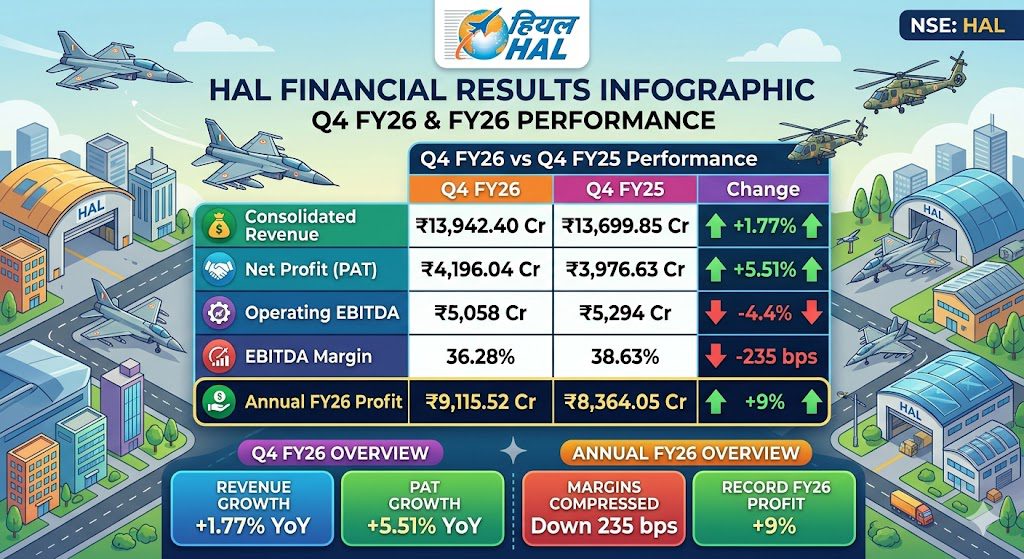
According to the audited results filed with the exchanges on May 14, 2026, HAL reported consolidated revenue of ₹13,942.40 crore for Q4 FY26 compared to ₹13,699.85 crore during the same quarter last year. This represents year-on-year growth of approximately 1.77%. While the revenue growth appears modest, investors should understand that aerospace and defense companies operate on long execution cycles. Revenue recognition depends heavily on delivery milestones, project approvals, and contract execution schedules. Because of this, quarterly revenue fluctuations are common in the defense sector.
Profit Growth Continues Despite Execution Challenges
HAL reported consolidated Profit After Tax (PAT) of ₹4,196.04 crore during Q4 FY26 compared to ₹3,976.63 crore during Q4 FY25, reflecting growth of around 5.51%. This stable profitability demonstrates the company’s ability to maintain strong operational performance despite supply-chain disruptions and rising input costs affecting the global aerospace industry. For the full financial year FY26, annual net profit rose to ₹9,115.52 crore compared to ₹8,364.05 crore in FY25, representing annual growth of nearly 9%. Such consistent profitability further strengthens HAL’s position as one of the highest-quality PSU defense businesses in India.
EBITDA Margins Show Some Pressure
Operating EBITDA for Q4 FY26 stood at ₹5,058 crore compared to ₹5,294 crore during the same quarter last year, reflecting a decline of approximately 4.4%. EBITDA margins also declined from 38.63% to 36.28%, representing contraction of nearly 235 basis points. Although HAL still maintains exceptionally strong margins compared to most manufacturing businesses, the decline indicates increasing pressure from rising material costs and execution-related expenses. Investors should continue monitoring this trend carefully because margin protection will remain critical as production volumes scale up.
Full-Year Profitability Remains Strong
Despite operational challenges, HAL delivered another strong annual performance. FY26 annual net profit crossed ₹9,115 crore, supported by healthy execution, strong defense demand, and a growing order pipeline. The company’s ability to maintain high profitability even while scaling production highlights the strength of its strategic positioning within India’s defense ecosystem.
Fundamental Analysis: Order Book & “Other Income”
Massive ₹2.54 Lakh Crore Order Book
One of HAL’s strongest long-term advantages remains its enormous order backlog. As of March 31, 2026, the company’s order book stood near ₹2.54 lakh crore, providing revenue visibility for approximately seven to eight years. Very few Indian companies across any sector possess this level of long-term earnings visibility. The order book includes fighter aircraft programs, helicopter contracts, avionics systems, maintenance agreements, upgrades, and export opportunities. This backlog effectively secures HAL’s long-term business pipeline and reduces earnings uncertainty significantly.
Other Income Played an Important Role
While revenue growth remained modest during the quarter, HAL’s bottom line received strong support from a sharp increase in “Other Income.” Other Income surged approximately 76.6% year-on-year to ₹1,151 crore. This additional income helped stabilize profitability despite operational margin pressure. However, experienced investors understand that sustainable long-term growth must eventually come from operational execution rather than non-core income sources. Therefore, future aircraft deliveries and execution efficiency remain the most important variables to monitor.
Margin Erosion Remains the Key Risk
Despite HAL’s strong order book and stable profitability, margin erosion remains an important concern. Aerospace manufacturing is a highly complex industry involving imported components, specialized materials, advanced engineering systems, and long production cycles. Delays in engine supply or increases in raw-material costs can directly impact margins. For HAL, the biggest challenge over the next few years will be scaling production efficiently while maintaining healthy profitability.
Technical Analysis: The Blue-Sky Zone
HAL Remains in a Strong Uptrend
From a technical-analysis perspective, HAL continues maintaining one of the strongest long-term chart structures in the Indian defense sector. Although the stock recently consolidated below its 52-week high near ₹5,166, the strong post-results volume breakout indicates improving bullish momentum. Institutional investors continue showing interest in defense-sector stocks due to India’s long-term military modernization programs.
Key Support Levels
The most important support zone currently lies between ₹4,730 and ₹4,750. This range has repeatedly acted as a strong institutional accumulation area where long-term investors step in during corrections. As long as HAL remains above this support zone, the broader bullish structure remains intact. Long-term investors often use such consolidation phases to gradually accumulate fundamentally strong companies.
Resistance Levels to Watch
Immediate resistance currently lies near ₹4,880. A strong daily close above this level could potentially trigger fresh momentum toward the psychologically important ₹5,000 mark and beyond. Technical traders are closely monitoring this resistance zone because a breakout supported by strong volume may indicate the start of another major rally phase.
RSI Indicates Healthy Momentum
HAL’s Relative Strength Index (RSI) currently remains in the neutral-bullish range near 54–58. This suggests the stock still has room for upward momentum without entering overbought territory. In simpler terms, the stock appears technically healthy and “primed” for movement rather than overheated.
Shareholder Rewards: The Dividend Story
HAL Continues Rewarding Shareholders
HAL remains one of the strongest dividend-paying PSU companies in India. Earlier in February 2026, the company announced an interim dividend of ₹35 per share, reinforcing management’s commitment toward shareholder returns. Stable dividends are especially attractive in volatile market conditions because they provide investors with predictable income while maintaining exposure to long-term capital appreciation opportunities.
Strong Cash Generation Supports Dividends
The company’s strong operating cash flows and healthy balance sheet allow it to maintain generous dividend payouts even while investing heavily in manufacturing expansion and strategic defense programs. This combination of growth visibility and dividend stability makes HAL particularly attractive for long-term investors seeking both income and capital appreciation.
Brokerage Sentiment & Targets
Analysts Remain Bullish on HAL
Most brokerage firms continue maintaining bullish ratings on HAL due to the company’s strategic importance, long-term order visibility, and exposure to India’s rapidly expanding defense budget. Analysts increasingly view HAL as one of the safest ways to participate in India’s “Atmanirbhar Bharat” defense-manufacturing theme.
Consensus Target Above ₹5,000
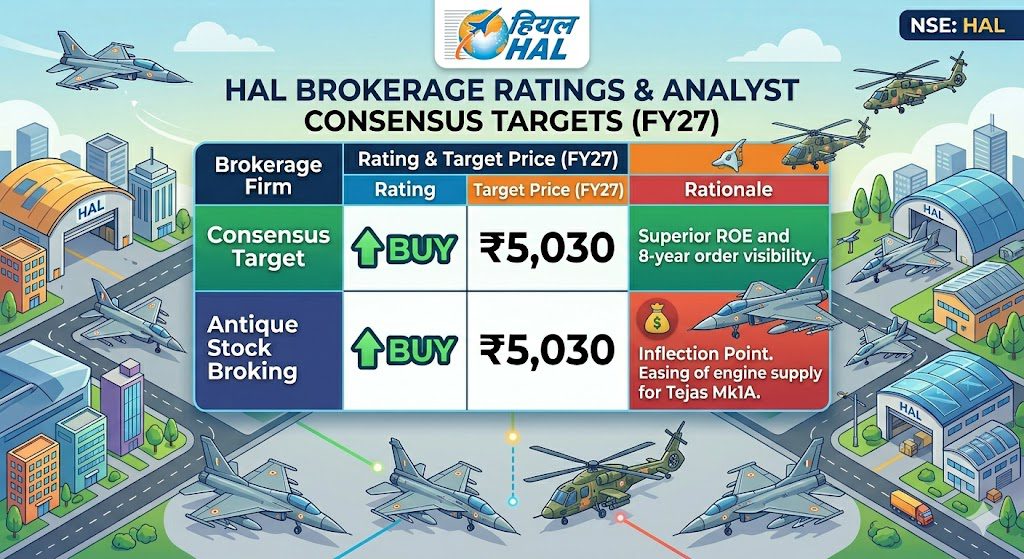
The broader analyst consensus currently maintains “Buy” ratings with average target estimates around ₹5,030 for FY27. Brokerages continue highlighting HAL’s strong Return on Equity (ROE), stable profitability, and unmatched order visibility as major strengths supporting higher valuations.
Antique Stock Broking’s Inflection Point View
Antique Stock Broking believes FY27 could become a major operational “inflection point” for HAL as engine supply issues affecting Tejas Mk1A production gradually ease. Faster aircraft deliveries could significantly accelerate revenue growth over the coming quarters.
Management Guidance: Tejas & Beyond
Tejas Mk1A Deliveries Become the Main Focus
One of the biggest themes for FY27 will be the acceleration of Tejas Mk1A fighter aircraft deliveries. Supply-chain bottlenecks related to engine availability had earlier slowed execution timelines. However, management now expects these issues to ease gradually during FY27. If delivery schedules improve successfully, HAL could enter a significantly stronger operational growth cycle.
Inventory Build-Up Signals Future Expansion
HAL’s inventory build-up currently stands near ₹30,850 crore. For aerospace manufacturers, rising inventory often signals future production scaling and upcoming delivery acceleration. Therefore, while high inventory levels may initially concern some investors, in HAL’s case they likely indicate stronger operational activity ahead.
The 30-Year Analyst Verdict
For Long-Term Investors
HAL remains one of the most strategically important companies in India’s defense ecosystem. With a ₹2.54 lakh crore order backlog, Maharatna status, strong government support, and direct exposure to India’s ₹6.81 lakh crore defense budget, HAL represents one of the safest long-term defense-sector opportunities available in the Indian market. The company combines national strategic importance with stable profitability and strong earnings visibility.
For Active Traders
For traders, HAL remains highly sensitive to operational updates and defense-sector sentiment. Dips toward the ₹4,750 support zone may provide favorable risk-reward opportunities for swing traders targeting the ₹5,000+ zone. However, traders should continue monitoring margin trends and execution timelines carefully because aerospace manufacturing remains execution-intensive.
Conclusion & Engagement (CTA)
Final Word on HAL
HAL’s Q4 FY26 results once again demonstrate why the company remains the centerpiece of India’s aerospace and defense ambitions. Stable profit growth, one of the largest order books in India, improving Tejas delivery visibility, and strong cash generation together create a compelling long-term investment story. The biggest challenge ahead remains operational execution and margin protection. If HAL successfully manages supply chains while accelerating aircraft deliveries, the company could enter its strongest growth phase in decades.
For investors seeking long-term exposure to India’s defense modernization and “Atmanirbhar Bharat” story, HAL continues standing among the most strategically important stocks in the Indian market today.
Investor Engagement CTA
Are you holding HAL for its ₹5,000+ long-term target, or do you prefer private defense players like Tata Advanced Systems? Share your defense-sector investment strategy in the comments below.