1. Introduction: The Dichotomy of Growth
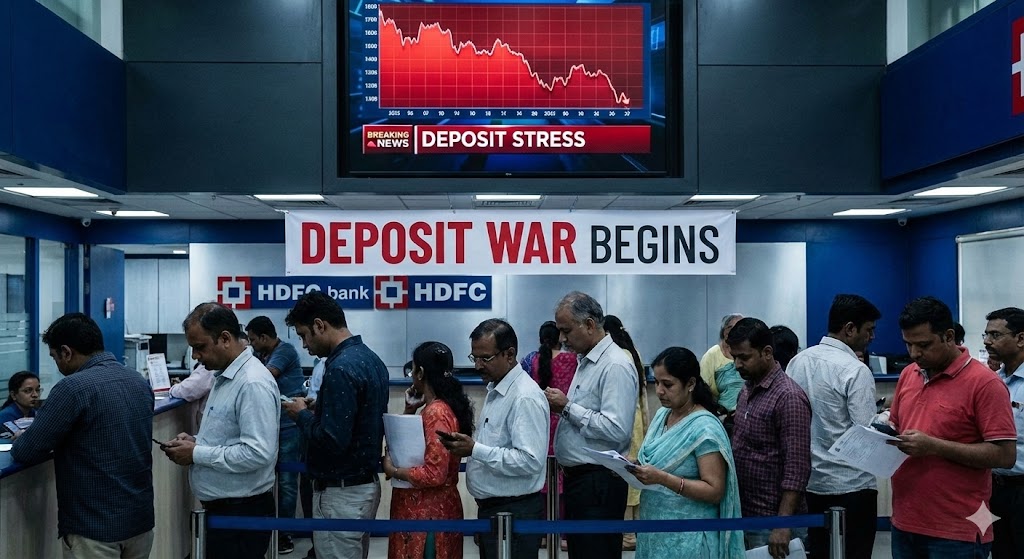
Indian banking is passing through a rare and uncomfortable phase. On one side, credit demand is strong. On the other, liquidity is tight. This combination is unusual because, historically, strong loan growth comes with easy money. That is no longer the case.
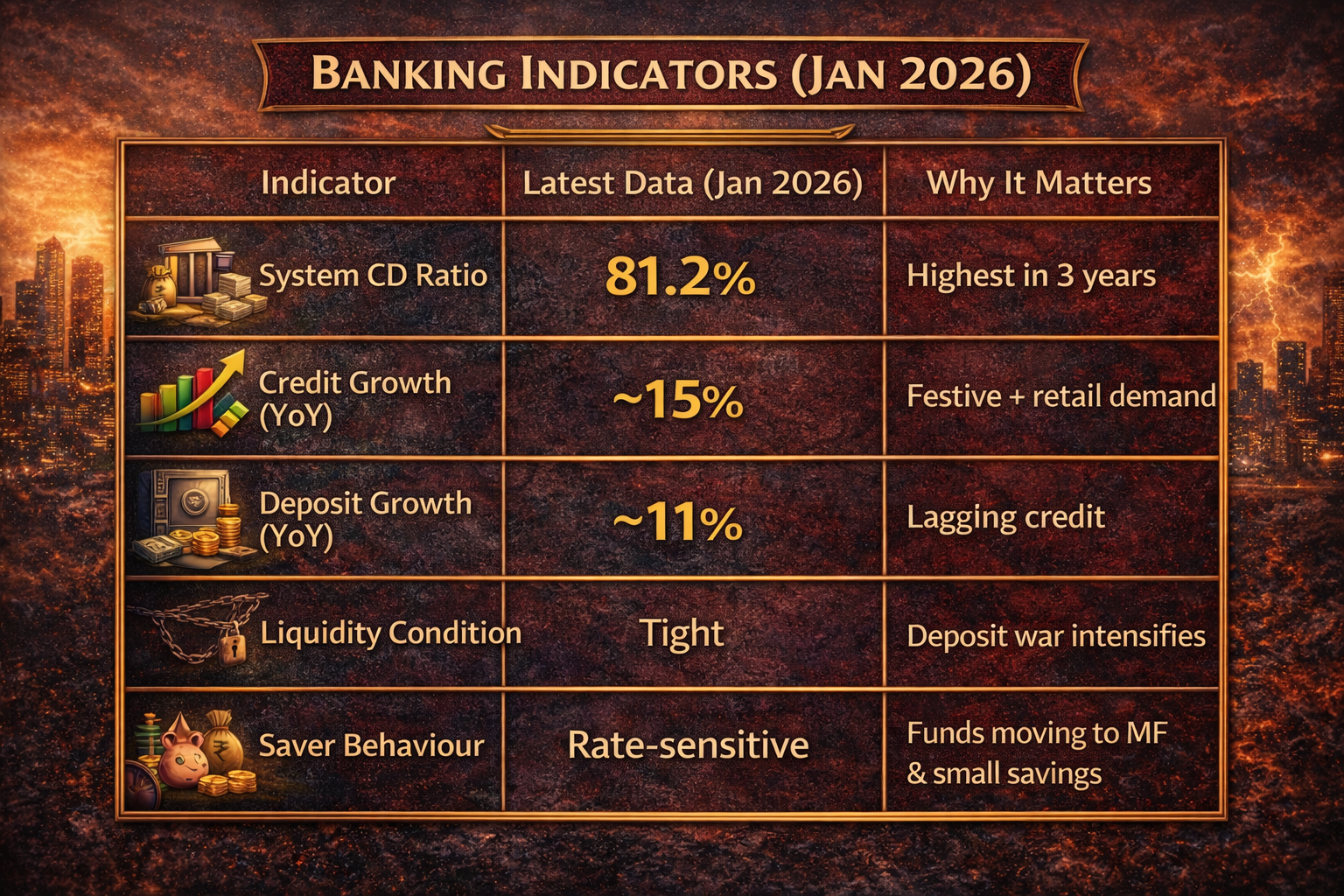
As of January 9, 2026, India’s banking system is running with a Credit-to-Deposit (CD) ratio of 81.2%, the highest level seen in more than a decade. In simple terms, banks are lending much faster than they are collecting deposits. This creates stress, not immediately, but structurally.
Festive demand, infrastructure push, retail loans, and GST-driven formalisation have kept credit offtake strong. But deposit growth has failed to keep pace. Savers are demanding higher interest rates, while alternative investments like mutual funds and government schemes are pulling money away from bank deposits.
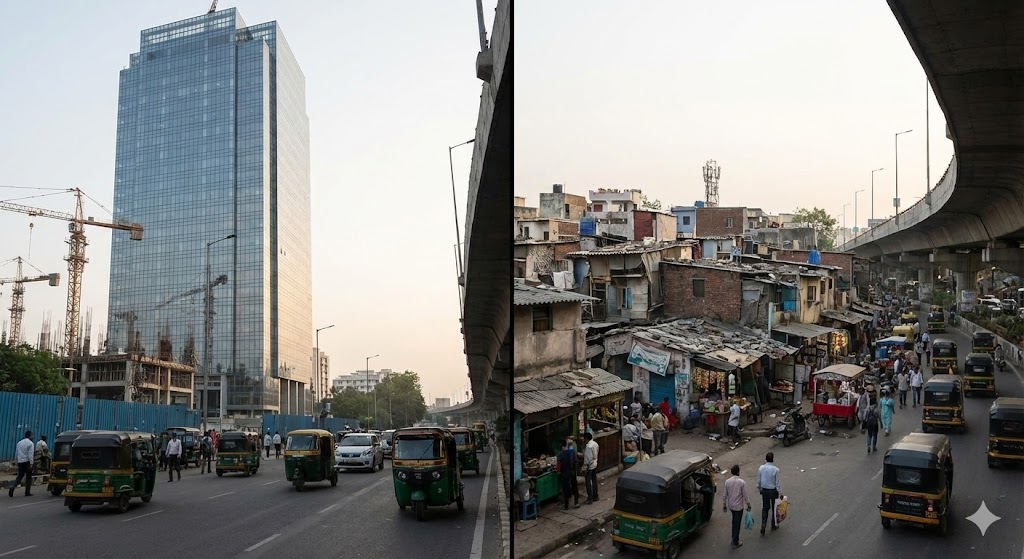
This is why Q3 FY26 results are not just about profit numbers. They are a stress test of each bank’s liability franchise. The contrast between HDFC Bank and IndusInd Bank clearly shows one truth:
In 2026, liability is the new asset.
2. HDFC Bank: The Resilience of a Post-Merger Giant
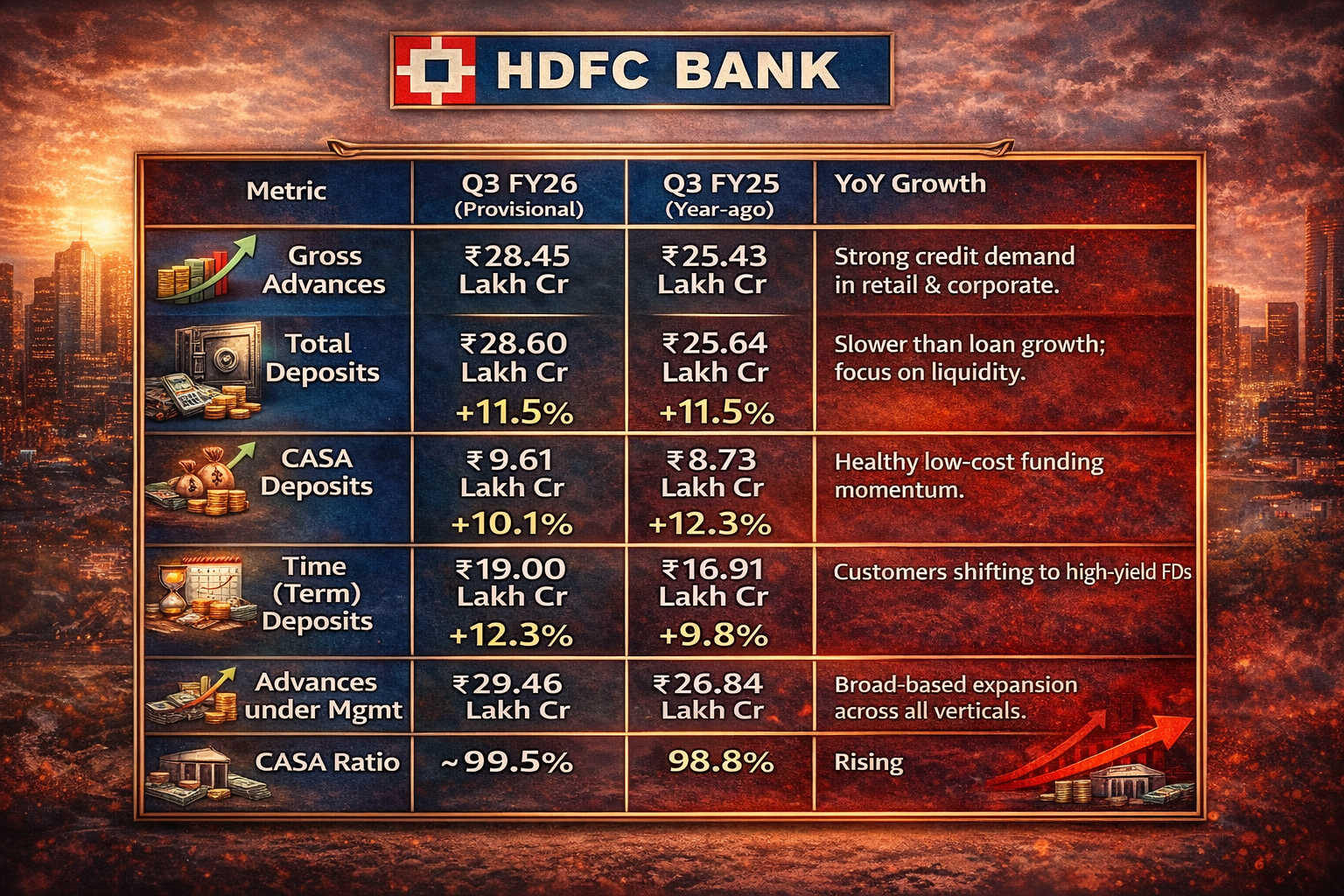
HDFC Bank’s Q3 FY26 numbers mark an important turning point. For the first time since its landmark merger with HDFC Ltd, the bank has returned to double-digit loan growth.
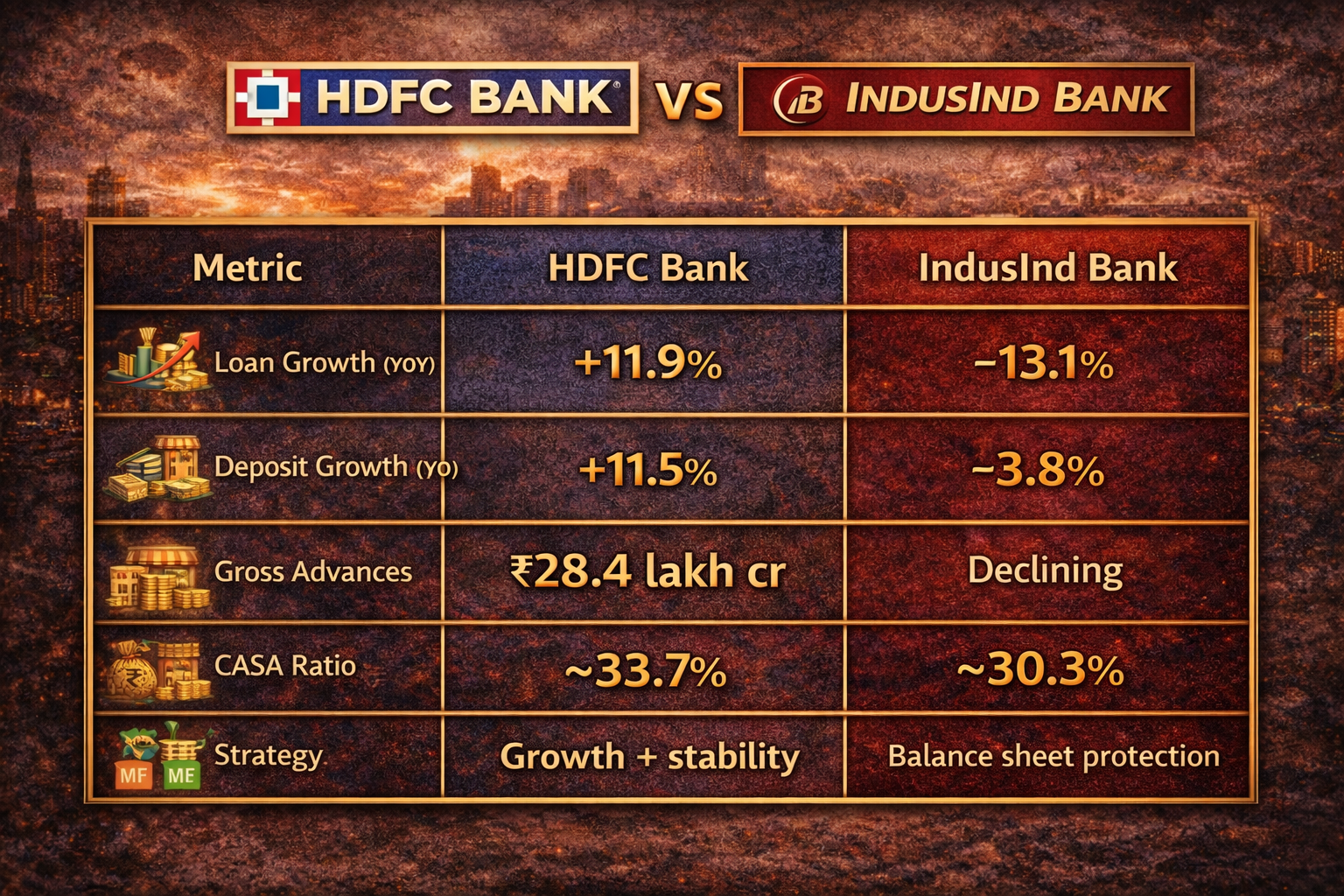
Gross advances grew 11.9% year-on-year, reaching nearly ₹28.4 lakh crore. This is not explosive growth, but it is healthy, balanced, and sustainable. More importantly, the quality of growth matters. Retail loans picked up steadily, while corporate demand also improved, especially from well-rated borrowers.
This confirms that merger synergies are finally kicking in. For several quarters after the merger, HDFC Bank deliberately slowed loan growth to stabilise systems, align products, and absorb the mortgage-heavy balance sheet of HDFC Ltd. That phase now appears largely complete.
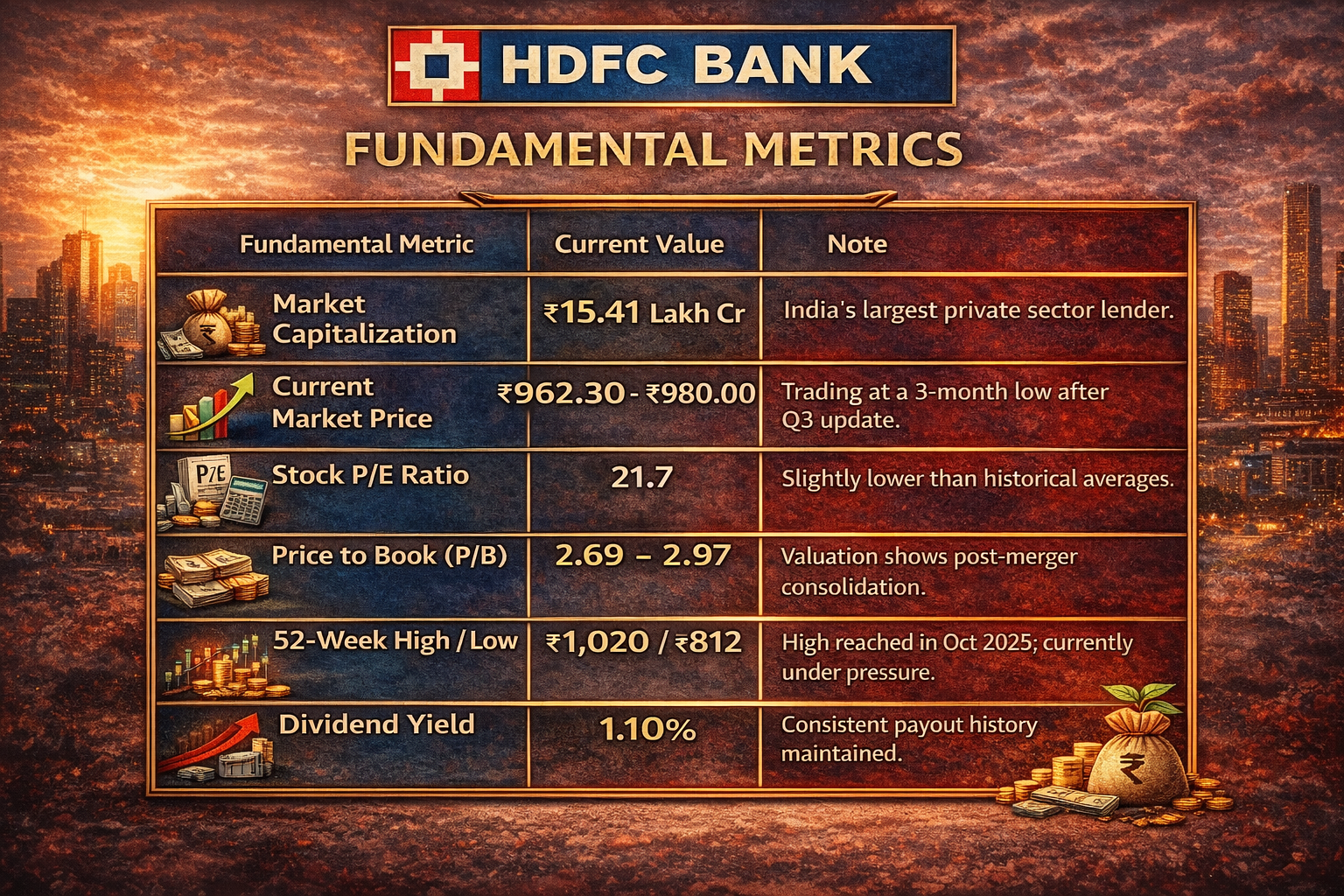
However, deposit growth, at 11.5% YoY, remains slightly behind loan growth. This keeps the bank’s incremental Loan-to-Deposit Ratio elevated. Yet, HDFC Bank enjoys one key advantage that most peers do not: CASA strength.
Its CASA book stands at around ₹9.6 lakh crore, translating to a CASA ratio of ~33.7%. In a tight liquidity environment, this is gold. Low-cost current and savings deposits protect margins, reduce dependence on bulk deposits, and provide stability during stress cycles.
Simply put, HDFC Bank can afford to run faster because its fuel is cheaper.
3. IndusInd Bank: The “Liquidity Trap” Warning
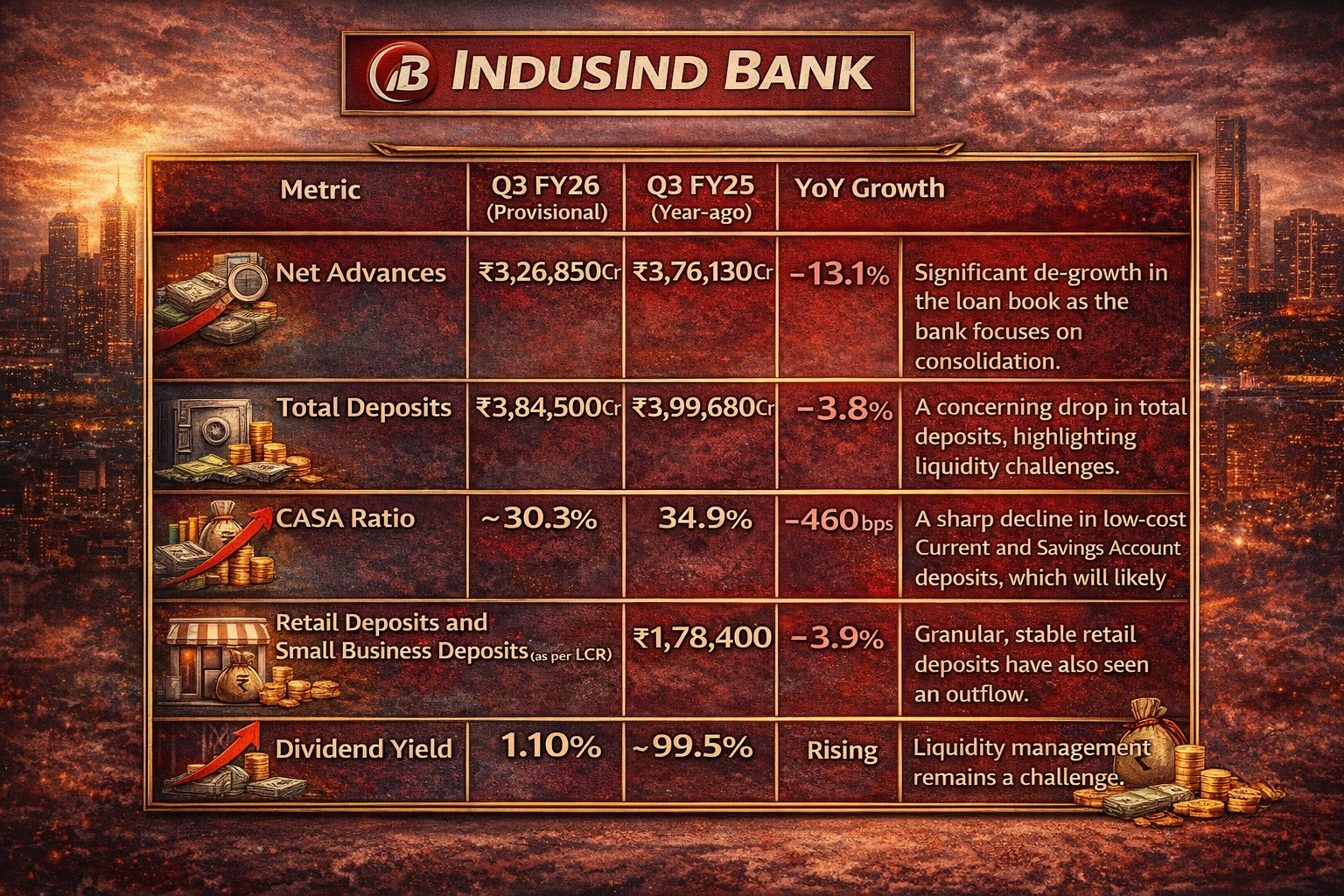
If HDFC Bank represents stability, IndusInd Bank represents caution. Its Q3 FY26 performance is a clear warning of what happens when deposit strength weakens.
Net advances declined sharply by 13.1% year-on-year, while deposits fell 3.8% YoY. This is not just a slowdown—it is a contraction. Management has openly acknowledged that the focus has shifted from growth to balance sheet consolidation.
The most worrying signal lies in deposits. IndusInd Bank’s CASA ratio slipped from 34.9% last year to 30.3% in Q3 FY26. This may look like a small change, but in banking, a few percentage points can destroy margins.
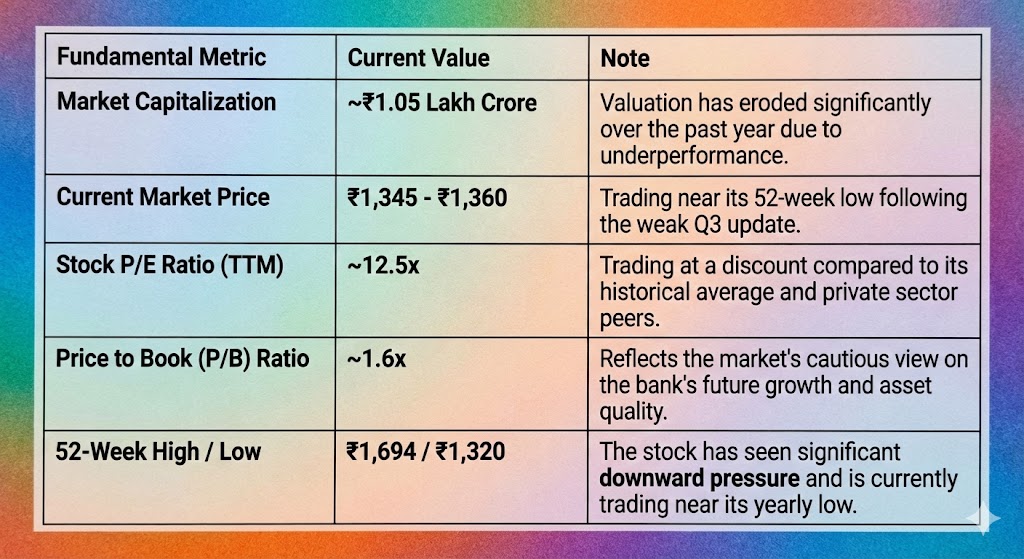
When low-cost CASA deposits shrink, banks are forced to rely on bulk deposits and wholesale borrowing, which are far more expensive and volatile. This directly hits Net Interest Margins (NIMs) and reduces profitability.
Adding to the pressure is the ongoing SFIO investigation, which has made the bank more conservative in lending. While this approach protects asset quality in the short term, it also limits growth and investor confidence.
IndusInd Bank is not in crisis—but it is clearly stuck in a liquidity trap, where caution replaces expansion.
4. Geoeconomic Impact: RBI’s “Liquidity Lifeline”
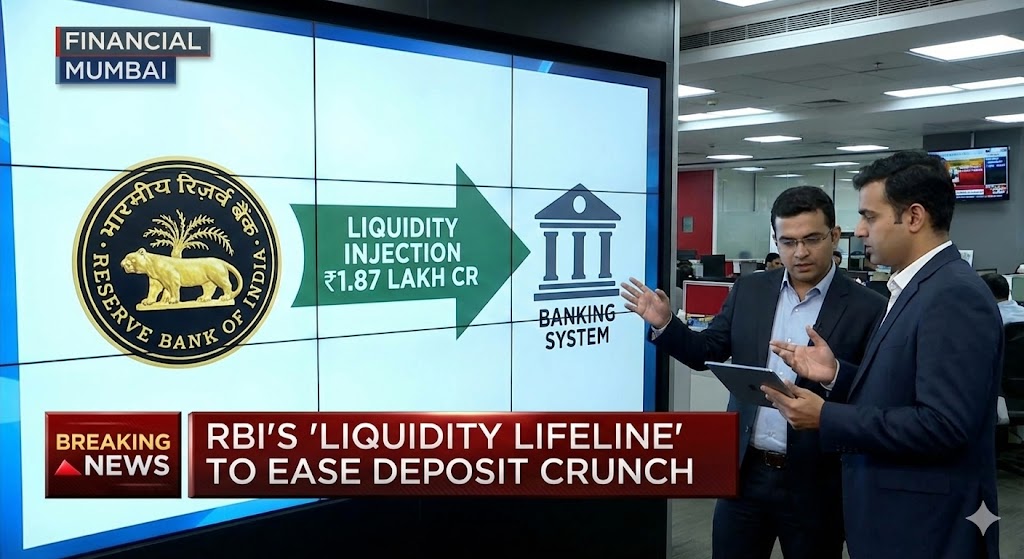
The deposit stress is not limited to individual banks. It is system-wide. Recognising this, the Reserve Bank of India stepped in during Q3 FY26 with a critical policy move.
The RBI announced a 100 basis point cut in the Cash Reserve Ratio (CRR), releasing nearly ₹1.87 lakh crore into the banking system. This provided immediate liquidity relief and prevented short-term funding stress.
However, this relief comes with a warning for the future.
From April 2026, new Liquidity Coverage Ratio (LCR 2.0) norms will come into effect. Under these guidelines, banks will have to apply a higher run-off factor (around 2.5%) on digital and callable deposits.
This means banks that rely heavily on app-based, quick-withdrawal deposits will need to hold more high-quality liquid assets. In simple terms, deposit mobilisation will become harder and more expensive, especially for digital-first banks.
The message from the RBI is clear: liquidity will be supported, but discipline is non-negotiable.
RBI Liquidity & CRR Policy (Primary Source)
5. Why the “Deposit War” Hits Your Portfolio

For investors, the deposit war is not an abstract banking concept. It directly impacts stock prices, valuations, and long-term returns.
Banks that can grow loans without stretching deposits will command a valuation premium. Banks that chase growth without stable funding will be punished.
Here is the logic in simple terms:
Strong deposit franchises enjoy lower cost of funds
Lower cost of funds protects margins
Stable margins support consistent profits
Consistent profits justify higher valuations
The market has already started reacting.
Large private banks with strong CASA and disciplined CD ratios continue to attract long-term investors. Mid-tier banks facing deposit pressure are seeing continuous downward re-rating, even when asset quality remains stable.
This is why Q3 FY26 results matter more than usual. They separate structural winners from cyclical survivors.
6. The Bigger Picture: From Credit Cycle to Liability Cycle
For most of the last decade, Indian banking was focused on asset quality. NPAs, bad loans, and capital adequacy dominated discussions. That phase is largely behind us.
Now, the system has entered a liability cycle.
Deposits are no longer guaranteed. Customers are rate-sensitive, digitally mobile, and willing to shift money quickly. Mutual funds, small savings schemes, and even equity markets are competing directly with banks for household savings.
In this environment, brand trust, branch reach, salary accounts, and transaction banking matter more than aggressive lending.
Banks that spent years building granular deposit franchises are now reaping rewards. Those that relied on wholesale funding are being forced to slow down.
This shift will define Indian banking returns over the next 3–5 years.
7. Conclusion: The “Flight to Quality” Has Begun
The lesson from Q3 FY26 is simple but powerful.
In 2026, the winner is not the bank that lends the most.
The winner is the bank that manages its cost of funds best.
The era of easy liquidity is over. Credit growth will continue, but only for banks with strong deposit engines. Investors should focus on two basic numbers:
CASA ratio above 35%
CD ratio below 80%
Banks that meet these conditions will survive and thrive. Those that don’t will struggle, regardless of how attractive loan growth looks on paper.
The Q3 FY26 results are not just quarterly updates. They are a clear signal that the Indian banking system has entered a new phase.
The Great Deposit Divide is real—and it has already begun.
Frequently Asked Questions (FAQ)
1. Why did IndusInd Bank’s net advances fall in Q3 FY26?
IndusInd Bank deliberately reduced loan growth to protect balance-sheet stability. With deposits declining and liquidity tightening, the bank chose consolidation over expansion to avoid funding stress and margin pressure.
2. Why is the fall in total deposits a serious concern?
Deposits are the cheapest and most stable source of funding for banks. A decline in total deposits forces banks to rely on costly bulk deposits or market borrowing, which directly impacts profitability and risk management.
3. What does the sharp drop in CASA ratio mean?
The CASA ratio fell from 34.9% to ~30.3%, indicating a loss of low-cost savings and current account funds. This increases the cost of funds and can compress net interest margins in coming quarters.
4. How does CASA erosion affect bank margins?
Lower CASA means higher dependence on fixed deposits and wholesale funding. These carry higher interest costs, reducing spreads between lending and borrowing rates, which hurts earnings.
5. Why are retail and small business deposits also declining?
Retail and small business depositors have become rate-sensitive. Many are shifting money to higher-yield fixed deposits, government schemes, or mutual funds due to tight liquidity and rising interest rate competition.
6. Is this deposit stress unique to IndusInd Bank?
No. The issue is system-wide. India’s banking system is facing a deposit crunch as credit growth outpaces deposit mobilisation. However, banks with weaker liability franchises feel the impact more sharply.
7. How is the RBI responding to the liquidity pressure?
The Reserve Bank of India has provided temporary relief through liquidity measures such as CRR cuts. However, upcoming tighter liquidity rules will increase long-term funding discipline.
8. How does IndusInd Bank compare with stronger peers?
Banks like HDFC Bank continue to outperform due to stronger deposit franchises and stable CASA ratios. This highlights why liability strength matters more than loan growth in FY26.
9. Should investors be worried about IndusInd Bank?
The situation is not a crisis, but it is a warning sign. The bank is prioritising stability over growth, which may limit near-term performance. Investor confidence will depend on deposit recovery and margin stability in upcoming quarters.
10. What should investors track next?
Key metrics to watch include:
Deposit growth trend
CASA ratio movement
Cost of funds
Net interest margins
Compliance with new liquidity rules
These indicators will decide whether IndusInd Bank can exit the liquidity stress phase smoothly.
People Also Ask (PAA)
Why are IndusInd Bank’s deposits falling in FY26?
IndusInd Bank’s deposits are falling due to intense competition for deposits across the banking system. Higher interest rates on fixed deposits, attractive government schemes, and mutual fund returns have drawn money away from savings and current accounts.
Is IndusInd Bank facing a liquidity crisis?
IndusInd Bank is not facing an immediate liquidity crisis, but it is under liquidity pressure. Falling deposits and a lower CASA ratio make funding more expensive, which is why the bank is focusing on balance-sheet consolidation instead of aggressive loan growth.
How serious is the CASA ratio decline for IndusInd Bank?
The drop in the CASA ratio from 34.9% to around 30.3% is significant. CASA deposits are the cheapest source of funds, and a sharp fall can directly impact net interest margins and profitability in future quarters.
Why is IndusInd Bank reducing loan growth?
The bank is slowing loan growth to match its funding capacity. Expanding loans without stable deposits would increase risk and funding costs, so management has chosen stability over growth.
Are other Indian banks facing similar deposit pressure?
Yes. Deposit pressure is a system-wide issue in India. Many banks are seeing credit growth outpace deposit growth. However, banks with strong retail deposit franchises are managing the situation better than mid-sized lenders.
How does IndusInd Bank compare with HDFC Bank in FY26?
Compared to HDFC Bank, IndusInd Bank has a weaker deposit franchise and lower CASA ratio. This difference explains why HDFC Bank continues to grow while IndusInd Bank is consolidating.
Will RBI liquidity measures fully solve the deposit problem?
Short-term liquidity measures from the Reserve Bank of India provide temporary relief. However, long-term solutions depend on deposit mobilisation, cost control, and adapting to tighter liquidity regulations.
What does this mean for IndusInd Bank shareholders?
Shareholders may face short-term volatility due to slower growth and margin pressure. Long-term performance will depend on how quickly the bank rebuilds deposits and stabilizes its funding costs.
Is IndusInd Bank stock undervalued because of these issues?
Valuation alone is not enough. While the stock may appear cheaper, markets usually wait for clear signs of deposit recovery and margin stability before re-rating banking stocks under liquidity stress.
What are the key signs of recovery investors should watch?
Investors should track:
Sequential deposit growth
Improvement in CASA ratio
Stabilization of net interest margins
Reduced dependence on bulk deposits
These indicators will show whether IndusInd Bank is emerging from its liquidity stress phase.
Infographic Table 1: Indian Banking System Snapshot (Q3 FY26)
📍 Place after Introduction – “The Dichotomy of Growth”
| Indicator | Latest Data (Jan 2026) | Why It Matters |
|---|---|---|
| System CD Ratio | 81.2% | Highest in 3 years |
| Credit Growth (YoY) | ~15% | Festive + retail demand |
| Deposit Growth (YoY) | ~11% | Lagging credit |
| Liquidity Condition | Tight | Deposit war intensifies |
| Saver Behaviour | Rate-sensitive | Funds moving to MF & small savings |
📌 Key Insight: Banks are lending faster than they can fund.
📊 Infographic Table 2: Q3 FY26 – HDFC Bank vs IndusInd Bank
📍 Place at the start of Section 2
| Metric | HDFC Bank | IndusInd Bank |
|---|---|---|
| Loan Growth (YoY) | +11.9% | -13.1% |
| Deposit Growth (YoY) | +11.5% | -3.8% |
| Gross Advances | ₹28.4 lakh cr | Declining |
| CASA Ratio | ~33.7% | ~30.3% |
| Strategy | Growth + stability | Balance sheet protection |
📌 Message: Liability strength decides momentum.
📊 Infographic Table 3: Why CASA Is the Real Power Metric
📍 Place after CASA explanation in Section 2
| CASA Ratio Level | Impact on Bank |
|---|---|
| Above 35% | Strong margin protection |
| 30–35% | Manageable |
| Below 30% | High funding stress |
| Falling CASA | Margin compression |
| Rising CASA | Valuation premium |
📌 Simple Truth: Cheap money = competitive advantage.
Infographic Table 4: The IndusInd “Liquidity Trap” Explained
📍 Place in Section 3
| Stress Point | Impact |
|---|---|
| CASA erosion | Higher cost of funds |
| Deposit decline | Lending slowdown |
| Wholesale borrowing | Margin pressure |
| SFIO probe | Conservative growth |
| Strategy shift | Consolidation over expansion |
📌 Reality: Protecting quality often means sacrificing growth.
📊 Infographic Table 5: RBI’s Liquidity Lifeline (Q3 FY26)
📍 Place in Section 4
| RBI Action | Impact |
|---|---|
| CRR cut | 100 bps |
| Liquidity released | ₹1.87 lakh crore |
| Short-term stress | Reduced |
| Long-term challenge | LCR tightening |
| Policy message | Support + discipline |
📌 Insight: Liquidity help is temporary; rules are permanent.
📊 Infographic Table 6: LCR 2.0 – What Changes From April 2026
📍 Place after LCR explanation
| Area | Old Rule | New Rule (LCR 2.0) |
|---|---|---|
| Digital deposits | Lower run-off | +2.5% run-off |
| Liquidity buffer | Lower | Higher |
| Impact on banks | Neutral | Funding stress |
| Digital-first banks | Advantage | Disadvantage |
| Deposit value | Medium | Very high |
📌 Meaning: Not all deposits are equal anymore.
📊 Infographic Table 7: What Investors Should Track in 2026
📍 Place near Conclusion
| Metric | Safe Zone |
|---|---|
| CASA Ratio | >35% |
| CD Ratio | <80% |
| Deposit Growth | ≥ Credit Growth |
| Retail Deposit Share | High |
| Wholesale Dependence | Low |
📌 Investor Rule: Funding strength beats loan growth.