Introduction: The ER&D Powerhouse at a Pivot
If you look back to the mid-1990s, engineering services in India were largely limited to CAD drawings and mechanical design outsourcing. Fast forward to 2026, and the entire landscape has transformed. Today, engineering is deeply intertwined with software, artificial intelligence, and digital ecosystems. Concepts like Software Defined Vehicles (SDVs), digital twins, and connected mobility are no longer futuristic—they are the present reality. At the center of this shift stands Tata Technologies, a company that is evolving rapidly to stay ahead of this transformation.
The Q4 FY26 results, approved on May 4, 2026, reflect this transition phase clearly. While global automotive clients are slowing down capital expenditure due to economic uncertainties, Tata Technologies has managed to deliver steady performance. The real story, however, lies beyond the numbers—it is about how the company is diversifying its business model and reducing its dependence on legacy revenue streams.
At present, the stock is trading around ₹780, recovering sharply from its March lows of ₹507. However, it still reflects a cautious sentiment in the market. Investors are trying to balance the premium associated with the Tata brand against the company’s moderate growth outlook in the near term.
Q4 FY26 Financial Scorecard (Actual Data from NSE)
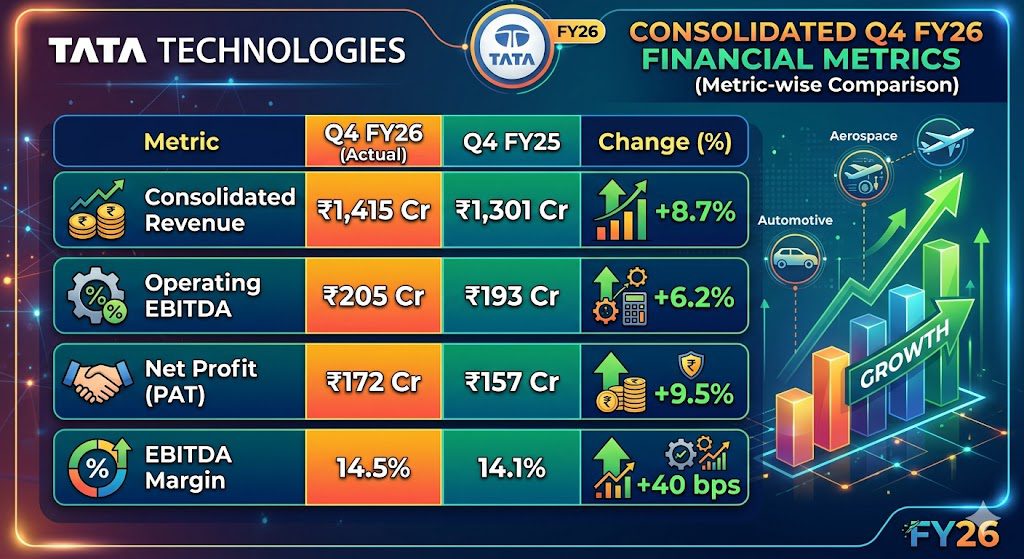
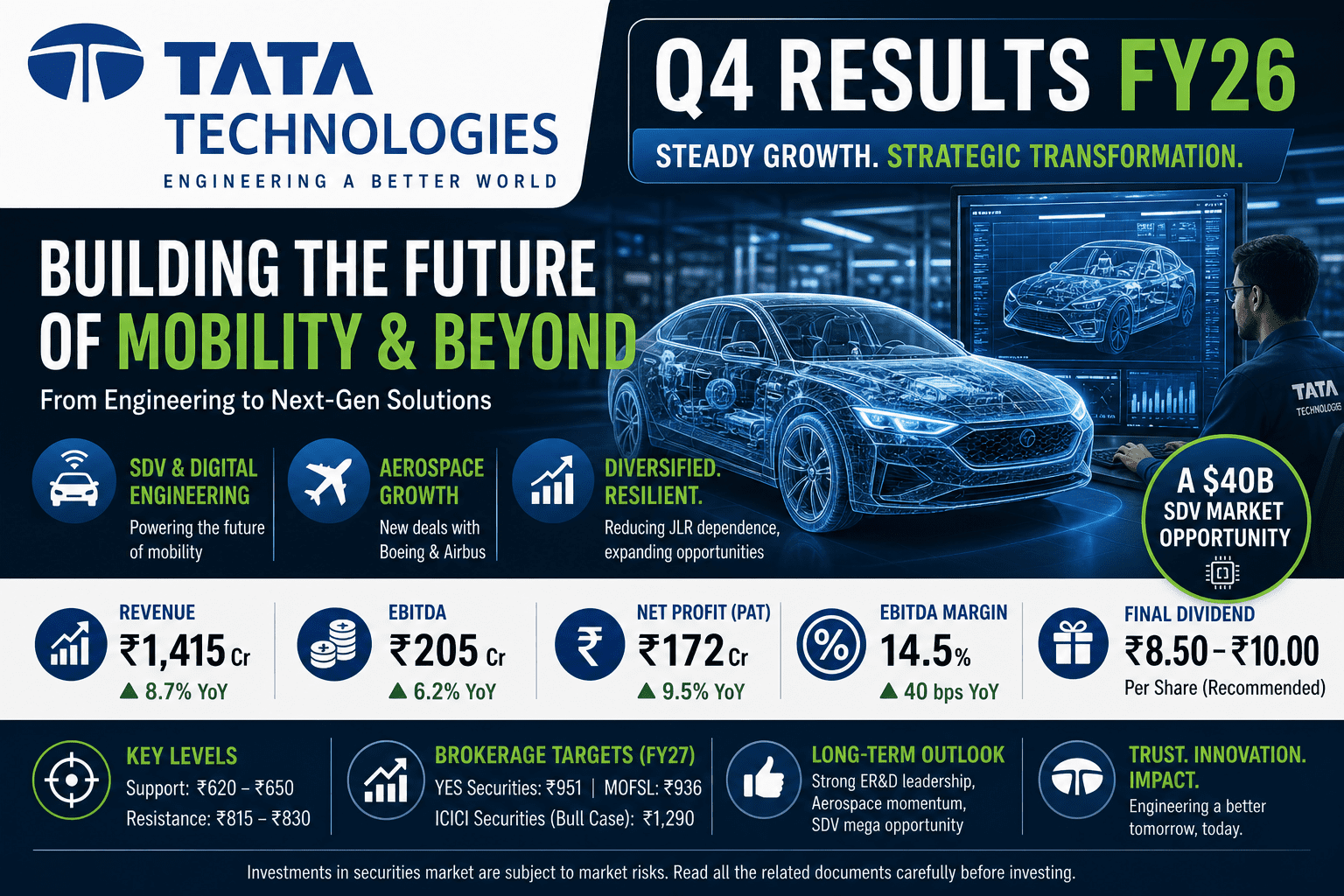
The financial performance for Q4 FY26 shows a company that is stable, disciplined, and gradually improving. Consolidated revenue came in at ₹1,415 crore, registering a growth of 8.7% compared to ₹1,301 crore in the same quarter last year. While this growth may not appear explosive, it is quite respectable given the slowdown in global automotive spending.
Operating EBITDA stood at ₹205 crore, up 6.2% year-on-year from ₹193 crore. This indicates that the company has maintained strong operational efficiency even in a challenging environment. Net profit (PAT) increased to ₹172 crore, reflecting a 9.5% growth compared to ₹157 crore last year. This growth is also supported by a partial recovery from the labor code-related impact seen in the previous quarter.
One of the most encouraging aspects of this quarter is the improvement in margins. EBITDA margin expanded slightly from 14.1% to 14.5%, showing better cost management and execution efficiency. Overall, the numbers reflect a balanced and steady performance, rather than aggressive expansion.
Fundamental Analysis: Diversification Beyond JLR
The Captive Anchor: JLR Dependence
For many years, Jaguar Land Rover (JLR) has been a key revenue contributor for Tata Technologies, accounting for more than 20% of its business. While this relationship has provided stability and long-term contracts, it has also created concentration risk. Any slowdown in JLR’s operations directly impacts Tata Technologies’ growth.
However, the company is now actively reducing this dependency. By expanding into new industries and geographies, it is building a more diversified revenue base. This transition is critical for long-term sustainability.
Aerospace Momentum: The New Growth Engine
One of the most significant developments is the company’s expansion into the aerospace sector. With new contracts from global leaders like Boeing and Airbus, Tata Technologies is entering a high-value, high-margin segment.
The aerospace business is expected to generate around $40 million in FY26. More importantly, it provides a hedge against the cyclical nature of the automotive industry. Aerospace contracts tend to be long-term and less volatile, making them an ideal diversification strategy.
Es-Tec Integration: Strengthening Europe
The acquisition of Es-Tec has strengthened Tata Technologies’ presence in Europe, especially in Germany. This has enabled deeper engagement with leading automotive companies like Volkswagen.
This integration is particularly important for building capabilities in Software Defined Vehicles (SDVs), which are expected to dominate the future of mobility. By combining engineering expertise with software capabilities, Tata Technologies is positioning itself as a key player in this space.
Technical Analysis: The Support & Resistance Zones
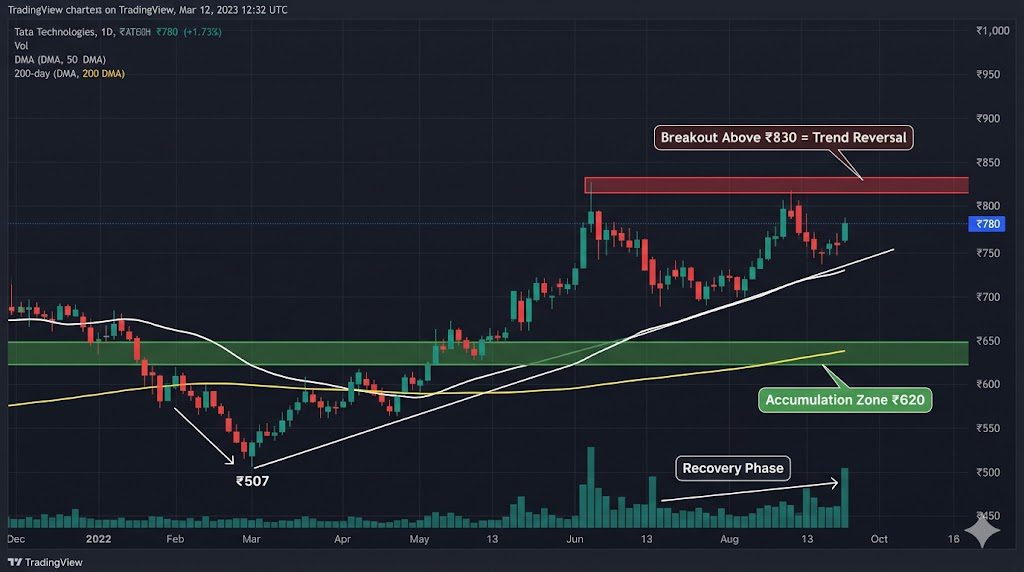
From a technical perspective, the stock is currently transitioning from a bearish phase to a more neutral stance. It has shown resilience by outperforming the broader market in the short term, delivering around 6.6% returns over the past month.
The pivot level stands at ₹780.35, which is close to the current trading price. This makes it a crucial level for short-term direction.
The major support zone lies between ₹620 and ₹650. This range has acted as a strong base for the stock over the past few months, making it a key accumulation zone for long-term investors.
On the upside, the immediate resistance is between ₹815 and ₹830. A strong breakout above this level could signal a reversal in trend and open the door for higher targets.
Dividend & Shareholder Value
Tata Technologies continues to follow the Tata Group’s tradition of rewarding shareholders. The board has recommended a final dividend in the range of ₹8.50 to ₹10 per share.
At the current price, this translates to a dividend yield of approximately 1.4% to 1.8%. While this may not seem very high, it is quite attractive for a company that is still in a growth phase.
This balanced approach—combining growth with consistent payouts—adds to the stock’s appeal, especially for long-term investors looking for stability along with capital appreciation.
Brokerage Sentiment & Targets (The Re-rating View)
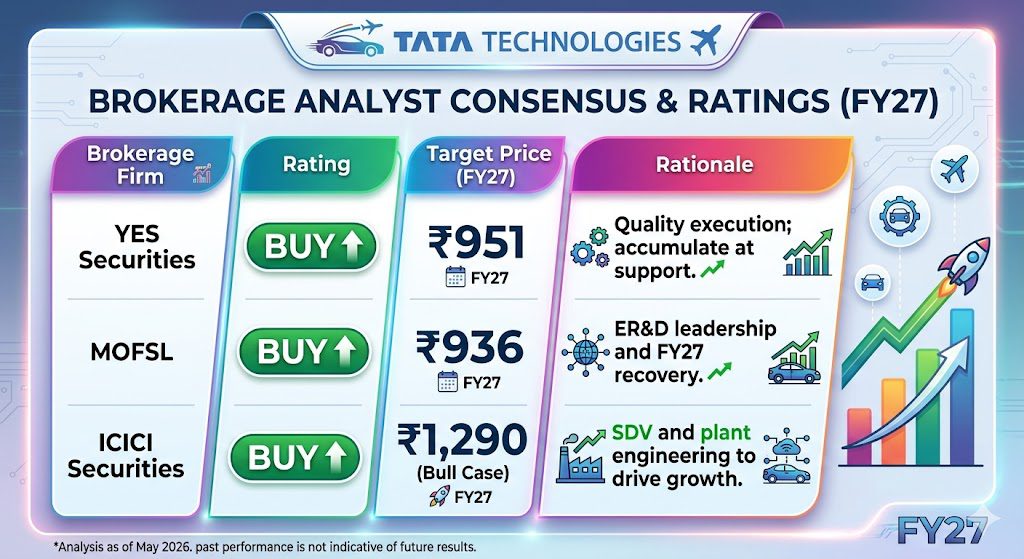
Brokerages remain largely optimistic about Tata Technologies’ long-term prospects.
YES Securities has given a “Buy” rating with a target price of ₹951, recommending accumulation at support levels. Motilal Oswal has also maintained a “Buy” rating with a target of ₹936, citing strong execution and leadership in the ER&D space.
ICICI Securities is the most bullish, with a target price of ₹1,290 in its bull-case scenario. This optimism is driven by the company’s exposure to Software Defined Vehicles and plant engineering.
These targets indicate that the market expects a potential re-rating as the company successfully executes its diversification strategy.
The “30-Year” Analyst Verdict
From a long-term perspective, Tata Technologies is a classic “patience play.” The company is undergoing a structural transformation, moving from a traditional engineering services firm to a diversified digital engineering powerhouse.
The opportunity in Software Defined Vehicles alone is estimated to be around $40 billion globally. Tata Technologies is positioning itself to capture a meaningful share of this market.
For investors, the strategy should be to accumulate during consolidation phases rather than chasing short-term rallies. For traders, a breakout above ₹830 with strong volume could signal a bullish trend, while a stop-loss around ₹745 helps manage risk.
Conclusion & Engagement (CTA)
Tata Technologies’ Q4 FY26 results highlight a company that is stable, disciplined, and strategically evolving. While growth remains moderate in the short term, the long-term story is becoming increasingly compelling.
With diversification into aerospace, expansion in Europe, and strong positioning in Software Defined Vehicles, the company is preparing for the next phase of growth.
The key question for investors is simple—are you willing to stay invested for the long-term transformation, or are you waiting for stronger growth signals before entering?
Let’s discuss your strategy on Tata Technologies in the comments, because this is one story where patience could potentially reward investors in a big way.