Introduction: The Spendthrift’s Resilience
In today’s India, consumption is no longer limited by income alone—it is driven by access to credit. Over the past decade, credit cards have evolved from a premium product used by a small section of society into a daily financial tool for millions. At the center of this transformation is SBI Cards and Payment Services, the country’s only pure-play listed credit card company.
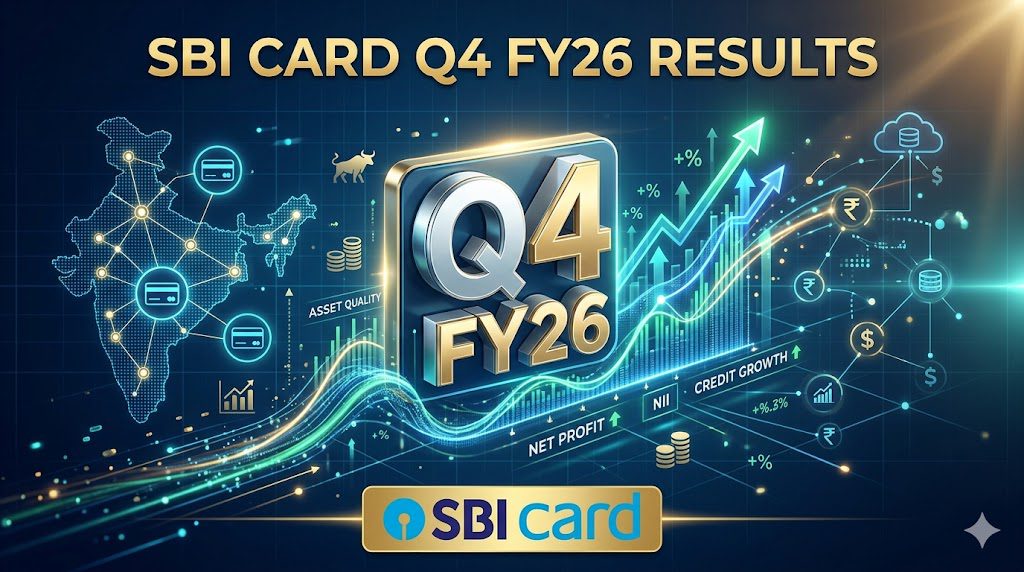
The Q4 FY26 results released on April 27, 2026, present a story of resilience and recovery. Despite high interest rates and a volatile macro environment, Indian consumers continue to spend aggressively. SBI Card reported a massive 31% jump in spending, reaching ₹1.15 lakh crore in a single quarter . This number alone tells you how strong the consumption engine in India remains.
At the same time, net profit for the quarter rose 14% to ₹609 crore, beating cautious market expectations. While the stock is still trading around ₹664 and has not yet reflected this improvement fully, the fundamentals indicate that the company is moving past its challenging phase.
FY26 can be described as the “year of cleanup” for SBI Card. Now, FY27 could become the “year of growth.”
Q4 FY26 Financial Scorecard: The Quality Turnaround
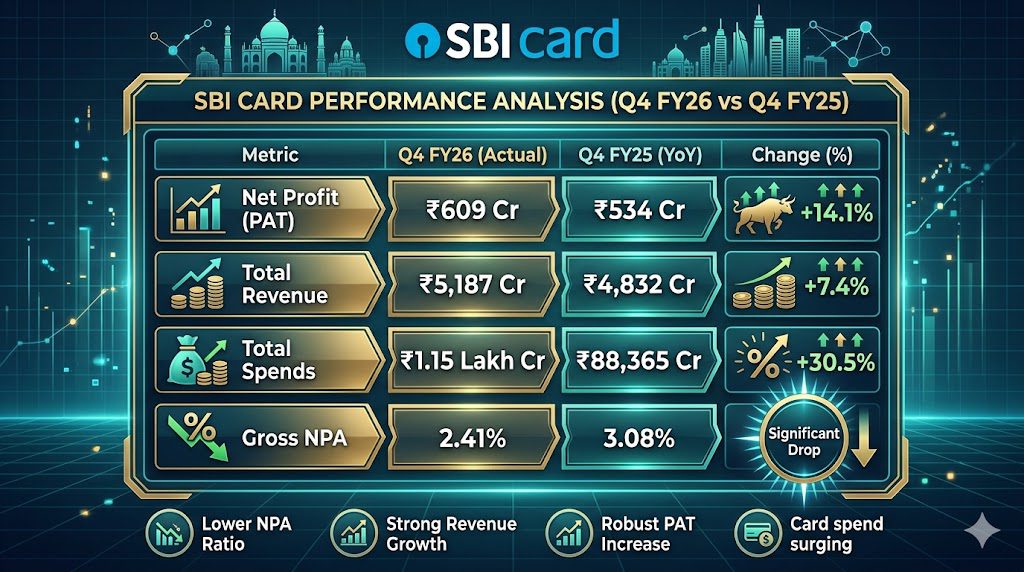
SBI Card’s Q4 FY26 financial performance reflects steady growth combined with improving quality of earnings. The company reported a net profit of ₹609 crore, compared to ₹534 crore in the same quarter last year, marking a growth of 14.1%. This increase, though moderate compared to high-growth sectors, is significant for a business that has been focusing on stabilizing its loan book.
Total revenue rose to ₹5,187 crore from ₹4,832 crore, representing a growth of 7.4%. This indicates that the company continues to expand its business even while tightening credit standards.
The most striking number is total spending, which surged to ₹1.15 lakh crore from ₹88,365 crore a year ago. This 30.5% growth highlights the rising adoption of credit cards across India.
Another critical metric is asset quality. Gross NPA declined sharply to 2.41% from 3.08%, showing a clear improvement in the quality of the loan book. For a credit card company, this is perhaps the most important indicator of long-term sustainability.
Fundamental Analysis: Quality Over Quantity
Asset Quality: The Biggest Victory
The most important takeaway from this quarter is the improvement in asset quality. Gross NPA has dropped significantly to 2.41%, compared to over 3% last year. This reduction indicates that the company’s efforts to clean up its loan book are working.
During FY25, SBI Card had taken a more cautious approach, tightening credit norms and reducing exposure to high-risk customers. While this strategy slowed down growth in the short term, it has now resulted in a healthier portfolio.
For investors, this is a crucial signal. A cleaner loan book means lower future losses and more stable earnings.
Spending Momentum: India’s Consumption Story
India’s consumption story remains strong, and SBI Card is one of its biggest beneficiaries. Spending growth of over 30% shows that consumers are increasingly using credit cards for travel, shopping, dining, and online purchases.
The company’s market share in card spending has reached 18.1%, which is a significant achievement in a competitive market. Interestingly, while spending has increased, the company has been selective in issuing new cards. It added around 9.17 lakh new accounts compared to 11 lakh last year.
This indicates a shift toward quality customers rather than aggressive expansion.
UPI Integration: The Next Growth Driver
One of the biggest structural changes in India’s payments ecosystem is the integration of credit cards with UPI, especially through RuPay cards. SBI Card is well-positioned to benefit from this trend.
By linking credit cards to UPI, users can make small-ticket payments using credit, increasing transaction frequency. This not only boosts spending but also enhances customer engagement.
Over time, this could become a major growth driver for the company.
Technical Analysis: Finding the Bottom
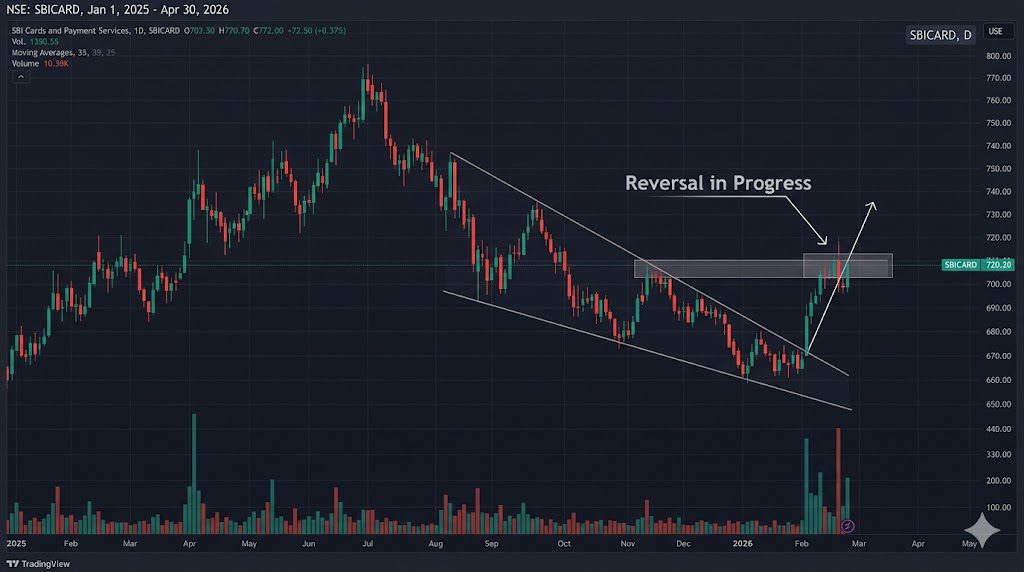
From a technical perspective, SBI Card’s stock has been under pressure for nearly a year, forming a falling wedge pattern. However, recent price action suggests that the stock may be nearing a bottom.
The ₹587–₹600 range has emerged as a strong support zone. The stock has tested this level multiple times and held firm, indicating strong buying interest.
On the upside, the ₹720–₹735 range acts as immediate resistance. A breakout above this level, supported by strong volume, could trigger a rally toward ₹860–₹870.
Momentum indicators are also improving. The RSI is currently around 48, moving out of the oversold zone. This suggests that selling pressure is easing and a potential trend reversal could be underway.
Dividend & Shareholder Value
SBI Card continues to reward its shareholders through consistent dividend payouts. The company has declared an interim dividend of ₹2.50 per share for FY26.
While the dividend yield may not be very high, it reflects the company’s stable cash flow generation. For investors, this provides an additional layer of comfort, especially in a business that combines growth with income.
Brokerage Sentiment & Targets: The FY27 Outlook
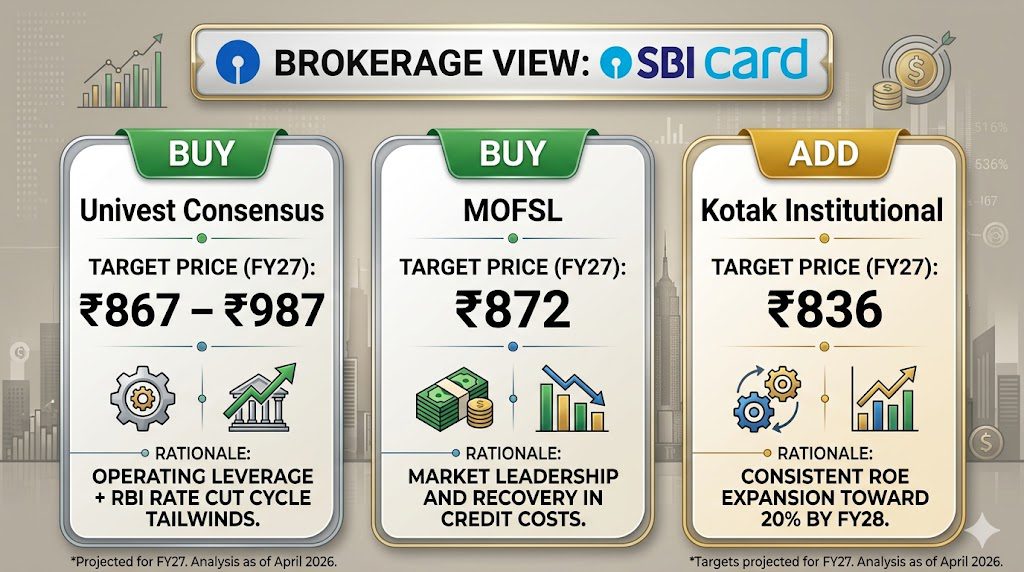
Brokerage firms have a positive outlook on SBI Card, especially as asset quality concerns begin to ease.
Motilal Oswal Financial Services has maintained a “BUY” rating with a target price around ₹872, citing strong market position and improving profitability.
Other analysts expect the stock to move toward ₹867–₹987 as operating leverage improves and credit costs decline.
The consensus view is that SBI Card is entering a re-rating phase, where improved fundamentals could lead to higher valuations.
The “30-Year” Analyst Verdict
For Long-Term Investors
SBI Card represents a structural growth story. In India, only about 5–7% of the population uses credit cards, compared to much higher penetration in developed markets.
This means the growth runway is enormous. With a current P/E of around 28x, the stock is trading at a discount compared to its historical average of 45x, making it relatively attractive.
For long-term investors, this is an opportunity to invest in a company that is at the forefront of India’s consumption growth.
For Traders
For traders, the current price level offers a favorable risk-reward setup. Buying near ₹664 with a stop-loss around ₹580 provides a controlled downside.
On the upside, a move toward ₹860 offers a strong return potential. However, traders should wait for confirmation of a breakout above ₹720 before taking aggressive positions.
Conclusion: Emerging from Troubled Waters
SBI Card’s Q4 FY26 results mark an important turning point. The company has successfully navigated a challenging period and is now emerging stronger.
The combination of improving asset quality, strong spending growth, and disciplined expansion creates a solid foundation for future growth.
While the stock has not yet fully reflected this improvement, the underlying fundamentals suggest that the worst may be behind.
What’s Your View? (CTA)
Do you think SBI Card can reach ₹987 in FY27, or do you prefer traditional banking stocks for stability? Share your thoughts and let’s discuss the future of credit in India.