The Lead: The “Elephant” in the Room
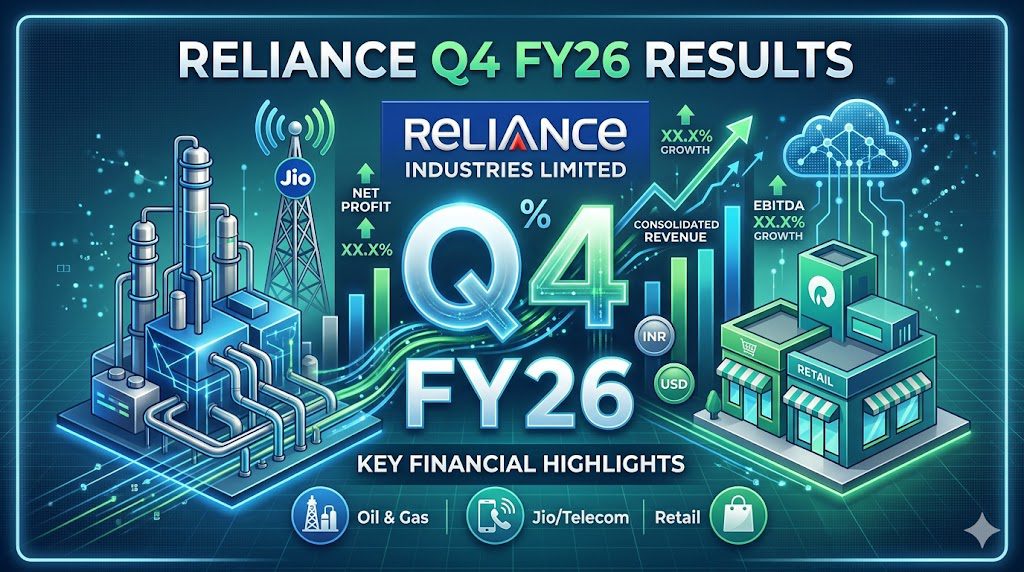
The market was expecting a roar from Reliance Industries this quarter, but what it delivered instead was a calm and steady performance. The company reported a net profit of ₹16,971 crore, marking a 12.5% decline year-on-year. At first glance, that might seem like a concern. However, when you look deeper, the bigger picture tells a different story. Revenue surged to an all-time high of ₹2.94 lakh crore, reflecting strong demand and operational scale. This contrast between falling profit and rising revenue highlights that the company is currently in a transition phase rather than facing any structural weakness. In simple terms, this is not a bad quarter—it’s a shifting quarter.
Company Introduction: The Oil-to-Digital Transition
Reliance Industries has evolved far beyond its roots as an oil and petrochemical giant. Today, it stands as India’s largest private sector company with a diversified business model that touches almost every part of the economy. Its operations are built on four strong pillars: the traditional Oil-to-Chemicals (O2C) business, the fast-growing digital arm through Jio Platforms, the massive consumer-focused Reliance Retail, and the emerging new energy segment focused on sustainability. This transformation from “oil to digital” is what makes Reliance a long-term growth story rather than just a cyclical stock.
Q4 FY26 Results: The Hard Data
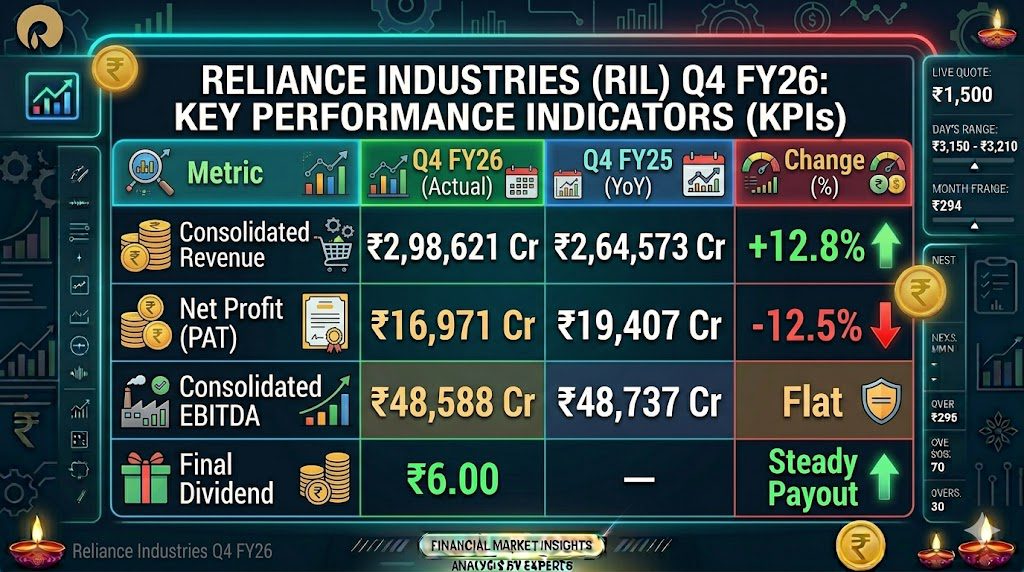
The numbers from this quarter show a mixed but stable performance. Reliance reported a net profit of ₹16,971 crore, down from ₹19,407 crore last year. At the same time, revenue increased significantly to ₹2.94 lakh crore, showing strong business momentum. EBITDA remained largely stable at ₹44,141 crore, indicating operational consistency. The company also announced a dividend of ₹6 per share, continuing its steady reward to shareholders. The slight dip in profit can largely be attributed to pressure in the O2C segment, where global refining margins were impacted by geopolitical disruptions, particularly in West Asia. Despite this, the company’s diversified structure helped maintain overall stability.
Segmental Deep-Dive: Where the Action Is
Jio Platforms: The Digital Growth Engine
The real growth engine of Reliance today is Jio Platforms. With over 268 million 5G users, Jio has become a dominant force in India’s digital ecosystem. What’s even more important is the rise in ARPU, which has reached ₹214, indicating better monetization of its user base. As data consumption continues to rise and 5G adoption expands, Jio is steadily transforming into a high-margin, cash-generating business. This segment is not just about telecom anymore—it represents the digital future of India.
Reliance Retail: The Consumption Story
Reliance Retail continues to capture the growth of India’s consumption economy. With more than 20,000 stores across the country, it has built one of the largest retail networks in India. The company has also seen a surge in footfalls and a sharp increase in hyperlocal delivery, which has grown by over 300% year-on-year. This segment reflects the rising spending power of Indian consumers and plays a key role in Reliance’s long-term growth strategy.
O2C (Oil-to-Chemicals): The Legacy Powerhouse
The O2C business remains the backbone of Reliance, even though it faced some challenges this quarter. Global refining margins have been volatile, and geopolitical tensions have disrupted supply chains, leading to pressure on profitability. However, the segment continues to show resilience, especially in areas like LPG and gas production from the KG-D6 basin. While short-term fluctuations are inevitable, the O2C business still provides strong cash flows that support the company’s expansion into new sectors.
Fundamental Analysis: The Value Play
Reliance Industries currently presents an interesting value proposition for investors. Despite its massive size, the company is still in a growth phase, driven by digital, retail, and new energy businesses. One factor that often comes into play is the “holding company discount,” where the market undervalues the combined worth of its different segments. As these businesses mature and possibly get listed separately, this gap could narrow, unlocking significant value for shareholders.
New Energy: The Next Big Catalyst
Reliance is making aggressive investments in renewable energy, including green hydrogen, solar manufacturing, and battery storage solutions. These projects are gradually moving from the planning and investment stage to execution and commissioning. Once operational, they could become a major revenue driver. This transition is similar to what the company achieved with Jio a few years ago, turning a new venture into a market leader.
Capital Expenditure & Cash Flow
The company continues to invest heavily, with capital expenditure exceeding ₹40,000 crore. While this may impact short-term profitability, it reflects strong confidence in future growth. Reliance is building long-term assets that are expected to generate stable cash flows for years to come. This strategy shows that the company is focused on sustainable growth rather than short-term gains.
Technical Analysis: The Chart Speaks
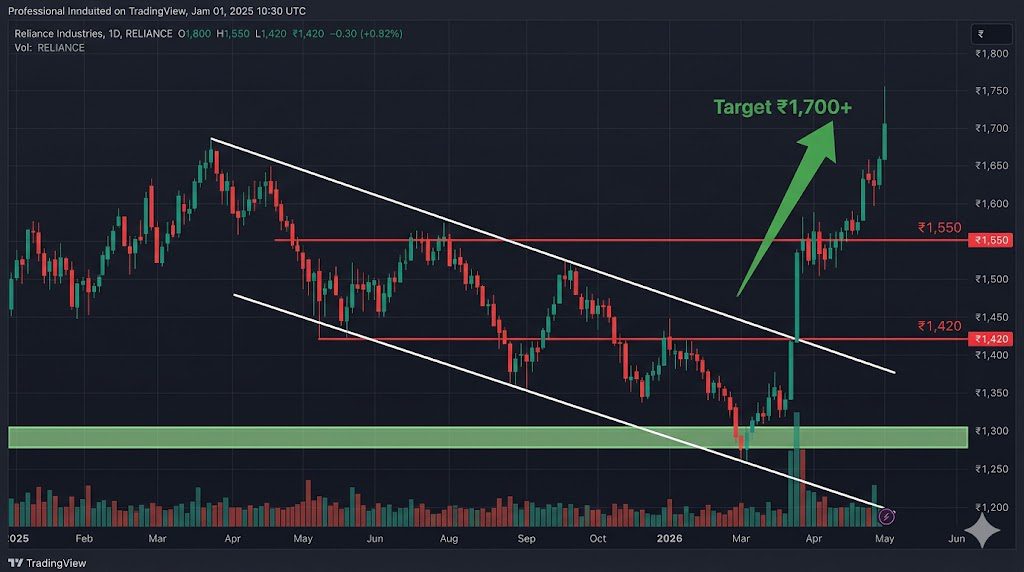
From a technical perspective, Reliance stock is currently trading in a consolidation range between ₹1,330 and ₹1,350. This indicates that the market is waiting for a clear trigger before making its next move. The strong support level lies between ₹1,280 and ₹1,300, which also aligns with its 52-week lows. On the upside, resistance is seen at ₹1,420 and ₹1,550. The stock is currently moving within a falling trend channel, and a breakout above the 200-day EMA could signal the start of a new upward trend. For traders, this is a critical zone to watch.
Brokerage Reports & Future Targets
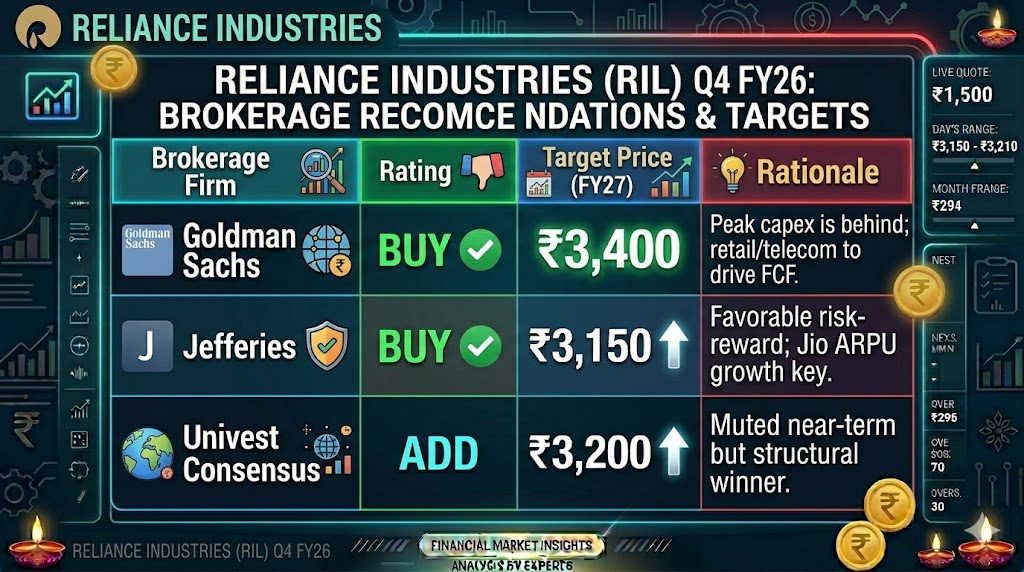
Market sentiment around Reliance remains largely positive. Global brokerage JPMorgan Chase has given an “Overweight” rating with a target price of ₹1,695, citing strong growth potential in Jio. UBS is even more bullish, with a target of ₹1,820, driven by expectations of recovery in the O2C segment. Meanwhile, Motilal Oswal Financial Services has set a target of ₹1,750, highlighting growth in retail and new energy. Overall, the consensus suggests a potential upside of 25–30%.
Management Guidance & IPO Timelines
Jio IPO: The Big Trigger
One of the biggest upcoming catalysts for Reliance is the potential IPO of Jio Platforms. While the company has not confirmed a timeline, market expectations suggest a possible listing around 2026. This IPO could unlock massive value and bring global investor attention to Reliance’s digital business.
Debt Profile & Financial Discipline
Under the leadership of Mukesh Ambani, Reliance has maintained a strong focus on financial discipline. Despite heavy investments in new energy and digital infrastructure, the company continues to manage its debt effectively. This balance between growth and financial stability is a key reason why investors remain confident in the stock.
Final Verdict: To Buy, Hold, or Exit?
For Long-Term Investors
For long-term investors, Reliance remains a strong “buy on dips” opportunity. It represents a diversified exposure to India’s growth story, covering energy, digital, retail, and sustainability. Short-term fluctuations in profit should not overshadow its long-term potential.
For Traders
For short-term traders, the stock is currently in a wait-and-watch zone. A decisive breakout above ₹1,360 with strong volume could trigger fresh momentum. Until then, the stock may continue to move within a range.
Conclusion: More Than Just a Stock
Reliance Industries is not just a company—it is a reflection of India’s economic evolution. From traditional energy to digital innovation and now renewable energy, the company continues to reinvent itself. While the current quarter shows a dip in profit, the record revenue and strong growth engines indicate that the long-term story remains intact. In many cases, such temporary corrections provide the best entry opportunities for patient investors.
What’s Your View? (CTA)
Are you buying Reliance on this dip, or waiting for a breakout? Share your thoughts and let’s discuss your investment strategy.