Introduction: The Phoenix of Private Banking
In banking, a 200% jump in profit usually makes investors cautious because such spikes are often driven by one-time accounting adjustments rather than real business improvement. However, the story of RBL Bank in Q4 FY26 is very different. The 234% surge in net profit to ₹230 crore is not a coincidence but the result of a carefully executed multi-year strategy focused on cleaning up the balance sheet and rebuilding the business model. Over the years, RBL Bank has moved from aggressive high-risk lending to a more stable, secured retail-focused approach. This transition has fundamentally changed how the bank operates and how investors perceive it. The stock’s closing near ₹321, just before the results, already hinted that informed investors had started recognizing this shift, suggesting that the recovery story was gaining traction even before the numbers were officially released.
Q4 FY26 Financial Scorecard: Decoding the 234% Surge
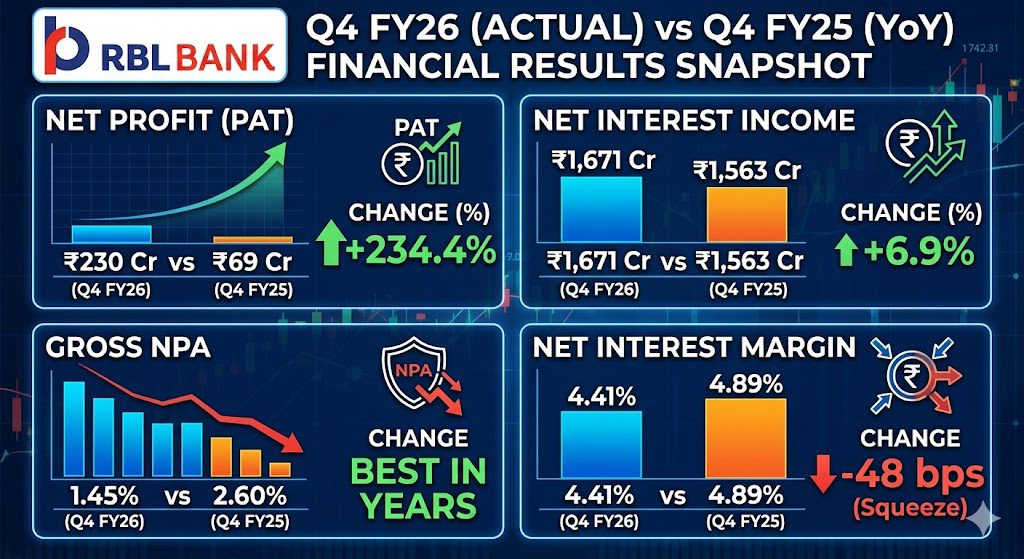
The financial performance of RBL Bank in Q4 FY26 reflects a strong turnaround driven by improving fundamentals rather than temporary gains. The bank reported a net profit of ₹230 crore compared to ₹69 crore in the same quarter last year, marking a massive 234% increase. While the profit growth is impressive, the underlying drivers provide even more confidence. Net Interest Income grew by 6.9% to ₹1,671 crore, indicating steady expansion in core lending operations. The most significant improvement, however, came from asset quality, with the Gross NPA ratio declining sharply to 1.45% from 2.60% a year ago. This is one of the best asset quality levels the bank has achieved in recent years. At the same time, Net Interest Margin declined to 4.41% from 4.89%, reflecting the bank’s conscious shift toward safer lending. These numbers together show that the bank is prioritizing long-term stability over short-term profitability spikes.
Fundamental Analysis: The Quality Over Quantity Trade
The Margin Trade-Off: Safety Comes First
The decline in margins might initially appear as a negative development, but in reality, it reflects a strategic decision by the bank. By shifting its focus toward secured lending segments such as home loans and vehicle loans, RBL Bank is intentionally sacrificing some yield. However, this move significantly reduces the risk of defaults, making the overall loan book more stable. This approach highlights a key shift in the bank’s philosophy, where predictable and sustainable returns are preferred over high but volatile earnings. Over time, this strategy is likely to result in more consistent profitability and improved investor confidence.
Asset Quality: The Real Hero of the Quarter
The improvement in asset quality stands out as the most important achievement in this quarter. The Gross NPA ratio has fallen to 1.45%, representing a sharp decline of more than 100 basis points year-on-year. This improvement indicates that the bank has successfully addressed its legacy issues and strengthened its risk management practices. A cleaner loan book not only reduces the risk of future losses but also enhances the bank’s ability to grow its business confidently. For investors, this is a strong signal that the bank has moved past its troubled phase.
Provisioning Decline: The Profit Booster
A key factor behind the sharp increase in net profit is the significant reduction in provisions. The bank’s credit costs have come down considerably, with provisions declining to around ₹678 crore. Lower provisioning means that a larger portion of the bank’s operating income translates into net profit. This improvement is directly linked to better asset quality, as fewer bad loans require less financial cushioning. If this trend continues, it could support sustained earnings growth in the coming quarters.
Technical Analysis: Riding the Bullish Momentum
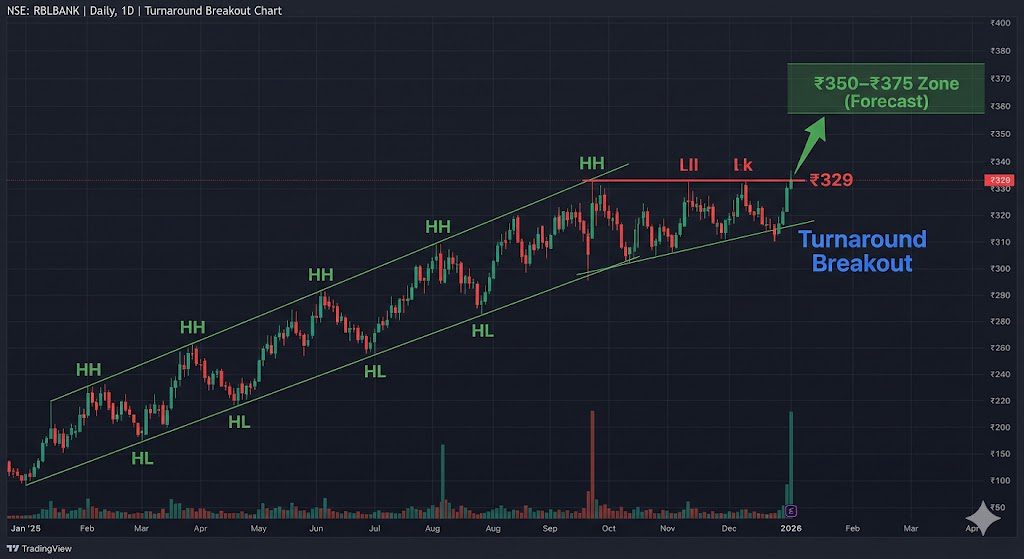
From a technical standpoint, RBL Bank’s stock is currently showing strong bullish momentum. Over the past year, the stock has delivered returns of around 63%, outperforming the broader market indices. The current price levels indicate that the stock is in an uptrend, supported by strong buying interest. The pivot point is around ₹319, which acts as a key level for short-term direction. Resistance is seen near ₹329, and a breakout above this level could trigger further upward movement toward ₹350 and possibly ₹375. On the downside, support around ₹307 provides a safety cushion for investors. Momentum indicators such as RSI are trending upward, suggesting that the bullish trend is still intact.
Brokerage Sentiment & Targets: The Re-Rating Phase
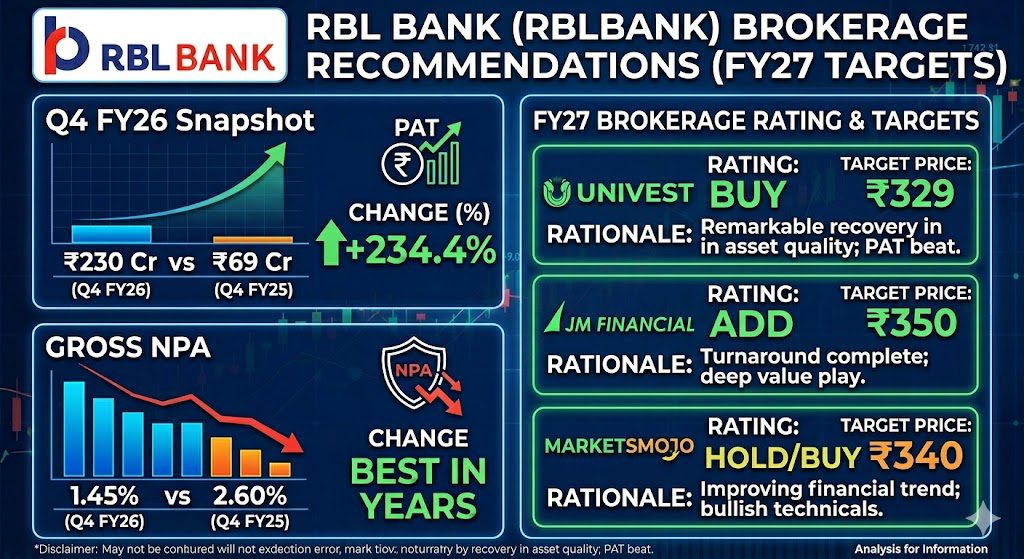
Brokerage sentiment toward RBL Bank has turned increasingly positive following the strong Q4 results. Firms like JM Financial have highlighted the successful turnaround and assigned target prices around ₹350. Other estimates suggest a range between ₹329 and ₹340, indicating moderate upside from current levels. The consensus view is that the bank is entering a re-rating phase, where improved fundamentals and consistent performance could lead to higher valuations. This shift in sentiment reflects growing confidence among analysts and investors.
Management Guidance: The Road to FY27
Shift Toward Secured Lending
The management has made it clear that the focus will remain on expanding the secured lending portfolio. The target is to increase the share of secured retail loans to around 60% of the total loan book. This strategy is expected to further strengthen asset quality and reduce volatility in earnings. By focusing on lower-risk segments, the bank aims to build a more stable and predictable business model.
CASA Growth: Strengthening the Deposit Base
The bank’s CASA ratio currently stands at around 33.6%, and management aims to increase this to over 40% in the coming years. A higher CASA ratio is crucial because it provides access to low-cost funds, which can improve margins and profitability. Strengthening the deposit base also enhances the bank’s ability to compete with larger private sector banks.
The “30-Year” Analyst Verdict
For Long-Term Investors
For long-term investors, RBL Bank represents a normalization story rather than a distressed opportunity. The bank is no longer dealing with major structural issues and is gradually moving toward stable growth. At a Price-to-Book ratio of around 1.25x, the stock is still relatively undervalued compared to peers that are delivering similar growth rates. This creates an opportunity for investors to participate in the next phase of the bank’s growth journey.
For Traders
For traders, the current trend is clearly favorable. The stock’s upward momentum suggests that buying near the ₹315–₹319 range could offer good risk-reward potential. Targets around ₹350 appear achievable if the current trend continues. However, it is important to maintain discipline and set a stop-loss around ₹298 to manage downside risk effectively.
Conclusion: A Turnaround That Matters
RBL Bank’s Q4 FY26 results mark a significant milestone in its transformation journey. The bank has successfully addressed its past challenges and built a stronger, more resilient business model. The sharp improvement in asset quality, combined with disciplined lending and lower provisions, has created a solid foundation for future growth. The 234% profit surge is not just a headline number but a reflection of the bank’s improved operational efficiency and strategic direction.
What’s Your View? (CTA)
Do you believe RBL Bank is the best value banking stock for FY27, or do you prefer other private sector banks for stability? Share your thoughts and let’s discuss your investment strategy.