Scope Outline
Introduction: The Resilience of a Giant
India’s banking sector has changed dramatically over the last three decades. In the 1990s, investors judged banks mainly by their branch network and deposit base. Today, markets focus more on digital efficiency, asset quality, return ratios, and credit growth. Punjab National Bank has successfully adapted to this transformation and is gradually rebuilding its reputation as one of India’s strongest PSU banks.
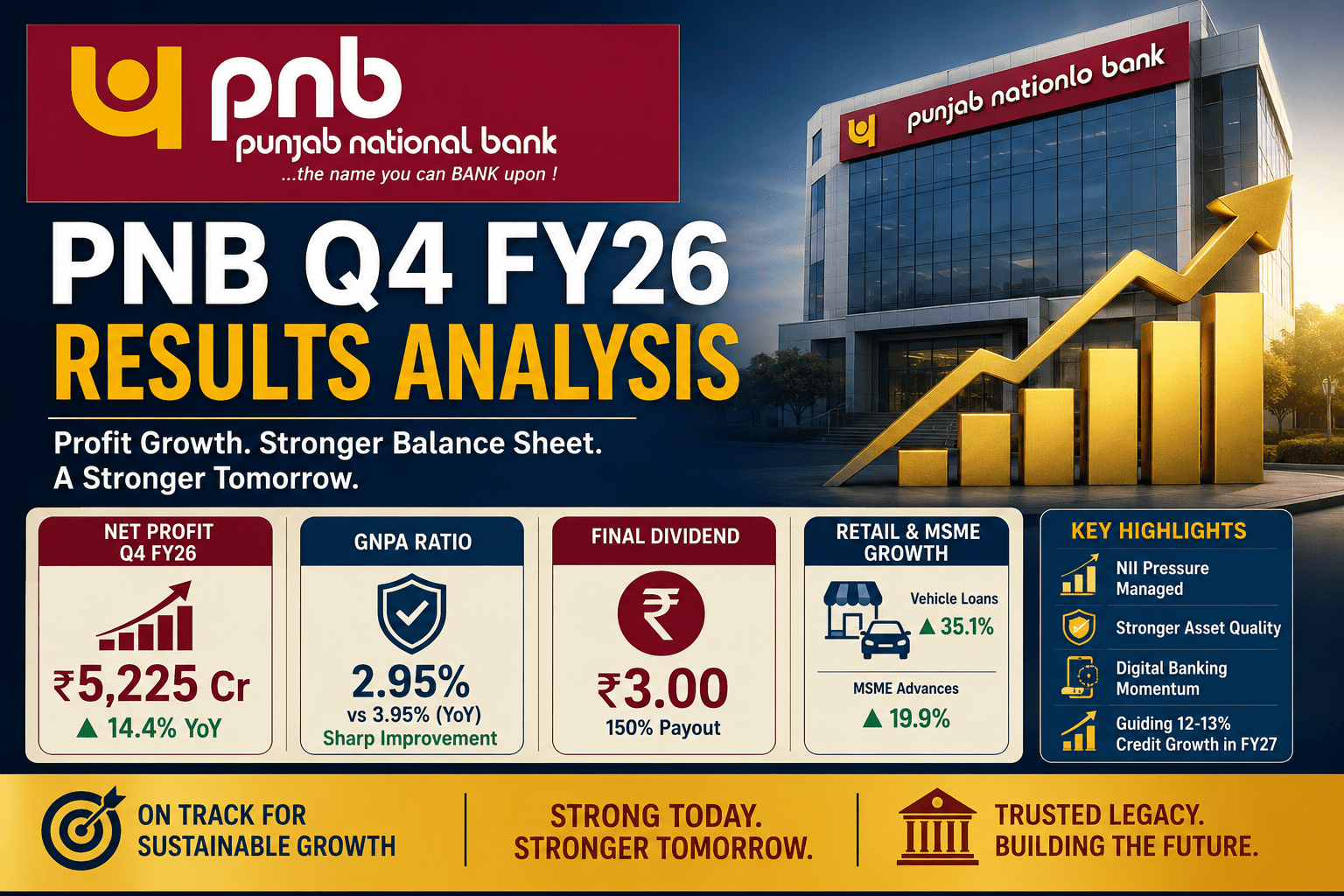
The Q4 FY26 results released on May 5, 2026, show a bank that is steadily moving toward stability and growth. PNB reported a net profit of ₹5,225.11 crore, reflecting a 14.4% year-on-year increase. While the profit growth appears strong, the real debate among investors revolves around the pressure on Net Interest Income (NII) and margins. However, experienced banking analysts understand that lower margins are acceptable if they come with cleaner balance sheets and higher-quality lending growth.
At present, the stock is trading near ₹108 and has shown signs of recovery as investors respond positively to improving asset quality and stronger operational performance.
Q4 FY26 Actual Scorecard: The Numbers That Matter
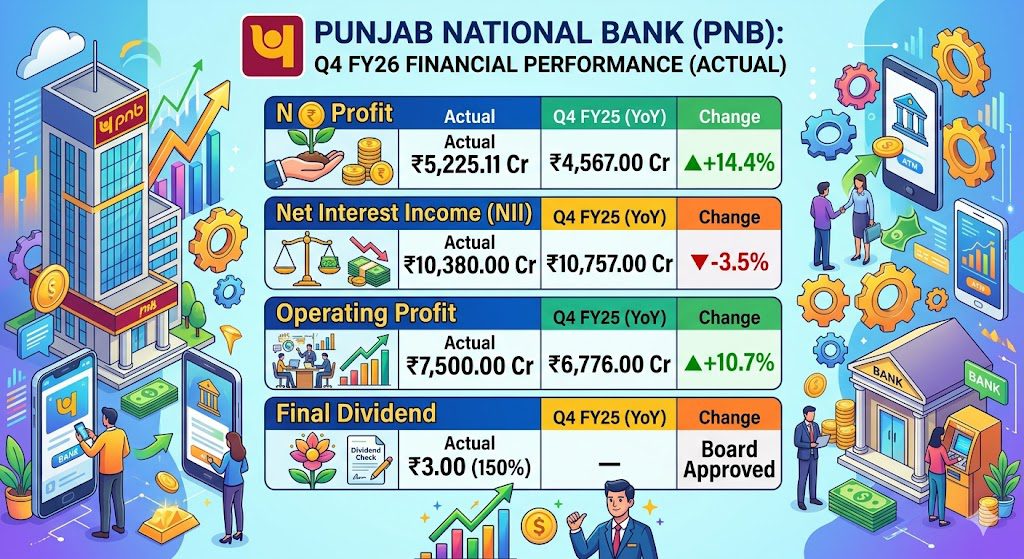
PNB delivered a solid operational performance during Q4 FY26 despite pressure on interest income. Net profit rose to ₹5,225.11 crore compared to ₹4,567 crore in the same quarter last year, registering a healthy growth of 14.4%. Operating profit also improved significantly to ₹7,500 crore from ₹6,776 crore, showing a 10.7% increase due to better efficiency and controlled costs.
However, Net Interest Income (NII) declined slightly to ₹10,380 crore from ₹10,757 crore, reflecting a 3.5% fall. This decline has become one of the key concerns for investors in the short term. Despite this, the board approved a final dividend of ₹3 per share, which equals a 150% payout on face value. The dividend announcement highlights management’s confidence in the bank’s future profitability and stability.
The most important aspect of the results is that PNB’s profit growth is increasingly being driven by stronger operational performance and improving asset quality rather than one-time gains.
Fundamental Analysis: The Asset Quality Pivot
GNPA Mastery
One of the biggest positives in PNB’s Q4 FY26 results is the sharp reduction in Gross Non-Performing Assets (GNPA). The GNPA ratio declined to 2.95% compared to 3.95% a year earlier. This is one of the cleanest balance sheets the bank has maintained in almost a decade.
Lower bad loans reduce provisioning requirements and improve long-term profitability. For PSU banks, asset quality improvement is often the biggest driver of stock re-rating because it signals stronger financial stability and improved lending discipline. The decline in stressed assets also suggests that PNB’s recovery mechanisms and risk management systems are becoming more effective.
The Margin Squeeze
PNB’s Net Interest Margin (NIM) for FY26 stood at 2.57%, slightly lower than the previous year. While some investors may view this negatively, the bank is intentionally focusing on safer and higher-quality lending segments rather than aggressively chasing margins.
The bank is increasing its exposure to Retail, Agriculture, and MSME loans, commonly referred to as the RAM segment. These categories generally provide more stable growth and lower long-term credit risk compared to large corporate loans. Although this strategy may slightly reduce margins in the short term, it improves the overall quality and sustainability of the loan book.
Retail Growth Engine
PNB’s retail-focused strategy is already showing strong momentum. Vehicle loans grew by around 35.1%, while MSME advances increased by approximately 19.9%. These figures indicate strong demand in sectors linked to India’s consumption recovery and small business expansion.
The bank’s growing focus on retail and MSME lending is helping diversify its loan book and reduce concentration risk. Increased digital lending capabilities are also enabling PNB to compete more effectively with private sector banks in the retail segment.
Technical Analysis: Support and Resistance Zones
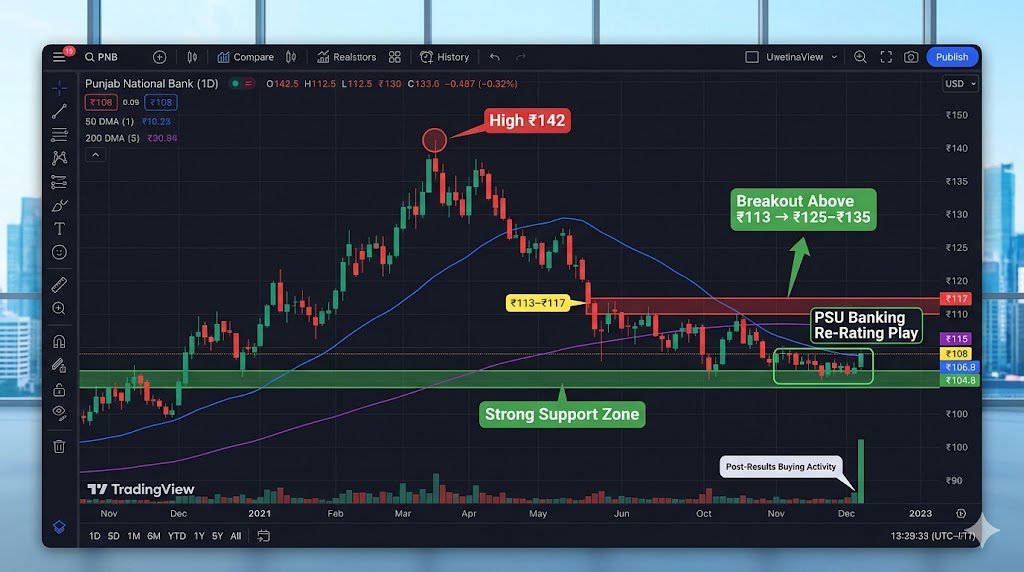
From a technical perspective, PNB’s stock has stabilized after correcting sharply from its 52-week high near ₹142. The stock has now formed a strong support base around the ₹100–₹104 zone, which is acting as an important demand area.
The immediate support range lies between ₹104.24 and ₹106.80. If the stock falls below this range, it could trigger additional selling pressure toward ₹100. On the upside, the key resistance level is near ₹113.23. A breakout above this level with strong trading volume could push the stock toward the next resistance zone near ₹117.10.
The Relative Strength Index (RSI) currently remains near 49, indicating neutral momentum. The stock is neither overbought nor oversold, making it a suitable “wait and watch” candidate until a clearer breakout direction emerges.
Management Guidance: The FY27 Vision
Credit Growth Outlook
PNB’s management, led by MD & CEO Ashok Chandra, has guided for credit growth of approximately 12–13% in FY27. The bank expects strong lending demand from sectors such as renewable energy, infrastructure, roads, MSMEs, and retail finance.
India’s broader economic expansion and infrastructure development cycle are expected to support PSU banks significantly over the next few years.
Efficiency Goals
The bank is targeting operating profit growth of around 9–10% in FY27 while aiming to reduce the GNPA ratio below 2.5%. Achieving these targets would further strengthen the balance sheet and improve investor confidence in the bank’s long-term transformation story.
Digital Credit Card Expansion
PNB is also expanding aggressively in digital financial services. The bank plans to increase its credit card base to nearly 15 lakh cards by March 2027. This strategy reflects management’s focus on improving fee-based income and strengthening its presence in digital banking.
Brokerage Sentiment & Targets: The Re-Rating Story
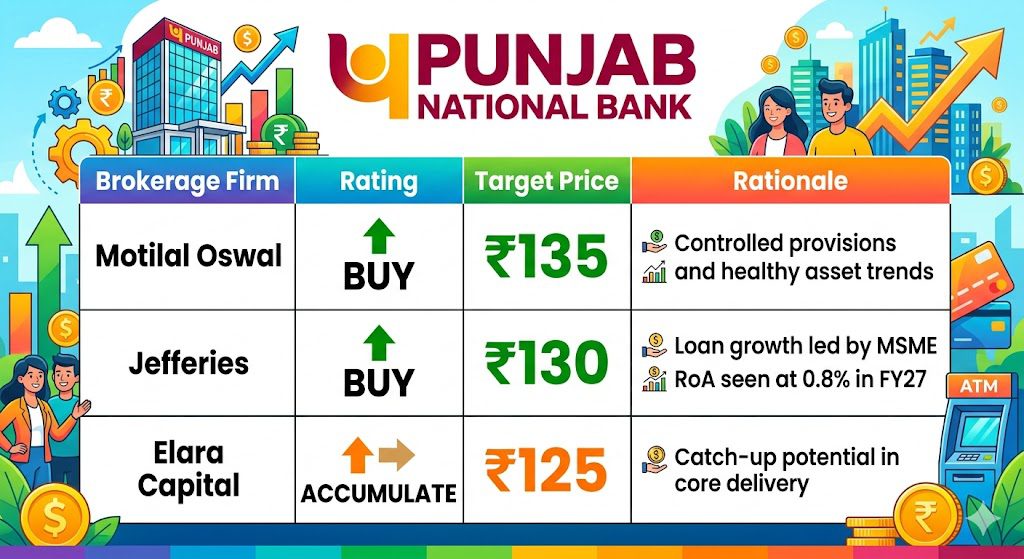
Brokerage firms remain increasingly positive on PNB’s transformation. Motilal Oswal has maintained a “Buy” rating with a target price of ₹135, highlighting improving asset quality and controlled provisioning costs. Jefferies also has a “Buy” recommendation with a target of ₹130, driven by expectations of stronger MSME loan growth and improving return ratios.
Elara Capital maintains an “Accumulate” rating with a target price near ₹125, citing the bank’s catch-up potential compared to other PSU banking peers. Overall, market sentiment suggests that PNB is gradually moving away from being viewed as a stressed PSU lender and becoming a structurally improving banking franchise.
The “30-Year” Analyst Verdict
From a long-term investment perspective, PNB is no longer simply a turnaround story. It is evolving into a structural transformation story supported by cleaner asset quality, stronger retail lending growth, and digital modernization. The ₹3 dividend payout further reflects management’s confidence in future earnings stability.
For long-term investors, PNB offers exposure to India’s PSU banking revival with improving fundamentals. For traders, however, patience remains important. The stock is currently in a “buy on strength” phase, meaning investors should ideally wait for a decisive breakout above ₹113 before expecting stronger upward momentum toward ₹125 and beyond.
Conclusion & Engagement (CTA)
PNB’s Q4 FY26 results clearly indicate that the bank is entering a stronger and more stable phase. While margin pressure remains a concern, the sharp improvement in asset quality and healthy retail loan growth suggest that the bank’s transformation is becoming structural rather than temporary.
With GNPA now below 3%, stronger operating profit growth, and increasing focus on digital banking, PNB appears well-positioned for long-term re-rating within the PSU banking sector. The key question for investors now is whether they are buying PNB for its improving balance sheet and dividend yield, or betting on the broader PSU banking revival story that could unfold over the next several years.