Introduction: The Monopoly in the Marketplace
Expert Hook
Over the last three decades, India’s financial markets have undergone a dramatic transformation. Trading floors once filled with shouting brokers and handwritten order slips have now evolved into lightning-fast algorithm-driven platforms where billions of rupees move within seconds. In this technological revolution, Multi Commodity Exchange of India Limited has emerged as one of the strongest and most strategically positioned financial infrastructure companies in India. As of May 11, 2026, MCX is no longer just a commodity exchange — it has become a powerful technology-driven financial marketplace benefiting from India’s growing retail participation in derivatives trading.
The Big Story
The biggest turning point for MCX over the past year has been the successful completion of its software transition. For several quarters, investors remained concerned about operational instability and transition risks as the exchange shifted away from the older 63Moons trading platform to the new TCS-powered trading system. Those concerns now appear to be fading rapidly. The Q4 FY26 numbers clearly show that the technology transition phase is largely behind the company, and the benefits are beginning to flow directly into profitability. Lower technology costs, higher operational efficiency, and exploding options trading activity have completely transformed MCX’s earnings profile.
Market Pulse
MCX shares have become one of the strongest-performing stocks in India’s capital market ecosystem. The stock recently tested levels near ₹4,200 as investor enthusiasm around commodity options trading continues growing rapidly. Retail participation in commodity derivatives, especially Crude Oil and Natural Gas options, has surged significantly over the past year. With India’s financialization trend accelerating and more traders entering derivatives markets, MCX is increasingly being viewed as a long-term monopoly-style growth story rather than just another exchange stock.
Q4 FY26 Performance: The “Hard Numbers” (Actual Data)
Revenue Growth
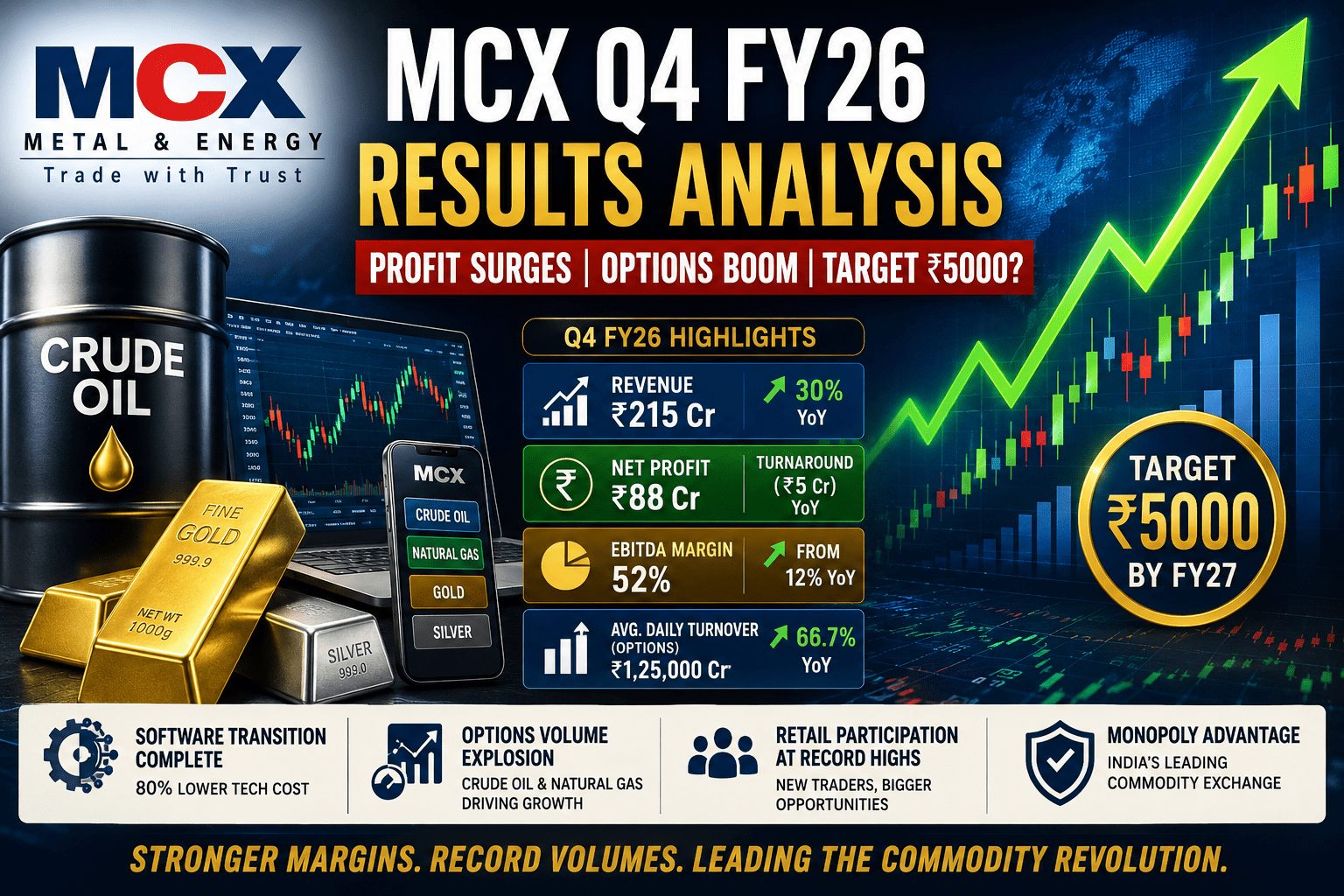
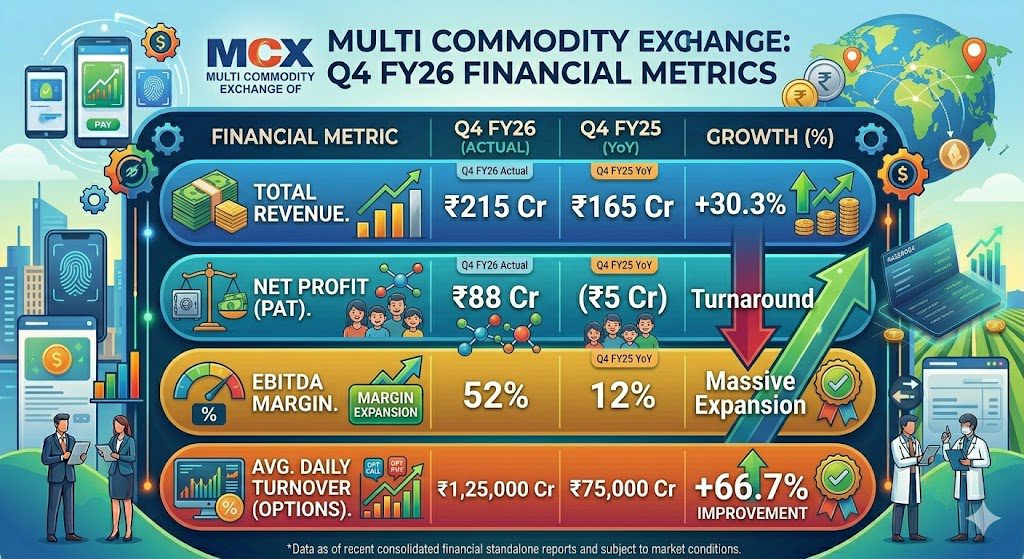
MCX reported total revenue of approximately ₹215 crore during Q4 FY26 compared to ₹165 crore in Q4 FY25, representing a strong year-on-year growth of around 30.3%. This sharp rise in revenue reflects the explosive growth in commodity options trading volumes and improved operational efficiency after the technology migration. The exchange benefited significantly from rising participation in energy derivatives and increased retail interest in commodity trading products. Revenue growth of this magnitude is particularly impressive for a financial infrastructure company operating in a relatively niche segment.
Net Profit Turnaround
One of the most remarkable aspects of MCX’s Q4 FY26 performance was the massive turnaround in profitability. The company reported a net profit of ₹88 crore compared to a loss of approximately ₹5 crore during the same quarter last year. This dramatic recovery highlights the impact of lower technology support costs and stronger trading activity across commodity derivatives segments.
The turnaround is especially important because it confirms that the operational disruptions and elevated costs related to the software transition phase are now largely behind the company. Investors typically reward exchange businesses that demonstrate scalable profit growth, and MCX is now entering that phase aggressively.
EBITDA Margin Explosion
MCX reported EBITDA margins of approximately 52% during Q4 FY26 compared to just 12% in Q4 FY25.
EBITDA Margin=EBITDARevenue×100EBITDA\ Margin = \frac{EBITDA}{Revenue} \times 100
This massive margin expansion clearly demonstrates the operational leverage embedded within exchange businesses. Once technology infrastructure stabilizes, additional trading volumes generate disproportionately higher profits because fixed costs remain relatively stable. The sharp increase in margins indicates that MCX is now beginning to operate like a high-margin financial technology platform rather than a cost-heavy transition business.
Options Trading Boom
Average daily turnover in commodity options surged to approximately ₹1,25,000 crore during Q4 FY26 compared to ₹75,000 crore in Q4 FY25, reflecting a growth of nearly 66.7%.
This explosive rise in options turnover has become the single biggest growth driver for MCX. Commodity options are rapidly becoming popular among retail traders because they offer lower capital requirements, better risk management flexibility, and increased trading opportunities during volatile commodity cycles. The rapid expansion in options activity is helping MCX diversify revenue streams while improving transaction fee generation significantly.
Fundamental Analysis: The Tech-Powered Moat
Software Transition Gains
The successful migration from the older 63Moons platform to the new TCS-powered trading infrastructure represents one of the most important developments in MCX’s recent history. Earlier, the exchange faced high technology support costs and operational uncertainty during the migration phase. However, the new technology stack has dramatically reduced operational expenses while improving system reliability and scalability.
Reports suggest that technology support costs have declined by nearly 80% after the transition. This cost reduction directly explains the massive improvement in EBITDA margins and profitability during Q4 FY26. More importantly, MCX now controls a stronger and more scalable technology infrastructure capable of supporting future growth in trading volumes.
The Options Revolution
The structure of MCX’s business model is also evolving rapidly. Earlier, futures contracts contributed the majority of trading activity and exchange revenue. However, commodity options are now becoming the primary growth engine for the company.
Crude Oil and Natural Gas options currently contribute more than 75% of the exchange’s transaction fee revenues. Retail traders are increasingly preferring options because they provide leveraged exposure with limited downside risk compared to futures contracts.
This shift in revenue mix is highly positive because options trading generally generates more stable and recurring fee income for exchanges.
New Product Pipeline
MCX continues expanding its product portfolio aggressively to attract a wider trader base. One of the latest developments includes the launch of monthly Gold and Silver mini-options contracts designed specifically for smaller retail participants.
These products lower entry barriers for small-ticket traders who want exposure to commodity markets without committing large amounts of capital. As retail participation deepens further, such products could significantly increase trading activity over the next few years.
Technical Analysis: The Blue-Sky Marathon
Current Setup
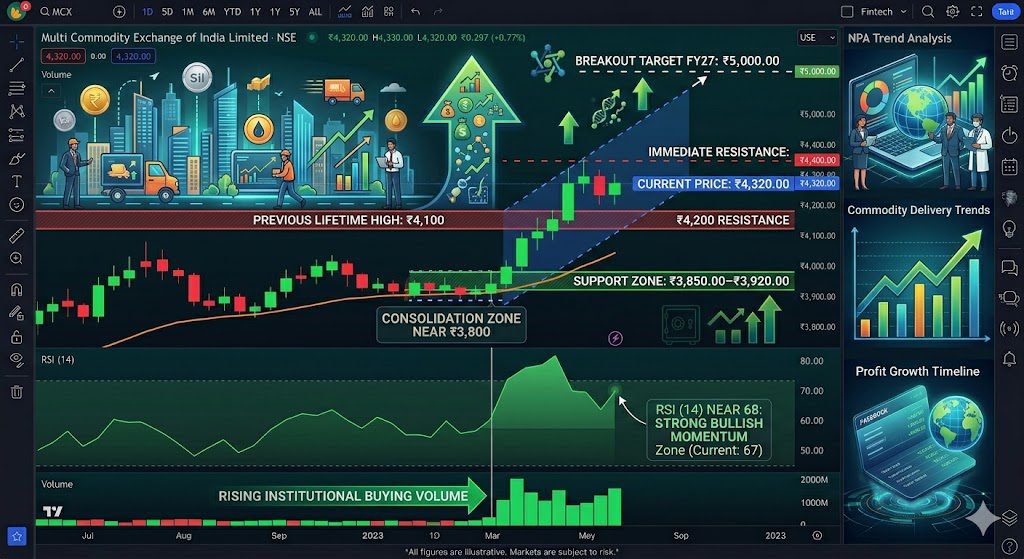
Technically, MCX is currently trading within a strong ascending channel pattern, which is generally considered a bullish continuation structure. The stock recently crossed its previous lifetime high with strong institutional buying volumes, indicating continued bullish sentiment among investors.
The broader trend remains firmly positive as long as the stock sustains above key support zones.
Key Support Levels
The ₹3,850–₹3,920 zone currently acts as the most important support region for the stock.
This area coincides with:
- 50-day Exponential Moving Average (EMA)
- Institutional accumulation zone
- Previous breakout region
Technical traders often refer to this area as the “Line in the Sand” because any sustained breakdown below this region could weaken short-term momentum.
Immediate Resistance Levels
On the upside, MCX faces immediate resistance near ₹4,400.
A decisive breakout above this level could potentially open the path toward the psychological ₹5,000 mark during FY27.
Given the strong earnings momentum and continued options volume growth, analysts believe the probability of further upside remains high if broader market conditions stay supportive.
RSI Momentum Signal
The Relative Strength Index (RSI) for MCX is currently hovering near 68.
RSI=100−1001+RSRSI = 100 – \frac{100}{1 + RS}
While the RSI is approaching overbought territory, investors should understand that in strong structural bull markets, momentum indicators can remain elevated for extended periods. This often happens in high-quality monopoly businesses experiencing rapid earnings upgrades.
Brokerage Sentiment & Targets (The Re-rating Cycle)
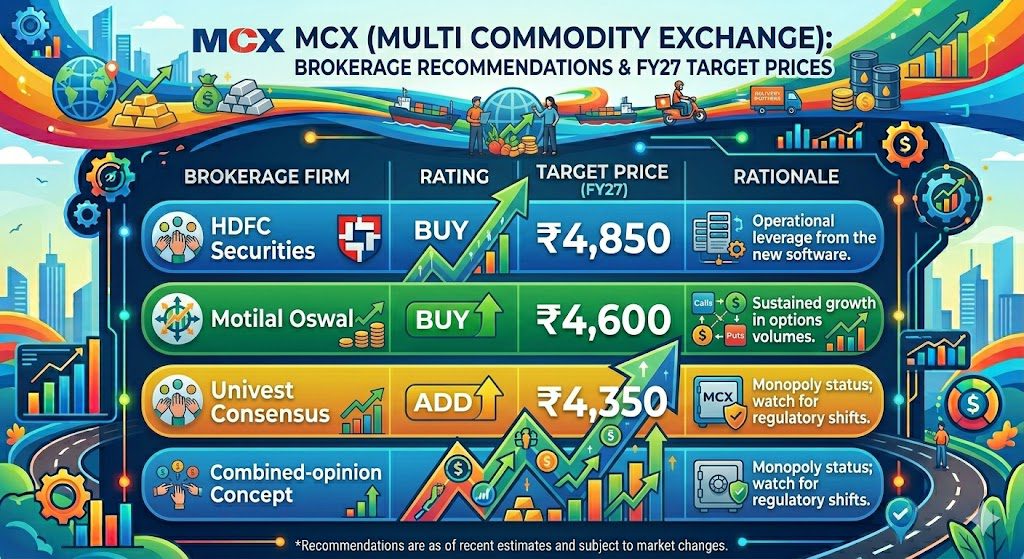
HDFC Securities Outlook
HDFC Securities maintains a BUY rating on MCX with a target price near ₹4,850 for FY27. Analysts believe the exchange will continue benefiting from operational leverage as trading volumes rise while technology costs remain under control.
The brokerage expects margins to remain elevated due to the successful software migration and expanding options participation.
Motilal Oswal View
Motilal Oswal also maintains a positive outlook on MCX with target prices around ₹4,600. The brokerage remains optimistic about sustained growth in commodity options volumes and increasing retail participation in derivatives markets.
Analysts believe MCX is still in the early stages of a structural growth cycle within India’s commodity derivatives ecosystem.
Univest Consensus
Several market analysts under the Univest Consensus framework continue maintaining an ADD rating on MCX with price targets near ₹4,350.
The primary bullish argument remains MCX’s near-monopoly status within India’s organized commodity exchange ecosystem. However, analysts also advise investors to monitor potential regulatory developments because exchange businesses remain highly regulated.
Management Guidance: Scaling to the Next Level
Volume Growth Outlook
Management has guided for approximately 15–20% CAGR growth in average daily turnover during FY27.
This guidance reflects confidence in:
- Growing retail participation
- Rising commodity derivatives awareness
- Product innovation
- Expanding options trading ecosystem
If achieved, this growth could further strengthen revenue visibility and operational leverage over the next few years.
Institutional Participation Focus
MCX management is also focusing heavily on increasing participation from Domestic Institutional Investors (DIIs), mutual funds, and larger institutional participants.
Currently, institutional activity in commodity derivatives remains relatively underdeveloped in India compared to equity markets. However, as portfolio diversification strategies evolve, institutional participation could become a major future growth driver for MCX.
Dividend Policy
MCX continues to remain a strong cash-generating business with relatively low debt and high operating leverage. The board is expected to maintain a dividend payout ratio of at least 50%.
This makes MCX attractive not only for growth investors but also for long-term shareholders seeking consistent cash returns from high-quality financial infrastructure businesses.
The “30-Year” Analyst Verdict
For Long-Term Investors
From a long-term perspective, MCX represents much more than a commodity exchange stock. It is effectively a “Capital Market Proxy” linked directly to India’s financialization story.
As more Indians enter financial markets, participation naturally expands from equities into derivatives, commodities, and alternative asset classes. MCX stands at the center of this structural shift.
The company’s monopoly-like positioning, high operating leverage, scalable technology infrastructure, and growing retail participation make it one of the strongest long-term plays within India’s financial market ecosystem.
For Active Traders
For short-term traders, the trend remains decisively bullish.
In strong monopoly-style growth businesses, betting aggressively against momentum often becomes risky. Traders may continue viewing corrections toward the ₹4,000 region as buying opportunities for potential upside targets near ₹4,500 and beyond.
Momentum indicators remain strong, and institutional participation continues supporting bullish price action.
Conclusion & Engagement (CTA)
Final Word
MCX has successfully completed one of the most important operational transformations in its history. With technology transition concerns fading, margins recovering above 50%, and options trading volumes hitting record highs, the company now appears structurally stronger than ever before.
The exchange is benefiting directly from India’s rising financial awareness, expanding derivatives ecosystem, and increasing retail participation in commodity markets.
For many investors, MCX is no longer simply an exchange operator — it is becoming one of the clearest long-term beneficiaries of India’s financial market expansion story.
Investor Discussion
Are you trading Crude Oil and Natural Gas options on Multi Commodity Exchange of India Limited, or are you holding MCX shares for the long-term ₹5,000 target opportunity?
Share your commodity market strategy and MCX outlook in the comments below.