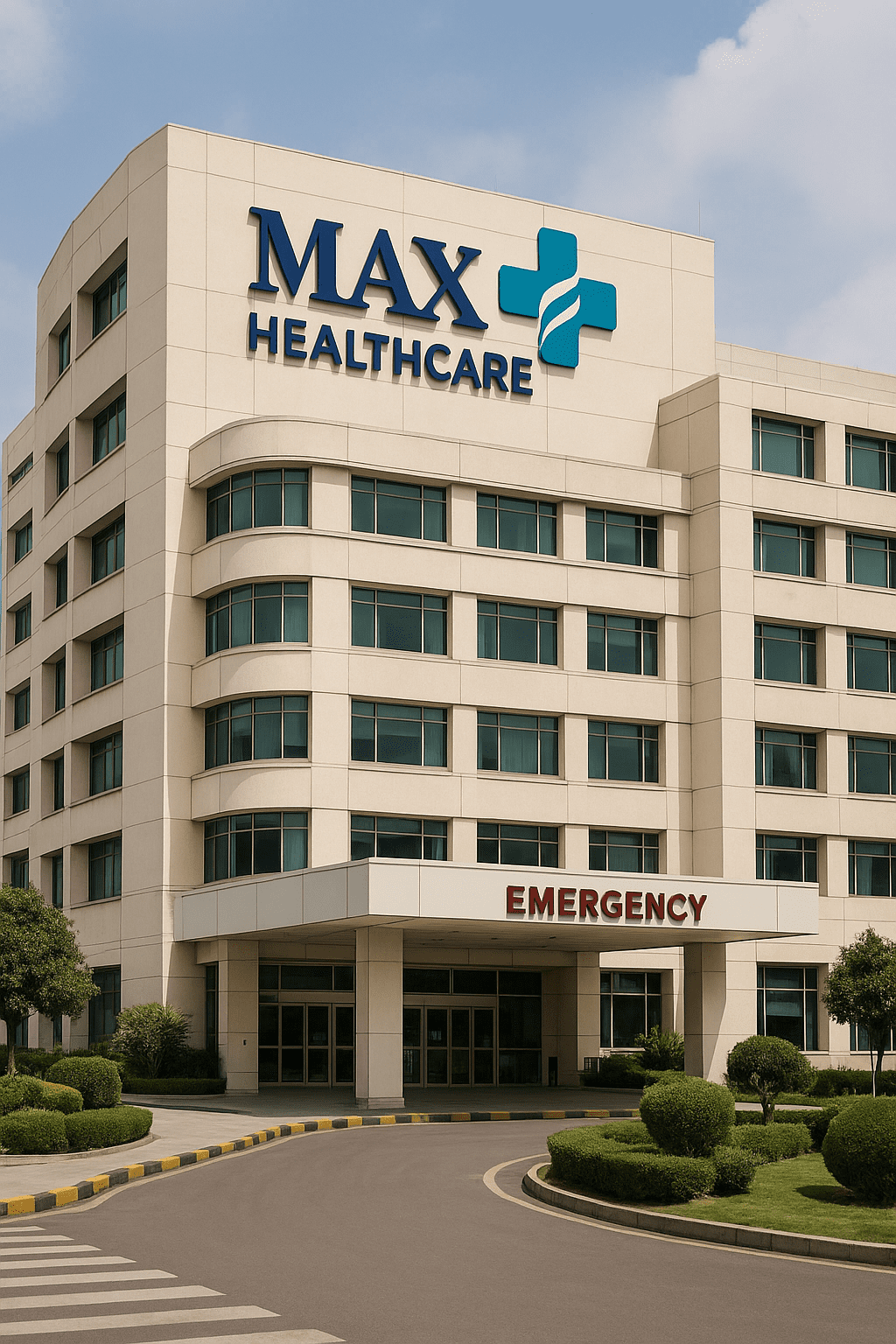
⭐ Max Healthcare Q2 FY2025-26 Financial Report: Revenue Soars, EBITDA Strengthens, PAT Surges with Tax Benefit — Full SEO-Friendly 1000+ Word Analysis
Max Healthcare Institute Ltd has released its financial performance for the quarter ended 30 September 2025 (Q2 FY2025-26), and the results signal a powerful combination of strong revenue growth, improved operating margins, higher international patient inflows and a one-time tax benefit that lifted quarterly profitability significantly. The company reported a network gross revenue of ₹2,692 crore, reflecting close to 21–25% year-on-year growth, supported by increased patient volumes, higher occupancy, and a rapidly improving case-mix. Network Operating EBITDA rose to ₹694 crore, showcasing strong operational leverage, while network PAT surged to ₹554 crore, a jump influenced not only by revenue and margin growth but also by a ₹149 crore tax benefit arising from the merger of wholly-owned subsidiaries. This marks one of the strongest quarterly performances delivered by Max Healthcare in recent years. The company also reported that international patient revenue increased sharply to about ₹231 crore, registering nearly 25% YoY growth, demonstrating the company’s strengthened position in cross-border medical services and high-acuity care.
A deeper look at the quarter reveals that the surge in performance was driven mainly by improved Occupied Bed Days (OBDs), an indicator of how effectively hospitals are utilizing their bed capacity. As patient footfall increased, both elective and non-elective procedures rose compared to the same quarter last year. Additionally, higher-acuity cases in oncology, cardiology, transplants, orthopedics and other complex specializations contributed strongly to revenue expansion. The case mix played a crucial role in pushing margins higher because tertiary care and complex procedures typically generate significantly stronger earnings per bed. This shift toward more specialized care, backed by improved clinical programs and expansions in centres of excellence, shaped much of the financial strength witnessed in the quarter.
Another major highlight this quarter has been the growth from international patients, which is increasingly becoming one of Max Healthcare’s most strategic revenue streams. Countries across Africa, the Middle East, South Asia and the CIS region contributed meaningfully to international patient inflow, taking the segment’s revenue contribution close to 9% of overall hospital revenue. Higher trust in Indian medical infrastructure, competitive pricing, advanced clinical outcomes and improving global partnerships allowed Max Healthcare to scale this vertical successfully. International patients often seek advanced critical-care services, contributing higher revenue per patient, which directly benefits the company’s EBITDA margins.
Sequential performance also indicates healthy growth. In Q1 FY2025-26, the company recorded revenue of around ₹2,568–₹2,574 crore, Network Operating EBITDA of ₹613 crore, and PAT of ₹345 crore. Comparing that with Q2’s results shows revenue improvement, margin expansion and significant PAT growth, even after adjusting for the one-time tax impact. This proves that Max Healthcare is not only riding on seasonal healthcare cycles but is also benefiting from sustained operational improvements across the network. The smooth normalization of elective surgeries post-monsoon, increased footfall in tertiary-care programs, and faster admission-to-discharge turnover also contributed to this sequential uplift.
The company’s management commentary for Q2 FY2025-26 further explained the underlying growth pillars. Leadership highlighted that the hospital chain is experiencing strong and stable demand across adult specialties, high-acuity care and international medical tourism. With better patient profiling and capacity planning, the company succeeded in optimizing bed occupancy, which is a critical driver in healthcare operating efficiency. Management also emphasized ongoing investments in digital systems for improved care delivery, expansions in specialized clinical infrastructure and continuous recruitment of experienced specialists to support high-growth departments. They reaffirmed that the company remains committed to long-term expansion and intends to add more beds and advanced care units over the next several quarters.
A key aspect of the quarter was the ₹149 crore tax benefit due to the merger of wholly-owned subsidiaries. While this benefit boosted PAT significantly, it is not a recurring contributor to future earnings. Management clarified this in their communication, emphasizing that underlying profitability trends should be measured using EBITDA and operating profit metrics, which continue to show strong year-on-year improvement. The company’s consistent cash flow generation and stable balance-sheet position have allowed it to reinvest strategically in capacity building, clinical excellence programs and digital transformation initiatives.
There are also strategic opportunities emerging from the company’s ability to attract international patients, especially as global travel normalizes. Max Healthcare continues to strengthen its referral networks, partner with foreign healthcare facilitators, collaborate with embassies and advance its outreach in Africa, GCC and Central Asia. As these regions typically seek India for specialized and affordable healthcare, analysts expect this vertical to remain one of the strongest contributors to Max Healthcare’s margin profile over the next several quarters.
However, the quarter is not without risks. Seasonal fluctuations in local patient traffic, potential delays in elective surgeries due to external factors, rising competition in the Indian healthcare space and the need for continuous medical talent acquisition could influence upcoming results. But overall, the company’s strong operational performance, growing demand for tertiary care, improved payer mix, and increasing share of international patients place Max Healthcare in a well-insulated position compared to many peers.
Below is the SEO-friendly comparison table highlighting Q2 FY2025-26 performance against Q1 FY2025-26 and Q2 FY2024-25:
📊 Max Healthcare Quarterly Comparison Table (SEO Optimized)
| Quarter | Revenue (₹ Cr) | Operating EBITDA (₹ Cr) | PAT (₹ Cr) | Key Notes |
|---|---|---|---|---|
| Q2 FY2025-26 (Sep 2025) | 2,692 | 694 | 554 | Strong YoY growth, high OBDs, strong international patient revenue, includes ₹149 Cr tax benefit. |
| Q1 FY2025-26 (Jun 2025) | 2,568–2,574 | 613 | 345 | Sequential growth in revenue and EBITDA, strong case-mix. |
| Q2 FY2024-25 (Sep 2024) | 1,707–1,748 | Lower base | 349 | Lower base due to post-pandemic mix and moderate OBDs. |
In conclusion, Max Healthcare’s Q2 FY2025-26 results reflect a phase of strong expansion powered by increased patient volumes, improved case mix, scaling international business and better operating efficiencies. While PAT received a boost from a one-time tax adjustment, the real driver of the quarter’s success lies in the company’s continuous improvement in operational performance. With robust EBITDA growth, favourable demand trends, ongoing expansion of centres of excellence and sustained traction in its international patient division, Max Healthcare has positioned itself for a strong finish to FY2025-26. Future performance will depend heavily on maintaining occupancy rates, executing capacity expansions, sustaining international patient flow, and continuing to improve clinical and operational efficiency.