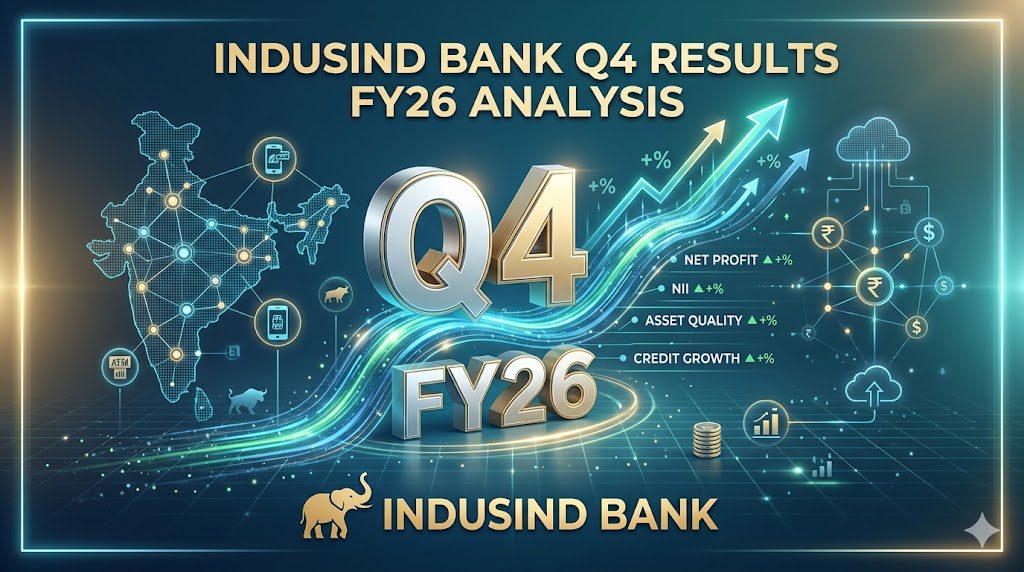
Introduction: From Crisis to Recovery
Just a year ago, IndusInd Bank was going through one of the toughest phases in its history. The derivatives accounting issue that surfaced in early 2025 shook investor confidence and raised serious questions about internal controls. Many analysts even called it a “Lehman moment” for the bank. But fast forward to April 2026, and the story looks very different. The bank has reported a net profit of ₹594 crore in Q4 FY26, marking a sharp turnaround from the ₹2,329 crore loss it posted a year ago.
This is not just about numbers—it’s about trust. Under the leadership of Rajiv Anand, the bank has shifted its approach from aggressive expansion to disciplined and calibrated growth. The focus is now clearly on stability, risk control, and long-term sustainability.
The market has started to recognize this shift. The stock is currently trading around ₹850, recovering strongly from its 52-week low of ₹650. While it is still below its historical highs, the direction of movement suggests that investors are slowly regaining confidence.
Q4 FY26 Financial Scorecard: The “Phoenix” Quarter
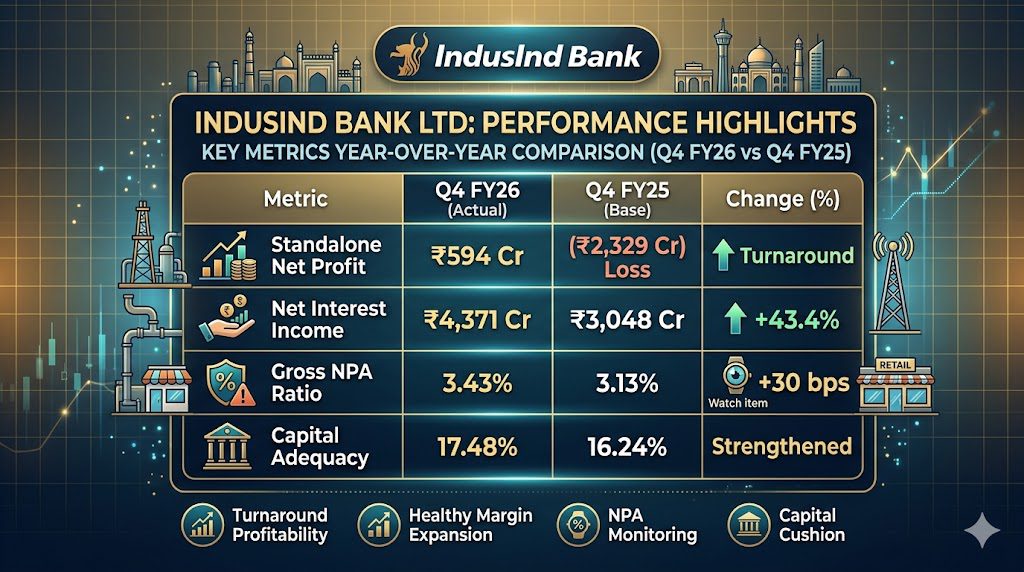
The financial performance of IndusInd Bank in Q4 FY26 can best be described as a “Phoenix moment”—a strong recovery rising from last year’s crisis. The bank reported a standalone net profit of ₹594 crore, compared to a massive loss of ₹2,329 crore in Q4 FY25. This turnaround is one of the most important highlights of the quarter.
Net Interest Income (NII), which is a key indicator of a bank’s core earnings, grew sharply to ₹4,371 crore, reflecting a 43.4% year-on-year increase. This growth shows that the bank’s core lending operations are back on track.
However, asset quality remains an area to watch. The Gross NPA ratio increased slightly to 3.43% from 3.13%, indicating some stress in the loan book. On the positive side, the bank’s capital adequacy ratio improved to 17.48%, providing a strong cushion for future growth and risk management.
Overall, the numbers show that while the bank has stabilized, the journey toward full recovery is still ongoing.
Fundamental Analysis: Cleaning the Closet
The Derivatives Ghost Is Now Behind
One of the biggest overhangs on IndusInd Bank over the past year was the derivatives-related issue, which led to a one-time provision of around ₹1,960 crore. This significantly impacted profitability in FY25. However, with this issue now largely resolved, the bank has moved into a phase of normalized operations. The Q4 FY26 results clearly reflect this shift, as earnings are now being driven by core banking activities rather than exceptional adjustments.
MFI Stabilization: The Hidden Growth Engine
The Microfinance (MFI) segment, once considered a risk area, is now showing signs of stability. The loan book in this segment stands at ₹16,782 crore, although it has declined by 42% year-on-year. This reduction is not necessarily a negative—it reflects the bank’s cautious approach to risk management.
More importantly, collection efficiency has improved, which is a strong signal that the worst may be over. Since MFI loans typically carry higher yields, this segment has the potential to significantly boost margins in FY27. If managed carefully, it could become a key driver of profitability.
Loan Book Contraction: A Healthy Correction
The bank’s overall loan book has declined by around 8.7% year-on-year. While this might appear concerning at first, it is actually a positive step in the long run. The bank is deliberately reducing exposure to risky segments and focusing on high-quality lending.
This strategy can be compared to pruning a tree—removing weak branches to allow stronger ones to grow. By focusing on quality rather than quantity, IndusInd Bank is laying the foundation for sustainable growth.
Technical Analysis: The Long Base Formation
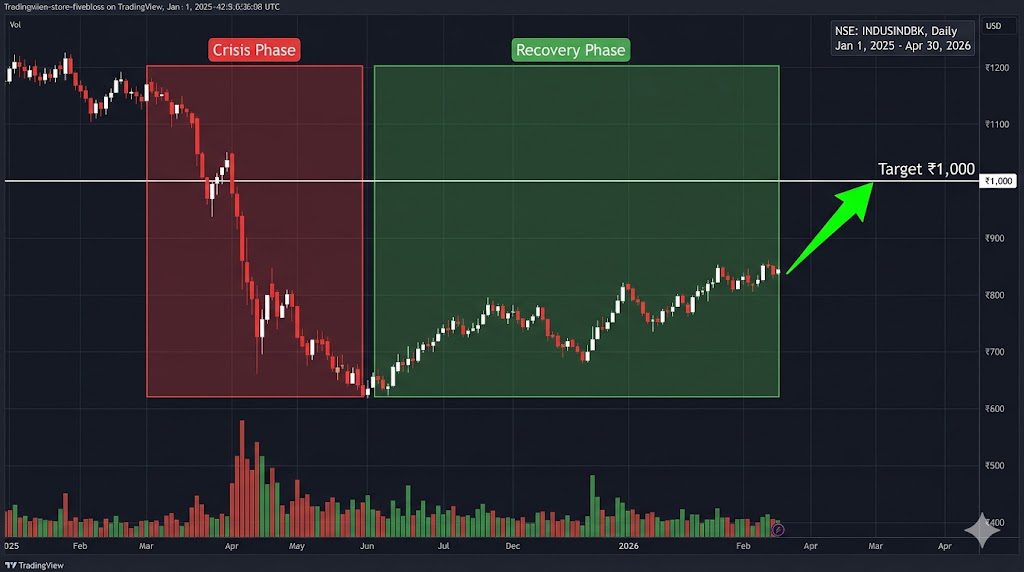
From a technical perspective, IndusInd Bank’s stock is showing signs of a long-term base formation. The ₹800 level has emerged as a strong support zone, acting as a psychological floor for the stock.
On the upside, ₹900 is a critical resistance level. A sustained breakout above this level, supported by strong trading volumes, could trigger a short-covering rally. In such a scenario, the stock may move toward ₹1,050 in the near term.
The Relative Strength Index (RSI) is currently around 52, indicating a neutral trend. This suggests that the stock is neither overbought nor oversold and is preparing for its next major move.
With most of the negative news already priced in, the risk-reward ratio appears favorable for investors at current levels.
Corporate Action: The Dividend Signal
One of the most encouraging aspects of the Q4 FY26 results is the announcement of a final dividend of ₹1.50 per share. While the dividend amount may seem modest, the timing of the announcement carries significant importance.
Declaring a dividend immediately after a loss-making year sends a strong message to the market. It reflects management’s confidence in the bank’s future cash flows and its commitment to rewarding shareholders.
The record date for the dividend has been set as June 26, 2026. For income-focused investors, this adds another layer of attractiveness to the stock.
Management Guidance for FY27
A Reset Toward Sustainable Growth
Under CEO Rajiv Anand, the bank has clearly reset its growth strategy. Instead of chasing aggressive expansion, the focus is now on achieving steady growth in line with industry trends, which is expected to be around 13–15% in FY27.
This shift reflects a more mature and disciplined approach to banking, which is likely to reduce risk and improve long-term profitability.
Macro Risks: West Asia Exposure
The management has also highlighted potential risks related to geopolitical tensions in West Asia. Some of the bank’s SME clients are exposed to oil and gas supply chains in the region, which could be impacted by ongoing conflicts.
While this risk is not immediate, it is something investors should keep an eye on as it could affect asset quality in the future.
Brokerage Sentiment & Targets: The Re-Rating Cycle
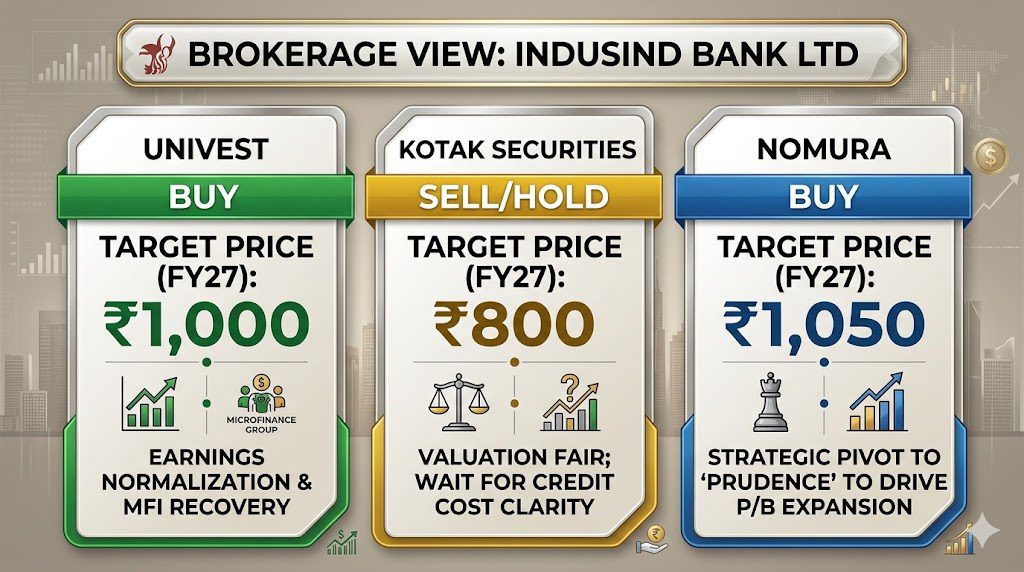
Market sentiment toward IndusInd Bank is gradually improving, but opinions remain divided.
Nomura has maintained a bullish stance with a target price of ₹1,050, citing the bank’s strategic shift toward prudent growth. On the other hand, Kotak Securities has taken a more cautious approach, suggesting a hold or sell rating with a target around ₹800, mainly due to concerns about credit costs.
Meanwhile, consensus estimates from various analysts suggest a target of around ₹1,000, driven by expectations of earnings normalization and recovery in the MFI segment.
This divergence in views indicates that the stock is currently in a re-rating phase, where market perception is gradually improving.
The “30-Year” Analyst Verdict
For Long-Term Investors
For long-term investors, IndusInd Bank presents a compelling value opportunity. The stock is currently trading at a Price-to-Book (P/B) ratio of around 1.1x, which is relatively low for a private sector bank. If the bank can restore its return on equity (ROE) to around 15%, this valuation could appear very attractive in hindsight.
For Traders
For traders, this is a classic turnaround play. The downside risk appears limited to around ₹750, while the upside potential extends to ₹1,000 or higher. This creates a favorable risk-reward scenario, making the stock attractive for short- to medium-term trades.
Conclusion: A Year of Repair, A Future of Growth
IndusInd Bank’s Q4 FY26 results mark the end of a difficult chapter and the beginning of a new one. The bank has successfully completed its “year of repair,” addressing key issues and stabilizing its operations.
The focus now shifts to FY27, where the challenge will be to demonstrate consistent and responsible growth. If the bank can deliver on its promises, it has the potential to regain its position as a leading private sector lender.
What’s Your View? (CTA)
Are you buying IndusInd Bank for the ₹1,000 target, or do you think risks still remain? Share your thoughts and let’s discuss your banking portfolio strategy.