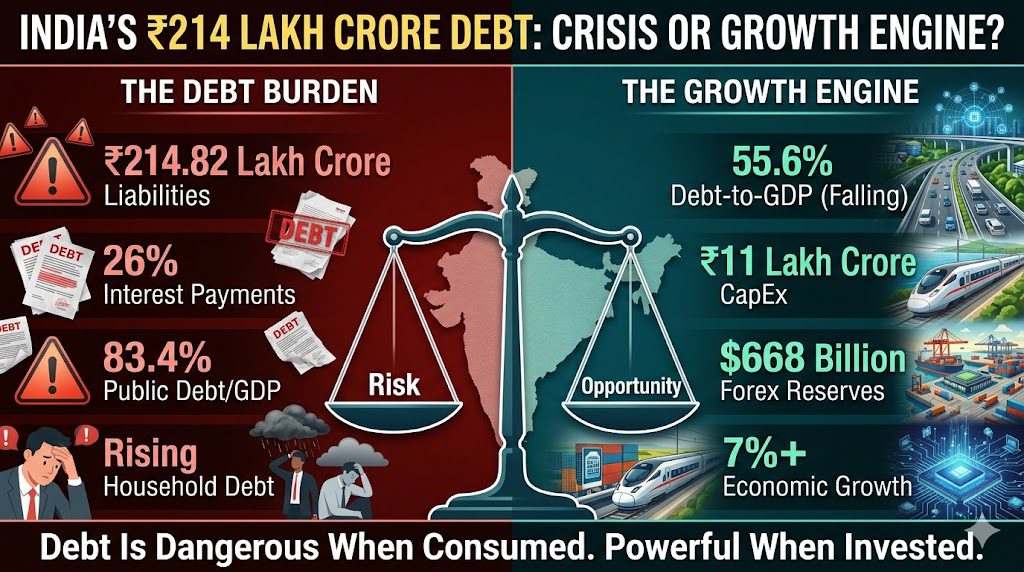
Introduction: The ₹214 Lakh Crore Question That Dominates Political Debate
Few economic topics generate as much political controversy in India today as the country’s rising debt burden. Every election season, television debate, or social media discussion seems to feature alarming claims about India’s liabilities crossing ₹214 lakh crore. For many ordinary citizens, such a massive figure immediately raises concerns about the country’s financial future. Critics often present these numbers as evidence that India is moving toward a dangerous debt trap, while supporters of the government’s economic policies argue that borrowing is necessary to build a modern economy capable of becoming a developed nation by 2047. The debate has become increasingly polarized, with one side warning of a future financial crisis and the other highlighting record infrastructure development and strong economic growth.
The reality, however, is far more complex than political slogans suggest. Debt by itself is neither good nor bad. What matters is how the borrowed money is used, how quickly the economy is growing, and whether the government can comfortably service its obligations over time. To understand the true state of India’s finances, it is necessary to move beyond political narratives and examine the latest available data from the Union Budget 2026-27, the Reserve Bank of India (RBI), the Ministry of Finance, and international institutions such as the IMF. A detailed examination of the numbers reveals that while India does face challenges related to debt management, the country is not currently facing a sovereign debt crisis. Instead, India finds itself at a critical stage where responsible fiscal management will determine whether debt becomes a burden or a powerful engine of economic transformation.
What the Latest 2026 Numbers Actually Reveal
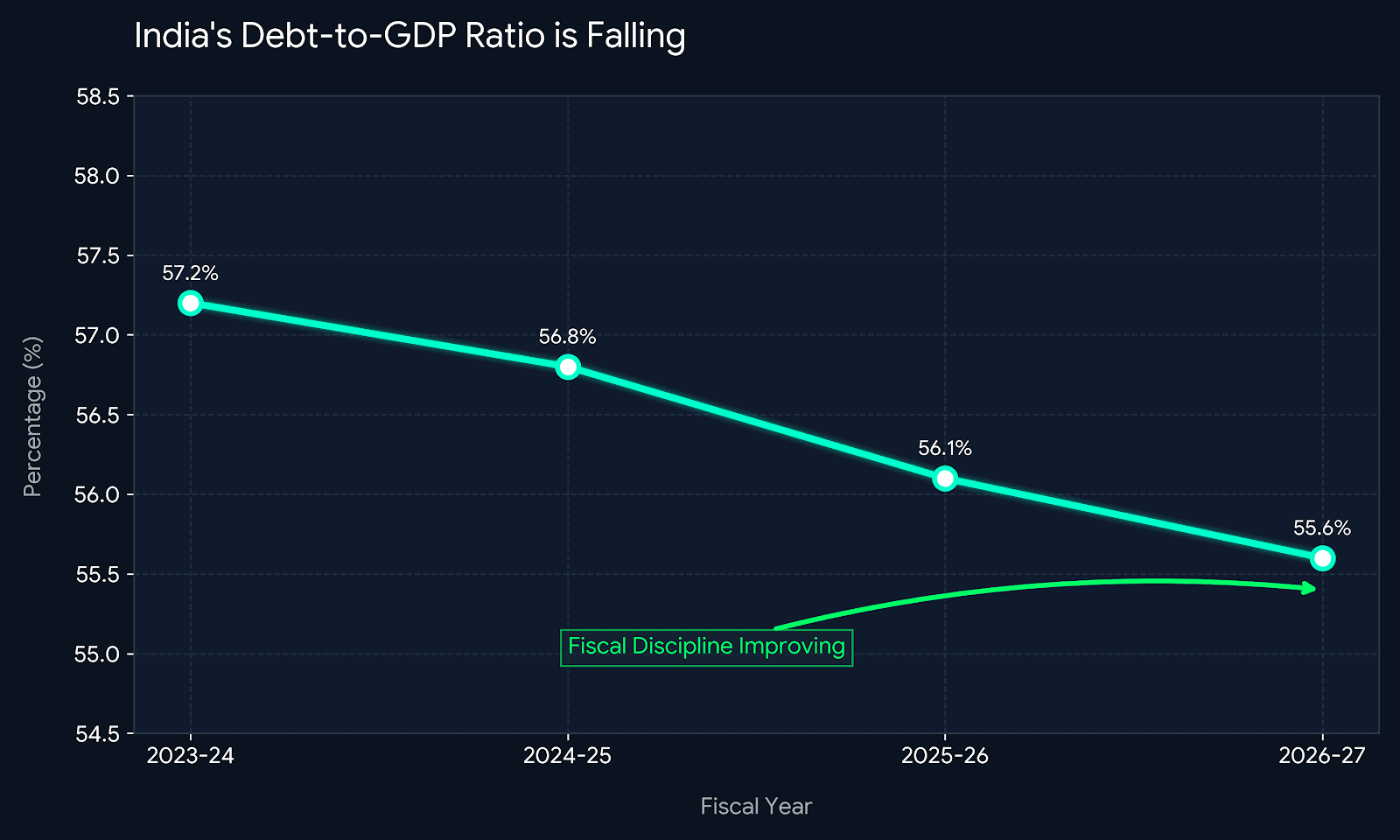
According to the latest fiscal projections, India’s total central government liabilities are estimated to reach approximately ₹214.82 lakh crore during the financial year 2026-27. While this figure appears enormous, economists generally do not evaluate a country’s financial health based solely on the total amount of debt. Instead, they focus on the debt-to-GDP ratio, which compares government debt with the overall size of the economy. This ratio provides a much clearer picture of whether a country can sustain its borrowing levels. The encouraging news for India is that the central government’s debt-to-GDP ratio is projected to decline from 56.1 percent in the revised estimates for FY 2025-26 to around 55.6 percent in FY 2026-27. Although the improvement may seem modest, it indicates that economic growth is outpacing the increase in debt, which is generally viewed as a positive sign by economists and investors.
India’s broader public debt, including both central and state government liabilities, is estimated to stand at approximately 83.4 percent of GDP. While this remains relatively high compared to some emerging economies, international institutions such as the IMF have described India’s debt position as elevated but stable. Another important indicator is the fiscal deficit, which measures the gap between government spending and revenue. The government has successfully reduced the fiscal deficit and is targeting 4.3 percent of GDP for FY 2026-27, demonstrating a commitment to fiscal consolidation. At the same time, India continues to maintain foreign exchange reserves exceeding $668 billion, providing one of the strongest financial buffers among emerging economies. These reserves significantly reduce the risk of external payment pressures and help protect the economy from global financial shocks.
Understanding Why Debt-to-GDP Matters More Than Total Debt
One of the most common mistakes made in public discussions about government borrowing is focusing exclusively on the total debt figure without considering the size of the economy. A country’s ability to manage debt depends largely on its income-generating capacity. Just as a household earning ₹20 lakh annually can comfortably handle a larger loan than a household earning ₹2 lakh, a rapidly growing economy can sustain higher debt levels than a stagnant one. This is why economists pay close attention to the debt-to-GDP ratio. If the economy grows faster than debt, the debt burden gradually becomes easier to manage over time. India’s declining debt-to-GDP ratio suggests that the country’s economic growth is helping improve its fiscal position even as total liabilities continue to increase in absolute terms.
This distinction is particularly important because many political debates deliberately focus on the headline debt number without providing proper context. While ₹214 lakh crore sounds alarming, the more relevant question is whether India’s economy is growing fast enough to support that debt. Current data suggests that it is. India’s economy remains one of the fastest-growing major economies in the world, and this growth provides a strong foundation for managing public liabilities. Nevertheless, maintaining this trajectory will require continued fiscal discipline, efficient tax collection, and sustained investment in productive sectors of the economy.
The Debt Trap Argument: Where Critics Are Right and Where They Are Wrong
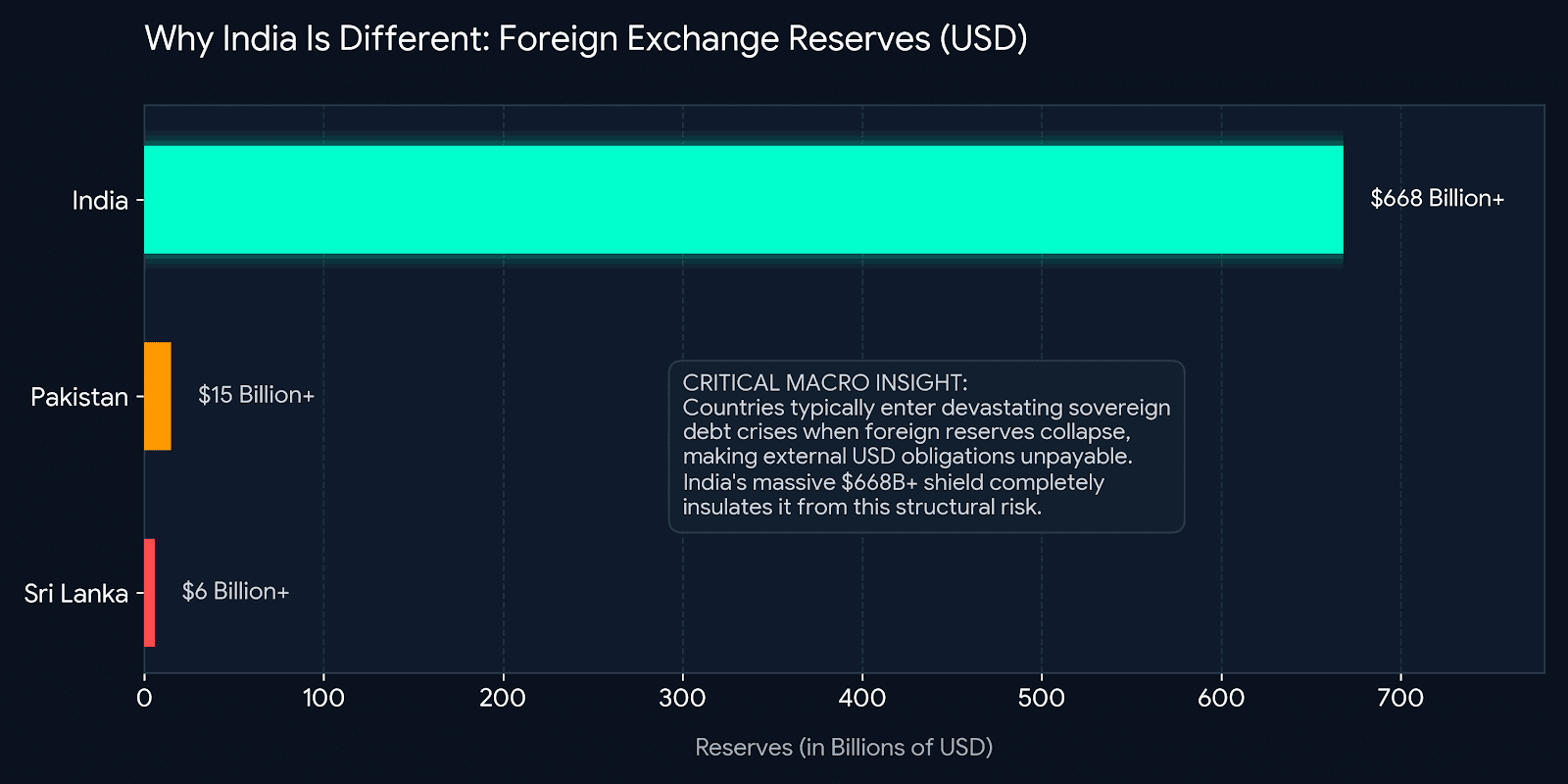
Opposition parties and government critics frequently argue that India’s debt trajectory poses serious long-term risks. They point to rising household debt levels, declining household savings rates, and increasing interest obligations as warning signs. Some critics even compare India’s situation to countries such as Sri Lanka and Pakistan, which experienced severe economic crises in recent years. There is some truth in these concerns. Household debt in India has indeed risen significantly over the past decade as consumers increasingly rely on credit for housing, vehicles, education, and personal spending. At the same time, household financial savings have declined from earlier peaks, reducing the financial cushion available to families during economic disruptions.
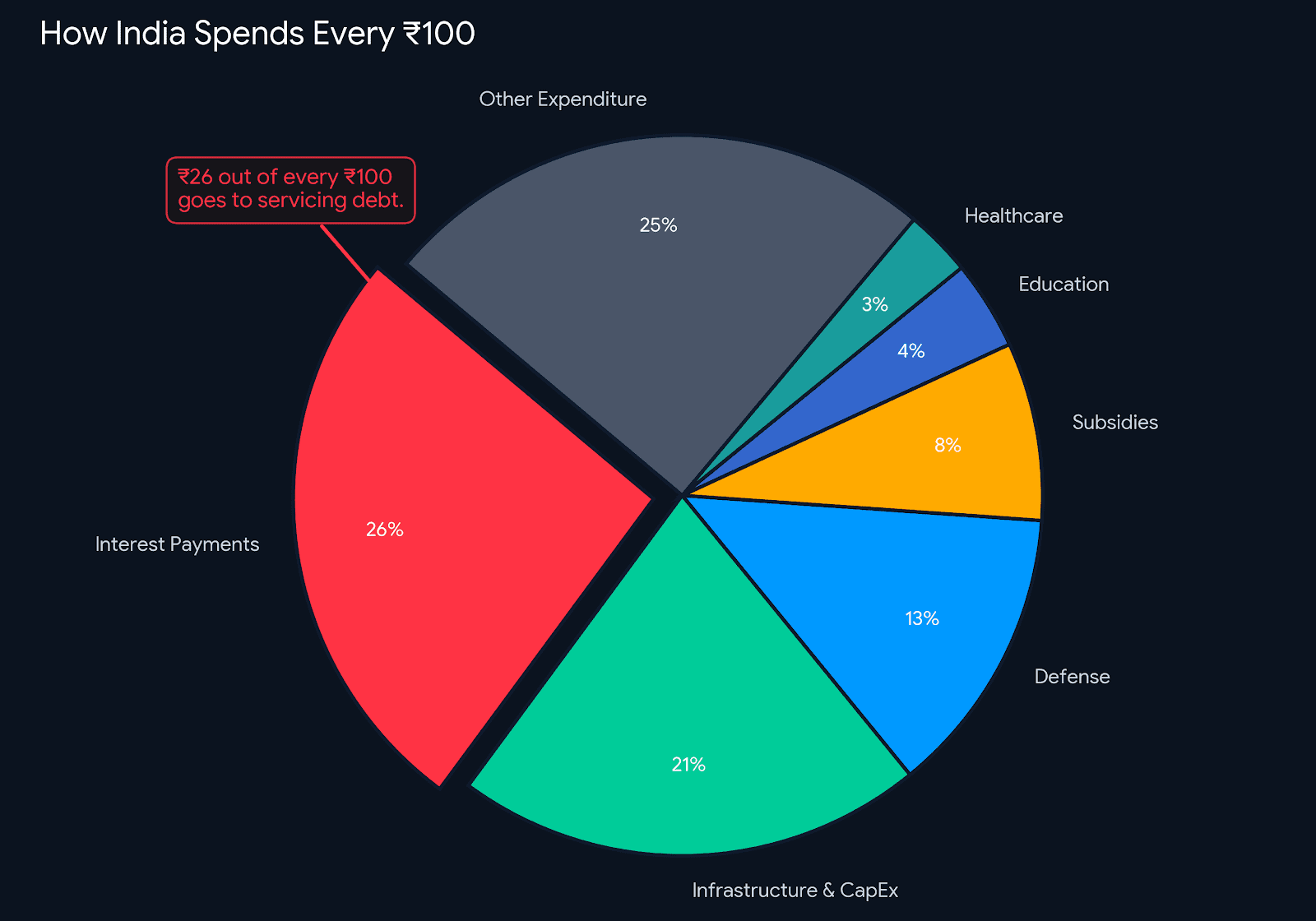
Another legitimate concern is the government’s growing interest burden. Approximately 26 percent of total government expenditure now goes toward servicing existing debt. This means that more than one-fourth of government spending is allocated to paying interest rather than building schools, hospitals, roads, or other productive assets. Such a high interest burden limits the government’s flexibility and reduces the amount of money available for social development programs. These concerns are valid and deserve serious attention from policymakers.
However, the comparison with Sri Lanka or Pakistan is largely inaccurate. Those countries experienced crises primarily because a significant portion of their debt was denominated in foreign currencies, particularly the US dollar. When foreign exchange earnings collapsed, they struggled to repay external creditors, triggering severe balance-of-payments crises. India’s situation is fundamentally different. Most of India’s public debt is denominated in Indian rupees and held domestically by banks, insurance companies, pension funds, and other financial institutions. In addition, India’s foreign exchange reserves exceed $668 billion, providing substantial protection against external financial shocks. These factors make a Sri Lanka-style debt crisis highly unlikely under current circumstances.
The Growth Argument: Why Government Borrowing Can Strengthen the Economy
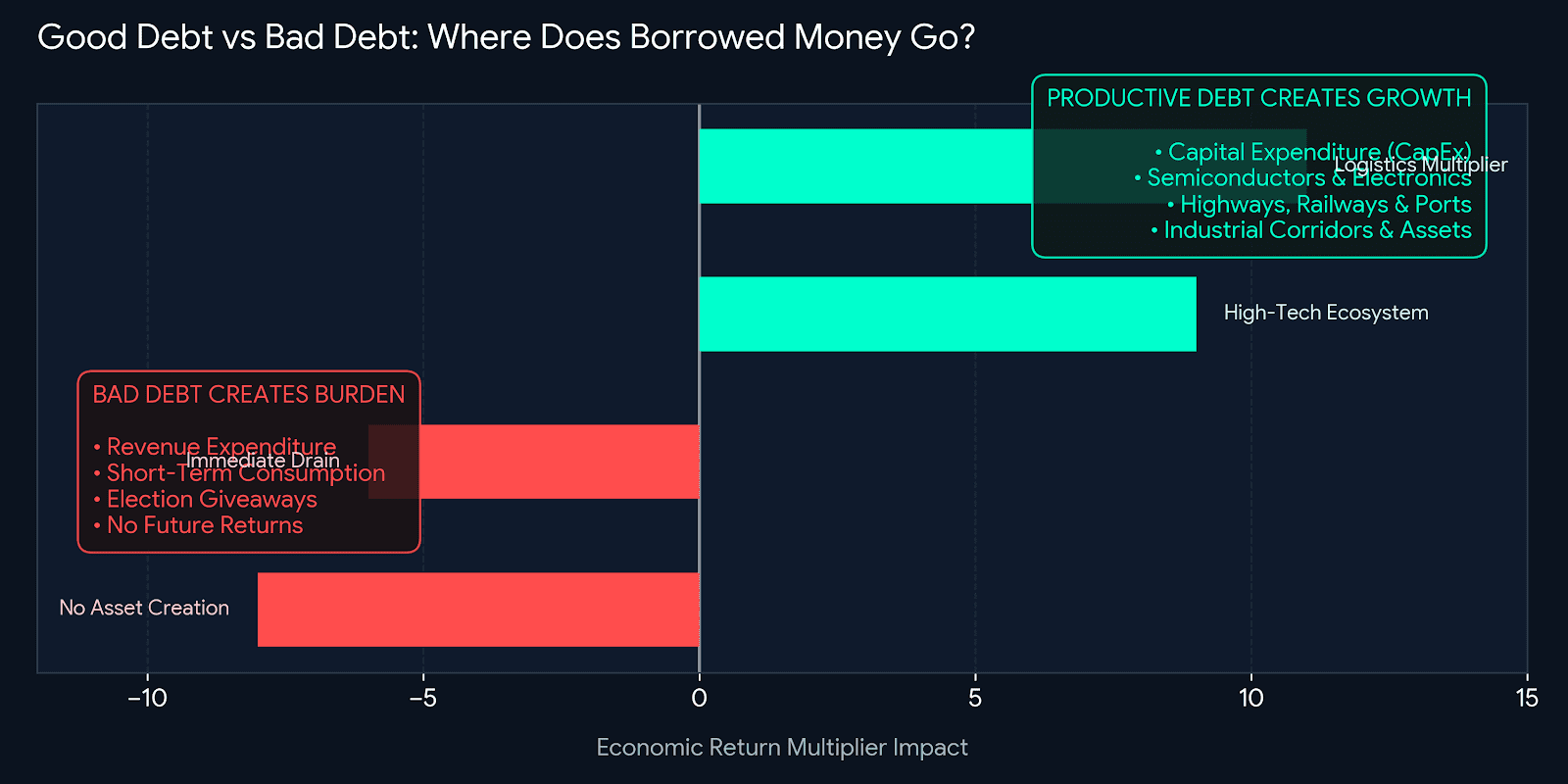
Supporters of the government’s economic strategy argue that borrowing is being used to finance long-term development rather than short-term consumption. This argument is supported by the sharp increase in capital expenditure over recent years. The government has allocated approximately ₹11 lakh crore toward capital expenditure in FY 2026-27, focusing on highways, railways, ports, airports, industrial corridors, semiconductor manufacturing, renewable energy, and digital infrastructure. Such investments create productive assets that enhance the economy’s future growth potential.
Infrastructure investment generates what economists call a multiplier effect. A new highway reduces transportation costs for businesses. Modern ports improve export competitiveness. Better rail connectivity lowers logistics expenses. Digital infrastructure improves efficiency across multiple sectors. As productivity increases, businesses become more competitive, employment opportunities expand, and tax revenues grow. Over time, this growth helps reduce the debt-to-GDP ratio naturally. In this sense, productive borrowing can become a powerful tool for nation-building.
At the same time, supporters of the growth narrative sometimes underestimate the risks associated with high debt levels. Even productive debt creates repayment obligations. Future economic shocks, including global recessions, geopolitical conflicts, commodity price spikes, or climate-related disasters, could place significant pressure on government finances. High debt levels reduce fiscal flexibility during periods of crisis. Therefore, while borrowing for infrastructure can support growth, it must be accompanied by prudent fiscal management and a clear long-term strategy for debt reduction.
Editor’s Verdict: Debt Is Neither a Crisis Nor a Free Pass
After examining the latest data, it becomes clear that India is not currently facing a debt crisis. The country’s debt-to-GDP ratio is gradually declining, fiscal deficits are narrowing, foreign exchange reserves remain strong, and economic growth continues to outperform most major economies. These indicators suggest that India’s fiscal position remains manageable despite the large absolute size of government liabilities.
However, this does not mean debt should be ignored. Rising interest payments, increasing household leverage, and elevated public debt levels present genuine challenges that require careful management. The future impact of India’s debt will depend largely on how effectively borrowed funds are utilized. Debt spent on productive infrastructure, industrial development, technological innovation, and economic modernization can generate long-term benefits that outweigh the costs. Debt spent on short-term consumption or politically motivated giveaways, however, can become a significant burden.
The ultimate conclusion is that debt is a tool. Like any tool, its value depends on how it is used. Based on the available evidence in 2026, India appears to be using debt primarily as an engine for growth rather than moving toward a debt trap. Whether that remains true in the coming decade will depend on continued fiscal discipline, sustained economic growth, and wise policy decisions.