The Great Indian Employment Paradox
India’s labour market has become one of the most debated subjects in the country’s economic and political landscape. Every major election, policy announcement, or economic report eventually leads to discussions about employment generation, unemployment rates, and job opportunities for young people. The debate becomes even more intense because India today is not an economy struggling with growth. On the contrary, India continues to be one of the fastest-growing major economies in the world, with GDP growth expected to remain above 7 percent. Massive investments in infrastructure, manufacturing, digitalization, logistics, and services have transformed the economic landscape over the past decade. Yet despite this strong growth story, concerns regarding employment continue to dominate public discourse.
At first glance, this appears to be a contradiction. How can an economy growing at such a rapid pace still face questions about job creation? The answer lies in understanding the difference between employment quantity and employment quality. Recent labour market data suggests that India is not suffering from a broad-based unemployment crisis. According to the latest Periodic Labour Force Survey (PLFS), the annual unemployment rate has remained close to 3.1 percent, indicating that the majority of the labour force is engaged in some form of economic activity. However, when the data is examined more closely, a different picture emerges. Urban unemployment indicators continue to fluctuate between approximately 5.1 percent and 6.6 percent, particularly among educated youth. This indicates that while jobs exist, many do not necessarily match the expectations, skills, or aspirations of job seekers.
The challenge facing India today is therefore not simply creating jobs but creating productive, formal, and well-paying jobs. Millions of people remain employed in agriculture, self-employment, family businesses, and informal activities. These occupations contribute to employment statistics, but they do not always generate high incomes or long-term economic security. Meanwhile, a growing number of educated young Indians aspire to secure formal-sector employment that provides stable salaries, career progression, social security benefits, and professional development opportunities. The gap between these aspirations and the realities of the labour market has become the defining employment challenge of modern India.
Understanding India’s employment situation requires moving beyond political narratives and focusing on data. It requires analyzing labour force participation, workforce formalization, youth employment, vocational skills, sectoral shifts, and demographic trends. Only by examining these structural factors can we understand what India’s employment data is actually telling us.
The Positives: Strong Signals of Labour Market Resilience
One of the most encouraging developments in India’s labour market has been the rapid formalization of employment. For decades, the Indian economy was dominated by informal jobs that lacked retirement benefits, healthcare coverage, legal protections, and financial security. Workers often operated outside formal payroll systems, making it difficult to track actual employment generation. However, recent data from the Employees’ Provident Fund Organisation (EPFO) suggests that this trend is changing rapidly.
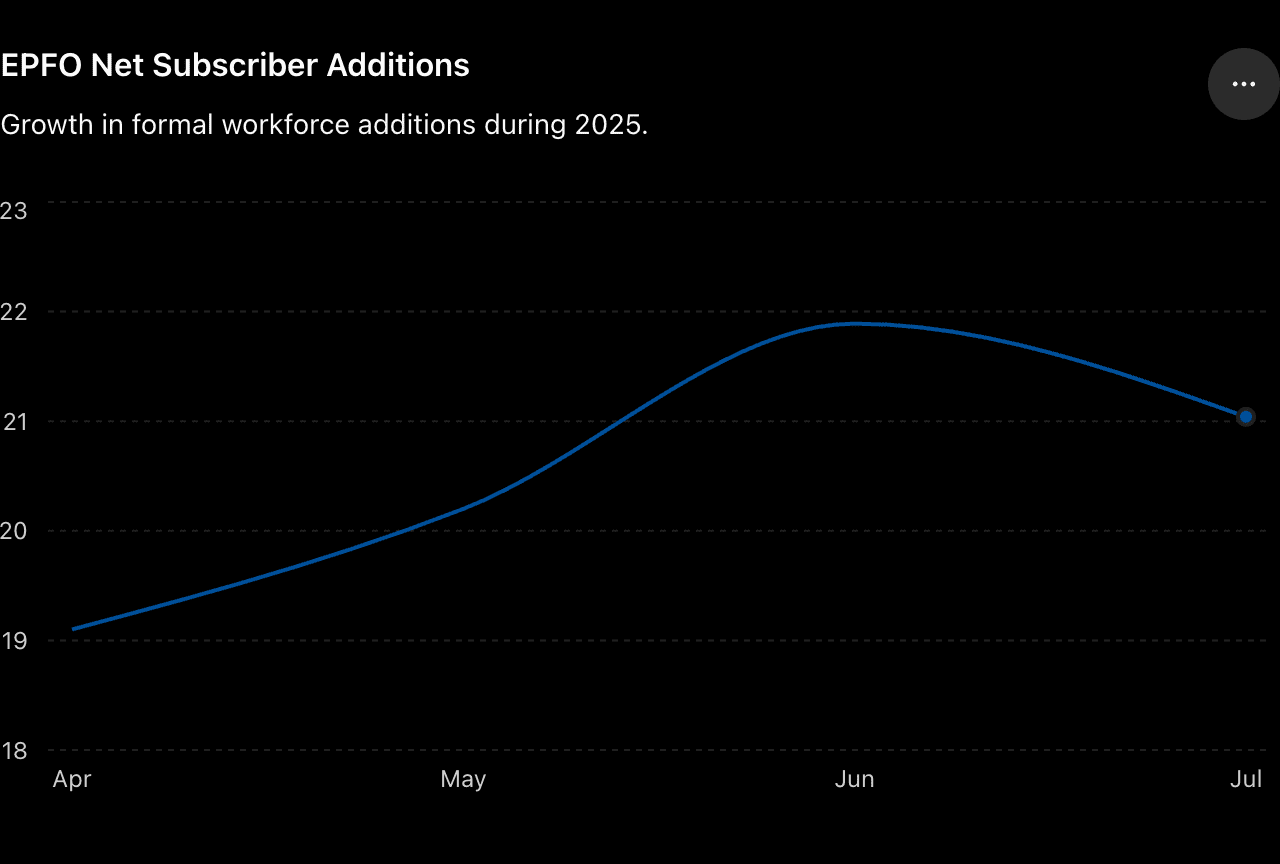
During 2025, EPFO recorded some of the highest levels of formal workforce additions in its history. Net additions reached approximately 21.89 lakh subscribers in June 2025 and remained above 21 lakh in July 2025. These figures are significant because EPFO registrations typically indicate entry into the organized workforce. They represent individuals who are now working in establishments that provide retirement benefits and comply with labour regulations. More importantly, over 60 percent of these new additions belonged to the 18-25 age group, indicating that first-time job seekers are entering the formal labour market at an unprecedented pace.
This trend carries important implications for India’s economic future. Formalization improves productivity, increases tax compliance, expands financial inclusion, and strengthens social security coverage. As more workers move into formal employment, household incomes become more stable, consumption becomes more predictable, and economic resilience improves. While formalization alone does not solve every employment challenge, it represents a major structural improvement compared to previous decades.
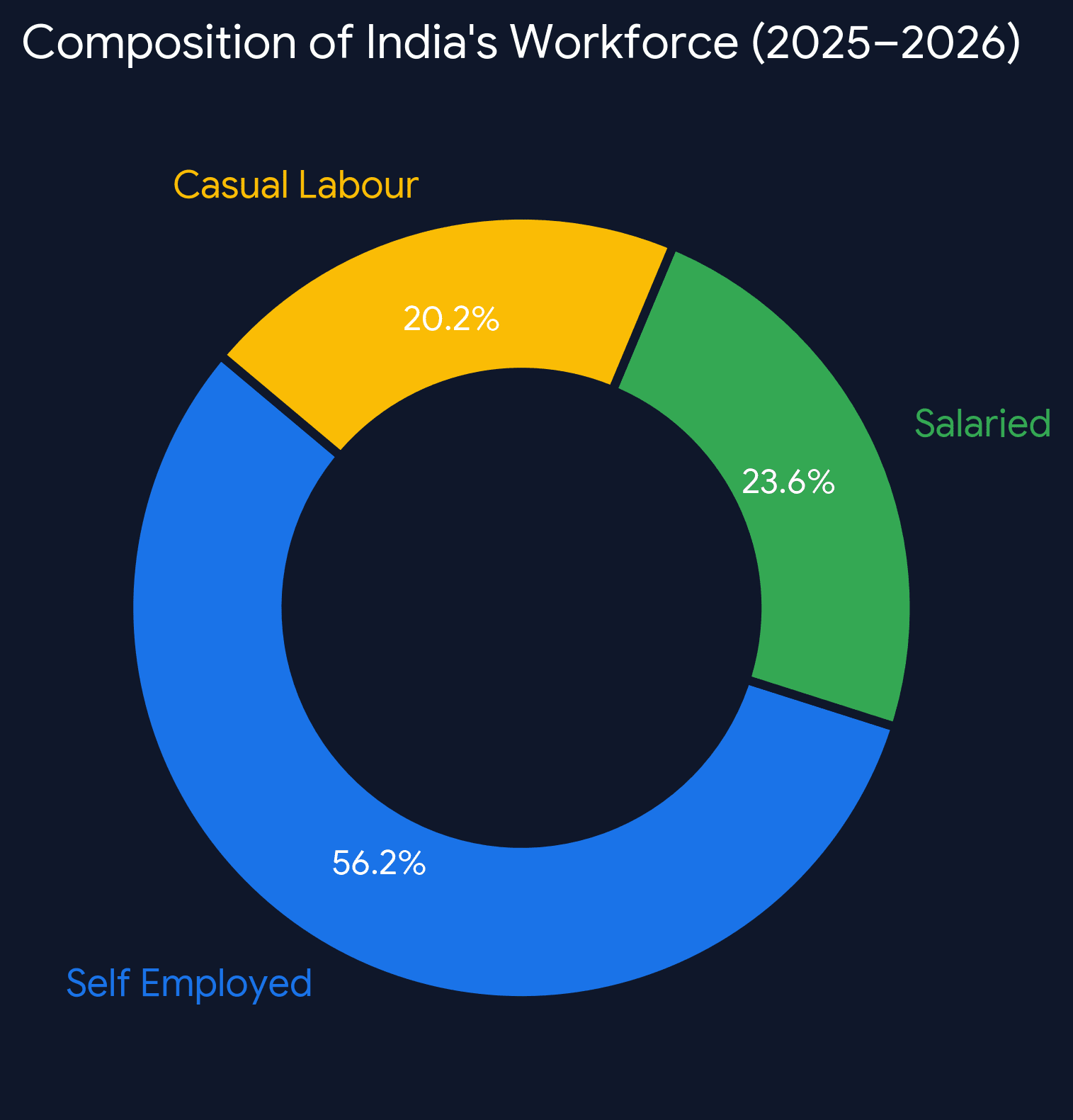
Another positive trend is the steady increase in regular salaried employment. According to PLFS data, the share of workers engaged in regular wage and salaried employment has risen to approximately 23.6 percent. At the same time, self-employment, while still dominant, has moderated slightly. This shift indicates gradual movement toward more structured forms of employment. Historically, countries transitioning from lower-income to middle-income status experience a similar transformation as workers move from subsistence activities into more productive sectors. India’s labour market appears to be following this pattern.
Female labour force participation also deserves special attention. For many years, economists viewed India’s low female participation rates as a major structural weakness. However, recent data indicates significant improvement. Female Labour Force Participation Rate (LFPR) has risen to approximately 40 percent nationally. While much of this increase has been driven by rural employment and self-employment activities, it nonetheless represents a positive shift. Greater female participation expands household incomes, improves economic productivity, and contributes to broader social development outcomes.
Rural labour markets have also demonstrated remarkable resilience. Rural unemployment remains close to 2.4 percent, significantly lower than urban unemployment rates. This reflects the unique structure of India’s economy, where agriculture and related activities continue to function as a safety net during periods of economic transition. While agriculture may not be the most productive sector, it provides employment stability and prevents the kind of mass unemployment shocks commonly observed in advanced economies.
The Negatives: India’s Structural Employment Challenges
Despite these positive indicators, significant challenges remain. Perhaps the most concerning statistic in India’s labour market is the NEET rate. Approximately 25 percent of Indian youth between the ages of 15 and 29 fall into the category of Not in Employment, Education, or Training. This means that one out of every four young Indians is neither studying nor working. Such a high level of youth underutilization represents a major economic and social challenge.
The problem becomes even more visible in urban areas, where youth unemployment remains elevated at approximately 13.6 percent. Unlike rural youth, who often find employment in agriculture, family enterprises, or local economic activities, urban youth typically seek formal-sector jobs. Competition for these positions is intense, and many graduates struggle to find opportunities that align with their educational qualifications.
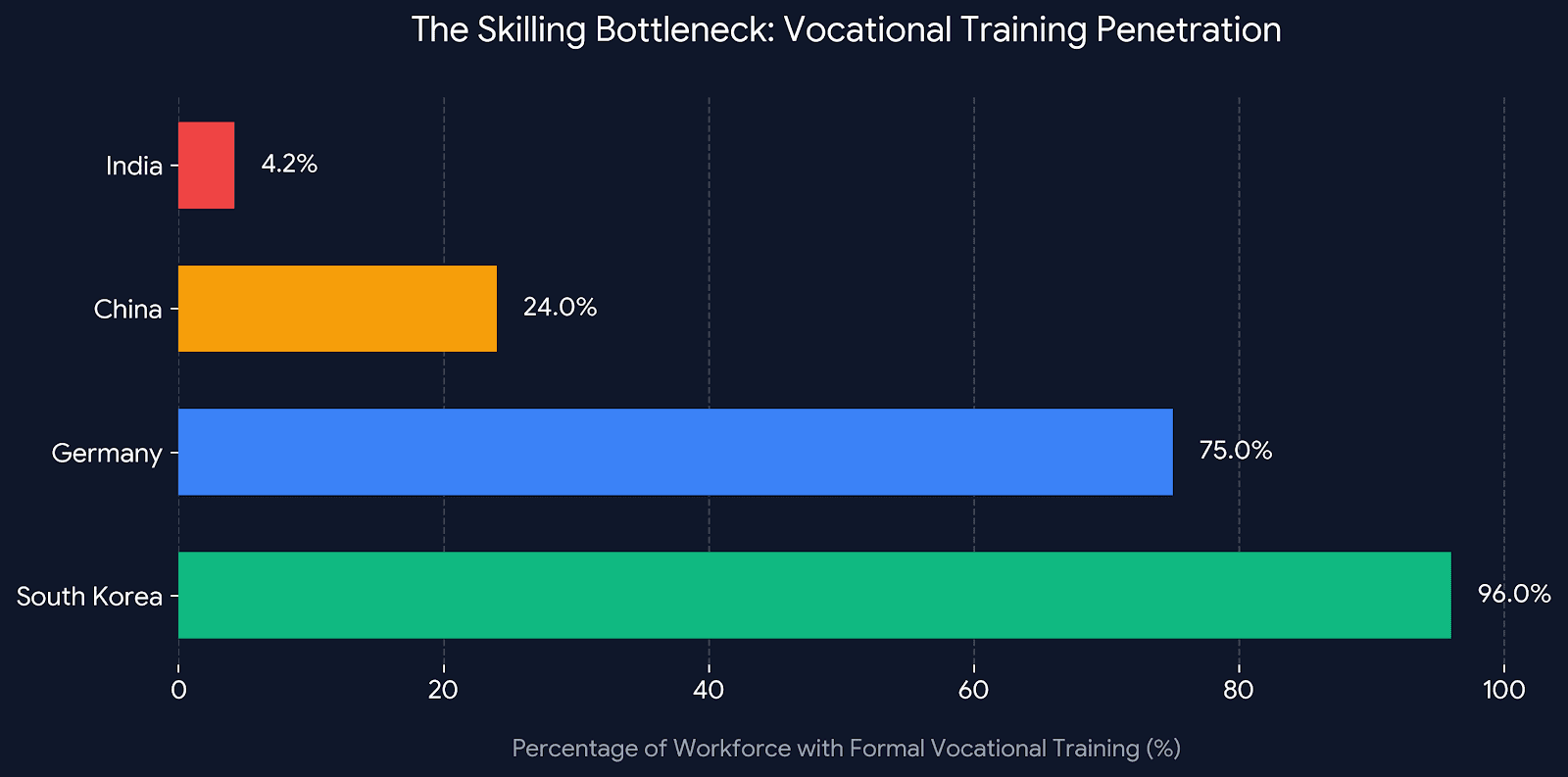
Another critical challenge is India’s skill deficit. Despite producing millions of graduates every year, only about 4.2 percent of the workforce aged 15 to 59 has received formal vocational training. This figure is extremely low when compared to countries such as China, Germany, South Korea, or Japan. The result is a paradoxical situation in which employers report skill shortages while large numbers of workers remain unemployed or underemployed.
Many graduates possess academic degrees but lack practical skills required by industry. Employers frequently cite deficiencies in communication skills, technical knowledge, digital competencies, problem-solving abilities, and workplace readiness. This mismatch creates friction within the labour market and limits the ability of businesses to expand efficiently.
Another important concern involves the nature of many newly created formal jobs. While EPFO data demonstrates strong employment growth, a substantial portion of new registrations originates from expert services, staffing agencies, manpower contractors, and outsourced workforce providers. More than 40 percent of EPFO additions are associated with these categories. Although these jobs are technically formal, many are contractual rather than permanent. Workers may receive social security benefits, but long-term job security often remains limited. This helps explain why positive employment data can coexist with public perceptions of job insecurity.
The Historical Illusion of Government Employment
One of the most persistent myths in India’s employment discourse is the belief that government jobs can solve the country’s unemployment challenge. This perception has deep historical roots dating back to the License Raj era, when public-sector employment represented stability, prestige, and economic security. Even today, millions of young Indians prepare for government examinations in hopes of securing a limited number of positions.
However, economic realities tell a different story. Total civilian employment within the Central Government has remained relatively stable at approximately 3.1 to 4.1 million positions over the past two decades. Annual recruitment is largely driven by retirements rather than expansion. In most years, government hiring simply replaces workers leaving the workforce.
The mathematics are straightforward. India adds millions of individuals to its labour force every year. Government employment, by contrast, creates only a fraction of that number in net new opportunities. Even if every vacant government position were filled immediately, the impact on national employment would be minimal. The public sector lacks the scale necessary to absorb India’s demographic dividend.
International experience reinforces this conclusion. Countries that relied heavily on state employment often encountered fiscal stress, declining productivity, and slower economic growth. Sustainable employment generation has historically come from private-sector expansion, entrepreneurship, industrialization, and technological innovation rather than government payroll expansion.
Separating Facts from Political Narratives
Employment statistics are often used to support political agendas. Some commentators portray India as facing a historic employment disaster, while others claim that employment challenges have been completely solved. Neither perspective is supported by evidence.
The narrative of a total employment collapse ignores important indicators such as record EPFO registrations, rising formalization, infrastructure-led hiring, manufacturing growth, and expanding service-sector opportunities. At the same time, overly optimistic narratives ignore genuine concerns regarding youth unemployment, skill shortages, job quality, and workforce productivity.
Similarly, criticism of gig work often lacks nuance. Gig employment is frequently portrayed as evidence of economic distress. While gig jobs may not represent ideal long-term careers for everyone, they perform an important function within a developing economy. For workers transitioning out of low-productivity agriculture, gig platforms provide immediate income opportunities and labour market entry points. The challenge is not the existence of gig work but ensuring pathways toward higher-productivity employment over time.
The proposal that governments should solve unemployment by continuously expanding public-sector hiring is equally problematic. Such policies would increase salary expenditures, pension obligations, and fiscal deficits. Higher government consumption could crowd out productive investments in infrastructure, education, and industrial development. Ultimately, this would weaken long-term job creation rather than strengthen it.
The Strategic Roadmap for India’s Employment Future
India’s employment future depends on improving productivity rather than simply increasing employment numbers. One important area of focus is geographic diversification. Major metropolitan cities such as Delhi, Mumbai, and Bengaluru face rising costs, congestion, and infrastructure pressures. Future employment growth is likely to emerge from Tier-2 and Tier-3 cities such as Surat, Indore, Coimbatore, Lucknow, Patna, and Nagpur. These cities offer lower operating costs, abundant labour availability, and improving infrastructure.
High-value manufacturing represents another critical opportunity. Global supply chains continue to diversify beyond China, creating opportunities for countries capable of combining competitive labour costs with improving industrial ecosystems. Production Linked Incentive (PLI) schemes have already encouraged investment in electronics, automotive components, defense manufacturing, textiles, and other sectors. Continued expansion of these industries could generate millions of productive jobs.
Global Capability Centers (GCCs) also represent a major source of future employment. India already hosts thousands of GCC operations serving multinational corporations. The next stage of growth will involve moving beyond routine back-office functions into advanced engineering, artificial intelligence, financial analytics, semiconductor design, and research activities.
The agricultural sector also requires transformation. Rather than keeping workers trapped in low-productivity farming, policy should focus on agro-processing, cold-chain logistics, food packaging, and export-oriented agricultural industries. These activities generate higher incomes while maintaining connections to rural economies.
Most importantly, India must address its skill deficit. Expanding apprenticeships, vocational training, industry partnerships, and micro-credential programs could dramatically improve workforce readiness. Education systems must become more responsive to labour market requirements. Future success will depend not only on academic qualifications but also on practical skills and continuous learning.
Editorial Verdict
The evidence suggests that India’s employment challenge is neither a crisis nor a complete success story. The country is generating jobs, formalizing its workforce, increasing female participation, and attracting investment across multiple sectors. These developments represent genuine progress and should not be ignored.
At the same time, structural weaknesses remain significant. High NEET rates, urban youth unemployment, limited vocational training, and concerns regarding job quality continue to constrain labour market performance. The issue is not a lack of economic activity but a mismatch between skills, productivity, and aspirations.
Ultimately, India’s future prosperity will depend on its ability to convert a large labour force into a highly productive workforce. The state cannot hire its way out of unemployment, nor can political rhetoric solve structural economic challenges. The path forward lies in strengthening private-sector growth, expanding vocational training, integrating into global value chains, supporting entrepreneurship, and creating an ecosystem where human capital can flourish.
India’s employment story is therefore best understood not as a volume problem but as a productivity problem. Solving that challenge will determine whether the country’s demographic dividend becomes its greatest economic advantage or its most significant missed opportunity.