Introduction: The Retail Marathon Finishes a Strong Lap
In the world of banking, true transformation doesn’t happen overnight. It takes years of discipline, strategy, and patience. If there is one bank in India that perfectly represents this journey, it is IDFC First Bank. Over the last few years, the bank has completely reinvented itself—from an infrastructure-heavy lender to a retail-focused, digital-first institution.
The Q4 FY26 results released on April 25, 2026, may not look explosive at first glance. Net profit grew by just 5% year-on-year to ₹319 crore. But numbers alone don’t tell the full story. Beneath the surface, the bank is showing strong signs of maturity, stability, and long-term growth potential.
What makes this even more interesting is the broader market context. Despite a sharp 900-point fall in the Sensex due to geopolitical tensions in West Asia, the stock has held steady around ₹67. This resilience indicates that investors are beginning to trust the bank’s business model.
FY26 can be seen as the “year of quality” for IDFC First Bank. The heavy lifting from past mergers and restructuring is now behind it. What lies ahead is a phase of consistent profit growth and operational efficiency.
Q4 FY26 Financial Scorecard: Decoding the Growth
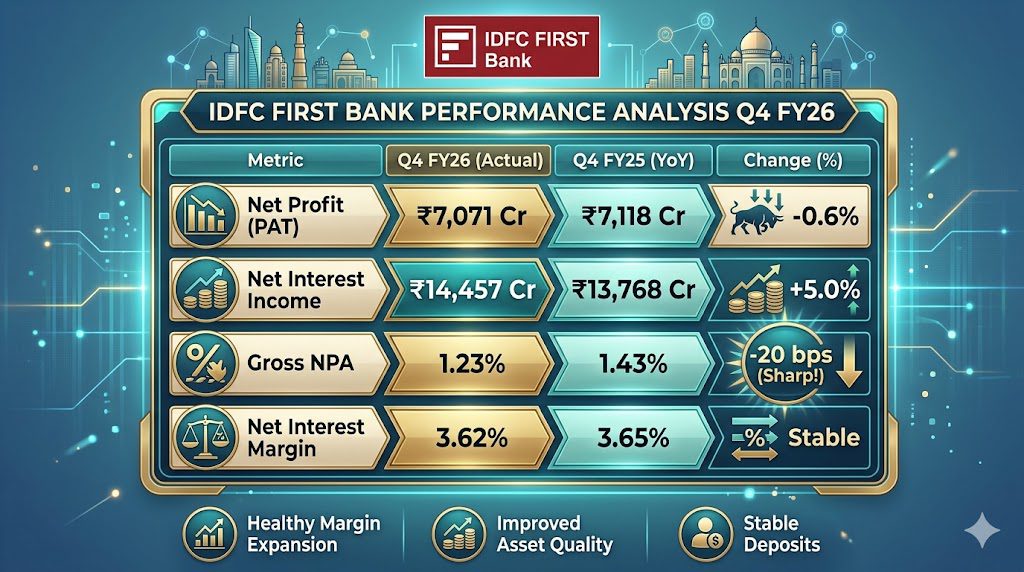
The financial performance of IDFC First Bank in Q4 FY26 reflects steady and improving fundamentals. The bank reported a standalone net profit of ₹319 crore, compared to ₹304 crore in the same quarter last year. While this 5% growth may appear modest, it is important to note that the quality of earnings has significantly improved.
Net Interest Income (NII), which is the core revenue driver for any bank, grew strongly by 16% to ₹5,677 crore. This indicates that the bank’s lending operations are expanding at a healthy pace.
Asset quality has also improved significantly. The Gross NPA ratio declined to 1.61% from 1.88%, while the Net NPA dropped to just 0.48%. These are among the best levels the bank has reported in recent years.
These numbers clearly show that the bank is not just growing—it is growing in a disciplined and sustainable manner.
Fundamental Analysis: The “Safety” Moat
MFI Issue Behind Us
One of the biggest concerns for the banking sector over the past year has been stress in the microfinance (MFI) segment. However, according to management commentary, the worst of this cycle is now over.
For IDFC First Bank, this is clearly visible in its improving asset quality. The Gross NPA has dropped to 1.61%, indicating that loan stress is reducing. This improvement suggests that the bank has successfully navigated one of the most challenging phases in recent times.
The Chandigarh Incident: A Test of Governance
During the quarter, the bank reported a ₹483 crore post-tax expense related to a branch-level fraud incident. While such events can raise concerns, the way the bank handled it is worth noting.
Instead of spreading the impact over multiple quarters, the bank chose to fully recognize the loss in one go. This approach reflects strong corporate governance and transparency.
For investors, this is actually a positive signal—it shows that the management is willing to take tough decisions to maintain credibility.
Deposit Powerhouse: Building a Strong Foundation
One of the most impressive aspects of IDFC First Bank’s growth is its deposit franchise. CASA (Current Account Savings Account) deposits grew by 24% to ₹1.46 lakh crore.
This is extremely important because CASA deposits are low-cost funds. The bank’s cost of funds has now reduced to around 6%, making it more competitive with larger private banks.
A strong deposit base not only improves profitability but also provides stability during uncertain times.
Technical Analysis: The Support at ₹65
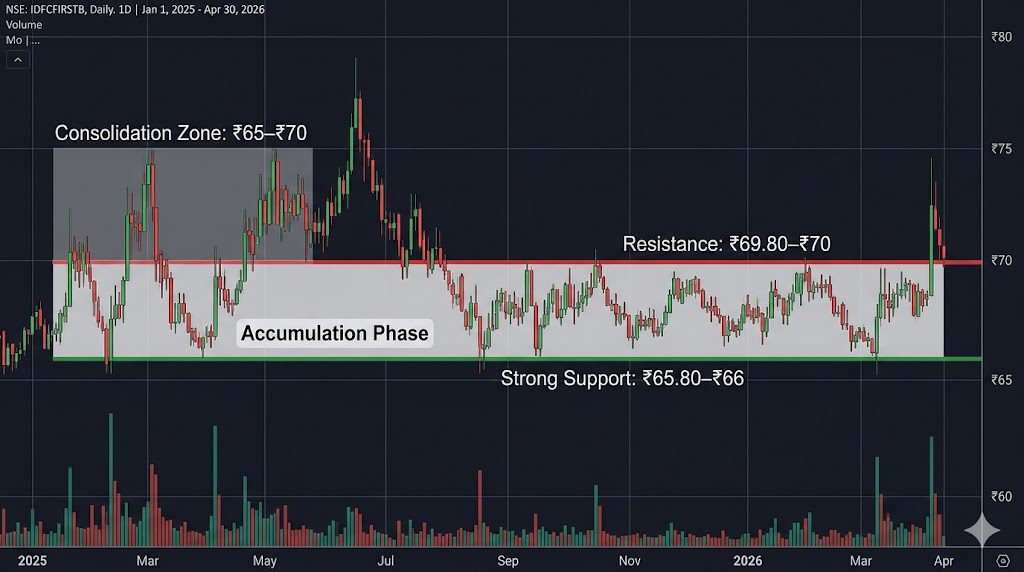
From a technical standpoint, the stock is currently in a consolidation phase. It is trading near its 20-day exponential moving average (EMA) around ₹66.9, indicating a balance between buyers and sellers.
The ₹65.80–₹66 range has emerged as a strong support zone. This level has been tested multiple times during April, and each time the stock has bounced back, suggesting strong buying interest.
On the upside, ₹69.80 is the key resistance level. A breakout above ₹70, supported by strong volume, could trigger a rally toward ₹87, which is close to its 52-week high.
The Relative Strength Index (RSI) is currently around 54, indicating a neutral trend. This suggests that the stock is building energy for its next move.
Management Guidance & FY27 Outlook
Loan Growth Outlook
The management has guided for loan growth of over 20% in key segments such as retail mortgages and vehicle loans. This indicates strong demand and confidence in the bank’s growth strategy.
Retail lending remains the core focus, as it provides better risk-adjusted returns compared to corporate lending.
Profitability Improvement
One of the most important factors for FY27 will be profitability. The bank expects its Return on Assets (ROA) to improve significantly as credit costs decline.
Provisions have already come down from 2.69% to 1.63%, and further improvement is expected. Lower provisions mean higher profits, which could drive earnings growth in the coming years.
Wealth Management: The Next Growth Engine
Another area of focus is wealth management. The bank’s private wealth business has grown by 23%, indicating strong demand for financial advisory services.
This segment is important because it generates high-margin fee income, which can significantly boost overall profitability.
Brokerage Sentiment & Targets: The Re-Rating Potential
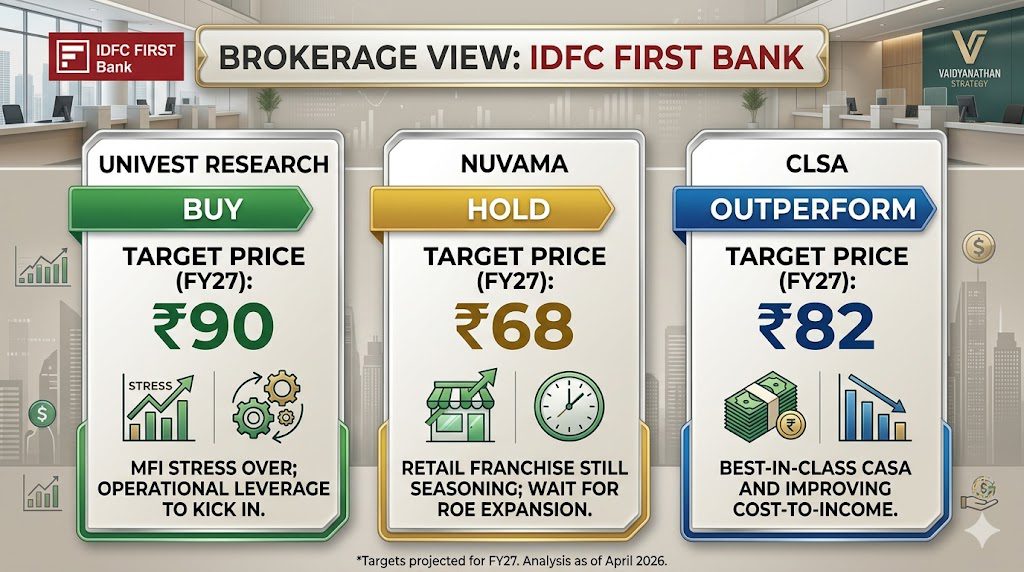
Brokerage firms have a mixed but generally positive outlook on IDFC First Bank.
CLSA has given an “Outperform” rating with a target price of ₹82, highlighting strong CASA growth and improving cost efficiency.
Nuvama Institutional Equities has taken a more cautious stance with a “Hold” rating and a target of ₹68, suggesting that the bank still needs to demonstrate consistent return on equity.
Meanwhile, consensus estimates from various analysts suggest a target of around ₹90, driven by expectations of operational leverage and reduced credit costs.
This indicates that the stock is in a re-rating phase, where improved fundamentals could lead to higher valuations.
The “30-Year” Analyst Verdict
For Long-Term Investors
For long-term investors, IDFC First Bank represents a “quality at a reasonable price” opportunity. With a price-to-earnings ratio of around 18x, it is relatively cheaper than many high-growth banking stocks.
The bank’s transformation story, combined with improving asset quality and strong deposit growth, makes it a compelling long-term investment.
For Traders
For traders, the stock is currently range-bound. The strategy is to buy near the support level of ₹65 and look for targets around ₹75.
However, strict risk management is essential, with a stop-loss around ₹61.
Conclusion: A Story of Maturity and Discipline
IDFC First Bank’s Q4 FY26 results may not be flashy, but they reflect something far more important—maturity.
The bank has successfully moved past its transformation phase and is now entering a period of stable growth and improving profitability. With strong fundamentals, disciplined management, and a clear growth strategy, it is well-positioned for the future.
What’s Your View? (CTA)
Do you think IDFC First Bank can reach ₹90 in 2026, or is the current valuation already pricing in the growth?
Share your thoughts and let’s discuss your banking portfolio strategy.