Introduction: Short-Term Pain, Long-Term Strategy
India’s automobile industry has gone through several major transitions over the last three decades. From the era of small hatchbacks and fuel-efficient compact cars to today’s dominance of SUVs and electric vehicles, only a few companies have consistently remained at the center of India’s passenger vehicle market. One such company is HYUNDAI. Hyundai Motor India has successfully transformed itself from a budget-friendly car manufacturer into one of the country’s strongest premium mass-market automotive brands.
Back in the early 2000s, Hyundai built its reputation with products like the Santro, i10, and Verna. Today, the company’s growth story is heavily driven by premium SUVs such as the Creta, Venue, Alcazar, and Tucson. This strategic shift toward higher-value products has significantly improved Hyundai’s brand positioning in India.
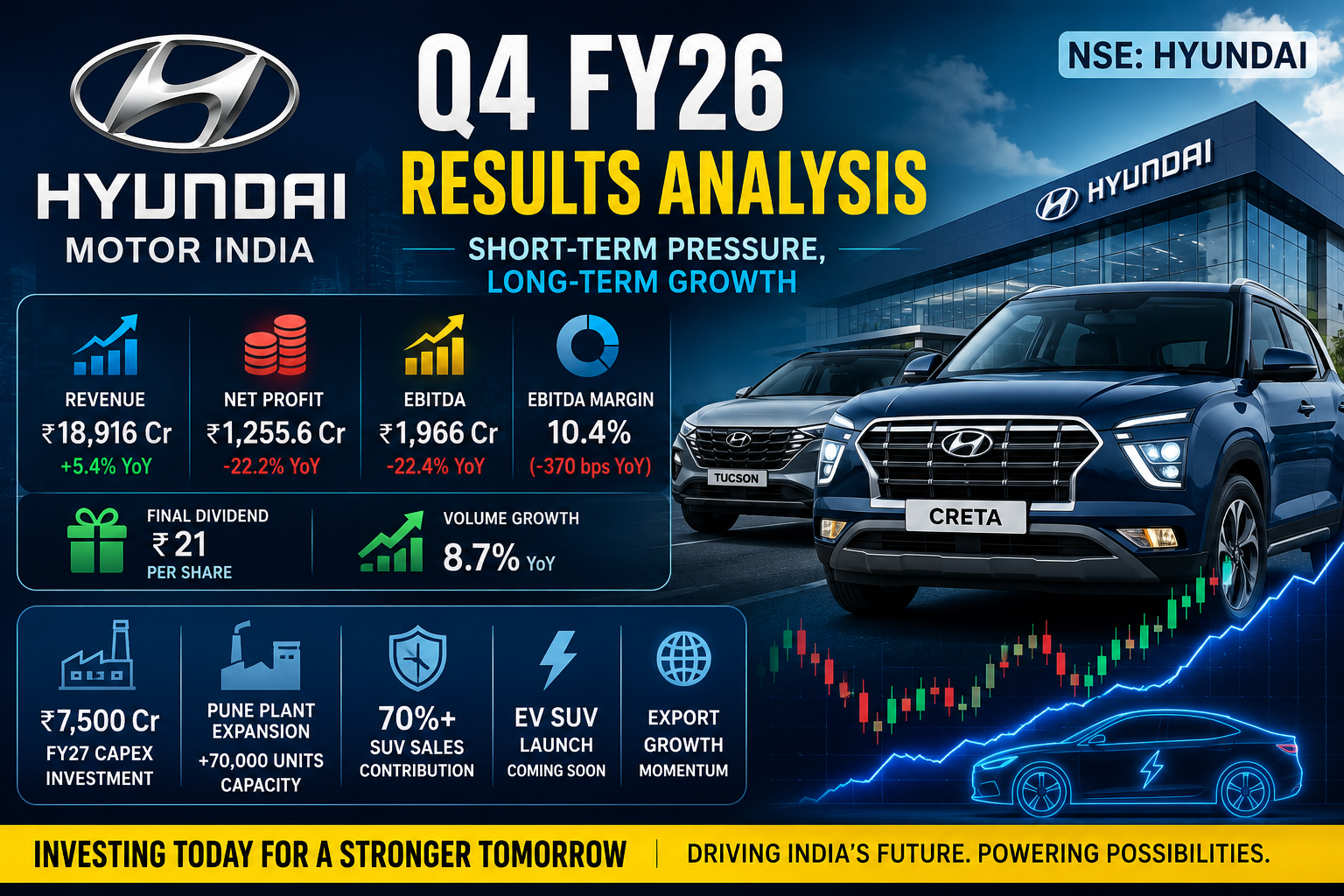
On May 8, 2026, Hyundai Motor India announced its Q4 FY26 financial results, and the market reaction was mixed. At first glance, the sharp decline in profits and margins appears disappointing. Net profit fell more than 22% year-on-year, while EBITDA margins dropped significantly. However, experienced investors understand that these numbers reflect a company that is aggressively investing in future growth opportunities rather than simply maximizing short-term profitability.
Hyundai is currently spending heavily on capacity expansion, EV development, rural penetration, and premium product growth. These investments are temporarily impacting margins, but management believes they will strengthen the company’s long-term position in one of the world’s fastest-growing automobile markets.
For long-term investors, the most important takeaway is that Hyundai continues to show healthy demand growth despite operational pressures. Wholesale volumes increased strongly, SUV sales remain robust, and the company is aggressively preparing for India’s next phase of automotive evolution.
The Core Scorecard: Q4 FY26 Actual Numbers
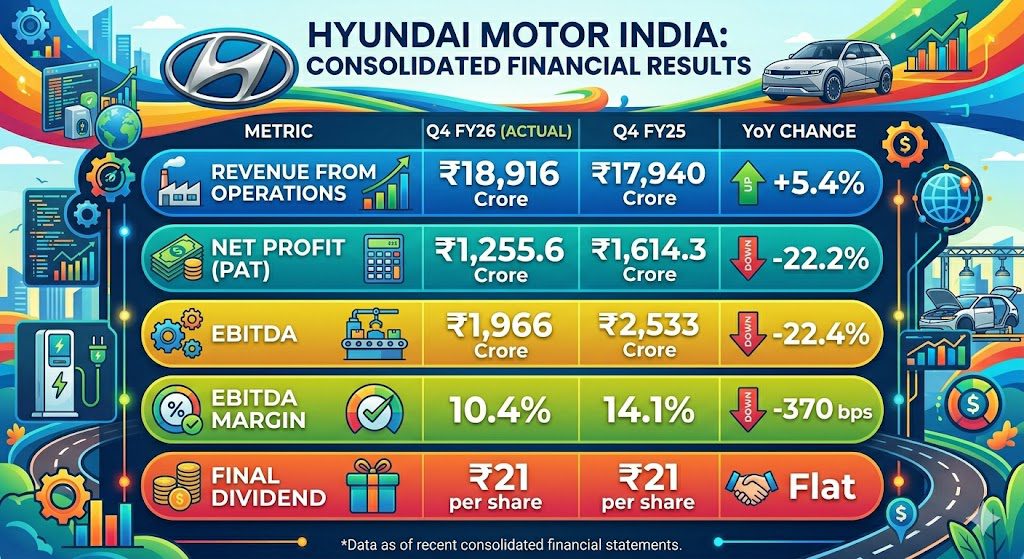
Hyundai Motor India delivered moderate revenue growth during Q4 FY26, but profitability came under pressure due to rising operating costs and margin compression. According to the company’s official filings, revenue from operations increased to ₹18,916 crore compared to ₹17,940 crore during Q4 FY25, reflecting healthy growth of 5.4% year-on-year.
However, the company’s bottom line showed significant weakness. Net profit after tax declined sharply to ₹1,255.6 crore from ₹1,614.3 crore in the same quarter last year, representing a decline of 22.2%. EBITDA also fell from ₹2,533 crore to ₹1,966 crore, while EBITDA margins contracted heavily from 14.1% to 10.4%.
Despite these pressures, Hyundai maintained its final dividend at ₹21 per share, signaling management confidence regarding long-term cash flow stability and future growth prospects.
| Metric | Q4 FY26 | Q4 FY25 | YoY Change |
|---|---|---|---|
| Revenue from Operations | ₹18,916 Cr | ₹17,940 Cr | +5.4% |
| Net Profit (PAT) | ₹1,255.6 Cr | ₹1,614.3 Cr | -22.2% |
| EBITDA | ₹1,966 Cr | ₹2,533 Cr | -22.4% |
| EBITDA Margin | 10.4% | 14.1% | -370 bps |
| Final Dividend | ₹21/share | ₹21/share | Flat |
The numbers clearly show that while demand remains stable, profitability is facing short-term pressure due to higher costs and aggressive expansion investments.
Fundamental Analysis: Why Did Profits Fall?
Margins Reveal the Real Story
In the automobile sector, operating margins often reveal far more about business quality than revenue growth alone. Hyundai’s sharp EBITDA margin decline to 10.4% is one of the most important developments from the Q4 FY26 results.
The margin contraction was mainly driven by rising raw material costs, higher operating expenses, and product mix changes. Prices of steel, aluminum, semiconductor components, batteries, and logistics services remain elevated globally, creating cost pressure across the auto industry.
At the same time, competition within the premium SUV market has intensified. Although SUVs remain highly profitable products, aggressive competition and promotional activity have slightly impacted pricing power during the quarter.
This explains why Hyundai’s revenue continued growing while overall profitability weakened significantly.
Employee Costs Increased Sharply
Another major factor affecting profitability was the sharp rise in employee-related expenses. Hyundai reported that standalone employee benefit costs surged nearly 37% year-on-year to ₹699 crore during the quarter.
A key reason behind this increase was the implementation impact of India’s evolving labor code regulations. Such regulatory changes often increase operational expenses temporarily before companies gradually adjust cost structures over time.
Although this increase affected short-term profitability, investors should remember that such expenses are often transitional rather than permanently structural.
Wholesale Volumes Continue Growing
Despite pressure on profits, Hyundai’s operational demand story remains healthy. The company’s wholesale vehicle volumes increased approximately 8.7% year-on-year to 208,275 units during Q4 FY26.
This growth was supported by strong exports, improving rural penetration, and continued demand for premium SUVs. Hyundai has been expanding aggressively into semi-urban and rural India where rising incomes and improving infrastructure are creating new automobile demand opportunities.
The company’s export business also remains an important strength because it reduces dependence on domestic demand cycles and provides geographical diversification.
Strong volume growth during a difficult margin environment suggests that Hyundai’s core demand fundamentals remain stable.
SUVs Continue Driving Hyundai’s Growth
One of Hyundai’s biggest strategic successes has been its aggressive focus on SUVs. Today, SUVs contribute nearly 70% of Hyundai’s domestic sales portfolio.
Models such as the Creta, Venue, Tucson, and Alcazar continue driving premium demand across Indian markets. Historically, companies that successfully dominated India’s premium SUV segment generated stronger profitability and brand loyalty over the long term.
India’s rising middle class increasingly prefers feature-rich SUVs over traditional hatchbacks due to changing lifestyle preferences, better roads, and aspirational purchasing behavior.
Hyundai appears determined to strengthen its SUV dominance even further over the next few years.
Technical Analysis: Key Trading Zones
Hyundai Stock Faces Short-Term Pressure
From a technical analysis perspective, HYUNDAI is currently trading within a cautious consolidation phase after the Q4 FY26 earnings announcement.
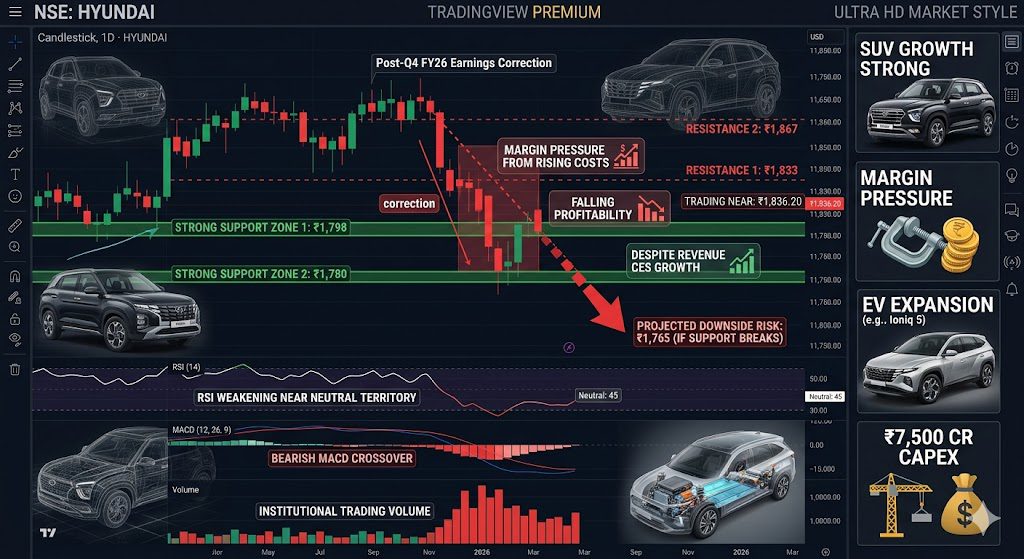
As of May 7, 2026, the stock closed near ₹1,836. Since the earnings performance came slightly below analyst expectations, short-term market sentiment has weakened.
The next few trading sessions may therefore become important for determining whether the stock stabilizes or enters a deeper correction phase.
Important Support Levels to Watch
The first key support zone for Hyundai lies near ₹1,798. This level has acted as an important short-term buying area during previous corrections.
A stronger support zone exists near ₹1,780, which previously acted as a major rebound level for the stock. If Hyundai breaks decisively below this support range, the stock could witness additional downside pressure toward ₹1,765 levels.
Long-term investors may closely monitor these levels for potential accumulation opportunities if broader market conditions remain stable.
Resistance Levels Remain Important
On the upside, Hyundai currently faces immediate resistance near ₹1,833. A strong breakout above this level could help restore short-term bullish momentum.
The next major resistance zone lies near ₹1,867, where previous selling pressure emerged.
Unless the stock breaks above these levels with strong trading volumes, short-term upside momentum may remain limited.
Moving Average Signals
Hyundai is currently trading close to its 30-day Simple Moving Average (SMA) near ₹1,820. Moving averages often act as important support and resistance indicators during volatile market conditions.
If the stock remains above the SMA, short-term stability may return. However, a sustained breakdown below this level could trigger additional technical weakness in the near term.
Brokerage Sentiment & Targets
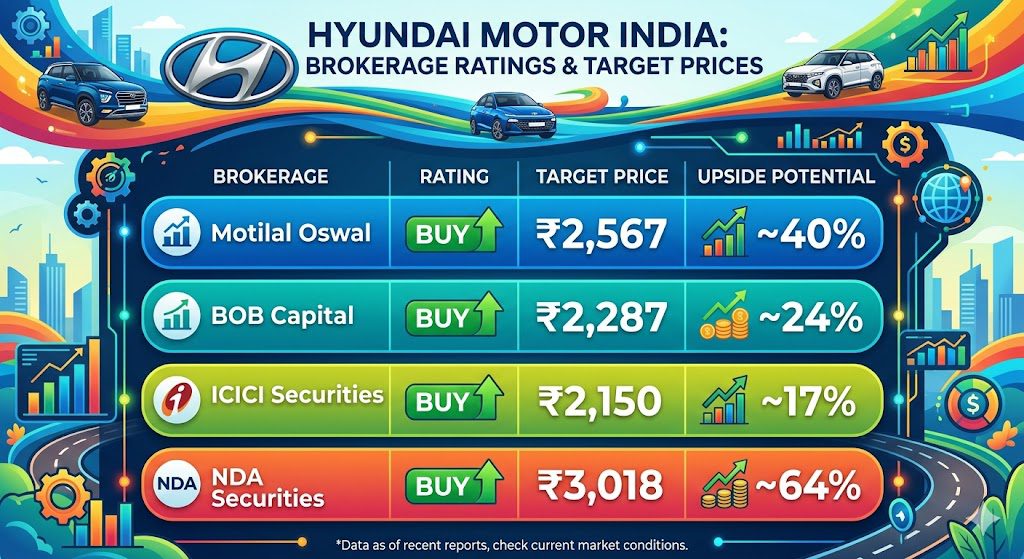
Despite short-term earnings pressure, most institutional brokerages remain optimistic regarding Hyundai’s long-term growth story.
Several analysts continue maintaining BUY ratings because of Hyundai’s strong SUV positioning, export business, EV expansion plans, and long-term market opportunity within India’s growing automobile sector.
| Brokerage | Rating | Target Price | Upside Potential |
|---|---|---|---|
| Motilal Oswal | BUY | ₹2,567 | ~40% |
| BOB Capital | BUY | ₹2,287 | ~24% |
| ICICI Securities | BUY | ₹2,150 | ~17% |
| NDA Securities | BUY | ₹3,018 | ~64% |
The wide range of target prices reflects differing assumptions regarding future EV adoption, margin recovery, premiumization success, and capacity expansion benefits.
Still, the overall institutional sentiment remains positive from a long-term perspective.
Future Guidance: The Road to FY27
Hyundai Targets Strong Volume Growth
Management remains confident about future demand trends despite short-term profitability pressure. Hyundai has guided for approximately 8–10% volume growth across both domestic and export markets during FY27.
India’s rising middle class, growing SUV demand, improving road infrastructure, and premiumization trends continue supporting long-term automobile demand growth.
The company believes these trends will remain strong over the coming years.
Massive ₹7,500 Crore Capex Plan
One of the most important announcements from Hyundai’s FY27 strategy is its aggressive ₹7,500 crore capital expenditure plan.
This investment will support manufacturing expansion, EV development, export infrastructure, product upgrades, and future production capacity growth.
Large capex investments often pressure margins in the short term, but they can create significant long-term competitive advantages if executed successfully.
Hyundai appears focused on strengthening its long-term market leadership rather than optimizing only for near-term profitability.
Pune Expansion Reflects Long-Term Confidence
Hyundai also announced Phase-II expansion of its Pune manufacturing facility. This expansion will add approximately 70,000 units of annual production capacity and help increase total India production capacity to nearly 1.14 million units by 2030.
This clearly reflects management’s strong confidence in India’s future automobile demand growth.
As competition intensifies within India’s auto market, manufacturing scale and operational efficiency will become increasingly important competitive advantages.
Hyundai’s Electric Vehicle Push
Perhaps the most strategically important development is Hyundai’s aggressive electric vehicle expansion plan.
The company plans to launch a mass-market electric SUV during FY27 to compete within India’s rapidly growing EV segment.
India’s EV market remains in its early stages, but adoption rates are expected to increase significantly over the next decade due to government incentives, improving charging infrastructure, and rising fuel prices.
Hyundai appears determined to establish itself as a major player within India’s premium EV category.
The Analyst’s Verdict: Buy, Hold, or Sell?
For Long-Term Investors
For long-term investors, Hyundai currently appears more like a HOLD or ACCUMULATE opportunity rather than a panic sell.
Yes, margins remain under pressure today. However, the company is aggressively investing in future growth drivers such as premium SUVs, electric mobility, export expansion, manufacturing capacity, and rural market penetration.
The ₹21 dividend also provides some valuation support during periods of market volatility.
Investors willing to focus beyond quarterly fluctuations may view current weakness as a potential long-term accumulation opportunity.
For Traders
For short-term traders, caution remains necessary because earnings disappointment and margin pressure may continue affecting stock sentiment over the near term.
The ₹1,780 support zone remains extremely important. If that level breaks decisively, additional downside volatility may emerge.
However, if the stock stabilizes above current support levels, short-term rebound opportunities may also develop.
Final Thoughts: Hyundai’s Big Bet on India’s Premium Future
Hyundai Motor India’s Q4 FY26 results initially appear disappointing because of the sharp decline in profitability and margins. However, experienced investors understand that companies often sacrifice short-term earnings while preparing for larger long-term opportunities.
Hyundai is currently making major investments in premium SUVs, electric mobility, manufacturing expansion, exports, and future capacity growth.
Historically, India’s premium SUV segment has been one of the most profitable areas within the automobile industry. If Hyundai successfully executes its EV and premiumization strategy, today’s margin pressure could eventually become the foundation for much stronger profitability in the future.
The key question now is whether Hyundai can convert today’s aggressive investments into stronger earnings growth by FY28 and beyond.
Are you viewing HYUNDAI as a long-term SUV and EV growth story, or do you believe margin pressure may continue hurting the stock over the next few quarters?