Introduction: The FMCG Titan’s Balancing Act
If you have tracked India’s consumption story over the last 30 years, you’ll know that Hindustan Unilever has always acted as a mirror to the Indian household economy. From selling basic soaps like Lifebuoy and Wheel in the 1990s to building a portfolio of premium skincare and digital-first brands today, HUL has evolved with the changing aspirations of Indian consumers.
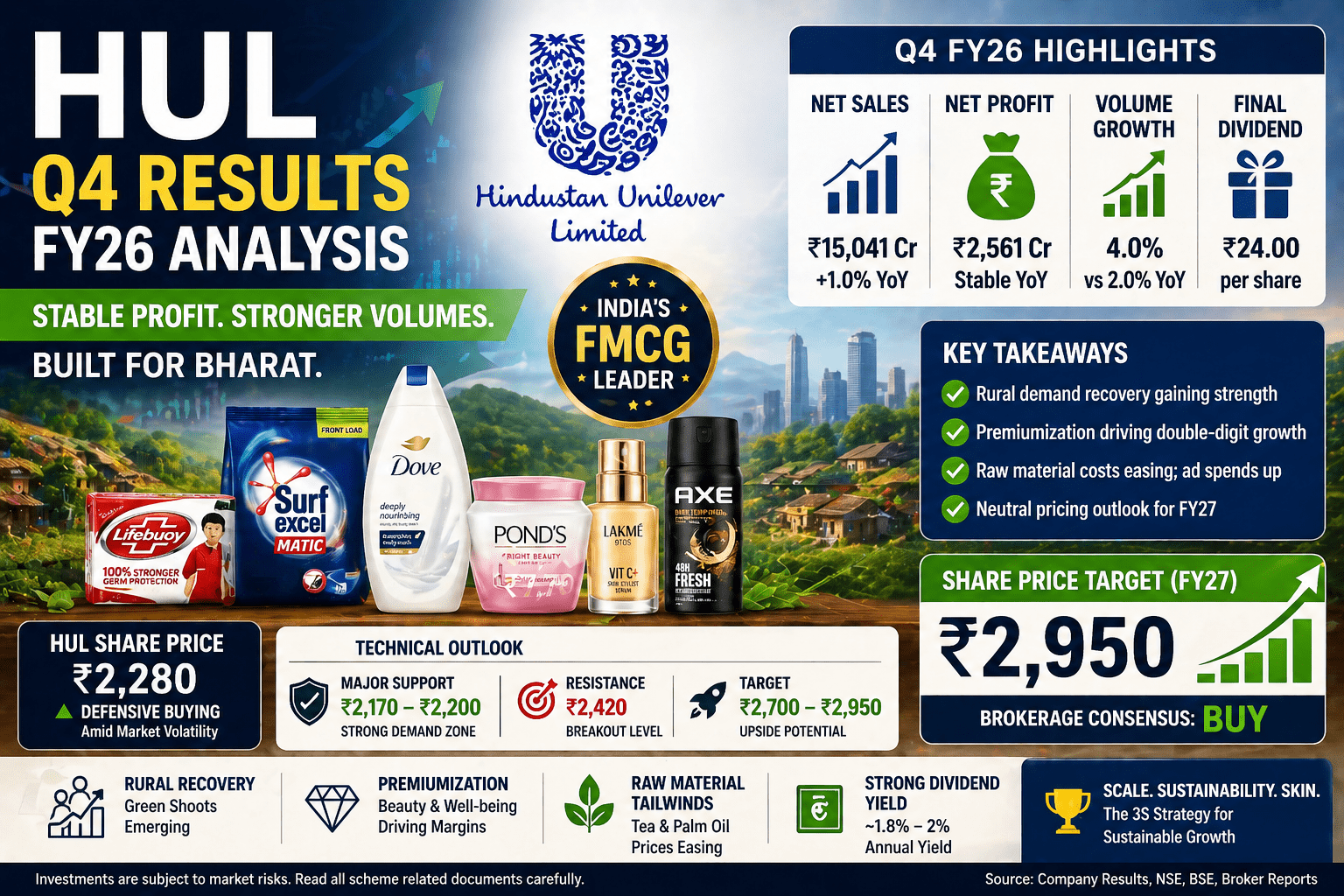
The Q4 FY26 results, released on April 30, 2026, tell a story of balance. This is not a quarter of explosive growth, but one of stability, recovery, and strategic positioning. Net profit came in at ₹2,561 crore, almost unchanged year-on-year, but the real signal lies in the 4% underlying volume growth (UVG). After several quarters of muted demand, especially in rural India, this improvement suggests that consumption is slowly returning.
At a current market price of around ₹2,280, the stock is seeing defensive buying. In a market impacted by global uncertainties like the 26% US reciprocal tariff concerns, investors are once again turning toward stable, predictable businesses—and HUL fits that bill perfectly.
Q4 FY26 Financial Scorecard: The Quality of Earnings
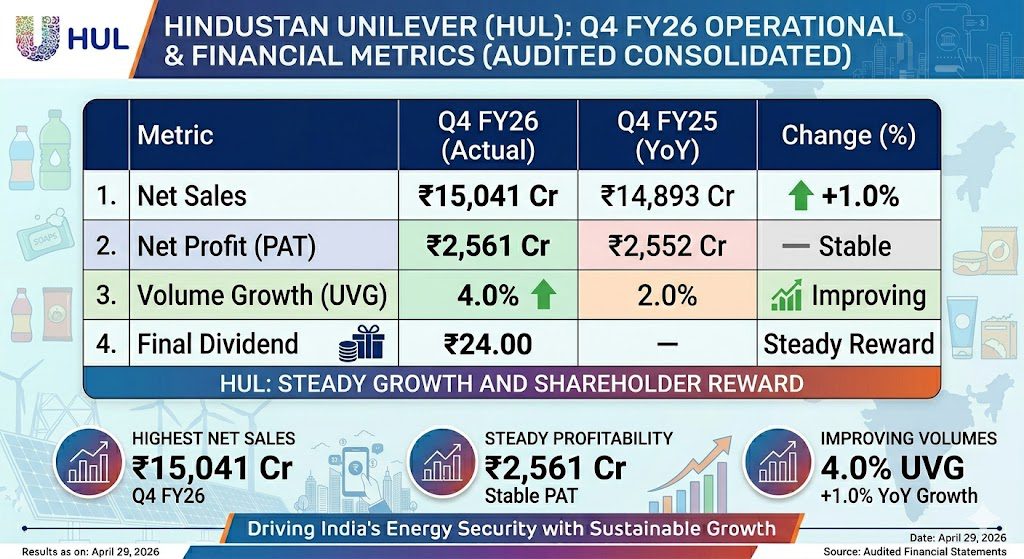
The financial performance of HUL in Q4 FY26 reflects resilience rather than rapid expansion. Net sales increased marginally to ₹15,041 crore from ₹14,893 crore in the same quarter last year, showing a modest 1% growth. While this may appear subdued, it is important to understand the context—pricing growth has been limited, and most of the expansion is coming from volumes.
Net profit stood at ₹2,561 crore compared to ₹2,552 crore last year, indicating stable profitability. This consistency is a hallmark of HUL’s business model.
The most encouraging metric is the underlying volume growth, which improved to 4% from 2% last year. This suggests that demand is strengthening, particularly in rural markets.
The company also announced a final dividend of ₹24 per share, reinforcing its position as a reliable income-generating stock for long-term investors.
Fundamental Analysis: The “Green Shoots” in Rural
Rural Recovery: Demand is Slowly Returning
One of the most important developments in this quarter is the recovery in rural demand. Lower inflation in essential commodities has increased disposable income for rural households. As a result, HUL’s affordable product formats, often referred to as “bridge packs,” are seeing strong traction in Tier-2 and Tier-3 markets.
This recovery is crucial because rural India contributes a significant portion of HUL’s revenue. A sustained improvement here could drive stronger volume growth in the coming quarters.
Premiumization Play: The Margin Engine
While rural demand is stabilizing the base business, the real growth driver for HUL lies in premiumization. The Beauty & Well-being segment has delivered double-digit growth, driven by products in skincare, haircare, and personal wellness.
Consumers are increasingly shifting from basic products to specialized and premium offerings. This transition from “soap to skincare” is not just about higher prices—it significantly improves margins.
For FY27, this segment is expected to be a key contributor to both revenue growth and profitability.
Raw Material Tailwinds: A Silent Support
Another factor supporting HUL’s performance is the stabilization of raw material costs. Key inputs like palm oil and tea have seen reduced volatility compared to previous years.
This has allowed the company to increase its advertising and promotional spending by around 200 basis points. By investing more in brand building, HUL is strengthening its market position and defending itself against regional competitors.
In a competitive FMCG landscape, this ability to reinvest savings into growth is a major advantage.
Technical Analysis: The Multi-Year Accumulation
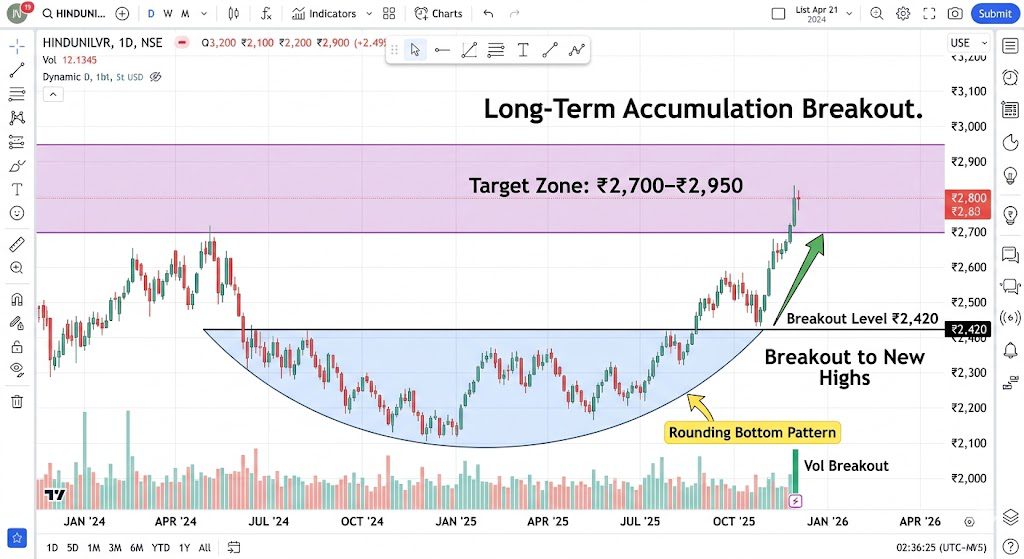
From a technical standpoint, HUL’s stock is currently in a long consolidation phase. Over the past two years, the stock has moved sideways, forming what appears to be a rounding bottom pattern on the weekly chart.
This kind of pattern often indicates accumulation by long-term investors.
The ₹2,170–₹2,200 range has emerged as a strong support zone. This is where institutional buying is consistently visible, making it a key level for investors to watch.
On the upside, ₹2,420 is the immediate resistance. A decisive breakout above this level could trigger a rally toward ₹2,700 and beyond.
The RSI is currently around 48, indicating neutral momentum. For experienced investors, this is typically seen as a “patient accumulation zone,” where long-term positions are built.
Dividend & Shareholder Value
The Payout: Consistency Over Aggression
HUL has recommended a final dividend of ₹24 per share, continuing its tradition of rewarding shareholders consistently.
While the dividend yield may not appear very high compared to PSU stocks, the reliability of these payouts makes HUL attractive for conservative investors.
Annual Yield: A Reliable Income Stream
When combined with interim dividends, HUL offers an effective annual yield of around 1.8% to 2%.
In a volatile market environment, this steady income stream provides stability and reduces overall portfolio risk.
Brokerage Sentiment & Targets: The Path to ₹2,950
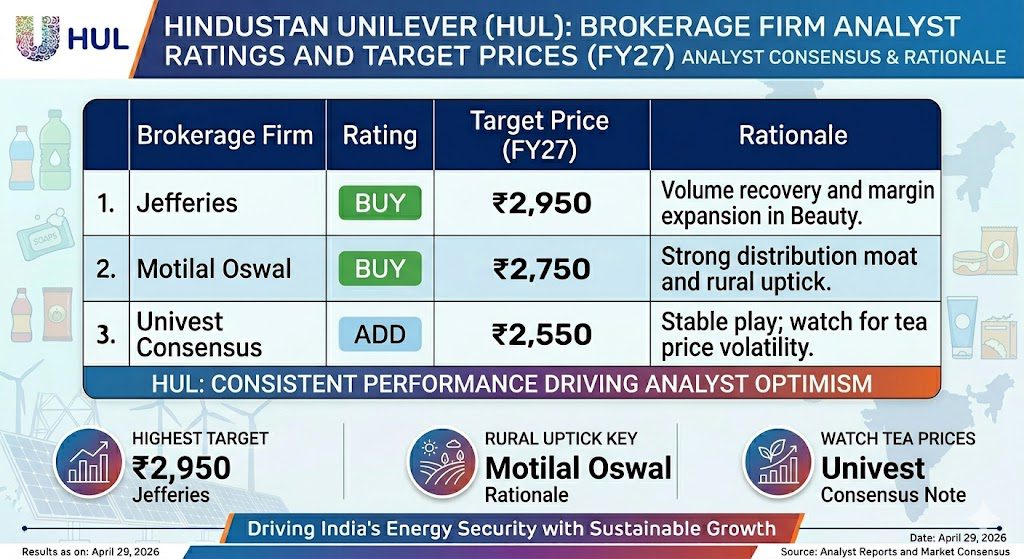
Brokerage firms remain optimistic about HUL’s long-term prospects.
Jefferies has assigned a “BUY” rating with a target price of ₹2,950, citing volume recovery and margin expansion in the premium segment.
Motilal Oswal Financial Services has a target of ₹2,750, highlighting the company’s strong distribution network and improving rural demand.
The broader consensus suggests a target range of ₹2,550 to ₹2,950, depending on how quickly volume growth accelerates.
Management Guidance: The “3S” Strategy
Strategic Focus: Scale, Sustainability, and Skin
Under the leadership of CEO Rohit Jawa, HUL is focusing on three key pillars—Scale, Sustainability, and Skin.
This strategy reflects the company’s intent to grow its core business while expanding into high-margin categories like skincare and wellness.
Pricing Outlook: Volume-Led Growth Ahead
Management has indicated a neutral pricing outlook for FY27. This means that future growth will not rely heavily on price increases.
Instead, the focus will be on increasing volumes and improving product mix. This shift aligns with the broader recovery in consumption demand.
The “30-Year” Analyst Verdict
For Long-Term Investors: A “Sleep Well” Stock
HUL remains one of the safest bets in the Indian equity market. It may not deliver explosive returns in the short term, but it offers stability, consistency, and downside protection.
For investors with a 3-year horizon, the ₹2,200 level represents a strong entry point.
For Traders: A Range-Bound Opportunity
For traders, HUL is currently a range-bound stock. The ₹2,200–₹2,500 range offers opportunities for short-term trades until a clear breakout occurs.
A sustained move above ₹2,420 could signal the start of a new upward trend.
Conclusion: Stability in a Volatile World
HUL’s Q4 FY26 performance reinforces its position as the backbone of India’s consumption story. While growth may not be spectacular, the combination of stable profits, improving volumes, and consistent dividends makes it a dependable investment.
In a market filled with uncertainty, HUL stands out as a symbol of reliability.
What’s Your View? (CTA)
Are you investing in HUL for its defensive strength, or are you waiting for rural demand to accelerate further? Share your thoughts and let’s discuss where India’s FMCG sector is headed next. 🚀