n September 2008, the Federal Reserve’s balance sheet stood at approximately $900 billion — a figure that had been broadly stable for decades, reflecting the normal operations of a central bank managing the world’s reserve currency. By April 2022, that same balance sheet had reached nearly $9 trillion. In less than fourteen years, the Federal Reserve had expanded its asset holdings by a factor of ten. No central bank in the history of modern capitalism had ever attempted monetary expansion of this scale, at this speed, without a world war to justify it. And the question that economists, investors, policymakers, and ordinary savers are increasingly asking — with data-backed urgency — is deceptively simple: is any of this sustainable, and if so, at what cost?
This analysis does not traffic in alarmism. The Federal Reserve is not reckless, and the dollar system has shown remarkable resilience in the face of challenges that would have broken lesser monetary arrangements. But a genuinely data-driven analysis of the Federal Reserve’s quantitative easing programs — their design, their documented consequences, their unresolved long-term risks — produces a picture that is considerably more complex than either the Fed’s official communications or its most strident critics tend to acknowledge. Understanding that complexity is no longer optional for anyone who holds savings, owns assets, manages a business, or simply wants to understand why prices, interest rates, and economic conditions feel increasingly unpredictable.
In the sections that follow, we explain quantitative easing in plain language, trace the full history of the Federal Reserve’s balance sheet expansion, examine the documented consequences — from the 2022 inflation surge to the quiet erosion of bond market price discovery — and provide an honest, data-backed assessment of what the 2026 outlook means for every category of investor. This is the analysis that most financial media gives you in fragments. Here, you get it whole.
Quantitative Easing Explained Simply — What the Federal Reserve Actually Does When It “Prints Money”
The phrase “money printing” is vivid, widely used, and — in the strict technical sense — not quite accurate. The Federal Reserve does not literally print currency when it conducts quantitative easing. What it does is both more subtle and, in its long-term consequences, more significant. Understanding the precise mechanism is essential before evaluating whether it can continue without consequences, because the nature of the consequences depends entirely on how the process actually works.
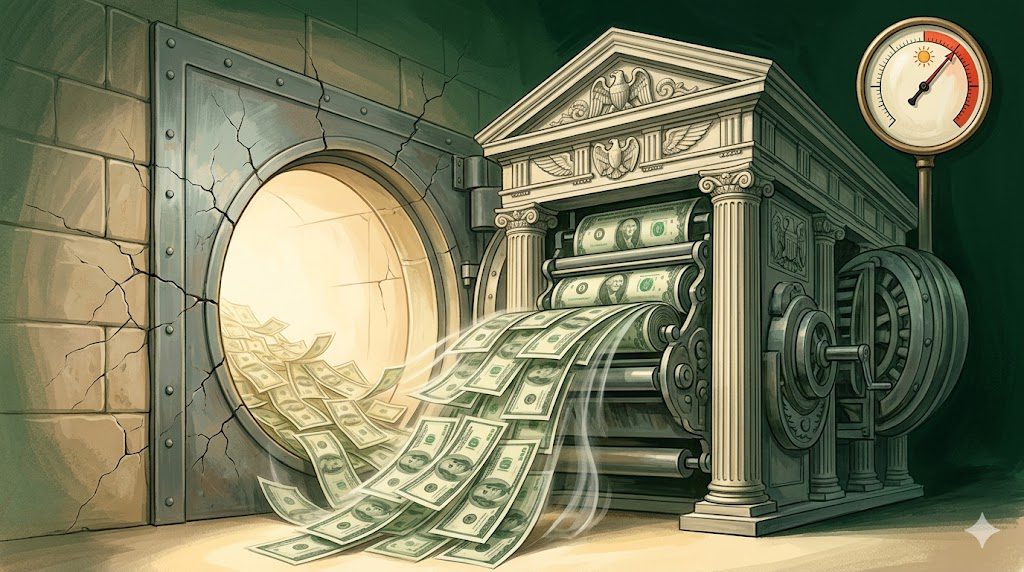
Quantitative easing is, at its core, an asset swap. The Federal Reserve creates new reserves — digital entries in the accounts of commercial banks — and uses those reserves to purchase financial assets, primarily U.S. Treasury bonds and mortgage-backed securities, from banks and financial institutions. The seller receives newly created reserves deposited in their Federal Reserve account. The Fed receives the bond. The total volume of financial assets in the private sector does not change immediately — what changes is their composition: fewer bonds, more reserves. The money supply in the narrow sense expands, long-term interest rates fall as bond prices rise, and credit becomes cheaper and more available throughout the economy.
The mechanism through which this stimulates the economy is called the “portfolio rebalancing effect.” When banks and investors hold more reserves and fewer bonds, they have an incentive to deploy those reserves into other, higher-yielding assets — corporate bonds, equities, real estate, business loans. Asset prices rise, borrowing costs fall, wealth effects encourage spending, and economic activity accelerates. In theory, this is a clean, controllable process. The Federal Reserve can expand its balance sheet when stimulus is needed and contract it — through quantitative tightening, or QT — when inflation threatens. In practice, as the post-2020 experience demonstrated with painful clarity, the real world is considerably messier.
Quantitative easing = the Federal Reserve creates new digital money and uses it to buy government bonds, making borrowing cheaper and pushing investors toward riskier assets that stimulate economic activity. When done in moderation, it is a standard monetary policy tool. When done at historic scale — as it was between 2008 and 2022 — the long-term consequences become a legitimate subject of data-driven analysis and investor concern.
What the Federal Reserve cannot easily control is the velocity and ultimate destination of the money it creates. When QE reserves stay within the financial system — as they largely did after 2008, when banks held excess reserves rather than lending them aggressively — the inflation impact on consumer prices remains modest. But when QE is combined with large-scale fiscal stimulus directly deposited into household bank accounts — as happened during the COVID-19 pandemic — the money moves rapidly into consumer spending, and inflation follows with a lag of twelve to eighteen months. This is precisely what the data shows happened between 2021 and 2022. It was not a surprise to every economist, but it was a policy mistake of historic proportions whose consequences are still working through the system today.
From $900 Billion to $9 Trillion — The Full History of Federal Reserve Balance Sheet Expansion
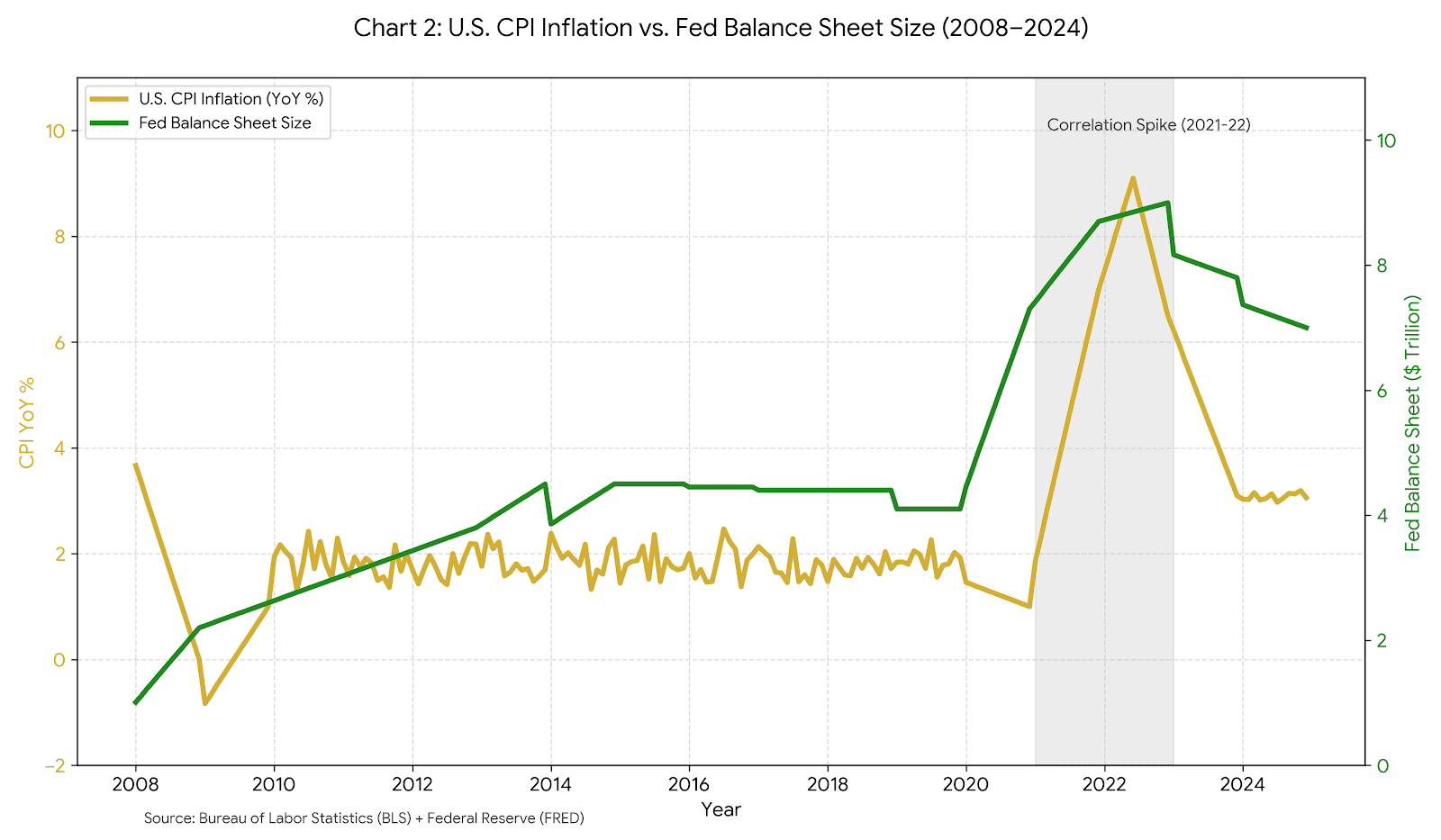
To assess whether U.S. monetary expansion is sustainable, the data demands that we look at the complete picture — not just the most recent episode, but the entire trajectory of Federal Reserve balance sheet growth since the 2008 financial crisis. Each round of expansion was justified by a genuine economic emergency. Each left the system larger, more dependent on cheap money, and more difficult to normalize than the round before it.
~$900B
~$2.3T
~$2.9T
~$4.5T
~$7.2T
$8.97T
~$7.3T
Source: Federal Reserve H.4.1 Statistical Release. Each bar represents balance sheet size relative to the 2022 peak.
| QE Round | Period | Scale | Stated Purpose | Inflation Result |
|---|---|---|---|---|
| QE1 | Nov 2008 – Mar 2010 | $1.75 trillion | Stabilize financial system after Lehman Brothers collapse | CPI: Low (0–2%) |
| QE2 | Nov 2010 – Jun 2011 | $600 billion | Prevent deflation, support recovery | CPI: Mild 3.2% spike |
| QE3 / “Taper” | Sep 2012 – Oct 2014 | $1.66 trillion | Sustain recovery, reduce unemployment | CPI: 1.5–2.5% stable |
| COVID QE | Mar 2020 – Mar 2022 | $4.36 trillion | Prevent pandemic economic collapse | CPI: 9.1% peak Jun 2022 |
| QT (Reversal) | Jun 2022 – Present | −$1.6T so far | Reduce balance sheet, combat inflation | CPI: Declining to ~3% |
What the data in this table reveals is a structural pattern that each successive round of QE reinforces: the economy becomes progressively more sensitized to the withdrawal of monetary support, making the “exit” from QE increasingly difficult and the case for the next round of expansion increasingly compelling at the first sign of economic stress. This is sometimes called the “QE ratchet” — the balance sheet goes up in crises and comes down only partially in recoveries, leaving a permanently elevated floor that rises with each cycle. The pre-2008 baseline of $900 billion is now essentially theoretical. Returning to it — or to any level close to it — would require a degree of monetary contraction that would, itself, trigger the very financial crisis it was meant to prevent.
The Documented Consequences — What the Data Shows About a Decade of Monetary Expansion
One of the most persistent errors in public debate about quantitative easing is treating its consequences as future speculation rather than present reality. The data is in. Fourteen years of Federal Reserve balance sheet expansion have produced a set of documented, measurable, and in several cases deeply troubling consequences — some intended, some not, all real. A data-driven analysis of the evidence produces the following picture.
The Federal Reserve did not create inflation through QE alone — it created conditions in which inflation became possible. The fiscal authorities pulled the trigger. But the gun had been loaded over fourteen years of balance sheet expansion, and when it fired in 2022, no one should have been surprised by the report.
— GeoEcon Insider
Is U.S. Monetary Expansion Sustainable? A Data-Driven Analysis of the Key Constraints
This is the question at the heart of this entire analysis, and it deserves the most careful, most honest treatment. The answer is neither the reflexive reassurance of official communications — “the Fed has the tools to manage this” — nor the apocalyptic narrative of its most extreme critics. It is something more nuanced, more data-grounded, and ultimately more useful for decision-making.
U.S. monetary expansion is sustainable in the narrow sense that the Federal Reserve cannot technically run out of dollars — it creates them. A sovereign currency issuer with control over its own central bank faces no hard constraint on the nominal quantity of money it can produce. This is the grain of truth in Modern Monetary Theory, and it is real. But sustainability in the narrow nominal sense is not the same as sustainability in the broader economic and institutional sense — the sense that matters for inflation, investment returns, dollar reserve status, and the long-term credibility of American financial institutions.
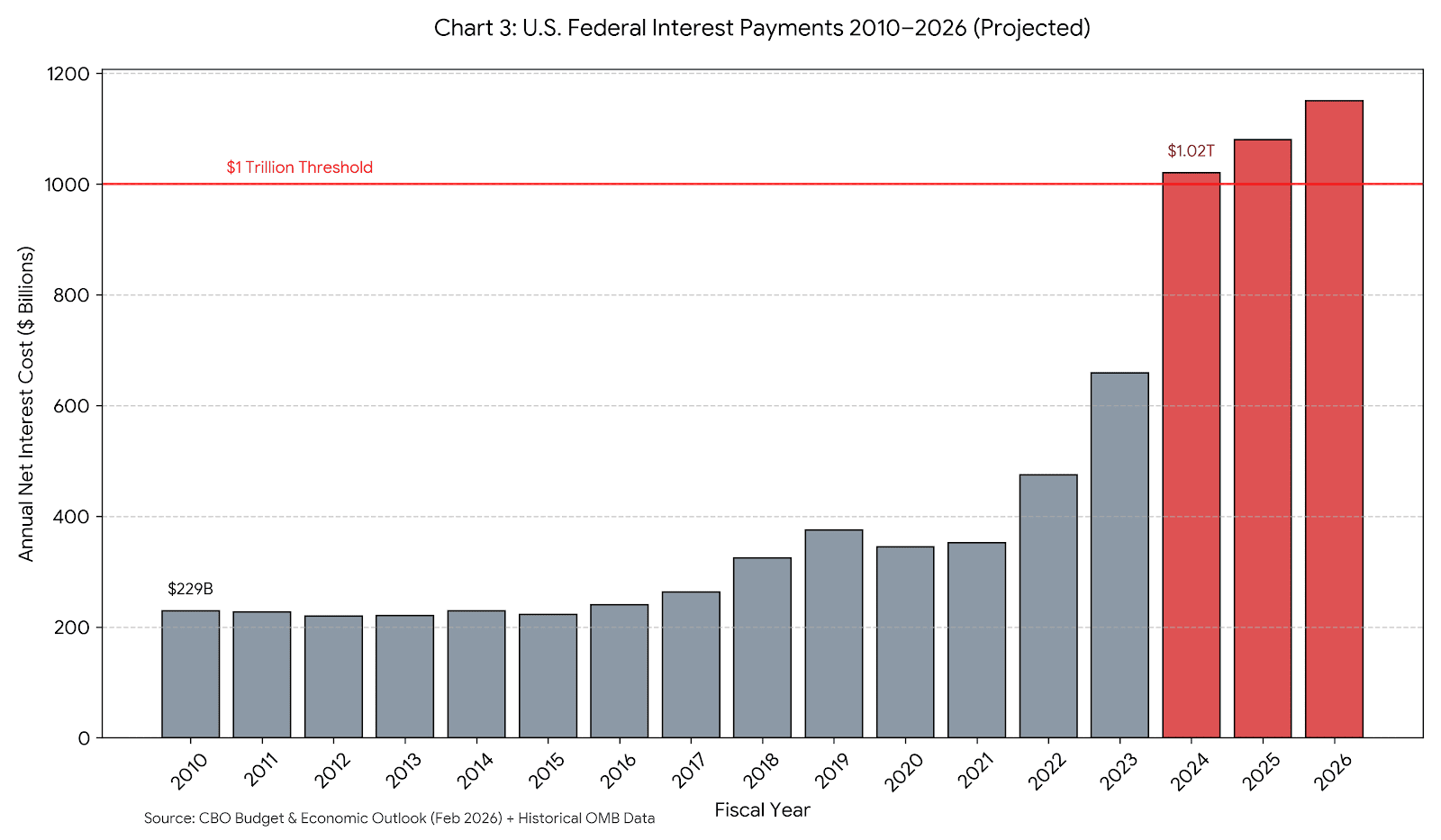
The binding constraints on U.S. monetary expansion are not legal or mechanical. They are economic and political. When the money supply expands faster than the economy’s productive capacity, inflation results — as the 2021–2022 experience demonstrated conclusively. When inflation requires aggressive rate increases to contain, the cost of servicing $34+ trillion in national debt rises sharply — annual interest payments have already crossed $1 trillion, more than the entire defense budget. When interest payments consume an ever-larger share of federal revenue, the space for productive public investment narrows, growth slows, and the fiscal and monetary problems compound each other in a self-reinforcing cycle.
Here is the critical arithmetic that makes current U.S. monetary expansion structurally challenging: the U.S. government is currently borrowing approximately $1 trillion every 100 days. At average interest rates of 3–4%, each new trillion in debt adds $30–40 billion in permanent annual interest costs. Interest payments are now the single fastest-growing line item in the federal budget — growing faster than defense, healthcare, or Social Security. This is not a political opinion. It is arithmetic derived directly from Congressional Budget Office data.
There is also the dollar’s global role to consider. Every episode of U.S. monetary expansion is observed by the foreign governments, central banks, and institutional investors who collectively hold approximately $7–8 trillion in U.S. dollar-denominated assets. Their willingness to continue holding those assets — and to accept new Treasury issuance at reasonable interest rates — depends on confidence that the Federal Reserve will maintain the purchasing power of the dollar over time. When that confidence is shaken — as it was in 2022 when inflation reached 9.1% — the consequence is not just higher domestic prices. It is higher Treasury yields, reduced foreign demand for U.S. debt, and a gradual erosion of the reserve currency premium that has allowed America to borrow at rates that would be unavailable to any other sovereign borrower with comparable fiscal ratios.
So: is U.S. monetary expansion sustainable? The data-driven answer is conditional. It is sustainable at a measured pace, in response to genuine economic contractions, with credible plans for normalization and with complementary fiscal discipline. It becomes progressively less sustainable as each cycle leaves a higher floor, as fiscal deficits grow faster than nominal GDP, as interest costs crowd out productive investment, and as the dollar’s reserve credibility erodes through repeated demonstrations that monetary discipline is subordinate to short-term economic management. All four of those erosion conditions are currently present in the data. None of them individually constitutes a crisis. Together, they constitute a trajectory that a data-driven analysis cannot responsibly describe as comfortably sustainable.
Common Misconceptions About Money Printing — What the Evidence Actually Shows
Public debate about quantitative easing and monetary expansion is plagued by misconceptions on both ends of the spectrum. Some believe QE inevitably and immediately destroys currency value. Others believe it is a costless tool that the Fed can deploy without limit. Neither view survives contact with the data. Here is a direct comparison of the most common misconceptions and what a data-driven analysis actually reveals.
| ❌ Common Misconception | ✅ What the Evidence Shows |
|---|---|
| “The Fed printing money automatically causes hyperinflation” | QE from 2009–2014 produced minimal consumer inflation because money stayed in the financial system. Context and velocity matter — QE alone does not guarantee hyperinflation. |
| “QE has no real consequences — the Fed can always unwind it” | The QT experience of 2022–24 produced SVB collapse, bond market volatility, and housing market stress. Unwinding QE has real, documented costs — it is not cost-free. |
| “The U.S. dollar will collapse because of money printing” | The dollar’s reserve status provides extraordinary resilience. Structural erosion of reserve share is real and measurable, but a near-term collapse scenario lacks empirical support. |
| “QE benefits everyone through economic stimulus” | QE disproportionately benefits asset owners. The top 10% who hold 89% of equities gained most. Workers with primarily wage income and rented housing faced higher costs with fewer offsetting benefits. |
| “The Fed is independent and makes purely technical decisions” | The Federal Reserve operates under congressional mandate and is subject to political pressure through appointments. Its 2021 decision to maintain near-zero rates despite rising inflation indicators reflected institutional as well as technical judgments. |
The 2026 Outlook — What Every Investor Must Know About the Federal Reserve’s Next Move
The Federal Reserve enters 2025 and approaches 2026 in a uniquely constrained position that has no direct historical precedent. It has raised rates aggressively to combat QE-driven inflation, yet the economy’s dependence on low rates — embedded through years of cheap money — means that sustained high rates produce their own cascade of problems: commercial real estate stress, bank balance sheet fragility, rising federal borrowing costs, and a slowing housing market. The Fed is threading a needle between two types of policy risk simultaneously, and the 2026 outlook reflects the difficulty of that task.
The base case for 2026, based on current Federal Reserve communications and economic projections, involves a gradual return to rate cutting as inflation moderates toward the 2% target. But “gradual” is doing significant work in that sentence. If inflation proves stickier than the Fed’s projections — as it has repeatedly in the post-2020 period — rate cuts will be delayed, and the $34+ trillion debt pile will be serviced at elevated rates for longer, compressing fiscal space further. If a recession materializes — as inverted yield curves persistently signaled — the Fed will face pressure to launch a fifth round of QE, restarting the cycle with a balance sheet that is already eight times its pre-crisis level.
The most underappreciated risk in the 2026 outlook is not runaway inflation or a debt crisis — it is a loss of Federal Reserve credibility. If the Fed cuts rates prematurely and inflation re-accelerates, it will have demonstrated that its inflation-fighting resolve is subordinate to short-term economic management. That demonstration, read clearly by the global bond market, would push long-term Treasury yields higher independent of Fed policy — a “fiscal dominance” scenario that economists consider the most dangerous medium-term threat to U.S. monetary stability.
These are analytical observations for portfolio awareness, not investment recommendations.
The honest conclusion of a data-driven analysis of Federal Reserve monetary expansion is this: the consequences are neither imminent catastrophe nor negligible background noise. They are real, measurable, accumulating, and — if present trends continue without meaningful fiscal adjustment — increasingly difficult to manage without costs that will eventually be borne by asset holders, taxpayers, and the holders of dollar-denominated savings everywhere. Understanding this is the first step toward navigating it.
For the broader context of how Federal Reserve policy connects to the global monetary transformation underway, see our companion analyses on De-Dollarization: Why Countries Are Moving Away from the Dollar, How U.S. Sanctions Shape Global Trade and Currency Power, and U.S. vs China Economy: Who Will Dominate by 2030?