Scope Outline
Introduction: The Heavyweight Under Pressure
Expert Hook
Over the last three decades, India’s banking sector has experienced multiple economic cycles, credit booms, liquidity crises, and structural reforms. During every major phase, Public Sector Banks have acted as key indicators of the broader Indian economy. Large PSU banks like Canara Bank often reflect the real condition of India’s credit demand, rural economy, infrastructure financing, and retail banking growth. On May 11, 2026, Canara Bank once again found itself at the center of investor attention after announcing its Q4 FY26 results. While the bank continues to remain one of India’s largest PSU lenders, the latest numbers reveal that it is currently navigating a difficult profitability environment driven by rising costs and sector-wide margin pressure.
The Big Story
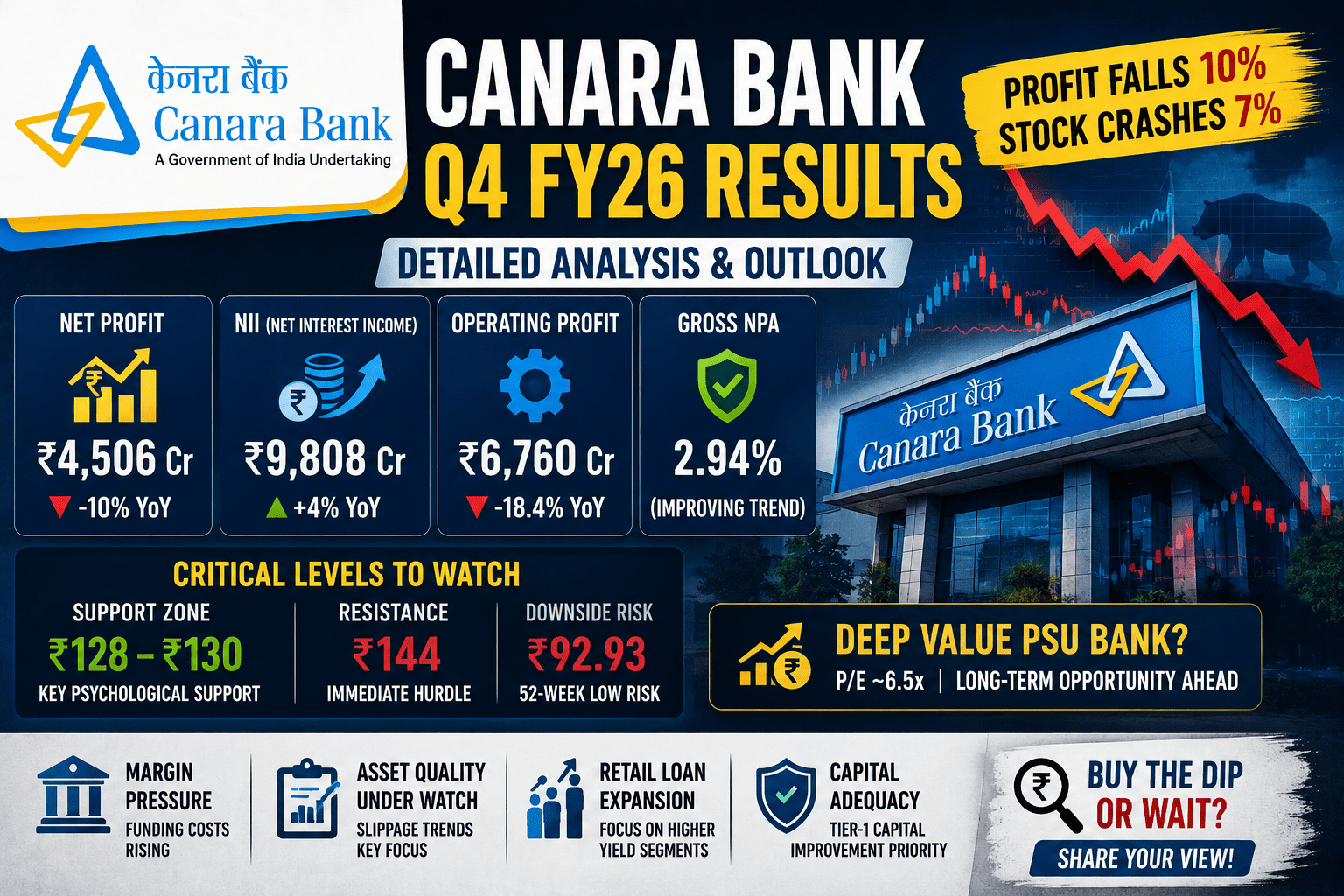
Canara Bank reported consolidated net profit of approximately ₹4,506 crore during Q4 FY26 compared to ₹5,004 crore during the same quarter last year, representing a decline of nearly 10% year-on-year. The lower profitability was mainly caused by rising provisions, increasing operational costs, and pressure on margins within the PSU banking ecosystem. However, despite the decline in bottom-line earnings, the bank still managed to deliver stable Net Interest Income growth and maintain improving long-term asset-quality trends. This mixed performance has created a divided market reaction, with some investors viewing the correction as a buying opportunity while others remain cautious about future profitability pressures.
Market Pulse
The market reaction to the quarterly results was sharp and emotional. Following the earnings announcement, Canara Bank shares declined more than 7% intraday and touched a low near ₹130.50 on the NSE. The stock broke below several important short-term support levels as traders aggressively exited PSU banking positions after weaker-than-expected profitability numbers. The sell-off also reflects broader concerns surrounding the PSU banking sector, where investors are increasingly monitoring Net Interest Margin pressure, provisioning requirements, and future asset-quality trends. Despite the sharp decline, value-focused investors are beginning to examine whether the stock has entered an attractive accumulation zone based on long-term fundamentals.
Q4 FY26 Performance: The “Hard Numbers” (NSE Actuals)
Consolidated Net Profit
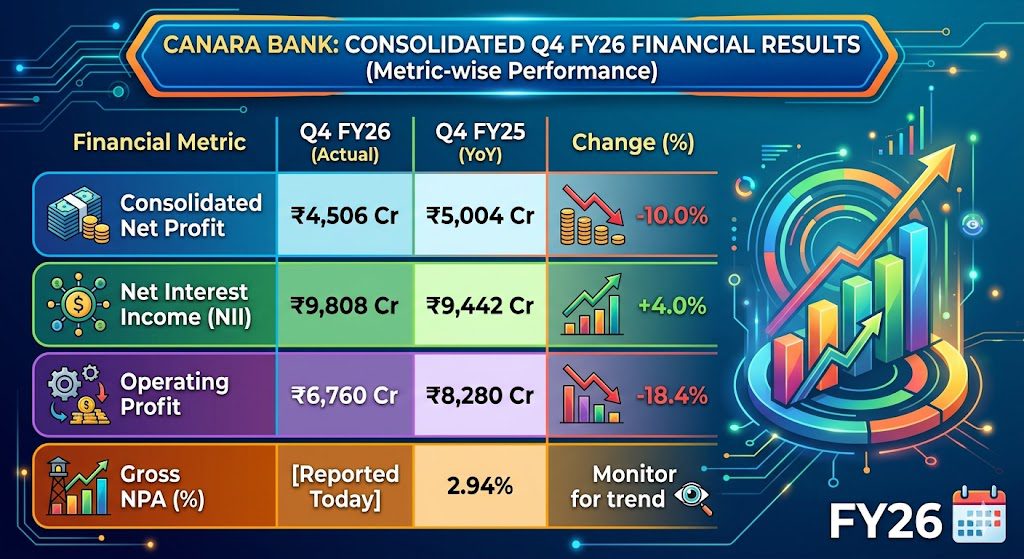
Canara Bank reported consolidated net profit of approximately ₹4,506 crore during Q4 FY26 compared to ₹5,004 crore during Q4 FY25. This represents a decline of nearly 10% year-on-year. The weaker profitability was mainly driven by higher provisions and increased operational pressures during the quarter. Rising funding costs and broader sector-wide margin compression also impacted earnings performance. Although the market reacted negatively to the headline profit decline, investors should remember that PSU banks often experience quarterly fluctuations depending on provisioning cycles, treasury gains or losses, and changes in operating expenses.
Net Interest Income (NII)
One of the major positives in the quarterly results was the steady growth in Net Interest Income. NII increased to approximately ₹9,808 crore during Q4 FY26 from ₹9,442 crore during the same period last year, reflecting healthy growth of nearly 4%. Net Interest Income remains one of the most important indicators for banking businesses because it represents the core earnings generated from lending activities. Despite increasing competition for deposits and rising funding costs, Canara Bank managed to maintain stable lending income growth, indicating that the bank’s core credit business remains resilient.
Operating Profit Decline
Operating profit declined sharply to approximately ₹6,760 crore during Q4 FY26 compared to ₹8,280 crore in Q4 FY25, representing a decline of nearly 18.4%. This decline highlights the operational challenges currently facing the broader PSU banking sector. Rising employee costs, higher deposit interest expenses, margin compression, and increasing operational expenditure all contributed to weaker operating profitability. The decline suggests that while the bank continues generating healthy lending activity, profitability efficiency has weakened temporarily under the current interest-rate environment.
Gross NPA Position
Gross NPA trends continue to remain one of the most closely watched metrics for Canara Bank investors. Historically, the bank has made significant progress in improving asset quality over the past few years. Gross NPA levels improved from approximately 8.93% in FY21 to nearly 2.94% by FY25, reflecting stronger recovery mechanisms and disciplined risk management practices. However, analysts are now closely monitoring fresh slippage data and recovery trends following the latest quarterly results. Asset quality remains critical because PSU bank valuations are heavily influenced by expectations regarding future bad loan cycles.
Fundamental Analysis: The Efficiency vs. Cost Battle
NII Growth Stability
Despite the decline in bottom-line profitability, Canara Bank still managed to deliver healthy growth in Net Interest Income during Q4 FY26. A 4% increase in NII during a difficult operating environment reflects resilience in the bank’s lending operations. The bank continues benefiting from stable retail loan growth, improving MSME demand, and gradual recovery in overall credit activity across the Indian economy. Stable NII growth is important because it provides long-term earnings stability even when short-term profitability fluctuates due to provisions or operating costs.
Margin Compression Concerns
One of the biggest concerns emerging from the latest quarterly results is pressure on Net Interest Margins. Sequential profit declined nearly 13%, indicating that rising funding costs are beginning to impact profitability across the PSU banking sector. Banks are currently facing intense competition for deposits, which is pushing deposit interest rates higher and reducing lending spreads. Several PSU banks are also experiencing slower CASA growth, increasing operational expenses, and treasury-related volatility. Investors are therefore expected to closely monitor future NIM guidance over the next few quarters to assess whether profitability pressure stabilizes or intensifies further.
Asset Quality Trends
Although short-term earnings performance remains under pressure, Canara Bank’s long-term asset-quality trajectory continues improving significantly compared to earlier years. The reduction in Gross NPAs from nearly 9% levels in FY21 toward below 3% reflects substantial improvement in underwriting discipline, loan monitoring systems, and recovery mechanisms. However, analysts remain cautious because future credit cycles could become more challenging if broader economic growth slows or stress emerges in unsecured lending categories. Asset quality sustainability will therefore remain one of the most important long-term factors for the bank’s valuation outlook.
Technical Analysis: The ₹130 Battlefield
Current Technical Setup
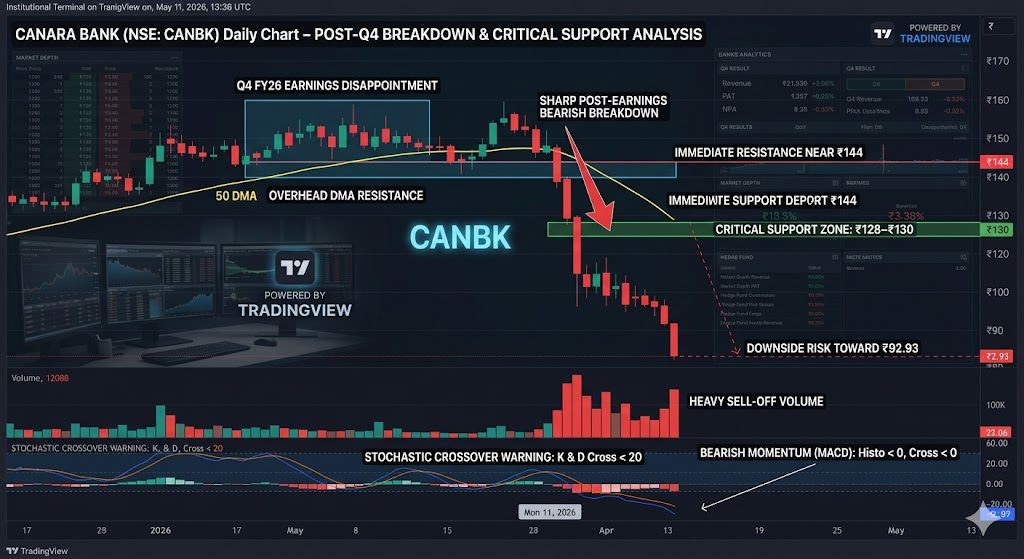
Technically, Canara Bank shares are currently trading under significant bearish pressure following the Q4 FY26 earnings announcement. The stock recently broke below important support zones while declining sharply toward ₹130.30. The breakdown triggered aggressive selling activity from traders and short-term momentum participants. At present, the stock remains technically weak unless it manages to stabilize and reclaim key resistance levels over the coming sessions.
Key Support Zone
The ₹128–₹130 region has now become the most important psychological support zone for Canara Bank shares. This range represents a major demand area and coincides with earlier support structures on long-term charts. If the stock successfully stabilizes within this region, it could potentially form a base for future recovery. However, if this support zone breaks decisively, the stock could drift toward its previous 52-week low near ₹92.93. This makes the current price range extremely important for both traders and long-term investors.
Immediate Resistance Levels
On the upside, immediate resistance is currently visible near ₹144. The stock must reclaim this level convincingly before any meaningful short-term recovery can begin. More importantly, reclaiming the 50-day moving average will be necessary for restoring bullish sentiment. Until the stock successfully crosses these resistance levels, upward rallies may continue facing selling pressure from traders exiting losing positions.
Analyst Technical Note
Several technical analysts had already identified warning signals before the quarterly results announcement. Weekly stochastic crossover indicators had started showing weakness even before May 8, suggesting that momentum was gradually deteriorating.
%K=Close−Lowest LowHighest High−Lowest Low×100\%K = \frac{Close – Lowest\ Low}{Highest\ High – Lowest\ Low} \times 100%K=HighestHigh−LowestLowClose−LowestLow×100
The weaker Q4 earnings simply acted as the trigger that accelerated the broader sell-off. Momentum indicators currently remain weak, indicating that traders should remain cautious until clear signs of price stabilization emerge.
Brokerage Sentiment & Targets (The Long-Term View)

Motilal Oswal Outlook
Motilal Oswal continues maintaining a constructive long-term view on Canara Bank despite the weak quarterly performance. The brokerage previously maintained a BUY outlook with a target near ₹650 on a pre-split adjusted basis. Analysts believe the bank still possesses strong retail growth opportunities, improving operational systems, and attractive valuation multiples. The brokerage expects long-term earnings normalization once sector-wide margin pressure begins stabilizing.
Univest Forecast
Several market analysts within the Univest framework currently maintain a HOLD to BUY stance on Canara Bank. Near-term target ranges remain between ₹115 and ₹130 depending on market conditions and future asset-quality developments. Analysts believe re-rating potential could emerge if the bank successfully delivers stronger PAT growth, stable NPAs, and better margin performance during FY27. The bank’s low valuation remains one of the strongest bullish arguments for value-focused investors.
Management Guidance: The Path to FY27
Loan Growth Strategy
Management has previously guided for approximately 11–12% loan growth during the current financial year. The bank plans to focus increasingly on higher-yielding retail lending segments rather than aggressively expanding low-yield corporate loans. Key growth areas include housing finance, personal loans, MSME lending, and retail banking products. This strategic shift toward retail-focused lending may help improve profitability and reduce concentration risks over the medium term.
Capital Adequacy Focus
Another major management priority remains improving Tier-1 capital adequacy levels. Stronger capital buffers increase lending flexibility, improve investor confidence, and strengthen overall balance-sheet stability. Capital adequacy improvements could also become an important catalyst for future valuation re-rating if the bank successfully demonstrates sustained operational resilience and healthier earnings growth.
The “30-Year” Analyst Verdict
For Long-Term Investors
The latest 10% profit decline certainly acts as a reality check for investors expecting uninterrupted PSU banking momentum. However, Canara Bank’s valuation remains extremely attractive compared to many private-sector peers. The stock currently trades near approximately 6.5x trailing earnings, placing it firmly within deep-value territory. Stable Net Interest Income growth, improving long-term asset quality, and a strong PSU banking franchise continue supporting the long-term investment case. However, accumulation should remain gradual and disciplined, especially while the ₹130 support zone remains under pressure.
For Active Traders
From a trading perspective, the stock currently remains technically weak after the sharp earnings-related breakdown. Attempting to aggressively “catch the falling knife” immediately after such a sharp correction can become risky for short-term traders. Many traders may therefore prefer waiting for consolidation formation, volume stabilization, and confirmation that the ₹128–₹130 support zone is holding before considering fresh swing-trading entries. Until stabilization appears, volatility is likely to remain elevated.
Conclusion & Engagement (CTA)
Final Word
Canara Bank’s Q4 FY26 results reflect the reality of a large PSU bank navigating a difficult profitability environment. Although profits declined and margin pressure remains a concern, the bank’s core lending franchise still appears stable with healthy NII growth and significantly improved long-term asset-quality trends. The next two quarters will likely determine whether this correction represents only a temporary earnings slowdown or the beginning of a deeper profitability challenge for the broader PSU banking sector. For now, Canara Bank remains one of the most important PSU banking stocks to watch in India’s financial markets.
Investor Discussion
Are you buying the dip in Canara Bank near ₹130, or are you waiting for better clarity regarding asset quality and margin stability before investing? Share your PSU banking strategy and CANBK outlook in the comments below.