
Introduction: The Quiet Wealth Creator
In a market that is often obsessed with flashy fintech startups and high-growth digital lending platforms, it’s easy to overlook the quiet performers. But if you’ve spent enough time in the markets, you know that real wealth is rarely created through noise—it is built through consistency. That’s exactly where Can Fin Homes stands out.
For over three decades, this housing finance company has steadily grown its business without chasing risky expansion or aggressive lending. Backed by Canara Bank, it has built a reputation for discipline, especially when it comes to credit quality. And its Q4 FY26 results prove that this strategy is still working.
The company reported another quarter of stable and predictable growth, reinforcing its position as a “quiet wealth creator.” While other lenders are struggling with rising deposit costs and margin pressure, Can Fin Homes continues to focus on its core strength—lending to salaried professionals.
At present, the stock is trading around ₹935, consolidating after a steady run-up. This consolidation phase often acts as a base before the next upward move, making it an interesting stock to watch.
Q4 FY26 Financial Scorecard: Stability is Sexy
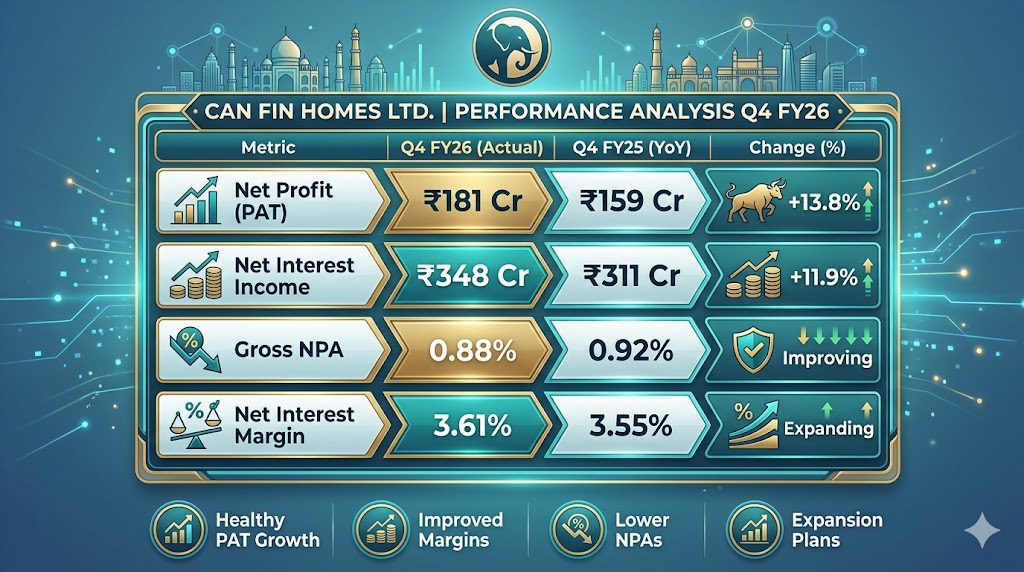
Can Fin Homes’ Q4 FY26 performance may not look dramatic, but that’s exactly its strength—it delivers consistent growth quarter after quarter.
The company reported a net profit of ₹181 crore, up from ₹159 crore last year, reflecting a healthy growth of 13.8%. This steady rise in profits shows that the business model is working efficiently even in a challenging environment.
Net Interest Income (NII) increased to ₹348 crore, marking an 11.9% growth year-on-year. This indicates strong lending activity and stable margins.
One of the most impressive aspects of the results is asset quality. The Gross NPA ratio improved slightly to 0.88% from 0.92%, which is exceptionally low for the housing finance sector. This highlights the company’s disciplined approach to lending.
Additionally, Net Interest Margin (NIM) expanded to 3.61%, compared to 3.55% last year. This shows that the company is not only growing but also improving its profitability.
In short, the financial performance reflects a business that is stable, efficient, and well-managed.
Fundamental Analysis: The Efficiency Moat
Cost-to-Income Ratio: Running a Lean Machine
One of the key strengths of Can Fin Homes is its low cost-to-income ratio. The company operates with a lean structure, keeping operating expenses under control while maximizing output.
This efficiency allows it to offer competitive interest rates without compromising profitability. In an industry where margins are often under pressure, this becomes a major advantage.
Asset Quality: Nearly Pristine
Asset quality is where Can Fin Homes truly shines. With a Gross NPA of just 0.88%, the company stands among the best in the industry.
This is not by accident. The company has a strict lending policy focused on salaried individuals, who typically have stable income and lower default risk. In times of economic uncertainty or inflation, this strategy proves extremely effective.
A low NPA also means lower provisioning costs, which directly boosts profitability.
Loan Book Mix: Safety First Approach
Around 90% of Can Fin Homes’ loan book is focused on individual housing loans. This is a key differentiator.
Unlike many lenders that finance real estate developers or large projects, Can Fin Homes sticks to retail customers. This reduces risk significantly, as individual borrowers are less likely to default compared to corporate borrowers.
This “safety-first” approach ensures long-term stability and consistent returns.
Technical Analysis: The Multi-Month Base
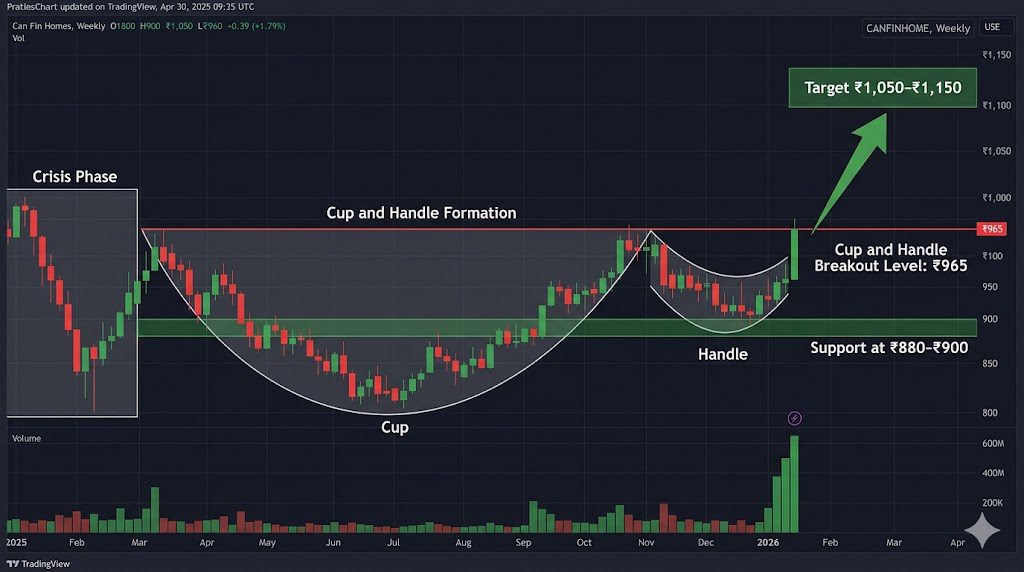
From a technical perspective, Can Fin Homes is showing a very interesting setup.
The stock has been forming a “Cup and Handle” pattern on weekly charts since January 2026. This pattern is generally considered bullish and often signals a strong breakout.
The major support level lies between ₹880 and ₹900, which has acted as a strong base for the stock. On the upside, ₹965 is the key resistance level.
A breakout above ₹965, supported by strong volume, could push the stock toward ₹1,050 in the near term.
The RSI currently stands around 56, indicating that momentum is building without the stock being overbought. Additionally, a “Golden Cross” (where the 50-day moving average crosses above the 200-day moving average) has already occurred, signaling a long-term bullish trend.
Dividend & Shareholder Rewards
Can Fin Homes has announced a final dividend of ₹4 per share for FY26.
While the dividend yield is relatively modest at around 0.4%, it is important to understand the company’s strategy. Instead of paying out large dividends, the company prefers to reinvest profits back into the business to drive growth.
This approach benefits long-term investors, as retained earnings are used to expand the loan book and generate higher returns in the future.
Brokerage Sentiment & Targets: The Re-Rating View

Brokerage firms remain positive on Can Fin Homes, with most maintaining a bullish outlook.
Motilal Oswal Financial Services has given a “BUY” rating with a target price of ₹1,150, citing strong return on equity (around 18%) and a clean balance sheet.
Global brokerage Investec has also maintained a positive view, with a target of ₹1,100, driven by expected growth from branch expansion.
Consensus estimates suggest a target around ₹1,020, indicating moderate upside from current levels.
The overall sentiment points toward a re-rating opportunity, where the stock could trade at higher valuations as growth continues.
Management Guidance & Future Outlook
Loan Growth Outlook
The management has guided for a loan growth of 15–18% CAGR over the next two years. This is a healthy growth rate, especially for a company that prioritizes quality over aggressive expansion.
Such growth, combined with strong margins, can lead to consistent earnings improvement.
Geographic Expansion Strategy
Currently, Can Fin Homes has a strong presence in South India. However, the company is now focusing on expanding into North and West India.
This diversification is important as it reduces regional concentration risk and opens up new growth opportunities.
The “30-Year” Analyst Verdict
For Long-Term Investors
Can Fin Homes is a classic “sleep well at night” stock. It may not deliver explosive returns in the short term, but it offers stability, consistency, and steady compounding over time.
For investors looking to benefit from India’s housing growth story without taking excessive risk, this stock is a solid choice.
For Traders
For traders, the strategy is simple—watch the ₹965 level closely.
A breakout above this level could trigger a strong upward move. However, strict discipline is required, with a stop-loss below ₹880 to manage risk.
Conclusion: A Model of Consistency
Can Fin Homes’ Q4 FY26 results reinforce a simple truth: consistency wins in the long run.
With steady profit growth, strong asset quality, and a disciplined business model, the company stands out in the housing finance space. While it may not grab headlines like high-growth fintech companies, it continues to quietly create wealth for investors.
What’s Your View? (CTA)
Are you betting on Can Fin Homes for the ₹1,150 target, or do you prefer other housing finance stocks?
Share your thoughts and let’s discuss the best way to play India’s housing boom.