1. Introduction
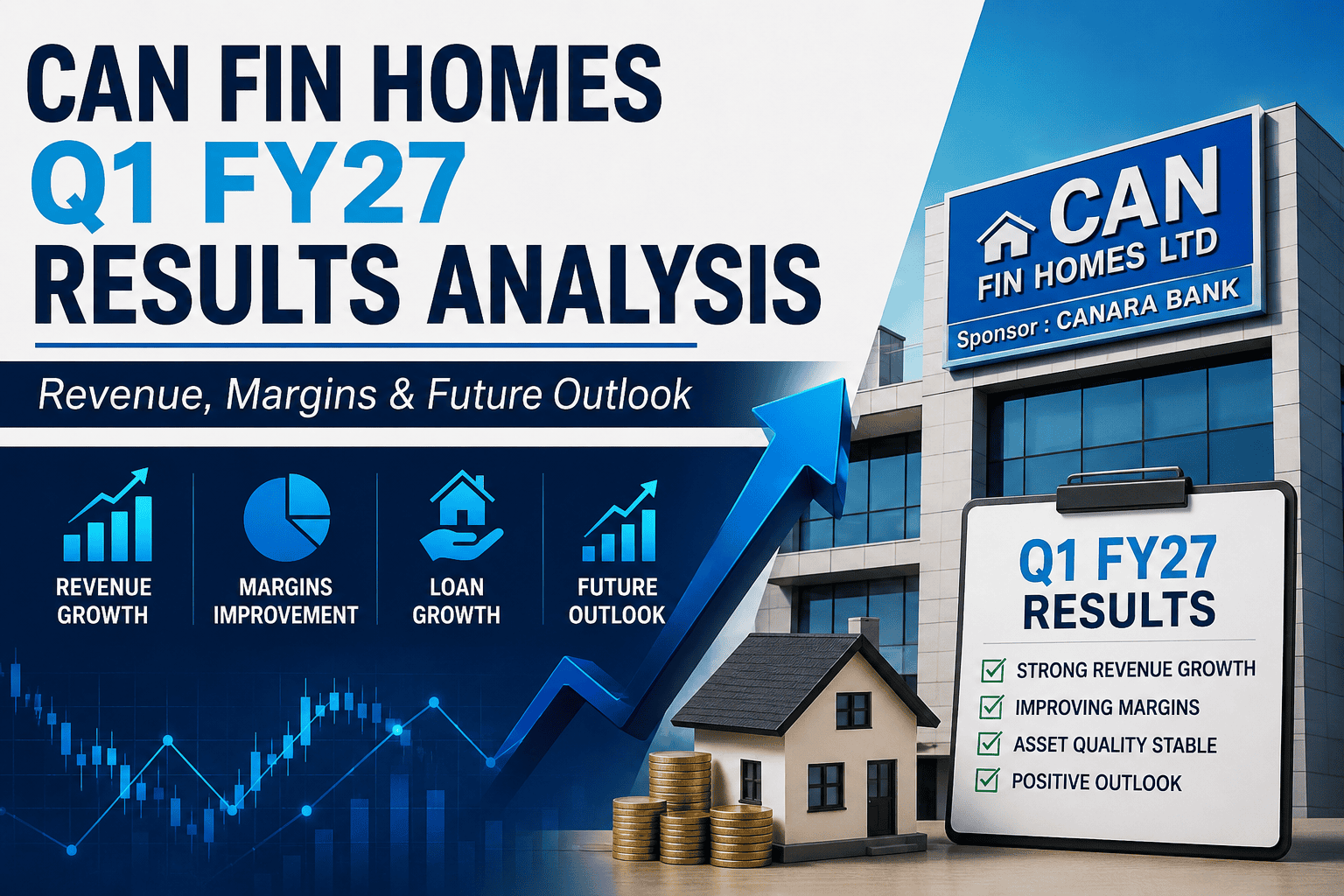
In a macroeconomic environment heavily influenced by fluctuating interest rate cycles and tightening liquidity, Can Fin Homes Limited—a prominent housing finance company (HFC) sponsored by Canara Bank—has reported a resilient set of numbers for the first quarter of the fiscal year 2026-27 (Q1 FY27). The biggest highlight of the quarter is the 19.6% Year-on-Year (YoY) jump in Net Profit After Tax (PAT), which stood at ₹267.82 crore. While the company demonstrated structural resilience, sequential (QoQ) metrics indicate a normalization of credit demand following the seasonally strong Q4 FY26.
For the retail investor and the seasoned swing trader alike, the critical question remains: Are these numbers strong enough to justify an accumulation strategy at the current market capitalization of ₹11,843 crore, or are there hidden execution risks buried in the asset quality metrics? This comprehensive analysis dissects the un-audited Q1 FY27 financial results, evaluating everything from Net Interest Margins (NIMs) and provisions to sectoral headwinds, ensuring that you have the institutional-grade insights needed to make an informed decision.
Editorial Transparency Note: The following analysis is strictly based on the un-audited financial results submitted by Can Fin Homes to the NSE/BSE on July 18, 2026, for the quarter ended June 30, 2026. This document should not be construed as personalized investment advice.
2. Quick Snapshot
| Key Metric | Q1 FY27 (June 2026) | Q4 FY26 (Mar 2026) | Q1 FY26 (June 2025) | YoY Growth |
| Total Income | ₹1,096.32 Cr | ₹1,075.22 Cr | ₹1,020.40 Cr | +7.44% |
| Net Profit (PAT) | ₹267.82 Cr | ₹345.67 Cr | ₹223.87 Cr | +19.63% |
| Basic EPS | ₹20.11 | ₹25.96 | ₹16.81 | +19.63% |
| Interest Income | ₹1,087.03 Cr | ₹1,056.49 Cr | ₹1,011.06 Cr | +7.51% |
| Finance Costs | ₹659.46 Cr | ₹634.16 Cr | ₹648.31 Cr | +1.72% |
| GNPA Ratio | 0.87% | – | – | – |
| NNPA Ratio | 0.42% | – | – | – |
| Net Profit Margin | 24.39% | – | – | – |
| Debt to Equity | 6.18x | – | – | – |
| CRAR | 23.39% | – | – | – |
Stock Data as of July 17, 2026:
Current Share Price: ₹889.45
52 Week High/Low: ₹971.50 / ₹708.60
Market Capitalization: ~₹11,843 Cr
3. Key Highlights
Robust Profitability: The company clocked a Net Profit After Tax of ₹267.82 crore for Q1 FY27, showcasing a healthy 19.6% YoY growth from ₹223.87 crore in the same quarter last year.
Controlled Interest Expenses: Despite a high-interest-rate regime, Finance Costs increased by a mere 1.7% YoY to ₹659.46 crore, aiding margin expansion.
Asset Quality Intact: Gross Non-Performing Assets (GNPA) stood at 0.87%, while Net NPA was contained at 0.42%, reflecting conservative underwriting standards.
Provision Coverage: The Provision Coverage Ratio (PCR) is reported at 52.09% as of June 30, 2026.
Regulatory Resolution: The company paid a penalty of ₹2.70 lakh to the RBI for non-compliance with the ‘Fair Practices Code’ (regarding principal and interest bifurcation) and implemented corrective measures effective April 1, 2026.
Asset Cover: Maintained a 100% asset cover on its secured redeemable non-convertible debentures (NCDs).
4. Company Overview
Can Fin Homes Limited (CFHL), sponsored by Canara Bank, is one of the premier Housing Finance Companies in India. Registered under the National Housing Bank (NHB), its core business involves providing loans for the purchase, construction, and renovation of residential and commercial properties.
Geographical Presence: Primarily concentrated in South India (especially Karnataka, Telangana, and Andhra Pradesh), with an expanding footprint in non-south geographies.
Competitive Position: Operates in the highly competitive affordable and mid-income housing finance segment. It competes with tier-1 NBFCs, specialized HFCs, and aggressive public and private sector banks.
Growth Drivers: India’s chronic housing shortage, nuclearization of families, rising urbanization, and government initiatives acting as secular tailwinds.
5. Detailed Q1 FY27 Financial Analysis
Revenue and Operating Income
The Total Income from Operations for Q1 FY27 was reported at ₹1,096.32 crore. This represents a steady 7.4% YoY growth compared to ₹1,020.40 crore in Q1 FY26. Sequentially, the total income grew by 1.9% from ₹1,075.22 crore in Q4 FY26. The growth was primarily driven by core Interest Income, which advanced to ₹1,087.03 crore from ₹1,011.06 crore YoY.
However, non-interest income components saw some volatility. Fees and Commission Income dropped slightly YoY to ₹9.11 crore from ₹9.26 crore, and Other Income stood at ₹0.17 crore for the quarter.
Expense Management and Margins
One of the most impressive aspects of this quarter’s results is CFHL’s liability management. Total Finance Costs stood at ₹659.46 crore in Q1 FY27, up only 1.7% from ₹648.31 crore in Q1 FY26. The ability to grow interest income at 7.5% while containing finance cost growth to under 2% indicates excellent transmission of yields to borrowers without a corresponding spike in borrowing costs.
Operating expenses (Employee Benefit Expenses + Depreciation + Other Expenses) aggregated to ₹81.96 crore for the quarter. Employee costs increased to ₹48.70 crore from ₹41.66 crore YoY, likely due to annual increments and workforce expansion for branch network growth.
Profitability
Profit Before Tax (PBT) came in at ₹338.50 crore, marking a 21.9% YoY increase from ₹277.63 crore. Sequentially, PBT contracted by 4.1% from ₹352.98 crore in Q4 FY26. Ultimately, Net Profit After Tax printed at ₹267.82 crore for Q1 FY27.
Asset Quality and Provisions
Provisions for Expected Credit Loss (ECL) and write-offs for Q1 FY27 stood at ₹13.06 crore. This is significantly lower than the ₹26.25 crore provisioned in Q1 FY26, signaling an improvement in early-stage delinquencies. The GNPA and NNPA stood at highly respectable levels of 0.87% and 0.42%, respectively. A Provision Coverage Ratio (PCR) of 52.09% ensures adequate buffering against future shocks.
6. Ratio Analysis
Based on the disclosures provided for the quarter ended June 30, 2026, the fundamental health of the balance sheet remains sound:
Debt to Equity Ratio: 6.18x. This is a conservative leverage level for a housing finance company, leaving ample room on the balance sheet to borrow and accelerate growth if demand spikes.
Capital Risk Adequacy Ratio (CRAR): 23.39%. This is well above the regulatory requirement, showcasing deep capitalization that protects the company against cyclical shocks.
Net Profit Margin: 24.39%. Capturing nearly a quarter of total income as pure bottom-line profit highlights operational leanness.
Interest Service Coverage Ratio (ISCR): 1.51x. Comfortably servicing its debt obligations.
7. Segment-wise Analysis
Can Fin Homes has explicitly noted in its disclosures that its main business is providing loans against/for purchase, construction, and renovation of properties. All activities are incidental to this main business, and accordingly, there are no separate reportable segments under Ind AS 108. The singular focus on housing finance removes the drag of unsecured, high-risk corporate or wholesale lending, which is a major positive for risk-averse investors.
8. Management Commentary & Regulatory Updates
While a detailed earnings call transcript is yet to be fully digested by the market, the statutory filings highlighted a key regulatory development.
The Reserve Bank of India (RBI), on June 19, 2026, imposed a penalty of ₹2.70 lakh under Section 52A of the National Housing Bank Act, 1987. This was related to non-compliance with ‘Fair Practices Code’ directives. Specifically, it related to the lack of bifurcation between principal, interest, and charges in the Statement of Account sent to borrowers. Management confirmed that corrective measures were implemented effective April 1, 2026, the systems were updated to reflect this bifurcation, and the penalty was remitted on June 22, 2026.
What This Means for Investors: The penalty amount is financially immaterial (₹2.7 lakh). The proactive systemic correction demonstrates management’s agility in complying with tightening RBI oversight in the NBFC space.
9. Macroeconomic Impact
The Q1 FY27 results must be viewed through the lens of the prevailing macroeconomic environment:
Interest Rate Plateau: The RBI’s repo rate strategy directly impacts the borrowing costs (Cost of Funds) for HFCs. Can Fin Homes’ suppressed finance cost growth suggests successful negotiation with lenders or a pivot towards cheaper short-term commercial papers.
Inflation & Affordability: While raw material inflation for construction has moderated compared to the 2022-2023 spikes, property prices in key micro-markets (like Bengaluru and Hyderabad) remain elevated.
Liquidity: The 100% asset cover on outstanding NCDs (totaling ₹5,430 crore as of June 30, 2026) proves the company is not facing liquidity mismatches.
10. Fundamental Analysis
Strengths:
Laser Focus: A pure-play mortgage lender with practically zero exposure to toxic wholesale/developer loans.
Cost Efficiency: Structurally low Cost-to-Income ratio fueled by centralized underwriting and a lean branch model.
Asset Quality: Consistently maintaining GNPA below the 1% mark (currently 0.87%).
Weaknesses/Threats:
Geographic Concentration: Heavy reliance on Southern states limits pan-India risk diversification.
Intense Competition: Public sector banks are aggressively targeting the retail home loan segment with extremely fine pricing, which could pressure CFHL’s yields going forward.
11. Valuation Analysis
At the current market price of ~₹889, Can Fin Homes is trading at a trailing Price-to-Earnings (P/E) multiple of approximately 10.9x and a Price-to-Book (P/B) ratio near 2.0x. Given the EPS of ₹20.11 generated in a single quarter (annualizing to roughly ₹80+), the valuation appears Fairly Valued to slightly Undervalued when compared to peers like PNB Housing or LIC Housing Finance. The strong Return on Equity profile justifies the current multiple, and any acceleration in the loan book growth in H2 FY27 could trigger a re-rating.
12. Investment Takeaways
For Short-term/Swing Traders: The stock may exhibit sideways movement in the near term as QoQ profit degrowth (typical for Q1 due to seasonality) is priced in. Resistance lies around the ₹940-₹950 levels, with strong support at ₹850.
For Long-term Investors: Can Fin Homes remains a solid structural compounder. The 19.6% YoY PAT growth and robust capital adequacy (23.39%) indicate that the fundamental machinery is fully intact. Accumulation on dips is a sound strategy.
Dividend Investors: The Board has recommended a final dividend of ₹8 per share (subject to AGM approval on July 29, 2026).
13. Conclusion
Can Fin Homes’ Q1 FY27 results are fundamentally clean, predictable, and reassuring. The management’s ability to drive a ~20% bottom-line growth despite a marginal 7.4% top-line increase speaks volumes about their liability management and cost control mechanisms. Asset quality is firmly under control, and the swift resolution of the minor RBI compliance issue clears any regulatory overhang. Moving forward, investors should closely monitor the AUM growth trajectory and Net Interest Margins in upcoming quarters as the interest rate cycle potentially shifts.