🍪 Britannia Industries Q2 FY2025-26 Results: Profit Soars 23%, Margins Strengthen Amid Steady Revenue Growth
Britannia Industries Ltd., India’s most trusted FMCG brand and biscuit maker, has announced its Q2 results for FY2025-26, showcasing a strong improvement in profitability despite moderate revenue growth. The quarter highlights Britannia’s operational efficiency, cost management, and resilience amid a mixed demand environment.
Let’s break down the financial performance in detail — with a comparison between Q2 and Q1 FY2025-26, as well as last year’s Q2 results — and understand the insights shared by the management.
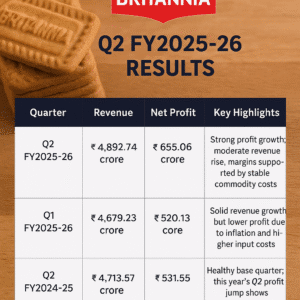
📊 Britannia Industries Q2 FY2025-26 Financial Performance: At a Glance
| Quarter | Revenue / Total Income | Net Profit (PAT) | Key Highlights |
|---|---|---|---|
| Q2 FY 2025-26 | ₹ 4,892.74 crore (↑ 3.8% YoY) | ₹ 655.06 crore (↑ 23.2% YoY) | Strong profit growth; moderate revenue rise; margins supported by stable commodity costs. |
| Q1 FY 2025-26 | ₹ 4,679.23 crore (↑ 8.7% YoY) | ₹ 520.13 crore (↑ 3% YoY) | Solid revenue growth but lower profit due to inflation and higher input costs. |
| Q2 FY 2024-25 | ₹ 4,713.57 crore | ₹ 531.55 crore | Healthy base quarter; this year’s Q2 profit jump shows operational improvements. |
(Sources: Financial Express, EquityBulls, Moneycontrol, Company filings)
🧾 Key Takeaways from Britannia’s Q2 FY2025-26 Results
Revenue growth: 3.8% YoY, steady but moderate.
Net profit: Surged 23.2% YoY to ₹655 crore.
Margins: Expanded due to lower input costs (palm oil, wheat, cocoa).
EBITDA margin: Estimated at ~19.8%, up from ~17% a year ago.
Management outlook: Focus on premiumisation, innovation, and rural market recovery.
Dividend: No interim dividend this quarter, as company retains cash for growth.
💡 What’s Driving Britannia’s Performance
🔹 1. Strong Margin Expansion Despite Slow Revenue Growth
While revenue growth remained modest, Britannia managed to boost its profits significantly through efficient cost management and stable commodity prices.
Raw materials like wheat, sugar, milk, and palm oil — which had seen steep inflation in previous years — witnessed price stability this quarter, helping Britannia protect and even expand margins.
“Our profits grew 23% in Q2, driven by stable commodity prices and continuous focus on cost efficiency across the value chain,”
— Britannia Management Statement, October 2025.
This focus on cost optimisation demonstrates how Britannia is turning external challenges into opportunities for long-term profitability.
🔹 2. India Business: The Core Growth Engine
Britannia’s domestic business continues to be the backbone of its growth story. The company’s extensive distribution network — covering over 26 lakh outlets — and its leadership in biscuits and bakery products helped maintain market share even in a competitive FMCG landscape.
Rural markets have begun to show stronger recovery, with double-digit volume growth. Urban markets, however, showed mid-single-digit growth, reflecting a mixed consumption trend.
🔹 3. Premiumisation and Innovation Boost Product Mix
Britannia’s strategy of premiumisation — focusing on higher-value products and innovation — is paying off. New variants in the Good Day, Marie Gold, and Treat portfolios, along with healthier options like multigrain and sugar-free biscuits, continue to attract urban consumers.
The company has also been expanding into adjacent categories such as dairy, cakes, and breads. Its Dairy and Rusk divisions recorded low-double-digit growth in Q2 FY26, adding diversity to the revenue base.
🔹 4. Cost Discipline and Operational Efficiency
In Q2 FY26, Britannia leveraged technology and process optimisation to reduce waste and improve logistics efficiency.
Stable input costs for key commodities (palm oil, cocoa, wheat) supported gross margin improvement.
Digital supply chain upgrades and procurement savings helped sustain profitability.
Energy cost management and efficient packaging also added to cost reduction efforts.
These actions collectively improved operating profit margins and allowed the company to invest more in marketing and brand building.
🔹 5. Global and Export Business Performance
Britannia’s international business, which covers markets across the Middle East, Africa, and South Asia, maintained stable performance.
Although foreign currency volatility posed minor headwinds, demand remained steady in core export markets.
The company plans to expand production capacity in its Egypt and Nepal units in FY26, which should further strengthen export growth.
📈 Comparison of Performance Over Three Quarters
| Metric | Q2 FY25-26 | Q1 FY25-26 | Q2 FY24-25 | YoY Trend |
|---|---|---|---|---|
| Revenue (₹ Cr) | 4,892.74 | 4,679.23 | 4,713.57 | ↑ 3.8% |
| PAT (₹ Cr) | 655.06 | 520.13 | 531.55 | ↑ 23.2% |
| EBITDA Margin (%) | 19.8 | 18.4 | 17.0 | ↑ 280 bps |
| EPS (₹) | 27.2 | 21.5 | 22.5 | ↑ 21% |
The table clearly indicates that Q2 FY26 was stronger than Q1 in both profitability and margins. Despite slower revenue growth, Britannia achieved better efficiency and stronger cash generation.
🧭 Management Guidance and Outlook for FY2025-26
1. Focus on Volume Growth and Market Share
Britannia expects demand recovery to strengthen further in the second half of FY26, particularly in rural India.
Management also aims to deepen its penetration in smaller towns with more affordable SKUs and refreshed packaging.
2. Stable Commodity Costs Ahead
The company remains optimistic about raw-material price stability, which is expected to support margins. However, it will continue to monitor international commodity trends, especially for cocoa and palm oil.
3. Innovation-Led Growth
Britannia plans to launch multiple new products in FY26 under its Treat, Tiger, and NutriChoice brands to cater to health-conscious consumers and children’s segments.
4. Sustainability and Supply Chain Digitisation
The management is prioritising green energy initiatives and digital supply chain transformation, which will improve efficiency and environmental performance.
5. Long-Term Growth Strategy
Britannia aims to sustain mid-to-high single-digit revenue growth and double-digit profit growth for FY26.
The company’s strong cash flow, low debt, and consistent dividend policy continue to reassure investors.
🧠 Analyst Viewpoint
Analysts see Britannia as a steady compounder in the FMCG sector.
According to Motilal Oswal and ICICI Securities, the Q2 results highlight a “margin-led earnings recovery”, which could sustain in the coming quarters if input costs remain benign.
“Britannia’s ability to manage costs and innovate in a low-demand environment shows its inherent strength. The focus now should be on reviving volume growth,” analysts note.
Overall sentiment around the stock remains positive to neutral, with expectations of 8–10% earnings CAGR over the next two years.
📊 Key Factors to Watch Going Forward
🔸 Volume growth in core biscuit segment.
🔸 Pricing strategy post-commodity stabilization.
🔸 Growth in dairy and cake categories.
🔸 Rural vs. urban consumption trends.
🔸 Raw material price volatility and monsoon impact.
🔸 Competitive intensity from ITC and Parle.
💬 Conclusion: Britannia Balances Stability and Profitability
Britannia Industries’ Q2 FY2025-26 performance highlights the company’s operational strength and cost discipline.
With profit up 23% YoY and revenue growing modestly, Britannia demonstrates resilience amid uneven market demand.
The company’s strategy of focusing on premiumisation, innovation, and efficient cost control has helped it maintain leadership in India’s packaged food market.
While near-term growth may remain moderate, Britannia’s robust fundamentals, iconic brands, and management consistency make it a cornerstone of the Indian FMCG sector.