Introduction: The High-Octane Turnaround
Over the last three decades, India’s automobile industry has gone through dramatic shifts. From the era of simple commuter scooters in the 1990s to today’s electric mobility race, only a few companies have managed to evolve successfully with changing consumer preferences. Bajaj Auto is one of those rare companies that has continuously reinvented itself without losing its core identity.
Back in 1995, Bajaj Auto was primarily associated with the iconic “Hamara Bajaj” scooters that dominated Indian roads. In 2026, however, the company has transformed into a diversified global motorcycle powerhouse with a growing electric vehicle portfolio, premium international partnerships, and strong export leadership.
The Q4 FY26 board meeting results released on May 6, 2026, clearly show how Bajaj Auto is balancing traditional strengths with future-focused growth strategies. While global export markets faced pressure during FY26 due to currency instability in Africa and slower recovery in certain Asian economies, the company successfully offset these challenges through premium motorcycles, operational efficiency, and strong EV momentum.
At present, the stock is trading near ₹10,151 on the NSE. Investors are closely monitoring the newly proposed share buyback and dividend announcements while evaluating the company’s aggressive push into the premium and electric mobility segments.
Q4 FY26 Financial Scorecard (Actual NSE Data)
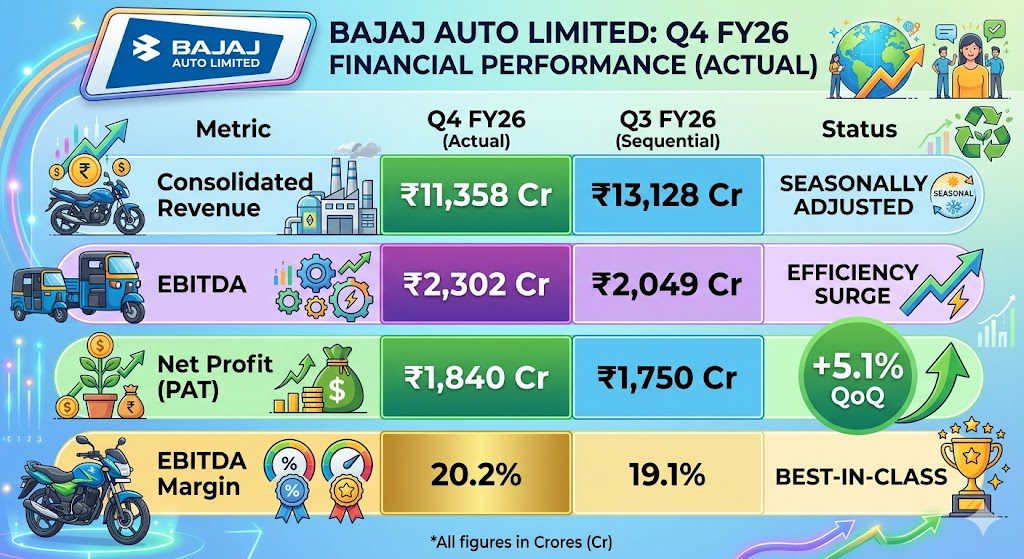
Bajaj Auto’s Q4 FY26 numbers reflect a company that continues to maintain strong profitability despite global macroeconomic challenges. Consolidated revenue for the quarter stood at approximately ₹11,358 crore. While this was slightly lower sequentially compared to ₹13,128 crore in Q3 FY26, the decline is largely viewed as seasonal and linked to export softness in key international markets.
EBITDA came in at ₹2,302 crore, significantly higher than ₹2,049 crore in the previous quarter. This improvement demonstrates the company’s strong focus on operational efficiency and premium product mix. EBITDA margins expanded sharply to 20.2%, compared to 19.1% in Q3 FY26, reinforcing Bajaj Auto’s position as one of the most profitable two-wheeler manufacturers globally.
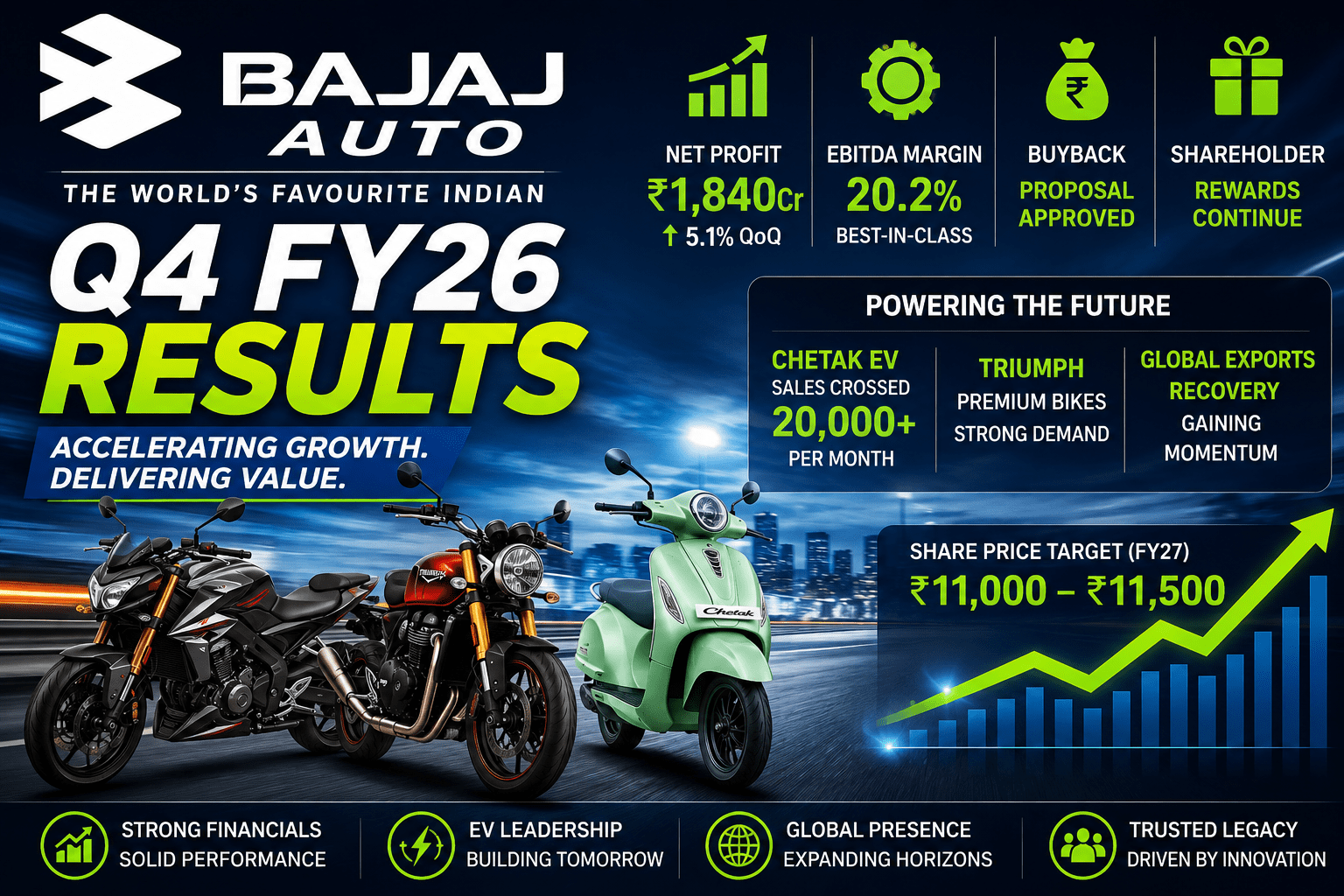
Net profit for the quarter stood at ₹1,840 crore, reflecting a sequential growth of 5.1% from ₹1,750 crore. Even in a challenging environment, the company managed to deliver steady profit growth while maintaining strong free cash flow generation.
The key takeaway from these results is that Bajaj Auto is no longer dependent only on domestic commuter motorcycles. Its earnings profile is now supported by premium motorcycles, EV growth, exports, and strong operational discipline.
Fundamental Analysis: The EV and Export Pivot
The Chetak EV Milestone
One of the most important developments for Bajaj Auto during FY26 has been the strong performance of the Chetak electric scooter. Monthly sales have now crossed 20,000 units, proving that the company is becoming a serious player in India’s highly competitive electric two-wheeler market.
For several years, investors believed Bajaj Auto was moving slowly in the EV race compared to newer startups and rivals. However, the latest numbers suggest that the company’s cautious and quality-focused approach is beginning to pay off.
The growing popularity of the Chetak brand gives Bajaj Auto a strong foundation to expand its EV portfolio further over the next few years.
Export Recovery Momentum
Exports remained a major challenge during FY26 due to currency depreciation and weak economic conditions in African and Southeast Asian markets. However, conditions are gradually improving. Stabilization in African currencies and recovery in Sri Lankan demand are helping Bajaj Auto regain momentum in its export-focused three-wheeler business.
Exports remain one of Bajaj Auto’s biggest long-term advantages because the company has built strong distribution networks in emerging markets over several decades. As global macroeconomic conditions stabilize, export recovery could become a significant growth driver again.
The Premium Motorcycle Strategy
The partnership with Triumph Motorcycles has become one of the most successful strategic moves for Bajaj Auto in recent years. The launch of the Triumph Speed 400 and Scrambler 400X motorcycles has opened access to the premium ₹2–5 lakh motorcycle segment.
Both models have witnessed strong demand, with waiting periods and consistent sold-out status across several regions. This partnership allows Bajaj Auto to improve brand perception while increasing profitability through premium product sales.
The premium segment also provides better protection against price competition compared to entry-level commuter motorcycles.
Technical Analysis: The ₹10,000 Psychological Floor
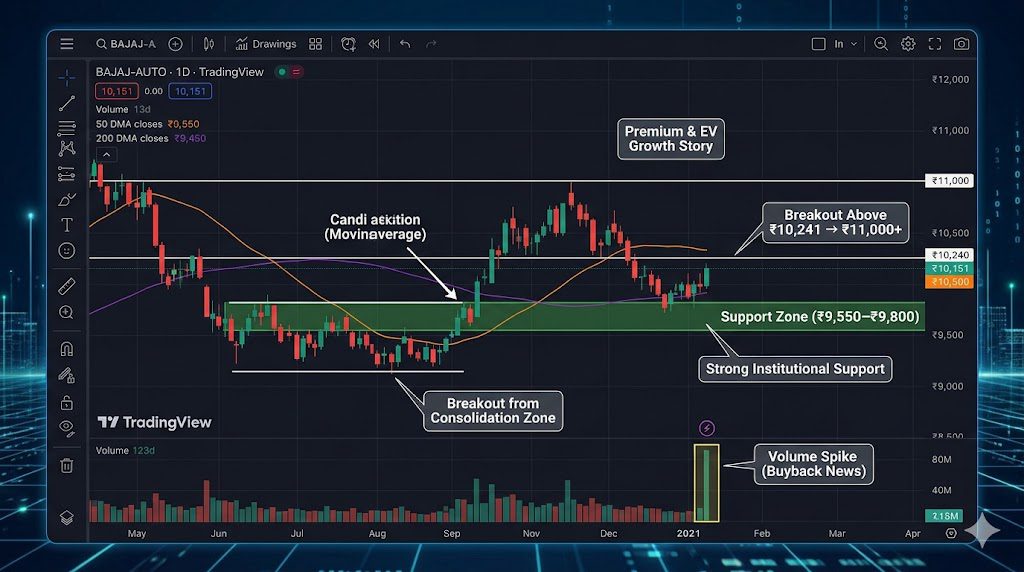
From a technical perspective, Bajaj Auto’s stock remains one of the strongest performers in the auto sector. On May 4, 2026, the stock touched a fresh 52-week high of ₹10,477.50, confirming a breakout from a prolonged consolidation phase.
The most important support zone currently lies between ₹9,551 and ₹9,798. This range is viewed as a strong institutional accumulation area where long-term investors and “smart money” are likely to increase positions during market corrections.
On the upside, the immediate resistance level stands near ₹10,241. A sustained breakout above this zone, particularly after confirmation of the share buyback details, could push the stock toward the next psychological target of ₹11,000.
The Relative Strength Index (RSI) currently stands near 62.93, indicating bullish momentum without entering extremely overbought territory. This suggests that the stock may still have room for additional upside if market sentiment remains positive.
Shareholder Rewards: Dividends & The Buyback
Record Dividend Expectations
Bajaj Auto has consistently maintained one of the strongest shareholder reward policies among Indian automobile companies. Following the massive ₹210 dividend payout in 2025, investors are once again closely watching the FY26 dividend announcement.
The company’s strong cash generation capabilities provide it with significant flexibility to reward shareholders while continuing to invest in EVs and premium products.
The 2026 Share Buyback Proposal
One of the most closely watched developments from the latest board meeting is the proposed share buyback plan. The company is considering utilizing its large cash reserves to repurchase shares, which could improve earnings per share and enhance shareholder value.
Share buybacks are generally interpreted positively by the market because they indicate management confidence in the company’s future prospects and valuation strength.
Management Guidance: Shifting Toward FY27
EV Market Share Goals
Management has set an ambitious target of achieving a double-digit market share in India’s electric two-wheeler market by the end of FY27. This growth will be supported by new product launches under both the Chetak and Pulsar brands.
The EV segment is expected to become one of the biggest long-term growth drivers for Bajaj Auto.
Margin Outlook
Despite risks from rising aluminum and steel prices, management expects EBITDA margins to remain strong within the 19–21% range. This confidence comes from the increasing contribution of premium motorcycles and higher-value products.
Premiumization continues to remain one of the strongest themes across the Indian automobile industry, and Bajaj Auto appears well-positioned to benefit from this trend.
Brokerage Sentiment & Targets: The Path to ₹11,500
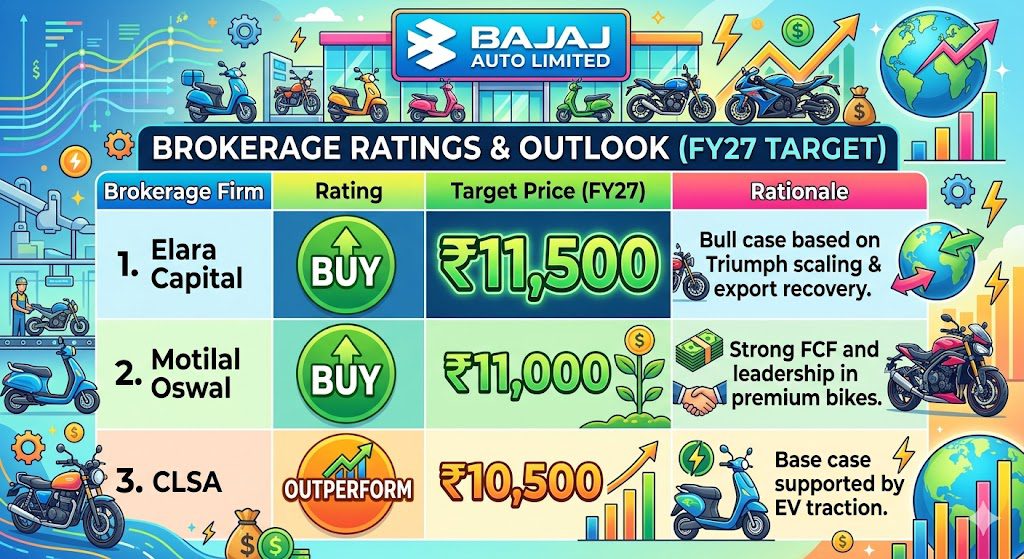
Brokerage firms remain highly optimistic about Bajaj Auto’s long-term growth potential. Elara Capital has maintained a “Buy” rating with a target price of ₹11,500, driven by expectations of export recovery and stronger premium motorcycle sales.
Motilal Oswal also maintains a “Buy” recommendation with a target of ₹11,000, highlighting the company’s strong free cash flow generation and leadership in premium motorcycles.
CLSA has an “Outperform” rating with a target price near ₹10,500, supported by growing traction in the electric vehicle segment.
Overall, the market increasingly views Bajaj Auto not just as a traditional auto manufacturer but as a diversified mobility company with strong future growth drivers.
The “30-Year” Analyst Verdict
For long-term investors, Bajaj Auto has evolved from being a stable value stock into a strong growth-oriented company with defensive characteristics. The combination of healthy dividends, cash-rich balance sheet, premium motorcycles, and EV expansion makes it one of the strongest long-term holdings in the Indian automobile sector.
Unlike many auto companies that are struggling to adapt to the EV transition, Bajaj Auto appears to be successfully balancing its traditional ICE business with emerging electric mobility opportunities.
For traders, the overall trend remains clearly bullish. The ₹9,800–₹10,000 zone appears attractive for buying on dips, while the share buyback proposal may provide additional downside support to the stock price.
Conclusion & Engagement (CTA)
Bajaj Auto’s Q4 FY26 performance highlights a company that is successfully reinventing itself for the future while maintaining strong profitability and shareholder returns. With improving EV traction, premium motorcycle success, export recovery potential, and possible buyback support, the company appears well-positioned for sustained long-term growth.
The key question for investors now is whether Bajaj Auto’s EV and premium growth story can continue driving the stock toward the ₹11,500 target, or whether short-term global uncertainties could slow momentum temporarily.