Introduction: The Adani Consolidation Phase
If you have followed the Indian cement industry over the last three decades, you would know that it has undergone a massive transformation. What was once a fragmented, regionally dominated business has now become a highly consolidated sector driven by scale, logistics efficiency, and cost leadership. In 2026, this transformation has reached a new peak, and at the center of it stands Ambuja Cements—now a key pillar of the Adani Group’s ambitious “One Cement” strategy.
Back in the 1990s, cement companies competed primarily on regional demand and local distribution networks. Today, the game is about national scale, integrated supply chains, and cost optimization. Ambuja is no longer just a standalone brand; it is part of a much larger ecosystem that includes ACC and a rapidly expanding production footprint under the Adani Group.
The Q4 FY26 results, announced after the board meeting on April 30, 2026, reflect this transition clearly. On the surface, the numbers show growth, but a deeper look reveals a more complex story.
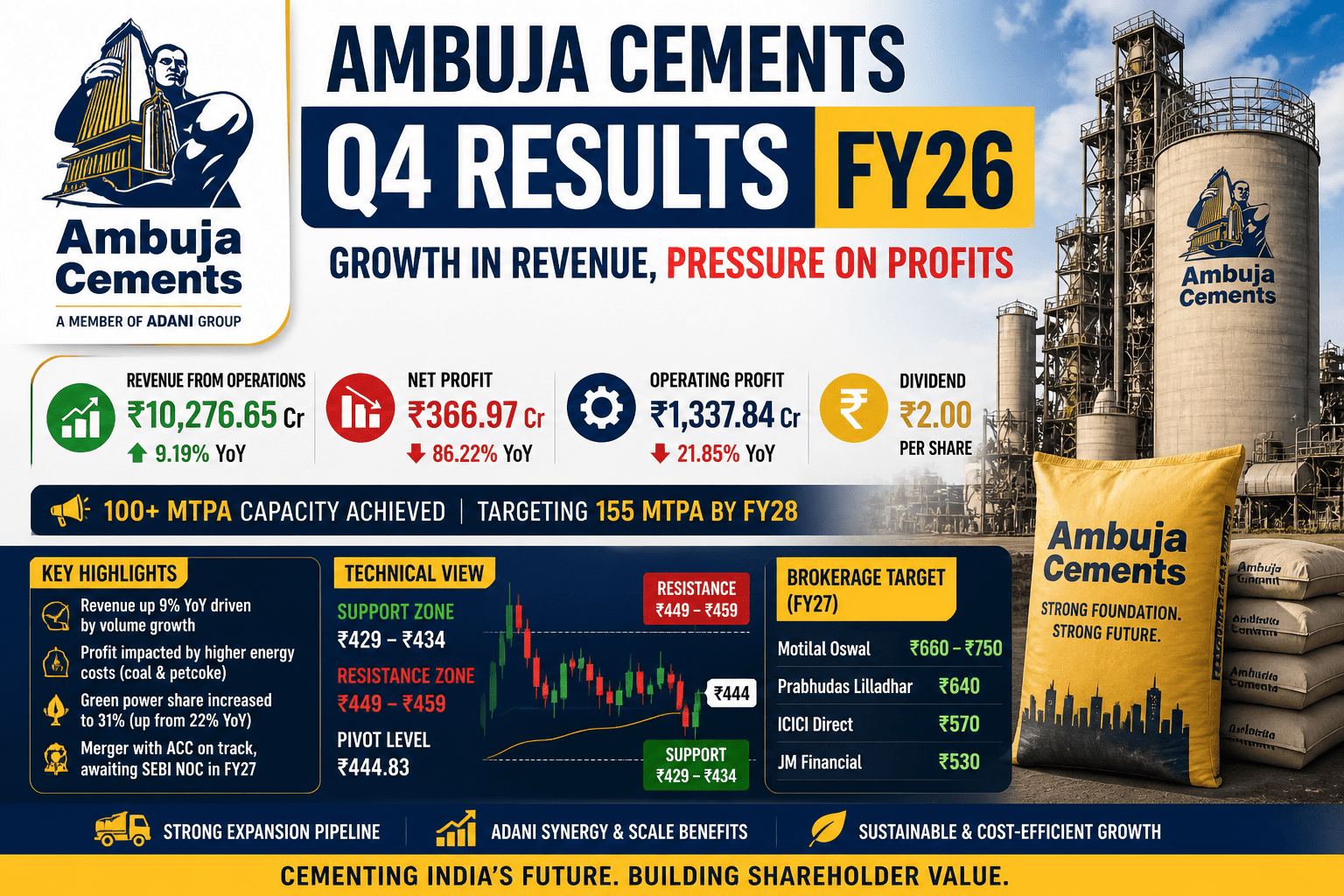
The headline figure shows that revenue grew 9.19% year-on-year to ₹10,276.65 crore, indicating strong demand and volume expansion. However, the bottom line paints a very different picture. Net profit declined sharply by 86.22% year-on-year to ₹366.97 crore, highlighting significant pressure on margins.
From a market perspective, the stock is currently trading around ₹444, and it has corrected roughly 17%–23% over the past year. This reflects investor concerns about rising costs, energy price volatility, and the time required for synergies to fully materialize.
Q4 FY26 Financial Scorecard (The Actuals)
The Q4 FY26 financial performance of Ambuja Cements highlights a clear divergence between revenue growth and profitability.
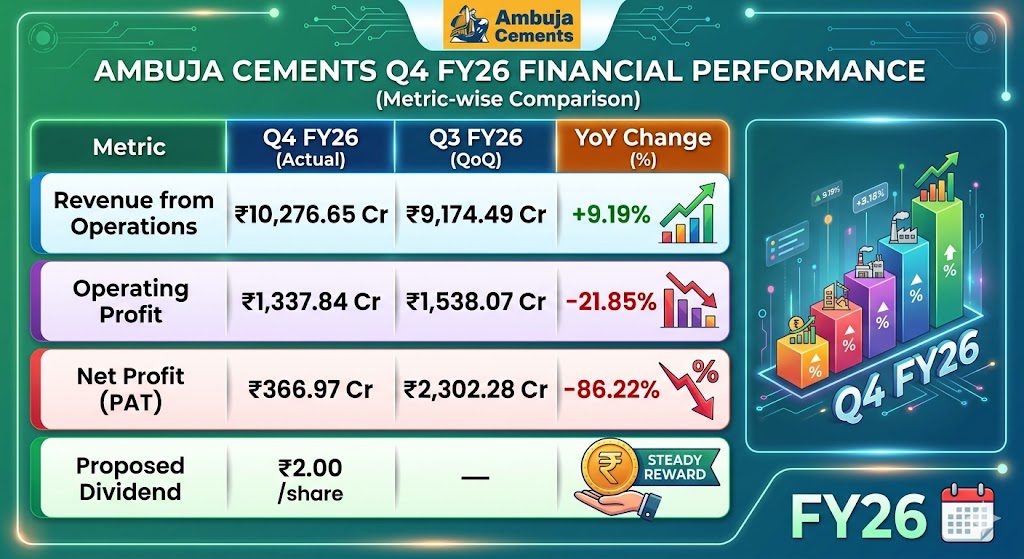
Revenue from operations stood at ₹10,276.65 crore, up from ₹9,174.49 crore in the previous quarter, reflecting steady demand and volume growth. This growth is largely driven by infrastructure activity and housing demand across India.
However, operating profit declined to ₹1,337.84 crore, compared to ₹1,538.07 crore in Q3 FY26, marking a 21.85% decline. This indicates rising cost pressures that are eating into operating efficiency.
The most striking figure is net profit, which fell sharply to ₹366.97 crore from ₹2,302.28 crore in the previous quarter. This represents a massive 86.22% decline, primarily due to elevated operating expenses.
Despite this, the company has maintained its commitment to shareholders by proposing a dividend of ₹2 per share, reflecting financial discipline and confidence in long-term growth.
(Source: NSE audited results published April 30, 2026)
Fundamental Analysis: Scale vs. Cost Shocks
Volume Delivery
One of the biggest positives for Ambuja Cements is its strong volume growth. The company has successfully crossed the 100 million tonnes per annum (MTPA) capacity milestone in FY26, which is a significant achievement.
Management has outlined an aggressive expansion roadmap, targeting 118 MTPA capacity by the end of FY27 and 155 MTPA by FY28. This positions Ambuja as one of the fastest-growing cement players in India.
The Profitability Miss
While volumes and revenue have grown, profitability has taken a hit. The primary reason behind this sharp decline in net profit is the increase in energy costs, particularly petcoke and coal prices.
Geopolitical tensions in West Asia have also contributed to higher fuel costs, which directly impact cement manufacturing margins. Since energy accounts for a significant portion of production costs, even a small increase can have a large impact on profitability.
The Merger Catalyst
A major structural trigger for Ambuja’s future growth is the ongoing merger with ACC. This merger is expected to be completed in FY27, pending final approval from SEBI.
Once completed, the merger is expected to unlock significant synergies, including cost savings, operational efficiencies, and improved market reach. This is one of the key reasons why long-term investors remain optimistic despite short-term challenges.
Technical Analysis: Navigating the Support Zones
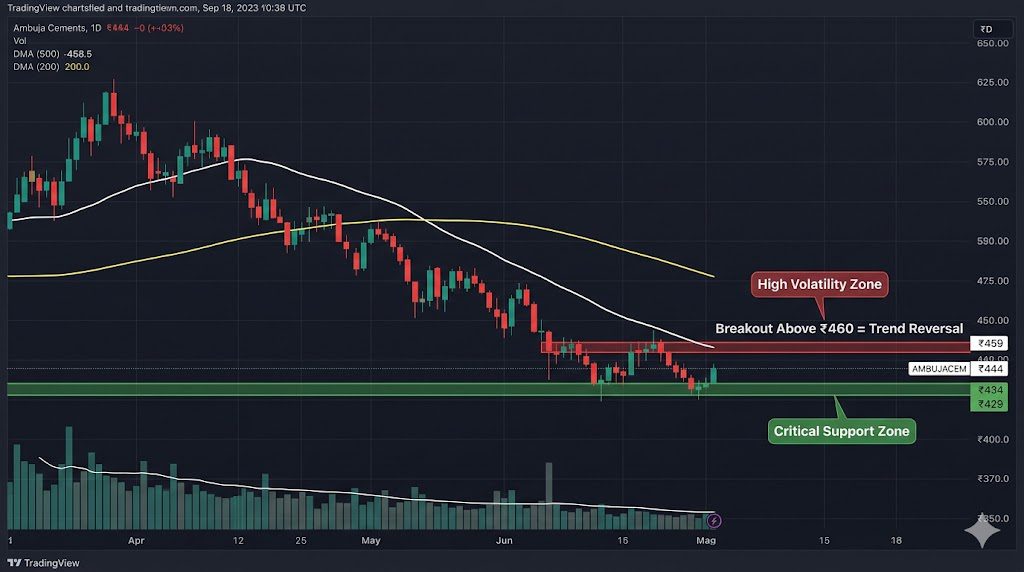
From a technical standpoint, Ambuja Cements is currently in a short-term bearish phase, trading below its 50-day simple moving average of ₹458.5.
The major support zone lies between ₹429 and ₹434, which is a critical level for the stock. If this support holds, it could act as a base for a potential recovery.
On the upside, the immediate resistance is between ₹449 and ₹459, with a pivot point around ₹444.83. A sustained move above ₹459 would be required to confirm a trend reversal.
At present, momentum is mildly positive, but volatility remains high. Traders are advised to wait for a clear breakout above ₹460 before initiating fresh positions.
Management Guidance & Expansion (The 155 MTPA Vision)
Capacity Ramp-up
Ambuja Cements is aggressively expanding its production capacity. The company recently reviewed its Sanghipuram plant and is targeting a 15% return on investment (ROI) for new kiln expansions.
This expansion strategy is central to the Adani Group’s vision of creating a dominant cement platform in India.
Cost Reduction Strategy
To address margin pressures, the company has set a target of reducing costs to ₹3,650 per metric tonne (PMT) by FY28. This will be achieved through increased use of captive coal and improved operational efficiencies.
Green Power Transition
Ambuja is also focusing on sustainability. The share of green power in its energy mix has increased to 31%, up from 22% year-on-year. This not only reduces costs in the long term but also aligns with global environmental standards.
Brokerage Sentiment & Targets (The Divergence)
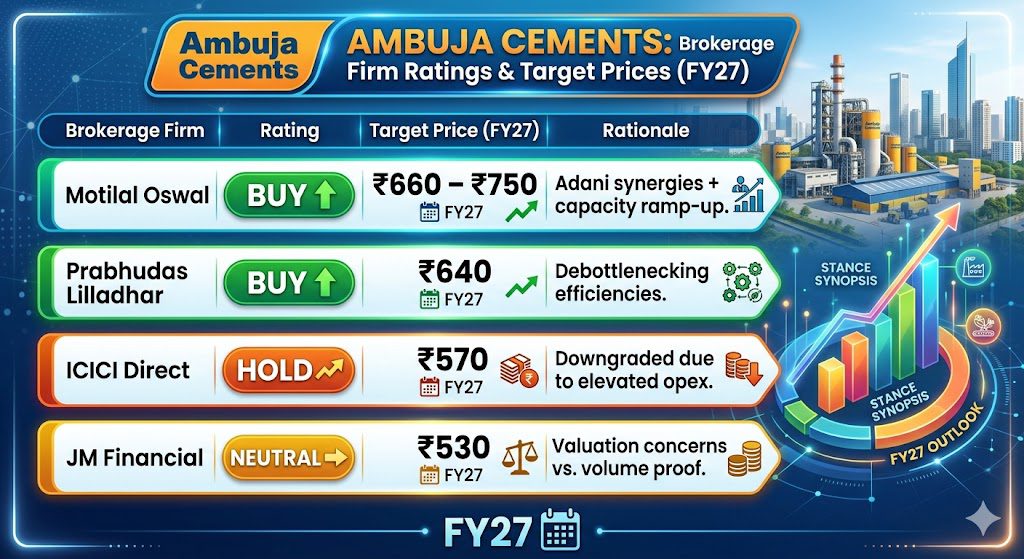
Brokerage opinions on Ambuja Cements are currently mixed, reflecting the uncertainty around short-term margins and long-term growth.
- Motilal Oswal maintains a “Buy” rating with a target range of ₹660–₹750, driven by expected synergies and capacity expansion.
- Prabhudas Lilladhar also has a “Buy” rating with a target of ₹640, highlighting efficiency gains from debottlenecking.
- ICICI Direct has a “Hold” rating with a target of ₹570, citing elevated operating expenses.
- JM Financial has a “Neutral” rating with a target of ₹530, expressing concerns about valuation versus growth visibility.
This divergence reflects a market that is optimistic about the long term but cautious in the near term.
The “30-Year” Analyst Verdict
From a long-term perspective, Ambuja Cements represents a value opportunity with transition risks. The company is undergoing a major transformation under the Adani Group, which will take time to fully reflect in financial performance.
At current levels, the stock appears to be fairly valued, with an intrinsic value estimate around ₹538. For long-term investors, this is a stock that can be accumulated gradually, especially near the ₹430 support zone.
For traders, the high volatility makes it a “wait and watch” situation. A breakout above ₹460 with strong volume would be a more reliable signal for a recovery trend.
Conclusion & Engagement (CTA)
Ambuja Cements’ Q4 FY26 results highlight a company at a critical turning point. While revenue growth remains strong, profitability is under pressure due to rising costs.
The Adani Group’s execution strategy is clearly focused on building scale and long-term dominance. However, the global energy environment is testing the company’s margins in the short term.
The key question for investors is simple—are you willing to ride through the short-term volatility for the long-term growth story, or do you prefer to wait for clearer signs of margin recovery?
Let’s discuss your strategy in the comments—because the future of India’s cement sector is being reshaped right now, and Ambuja is right at the center of it.