Introduction: The Green Giant Finds Its Strides
If there’s one word that defines the global energy race in 2026, it is speed. Countries are not just talking about renewable energy anymore—they are racing to build it at scale. And right at the center of this race stands Adani Green Energy.
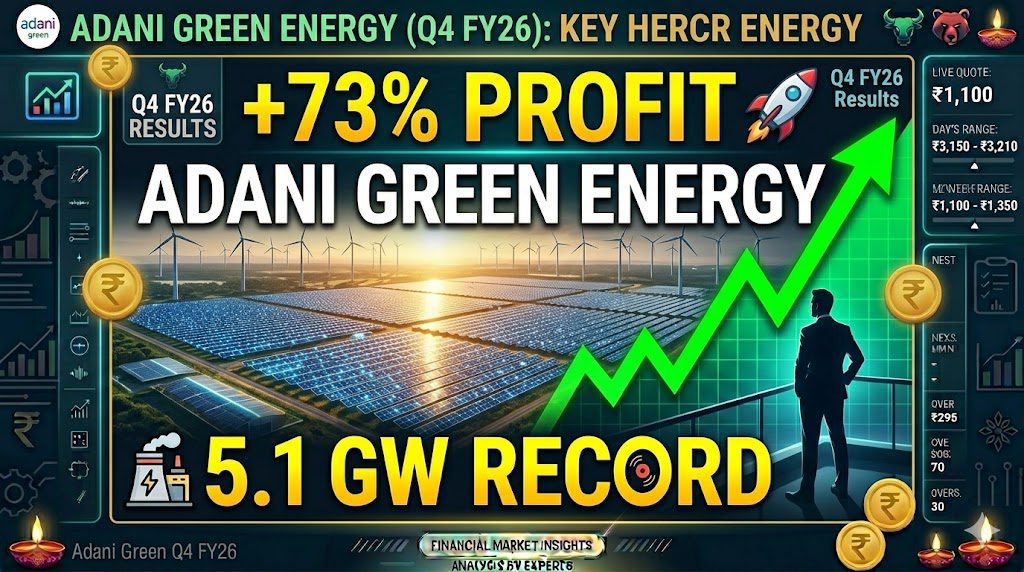
In Q4 FY26, Adani Green has delivered a result that goes beyond expectations. The company reported a 73% jump in net profit and added an industry-leading 5.1 gigawatts (GW) of renewable capacity in a single year. To put this into perspective, this is one of the fastest capacity expansions globally—outside China.
This isn’t just growth. It’s execution at a scale that very few companies in the world can match.
Despite ongoing volatility in the broader markets, the stock showed resilience. On April 24, 2026, shares of Adani Green climbed to around ₹1,231, even as the BSE Sensex remained under pressure. Earlier in the day, the stock even touched a fresh 52-week high—signaling strong investor confidence.
What makes this moment even more important is the shift in narrative. For the past couple of years, discussions around Adani Group companies were often dominated by concerns over debt and external challenges. But FY26 marks a turning point.
This is the “Year of De-risking.”
The conversation has moved from “Can they manage debt?” to “How fast can they execute?” And with projects like the massive Khavda Solar Park, Adani Green is now positioning itself as a global leader in renewable infrastructure.
Q4 FY26 Financial Scorecard: The Profit Surge
Numbers don’t lie—and Adani Green’s numbers tell a powerful story.
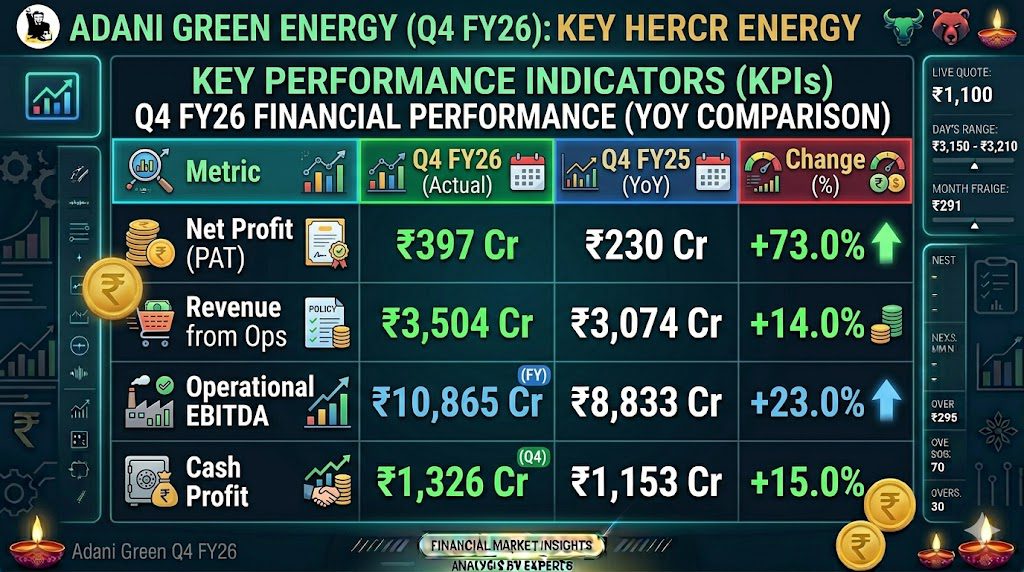
The company reported a net profit of ₹397 crore in Q4 FY26, compared to ₹230 crore in the same quarter last year. That’s a massive 73% increase, driven by higher operational capacity and improved efficiency.
Revenue from operations also grew steadily, reaching ₹3,504 crore, up 14% year-on-year. While this may seem modest compared to profit growth, it reflects the long-term nature of renewable energy contracts, where revenues scale gradually as projects stabilize.
The real highlight comes from operational EBITDA, which stood at ₹10,865 crore for the full year—up 23% from ₹8,833 crore. This shows strong operating leverage, meaning the company is generating more earnings from each unit of capacity.
Cash profit for the quarter came in at ₹1,326 crore, rising 15% year-on-year. This is a critical metric for investors because it reflects actual cash generation, not just accounting profits.
Overall, the financial scorecard clearly indicates that Adani Green is entering a phase of high-growth profitability, backed by strong execution.
Fundamental Analysis: Execution at Scale
The 19.3 GW Milestone
One of the biggest achievements for Adani Green this year is reaching an operational capacity of 19.3 GW. This represents a 35% year-on-year increase—a remarkable feat in an industry that typically faces long project timelines and regulatory hurdles.
This expansion puts the company firmly on track to achieve its ambitious target of 50 GW renewable capacity by 2030. If executed successfully, this would make Adani Green one of the largest renewable energy players in the world.
More importantly, this scale provides a competitive advantage. Larger capacity means better bargaining power, lower costs, and higher efficiency.
The Khavda Catalyst: Beyond Power Generation
The Khavda Solar Park in Gujarat is not just another project—it is a game changer.
Adani Green is now integrating Battery Energy Storage Systems (BESS) into its operations, with a deployment of 1,376 MWh already underway. This is a crucial step forward.
Why? Because renewable energy is not just about generating electricity—it’s about storing it.
Solar and wind power are intermittent by nature. The sun doesn’t shine at night, and the wind doesn’t blow all the time. Storage solutions like BESS allow companies to store excess energy and supply it when needed, ensuring stability.
This transforms Adani Green from a power producer into a complete energy solutions provider.
Finance Costs: Understanding “Good Debt”
One area that investors often worry about is rising finance costs. In FY26, Adani Green reported finance costs of ₹1,626 crore, up around 19%.
At first glance, this may seem like a negative. But in the renewable energy sector, this is actually a sign of growth.
Renewable projects require heavy upfront investment. Debt is used to build these assets, which then generate stable, long-term cash flows. This is often referred to as “good debt.”
In simple terms, the company is borrowing money to build assets that will earn money for decades. As long as returns exceed borrowing costs, this strategy creates value.
Technical Analysis: Breaking the 52-Week Ceiling
From a technical perspective, Adani Green’s stock is showing strong bullish momentum.
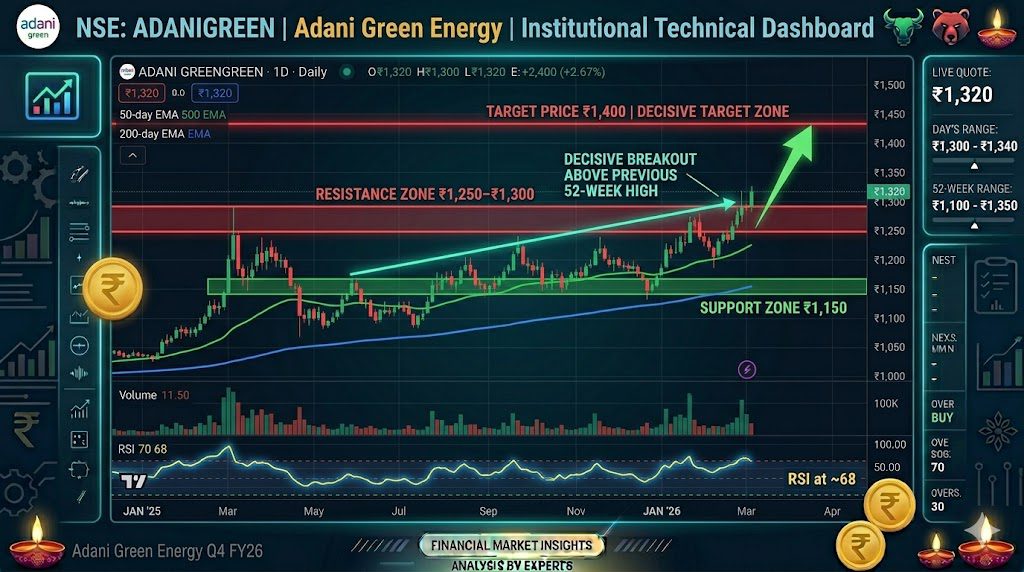
The stock is currently trading above all its key moving averages—the 50-day, 100-day, and 200-day EMAs. This is a classic sign of an uptrend.
The immediate support level lies around ₹1,150, which also acted as the intraday low. This level is important because it represents a psychological floor where buyers are likely to step in.
On the upside, resistance is seen in the ₹1,250–₹1,300 range. A breakout above this zone could open what traders call a “blue sky zone”—a phase where the stock moves freely toward higher levels due to lack of historical resistance.
The Relative Strength Index (RSI) is currently around 62. This indicates strong momentum, but the stock is not yet overbought (which typically happens above 70). In other words, there is still room for further upside.
For traders, this setup offers a combination of momentum and opportunity.
Management Guidance: 10,000 MWh and Beyond
The management’s vision for the future is both ambitious and clear.
Under the leadership of Sagar Adani, the company has set a target of achieving 10,000 MWh of battery storage capacity by FY27. This is a bold move that aligns perfectly with global energy trends.
Storage is expected to play a critical role in the renewable energy ecosystem, and early movers in this space will have a significant advantage.
Beyond numbers, the company is also making a strong environmental impact. Today, Adani Green powers around 8.7 million homes and helps avoid approximately 36 million tonnes of CO2 emissions annually.
These metrics are increasingly important for ESG (Environmental, Social, Governance) investors, who are allocating billions of dollars into sustainable businesses.
Brokerage Sentiment & Price Targets
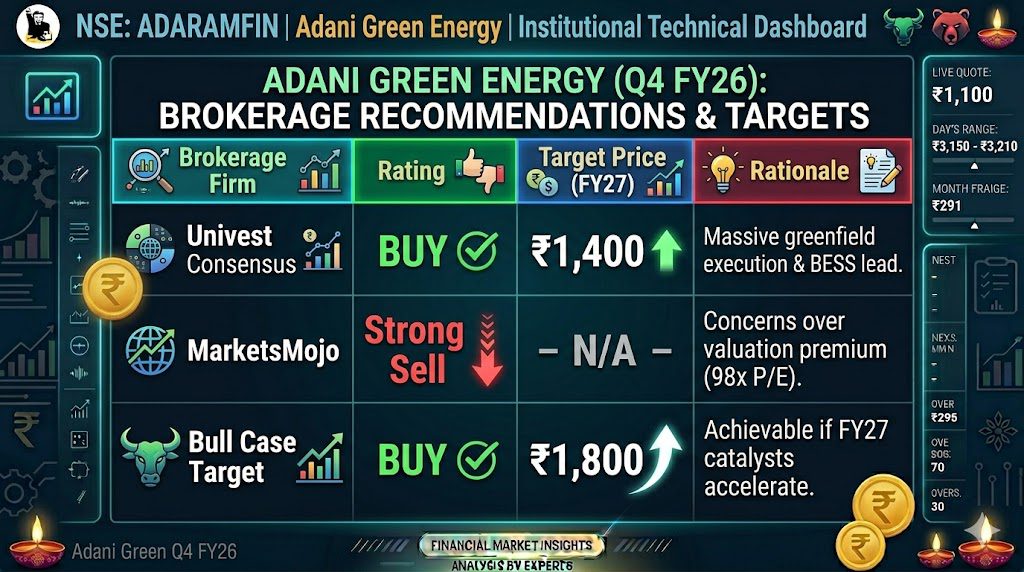
Market sentiment around Adani Green remains mixed—but largely positive.
According to consensus estimates, many brokerages maintain a “BUY” rating, with target prices around ₹1,400. The optimism is driven by the company’s unmatched execution speed and leadership in greenfield projects.
However, not all analysts are bullish. Some, like MarketsMojo, have raised concerns about high valuations, noting that the stock trades at around 98x P/E.
This brings us to the classic debate: growth vs valuation.
For bullish investors, the argument is simple—if execution continues at this pace, even high valuations can be justified. In fact, in a strong bull case scenario, the stock could potentially reach ₹1,800 if FY27 catalysts play out as expected.
The “30-Year” Analyst Verdict
For Long-Term Investors
Adani Green Energy can be compared to what Reliance Industries was during its early expansion phase—ambitious, aggressive, and transformational.
Yes, the stock is expensive by traditional metrics. But it is also operating in one of the fastest-growing sectors globally.
For investors who believe in India’s Net Zero journey and long-term renewable energy demand, this stock can be a core portfolio holding.
For Traders
For short-term traders, Adani Green offers volatility—and opportunity.
The best strategy here is to buy on dips, especially near strong support levels like ₹1,150. If momentum continues, the stock could move toward ₹1,400 in the near term.
However, traders should remain cautious of sharp corrections, as high-growth stocks often experience sudden pullbacks.
Conclusion: Execution is the New Narrative
Adani Green Energy’s Q4 FY26 results mark a turning point—not just for the company, but for the entire renewable energy sector in India.
A 73% jump in profit, record-breaking capacity addition, and a clear roadmap for future growth—these are not signs of a company struggling with challenges. These are signs of a company that is executing at scale.
The skeptics may still point to valuations, but the company has responded with performance.
And in the long run, performance is what drives value.
What’s Your View? (CTA)
Are you staying invested in Adani Green for its ambitious 50 GW target?
Or do you think the current valuation is too expensive?
Drop your thoughts in the comments and share your top renewable energy stock picks for 2026.