1. Powerful Introduction
In the global manufacturing and export sector, macroeconomic crosswinds can quickly turn a steady voyage into a turbulent storm. Jindal Saw Ltd.’s Q1 FY27 earnings report is a textbook example of this phenomenon. While the company demonstrated resilience by posting a consolidated total income of ₹44,760 million for the quarter ended June 30, 2026 (a YoY increase from ₹41,030 million in Q1 FY26), the real story lies further down the income statement.
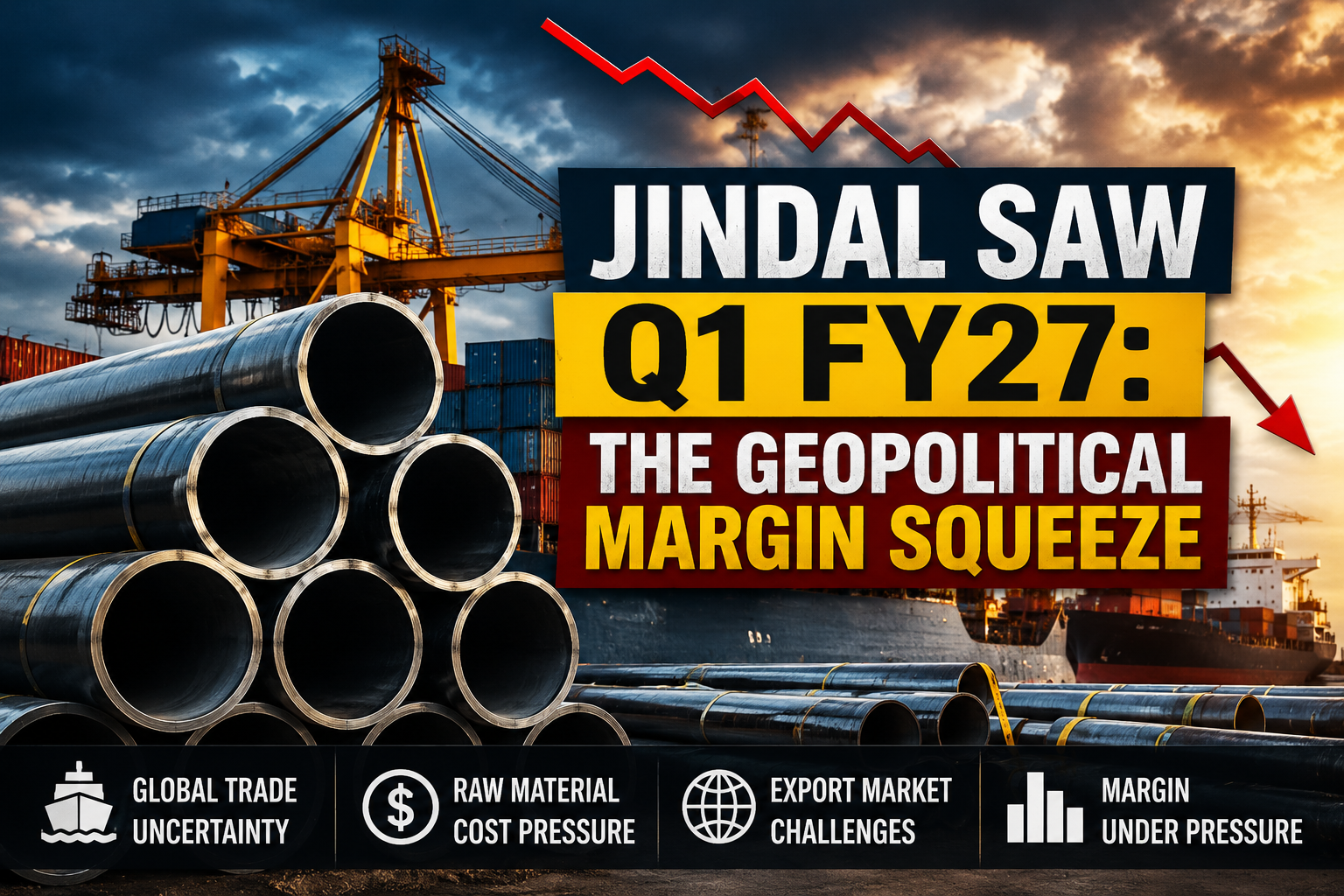
Investors opening the quarterly filing were met with a severe margin contraction, with consolidated Profit After Tax (PAT) plummeting from ₹4,155 million in Q1 FY26 to just ₹908 million in Q1 FY27.
Why did profitability collapse while the top line grew? The answers lie in a “perfect storm” of external headwinds: geopolitical instability in the Middle East and North Africa (MENA) region severely crippling high-margin export logistics, combined with the temporary suspension of a critical American Petroleum Institute (API) license. This comprehensive analysis breaks down Jindal Saw’s Q1 FY27 performance, examining the core financial data, the management’s strategic response to these crises, and what this transitional quarter means for long-term investors.
2. Executive Summary
For institutional and retail investors seeking immediate clarity, here are the key takeaways from Jindal Saw’s Q1 FY27 results:
Revenue Growth: Consolidated total income stood at ₹44,760 million, up from ₹41,030 million in Q1 FY26.
Severe Margin Compression: Consolidated EBITDA margin plummeted to 9.4%, down from a robust 16.8% in Q1 FY26.
Profitability Hit: Consolidated PAT fell drastically to ₹908 million, compared to ₹4,155 million a year ago.
Geopolitical Disruption: The ongoing Middle East conflict forced the company to invoke a Force Majeure clause, significantly impacting Q1 FY27 export operations and supply chains.
API License Reinstated: A temporary restriction on using the API monogram for seamless pipes (instated in January 2026) was successfully resolved and reinstated in June 2026.
Robust Order Book: The current order book for Iron & Steel Pipes and Pellets stands at a healthy ~$1,171 million.
De-leveraging: Consolidated institutional term debt decreased significantly to ₹19,365 million in June 2026 from ₹27,112 million in June 2025.
Future Capacity: Long-term international expansion remains on track, with new facilities in the UAE and KSA scheduled for commercial production in FY 2028-29.
What This Means for Investors: Q1 FY27 represents a quarter of external, anomalous shocks rather than a fundamental breakdown in product demand. The key monitorable metric going forward is the normalization of export logistics.
3. Company Snapshot
Business Model & Product Portfolio Jindal Saw Ltd. is a leading global manufacturer and total pipe solutions provider. Its core offerings include Iron & Steel Pipes (such as Submerged Arc Welded pipes, Ductile Iron pipes, and Seamless pipes) and Iron Ore Pellets.
Geographic Presence & Market Position The company maintains a highly diversified business model designed to hedge against localized economic downturns. It operates manufacturing facilities across India (Uttar Pradesh, Gujarat, Maharashtra, Madhya Pradesh, Andhra Pradesh, Karnataka, and Rajasthan) and has a significant footprint in overseas markets, particularly the MENA region and Latin America.
Industry Overview Jindal Saw supplies vital infrastructure components. A substantial portion of its revenue is derived from drinking water supply and sanitation (WSS) projects globally, while the Oil & Gas sector accounts for approximately one-fourth of its total revenue.
4. Q1 FY27 Earnings Snapshot
The following tables break down the unaudited financial performance for the quarter ended June 30, 2026, against previous quarters.
Note: All figures are in ₹ Millions (Rs in Million) unless stated otherwise. EBITDA stands for Earnings Before Interest, Tax, Depreciation, and Amortization.
Consolidated Financial Highlights
| Metric | Q1 FY27 (Unaudited) | Q4 FY26 (Unaudited) | Q1 FY26 (Unaudited) | YoY Trend |
| Total Income | 44,760 | 46,569 | 41,030 | Up |
| EBITDA | 4,204 | 5,042 | 6,883 | Down |
| EBITDA Margin | 9.4% | 10.8% | 16.8% | Down |
| Financial Costs | 1,084 | 1,627 | 1,711 | Down (Improved) |
| Depreciation | 1,637 | 1,667 | 1,533 | Up |
| PBT | 1,483 | 1,748 | 3,639 | Down |
| PAT | 908 | 1,236 | 4,155 | Down |
Standalone Financial Highlights
| Metric | Q1 FY27 (Unaudited) | Q4 FY26 (Unaudited) | Q1 FY26 (Unaudited) | YoY Trend |
| Total Income | 37,557 | 38,517 | 33,268 | Up |
| EBITDA | 3,410 | 4,131 | 5,596 | Down |
| EBITDA Margin | 9.1% | 10.7% | 16.8% | Down |
| PAT | 1,098 | 1,140 | 3,640 | Down |
Beat/Miss Expectations While exact street consensus is not provided in the source filing, the 16.8% to 9.4% YoY EBITDA margin drop likely represents a miss against optimistic market expectations that anticipated stable export flows. The revenue growth, however, demonstrates robust underlying demand.
5. Segment-wise Performance
Jindal Saw operates primarily across two volume-driven segments: Iron & Steel Pipes and Pellets.
Iron & Steel Pipes
Production: 3,71,000 MT in Q1 FY27, down from 3,89,000 MT in Q1 FY26.
Sales: 3,62,000 MT in Q1 FY27, an improvement from 3,26,000 MT in Q1 FY26.
Order Book: ~$1,164 million, representing ~1.8 million MT.
Demand Trends: The domestic water pipe business (primarily Ductile Iron) continued to face execution challenges despite possessing a backlog of orders extending over a year. Export order execution to the Middle East was officially put on hold due to regional conflicts.
Pellets
Production: 2,90,000 MT in Q1 FY27, down from 3,21,000 MT in Q1 FY26.
Sales: 2,82,000 MT in Q1 FY27, up from 2,22,000 MT in Q1 FY26.
Order Book: ~$7 million.
Did You Know? Export orders account for ~41% of Jindal Saw’s total pipe order book by volume, but they constitute ~30% of the total order book by value.
6. Margin Analysis
The most critical aspect of the Q1 FY27 results is understanding the collapse of the consolidated EBITDA margin from 16.8% in Q1 FY26 down to 9.4% in Q1 FY27.
What drove this margin compression?
Logistics and Freight Disruption: The MENA region is a massive market for Jindal Saw (constituting a majority of their ~30% export order book). The geopolitical conflict in the Middle East closed key maritime routes, leading to severe supply chain disruptions. When finished goods cannot be shipped efficiently, inventory costs rise, and high-margin export revenue cannot be realized. The company formally invoked a Force Majeure clause due to this.
Product Mix (The API Issue): In January 2026, the American Petroleum Institute (API) temporarily restricted Jindal Saw from using the API monogram on its seamless pipes following an audit. Seamless pipes for the Oil & Gas sector are typically higher-margin products. During this suspension (which lasted until June 2026), the company had to allocate its premium API manufacturing facilities to produce Non-API products, which inherently command lower margins.
Operating Leverage: The Abu Dhabi operations (Jindal Saw Gulf LLC) delivered only ~34,000 MT of Ductile Iron pipes in Q1 FY27, compared to ~48,000 MT in the previous quarter, directly impacting fixed cost absorption.
7. Balance Sheet Analysis
Amidst the margin pressures, Jindal Saw’s balance sheet management remains a significant bright spot for investors.
Debt Reduction: The company has aggressively deleveraged over the past year.
Consolidated Institutional Term Debt fell from ₹27,112 million in June 2025 down to ₹19,365 million in June 2026.
Consolidated Institutional Working Capital Debt (net of cash/cash equivalents) dropped from ₹7,724 million in June 2025 to ₹5,361 million in June 2026.
Capital Expenditure: The company continues to incur capex directed at debottlenecking operations to enhance productivity and efficiency.
Credit Rating: Reaffirming balance sheet strength, CARE Ratings maintained a “CARE AA (Outlook Stable)” rating for long-term debt facilities in June 2026.
8. Cash Flow Analysis
While a full cash flow statement is typically reserved for annual reports, the significant reduction in both Term Debt and Working Capital Debt over the trailing twelve months (TTM) indicates strong internal Free Cash Flow (FCF) generation. The ability to pay down approximately ₹7,700 million in term debt and over ₹2,300 million in working capital debt—even during a period of disrupted exports—highlights a resilient cash collection cycle and prudent capital allocation.
9. Management Commentary
Management provided transparent commentary regarding the external challenges and future strategic steps:
On the Middle East Conflict: Management noted that the conflict, which began in February 2026, created “serious logistical constraints” resulting in a notable decline in Q1 FY27 export sales, prompting the invocation of the Force Majeure clause.
On API Licensing: Management confirmed that the API restriction was a temporary compliance issue identified during a routine audit and has been fully reinstated as of June 2026 for all API licenses.
On Capacity Expansion (Middle East): The management confirmed that their greenfield projects in the UAE (a 300,000 TPA seamless pipe facility) and KSA (a 300,000 TPA Saw Pipe facility) are in advanced stages of securing long-lead items and financial closure, with commercial production slated for FY 2028-29. Importantly, they noted these development-stage projects are not currently affected by the ongoing Middle East conflict.
On Domestic Challenges: Management acknowledged that the domestic water pipe business is facing execution challenges, despite a massive order backlog.
10. Industry Analysis
The global pipeline infrastructure industry is heavily dependent on cross-border logistics.
Global Factors: The closure of key maritime routes across the MENA region represents a systemic risk for all heavy exporters, not just Jindal Saw. Freight rates naturally spike, and vessel availability plummets during such crises.
Demand Outlook: Despite logistical hurdles, underlying demand appears intact. Jindal Saw’s massive ~$1,171 million standalone order book (projected to take 9-12 months to execute) proves that end-users (municipalities, Oil & Gas players) are still ordering. Furthermore, the UAE subsidiary holds a separate order book of ~$188 million.
11. Valuation Analysis
Educational Note: Valuation metrics require real-time stock price data to be precise. The following is a theoretical framework based on the Q1 FY27 earnings data.
P/E (Price-to-Earnings): The drop in Q1 PAT will automatically increase the trailing P/E multiple, making the stock look mathematically more expensive in the short term. Investors must decide if they are valuing the stock on disrupted TTM earnings or forward normalized earnings.
EV/EBITDA (Enterprise Value to EBITDA): Because Jindal Saw is actively paying down debt, the Enterprise Value (Market Cap + Debt – Cash) is naturally compressing. However, the drop in EBITDA from ₹6,883 million to ₹4,204 million will push the multiple higher this quarter.
Debt/Equity: The aggressive reduction in institutional term debt dramatically improves the leverage ratios, making the company structurally safer for long-term equity holders.
12. Key Risks
Company-Specific Risks:
Execution Delays: The domestic water pipe business is struggling with execution despite a strong order book. Continual delays can lead to cost overruns.
Legal Disputes: The ongoing arbitration with NTPC (involving a massive ₹1,891 crore award initially won by Jindal ITF but later set aside and now under appeal) remains a significant contingent factor.
Macro & Industry Risks:
Geopolitical Escalation: If the MENA conflict intensifies or maritime routes remain closed indefinitely, the ~30% of Jindal Saw’s order book tied up in exports will continue to suffer.
Scenario Analysis:
Bull Case: The MENA conflict resolves quickly, unblocking maritime routes. The reinstated API license allows immediate resumption of high-margin seamless pipe sales. Earnings rebound sharply in Q2/Q3 FY27.
Bear Case: Red Sea/MENA logistics remain permanently altered, forcing structurally higher freight costs. The domestic water sector continues to face execution delays. EBITDA margins permanently rebase to the 9-10% range.
Base Case: Export logistics slowly normalize over the next 6-9 months. The API reinstatement provides a moderate margin boost in Q2. Debt reduction continues to fortify the balance sheet.
13. Future Outlook
Looking past the immediate quarterly turbulence, Jindal Saw’s management is laying the groundwork for a broader international footprint:
Growth Drivers: The reinstatement of the API license in June 2026 removes a major internal bottleneck, allowing the company to immediately re-enter the lucrative Oil & Gas seamless pipe market.
Capacity Expansion (Capex): The company is not retreating from the Middle East. It is establishing a 300,000 TPA seamless pipe facility in Abu Dhabi’s KEZAD Economic Zone and a 300,000 TPA Saw Pipe facility in Saudi Arabia through a joint venture.
Editorial Opinion: By localizing production in the UAE and KSA by FY 2028-29, Jindal Saw is structurally mitigating future shipping risks. If they manufacture in the Middle East for Middle Eastern clients, they bypass global maritime chokepoints entirely.
14. Investor Takeaways
For Long-term Investors: The fundamental investment thesis remains solid. The order book is massive (~$1.17 billion), and debt is falling rapidly. The international expansion plans into the UAE and KSA show long-term strategic vision.
For Value Investors: The headline drop in PAT (from ₹4,155 mn to ₹908 mn) might trigger a knee-jerk reaction in the market. Value investors should analyze whether this temporary geopolitical disruption has created an attractive entry point into a de-leveraging manufacturing asset.
For Swing Traders: Expect volatility. Headline risk regarding the Middle East conflict will directly drive the short-term price action of the stock, given the company’s explicit invocation of Force Majeure on exports.
15. Conclusion
Jindal Saw’s Q1 FY27 results are a stark reminder of the interconnected nature of global manufacturing. On paper, a drop in EBITDA margins from 16.8% to 9.4% is alarming. However, forensic analysis reveals that this is not a demand-side failure. The clients still want the pipes—evidenced by the ~$1.17 billion order book—but global logistics and a temporary API compliance hurdle prevented efficient delivery. With the API license reinstated in June and debt levels significantly reduced, the company is structurally sound, waiting for geopolitical storm clouds to clear.