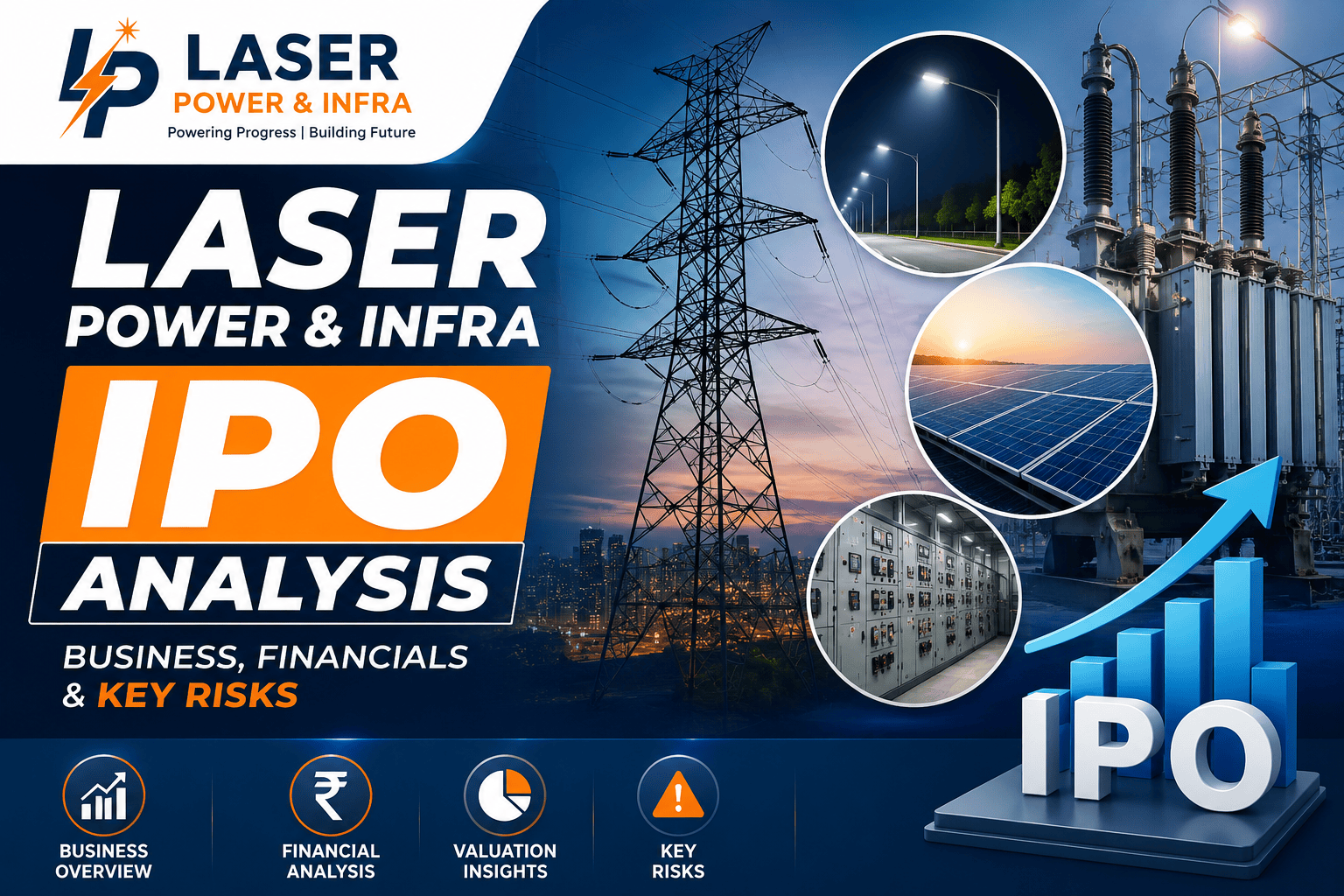
When you flip a switch in your home, you rarely think about the thousands of kilometers of complex cables, conductors, and substations that make that simple action possible. The backbone of India’s rapid infrastructure growth is the Power Transmission and Distribution (T&D) sector—an industry that is currently seeing billions of dollars in capital expenditure (capex).
Riding this massive macro tailwind is Kolkata-based Laser Power & Infra Limited, which is hitting Dalal Street with its ₹742 crore Initial Public Offering (IPO).
At first glance, the company boasts an impressive 42% Year-on-Year (YoY) jump in net profit and a robust order book of ₹3,243 crore. However, a deeper dive into the Red Herring Prospectus (RHP) reveals declining top-line revenue in FY26 and a significant debt burden.
So, does Laser Power & Infra offer the spark your portfolio needs, or is the valuation fully priced in? In this comprehensive, institutional-style analysis, we will strip away the hype, decode the financial metrics, and examine the hard facts so you can make an informed investment decision.
💡 Market Trivia: Did You Know? The Indian government has set an ambitious target of achieving 500 GW of renewable energy capacity by 2030. To integrate this, massive upgrades to the existing power transmission infrastructure are required, creating a structural multi-year bull run for cable and conductor manufacturers.
1. Executive Summary (Key Takeaways in 30 Seconds)
- The Issue: Laser Power & Infra is raising ₹742 crore through a mix of a Fresh Issue (₹542 crore) and an Offer for Sale (₹200 crore).
- Dual Business Model: The company is an integrated player, generating 73% of its revenue from manufacturing cables/conductors and 27% from EPC (Engineering, Procurement, and Construction) contracts.
- Margin Expansion: Despite a 9.5% drop in FY26 revenue (₹2,326.1 crore), the company achieved a stellar 42% growth in Profit After Tax (₹151.6 crore) due to expanding EBITDA margins (12.96%).
- Debt Reduction: The primary objective of the fresh issue is to retire ₹490 crore of its outstanding borrowings, which will significantly improve its balance sheet and lower interest costs post-listing.
- Order Book Visibility: As of March 2026, the company sits on a healthy order book of ₹3,243 crore.
- Key Risk: High dependency on government departments and state electricity boards, making it vulnerable to delays in project awards and elongated working capital cycles.
2. Laser Power IPO Snapshot
(Note: Data is based on the official RHP filings).
| Parameter | Details |
|---|---|
| IPO Type | Book Built Issue (Fresh Issue + Offer for Sale) |
| Total Issue Size | ₹742.00 Crore |
| Fresh Issue | ₹542.00 Crore (2.53 crore shares) |
| Offer for Sale (OFS) | ₹200.00 Crore (0.93 crore shares by promoters) |
| Face Value | ₹5 per equity share |
| Price Band | ₹203 to ₹214 per share |
| Lot Size | 70 shares |
| Retail Minimum Investment | ₹14,980 (at the upper price band) |
| Opening Date | July 9, 2026 |
| Closing Date | July 13, 2026 |
| Allotment Date | July 14, 2026 |
| Tentative Listing Date | July 16, 2026 |
| Listing Exchange | BSE & NSE |
| Book Running Lead Managers | IIFL Capital Services Ltd, ICICI Securities Ltd |
| Registrar | MUFG Intime India Pvt. Ltd. |
3. Company Profile: Who is Laser Power & Infra?
Incorporated in 1988, Laser Power & Infra Limited has over three decades of operating history. Based in Kolkata, it has evolved into one of the leading manufacturers of power cables and conductors in East India by installed capacity (according to CRISIL).
Manufacturing Footprint: The company operates three manufacturing facilities in West Bengal (two in Dhulagarh and one in Kharagpur). As of March 31, 2026, these facilities boast a combined installed capacity of 85,448 Metric Tonnes (MT).
Accreditations: In the highly regulated T&D space, approvals act as a massive entry barrier. Laser Power is an approved supplier to the Indian Railways and holds crucial RDSO (Research Designs and Standards Organisation) accreditation for various signaling and power cable products. Furthermore, their manufacturing units are ISO 9001, ISO 14001, and ISO 45001 certified.
4. Business Model Explained
Laser Power & Infra operates a bifurcated yet synergistic business model, bridging product manufacturing with project execution.
Segment 1: Manufacturing (73% of FY26 Revenue) The company produces a wide array of electrical products:
- Low and medium-voltage power cables.
- Aerial bunched cables.
- Control, quad, and specialty cables.
- A diverse range of conductors (ACSR, AAC, AAAC, AL-59).
- Backward Integration: They manufacture key inputs in-house, such as aluminum wire rods, PVC compounds, and even the wooden drums for packaging. This backward integration protects margins from third-party supplier shocks.
Segment 2: EPC Business (27% of FY26 Revenue) In 2015, the company forward-integrated into the Engineering, Procurement, and Construction (EPC) segment. They execute turnkey projects, including:
- Rural and urban electrification.
- Substation installations.
- Development of power distribution infrastructure across challenging terrains (flood-prone and hilly regions of Bihar, Odisha, Assam, and UP).
Strategic Edge: The EPC division acts as a captive consumer for the manufacturing division, creating a closed-loop revenue stream. Additionally, the company has a strategic manufacturing partnership with TS Conductor Corp (USA) to produce advanced conductor products, opening doors for technological upgrades.
5. Industry Analysis: The Macro Tailwinds
To evaluate an infrastructure company, you must evaluate government spending.
- The Capex Cycle: India is in the midst of a historic infrastructure upgrade. The Revamped Distribution Sector Scheme (RDSS) and the push for “24×7 Power for All” require thousands of kilometers of new, efficient cabling.
- Renewable Integration: Solar and wind farms are rarely located near urban consumption centers. Connecting renewable energy zones to the national grid requires specialized, high-capacity conductors—a space where Laser Power operates.
- Railway Electrification: With the Indian Railways aggressively pursuing 100% electrification and upgrading signaling systems (Kavach), RDSO-approved vendors like Laser Power have significant revenue visibility.
6. Promoter & Management Analysis
- The Promoters: The company is promoted by the Goel family—Deepak Goel, Devesh Goel, Akshat Goel, and Rakhi Goel.
- Offer For Sale (OFS): The ₹200 crore OFS involves promoters diluting a portion of their holding (Deepak Goel: ₹225 Cr [adjusted in RHP sizing], Devesh Goel: ₹125 Cr, Rakhi Goel: ₹50 Cr). While promoter selling is often viewed with caution, it is a standard practice to provide liquidity and meet SEBI’s minimum public shareholding norms. The promoters will still retain a significant majority post-listing, ensuring “skin in the game.”
7. Financial Analysis: Decoding the Numbers
Let us look at the hard facts from the RHP for the fiscal years ending March 31. (Note: Financial metrics are rounded for clarity).
| Particulars (in ₹ Crore) | FY26 | FY25 | FY24 | YoY Growth (FY25 to FY26) |
|---|---|---|---|---|
| Revenue from Operations | 2,326.10 | 2,570.39 | 1,747.57 | (-9.5%) 🔴 |
| EBITDA | 301.44 | 250.38 | 156.10 | +20.4% 🟢 |
| EBITDA Margin (%) | 12.96% | 9.74% | 8.50% | +322 bps 🟢 |
| Profit After Tax (PAT) | 151.59 | 106.75 | 40.40 | +42.0% 🟢 |
| PAT Margin (%) | 6.46% | 4.12% | 1.75% | +234 bps 🟢 |
The Analytical Takeaway: Why did revenue drop by 9.5% in FY26 while profits surged by 42%? This is a classic indicator of a company shifting its focus from volume to value. Instead of chasing low-margin, high-revenue contracts, the management appears to be executing higher-margin specialty cable orders and better-priced EPC contracts. Furthermore, internal backward integration (producing their own aluminum rods and PVC compounds) has drastically improved their operational efficiency, evident in the EBITDA margin jumping from 9.74% to 12.96%.
Key Ratios (FY26):
- Return on Equity (ROE): 23.32% (Excellent; indicates efficient use of shareholders’ capital).
- Return on Capital Employed (ROCE): 17.83% (Healthy for a capital-intensive manufacturing/EPC business).
- Debt-to-Equity Ratio: 1.10x.
- Insight: As of June 2026, total outstanding debt stood at ₹935.7 crore. The IPO fresh issue aims to repay ₹490 crore. Post-listing, the Debt-to-Equity ratio will drop significantly, immediately boosting future net profit margins due to reduced interest expenses.
8. Peer Comparison: Where Does Laser Power Stand?
The wire and cable industry in India is dominated by massive players. How does Laser Power stack up against listed peers? (Based on FY26 annualized EPS and RHP data).
| Company | EPS (₹) | P/E Ratio (x) | RoNW / ROE (%) | Market Focus |
|---|---|---|---|---|
| Polycab India | 177.53 | ~56.98x | 22.25% | B2C/B2B Giant, FMEG |
| KEI Industries | 96.09 | ~58.64x | 13.78% | Heavy B2B & Retail |
| Apar Industries | 243.21 | ~67.05x | 18.11% | Specialty Conductors |
| Dynamic Cables | 17.42 | ~21.05x | 18.47% | Cables/Conductors |
| Laser Power & Infra | 13.18 | ~16.2x (At upper band) | 20.90% | Cables + EPC |
Analysis: At the upper price band of ₹214, Laser Power is demanding a P/E multiple of roughly 16x on its FY26 EPS. Compared to industry titans like Polycab or KEI (trading at 50x+), Laser Power is priced much more conservatively. It aligns closer to smaller players like Dynamic Cables. This indicates that the promoters are leaving some money on the table for investors rather than pricing the IPO to perfection.
9. Realistic Case Study: The Working Capital Cycle
Imagine an investor named Rohit looking at EPC stocks. Rohit notices that EPC companies often show massive profits on paper, but struggle with cash flow. Why? Because they build substations for the government, and the government often pays late.
The Laser Power Reality: In FY23, Laser Power had net working capital days of 142 days. By FY25, they slashed this to 88 days. This is a crucial metric. It means the company is collecting cash from its debtors much faster. A tighter working capital cycle reduces the need for expensive short-term loans, directly boosting the bottom line.
10. SWOT Analysis
- Strengths: High level of backward integration protecting margins; strong ROE of 23%; formidable order book of ₹3,243 crore providing 1.5 years of revenue visibility; RDSO accreditations.
- Weaknesses: High reliance on raw materials (Aluminum, Copper, PVC) whose prices are highly volatile; current debt levels are relatively high prior to IPO repayment.
- Opportunities: The massive government capex in power transmission, railways, and renewable energy grids; leveraging the TS Conductor Corp USA partnership for advanced tech exports.
- Threats: Intense competition from deep-pocketed giants like Polycab, KEI, and Sterlite Power; delays in government project clearances impacting the EPC segment.
11. Risk Factors (Disclosed & Analyzed)
Before applying, investors must weigh these risks carefully:
- Client Concentration & Government Dependency: A significant portion of revenue is generated through competitive, tender-based contracts with government departments, PSUs, and state electricity boards. A slowdown in state infrastructure spending or delayed payments could squeeze cash flows.
- Raw Material Volatility: Cables require massive amounts of aluminum and copper. Since these are globally traded commodities, a sudden spike in prices can compress margins if the company cannot pass the costs onto clients due to fixed-price EPC contracts.
- Revenue De-growth: While profits are up, the 9.5% top-line de-growth in FY26 is a metric that institutional investors will watch closely in the upcoming quarters.
12. Bull Case vs. Bear Case
🟢 The Bull Case: The company uses the IPO proceeds to wipe out over half its debt, resulting in massive interest savings that flow straight to PAT in FY27. They execute their ₹3,243 Cr order book efficiently, maintaining their ~13% EBITDA margins. The stock experiences a “valuation re-rating” to catch up with peers trading at 25x-30x P/E multiples.
🔴 The Bear Case: Global copper and aluminum prices surge due to supply chain shocks. Government agencies delay project approvals for the EPC division, causing working capital days to stretch back above 120 days. The market treats it as a low-margin B2B contractor rather than a premium cable manufacturer, capping the stock’s upside.
13. Investor Suitability: Who Should Apply?
- Long-Term Investors (3-5 Years): SUITABLE. The macro story of India’s power transition is undeniable. If management continues to improve margins and reduce debt, this stock could be a solid compounder.
- Short-Term / Listing Gain Seekers: MODERATE TO HIGH. The grey market premium (GMP) indicates positive, albeit cautious, sentiment. Given the reasonable P/E valuation (~16x), there is a margin of safety for listing gains, provided broader market sentiment (Nifty/Sensex) remains stable on listing day.
- Risk-Averse / Conservative Investors: Wait and watch. Track the company’s first two quarterly results post-listing to ensure the FY26 margin expansion was structural and not a one-off anomaly.
14. Conclusion & What to Watch Next
The Laser Power & Infra IPO brings a fundamentally sound, integrated T&D player to the public markets at a seemingly reasonable valuation compared to its larger peers. The decision to prioritize debt reduction with the IPO proceeds is a strong positive signal.
What to watch post-listing: Investors should keep a close eye on the company’s subsequent quarterly results for two metrics:
- Top-line revenue growth (to ensure the FY26 dip was temporary).
- The working capital cycle (to ensure government receivables aren’t piling up).
🗣️ Question for our Readers: With heavyweights like Polycab and KEI Industries commanding premium valuations, do you think mid-sized, integrated players like Laser Power & Infra are the better value-buys in the current market? Drop your strategy in the comments below!
Educational Disclaimer: The information provided in this article is for educational and informational purposes only. It does not constitute personalized financial, investment, trading, or legal advice. The analysis is based on Draft Red Herring Prospectus (DRHP) and Red Herring Prospectus (RHP) filings, which are subject to market risks. Past performance is not indicative of future results. Please consult a SEBI-registered investment advisor and review all official scheme-related documents before making any investment decisions.
Sources & Further Reading:
- Red Herring Prospectus (RHP) of Laser Power & Infra Limited (SEBI / BSE / NSE filings).
- CRISIL Research reports on the Indian Power Transmission and Distribution sector.