1. Introduction
On July 2026, India’s maritime ambitions collided with regulatory and federal governance realities. Adani Ports and Special Economic Zone (APSEZ) announced what it hailed as a historic milestone: the sale of a 49% equity stake in the Vizhinjam International Seaport container terminal to Terminal Investment Limited (TiL), the terminal operating arm of the Switzerland-based Mediterranean Shipping Company (MSC), for a staggering $1.4 billion (approx. ₹13,000–₹13,220 crore).
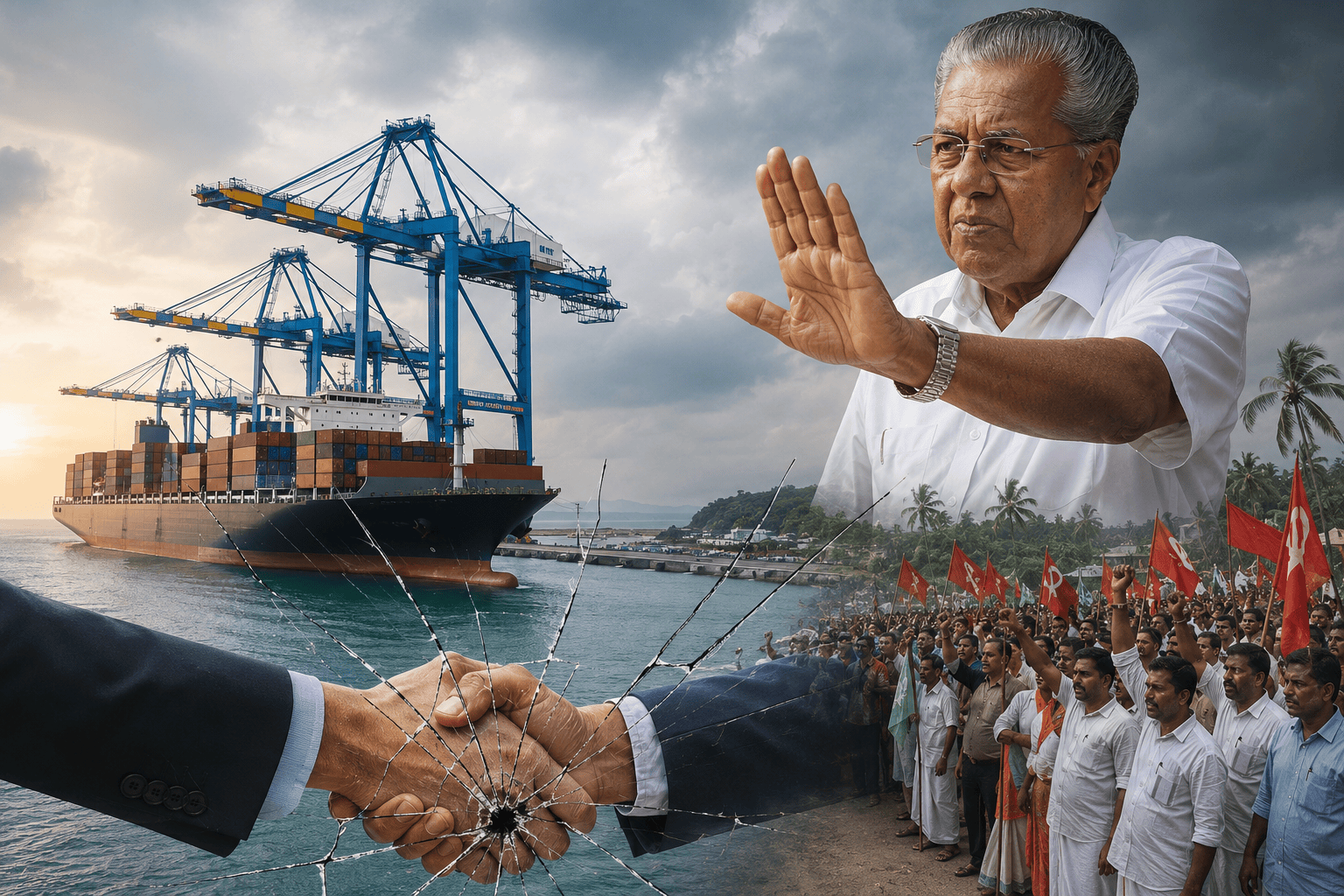
On paper, the transaction represents one of the largest single foreign direct investments (FDI) in Indian port infrastructure. It hitches India’s first deep-water automated transshipment hub directly to the world’s largest container shipping line. Yet, rather than a celebration, the announcement triggered immediate political and administrative pushback.
On the floor of the Kerala Legislative Assembly, the state government declared it had been kept entirely in the dark. Citing foundational clauses in the Public-Private Partnership (PPP) Concession Agreement, Kerala Chief Minister V.D. Satheesan asserted that no stake transfer exceeding 25% could occur without explicit state approval. Meanwhile, the political Opposition launched scathing attacks, alleging breaches of sovereignty, national security risks, and the threat of a private shipping monopoly controlling state-subsidized infrastructure.
Why would a state actively resist an injection of global capital into its flagship maritime project? At its core, the Vizhinjam controversy is a high-stakes stress test of Indian infrastructure contracts, balancing contractual enforcement, global supply chain competitiveness, and public accountability.
2. Summary
The Transaction: APSEZ announced a definitive agreement to sell a 49% equity stake in Adani Vizhinjam Ports Private Limited (AVPPL) to MSC’s terminal arm (TiL) for $1.4 billion, valuing the terminal project at roughly $2.85 billion.
The Core Legal Objection: The Kerala government contends the deal violates Clause 5.3 of the 2015 Concession Agreement, which strictly mandates prior written approval from the state (the Conceding Authority) for any equity restructuring or shareholding transfer exceeding 25%.
Monopoly and User Access Concerns: Policymakers fear that transferring nearly half the port’s ownership to MSC—the world’s largest shipping line—could lead to discriminatory access, prioritizing MSC vessels over competing liners (like Maersk or CMA CGM) and destroying the port’s mandate as a multi-user common carrier.
Public Capital vs. Private Value Capture: Because the project was built with substantial public funds—including Viability Gap Funding (VGF) and state-financed breakwater infrastructure—critics argue Adani is monetizing state-backed risk to capture a massive private capital gain without state oversight.
Political Consensus Across Aisles: Uncharacteristically, both the ruling administration (led by Chief Minister V.D. Satheesan) and the Opposition (led by former CM Pinarayi Vijayan) are aligned in opposing the unilateral transfer, with the Opposition approaching SEBI to halt the transaction.
National Security Dimensions: Senior lawmakers, including Tharoor, have highlighted that transshipment ports are critical maritime infrastructure; transferring substantial ownership to foreign entities requires rigorous national security clearance from the Union Ministry of Home Affairs and Ministry of Ports.
3. Timeline of the Vizhinjam Controversy
4. Background: The Strategic & Legal Anatomy of Vizhinjam
The Geoeconomic Imperative
Historically, India lost hundreds of millions of dollars annually in foreign exchange because domestic ports lacked the natural draft required to berth “mother ships”—Ultra Large Container Vessels (ULCVs) carrying over 20,000 TEUs. Over 75% of India’s transshipment cargo had to be routed through foreign hub ports such as Colombo (Sri Lanka), Singapore, or Jebel Ali (UAE).
Located just 10 nautical miles off the major international east-west shipping lane and blessed with a natural depth of 20 meters, Vizhinjam was envisioned as India’s counterweight to foreign transshipment dominance.
The Financial Risk Structure
Vizhinjam is not a purely private venture; it is a Landlord/PPP Hybrid Model. The financial structure agreed upon in 2015 distributed risk heavily toward the public exchequer:
Total Initial Estimated Cost: ~₹7,525 crore.
State & Central Viability Gap Funding (VGF): ₹1,635 crore (the first of its kind for an Indian port project).
State Infrastructure Commitment: The Kerala government assumed the financial burden for land acquisition, rail/road connectivity, and a substantial portion of the massive breakwater construction.
The Legal Guardrails
Because the state committed extensive public funds and sovereign guarantees, the 2015 Concession Agreement incorporated stringent covenants to prevent speculative asset-flipping and ensure operational continuity. Specifically, the agreement mandated that the lead promoter (APSEZ) maintain majority control and ownership lock-ins during the construction and early commercialization phases, requiring explicit state consent before any major restructuring.
5. What Happened? (Facts vs. Claims)
| Category | Verified Facts (Official Records & Statements) | Contested Claims / Ongoing Disputes |
| The Transaction | APSEZ agreed to transfer 49% equity in AVPPL to MSC’s TiL arm for $1.4B. SEBI and stock exchanges were notified via corporate disclosures. | Whether the agreement constitutes a binding “sale” or a non-binding “term sheet/MoU” awaiting regulatory preconditions. |
| State Consultation | Kerala Chief Minister officially stated on the floor of the Assembly that no formal prior application or communication was submitted to the state authority. | Whether informal discussions occurred or if APSEZ planned to seek approval after structuring the term sheet but prior to financial close. |
| Contractual Thresholds | Concession Agreement mandates written approval from the Conceding Authority for shareholding changes exceeding 25%. | Whether holding company restructurings or subsidiary stake infusions bypass the primary concession lock-in clauses. |
| Operational Control | APSEZ retains a 51% majority stake and operational management rights on paper. | Opponents claim MSC’s massive cargo volume will effectively grant it de facto control over terminal operations and pricing. |
6. Investigation: The Contractual Mechanics & Governance Concerns
To understand why the Kerala government intervened, one must examine the specific governance mechanisms embedded in typical Indian public infrastructure concessions, modeled on the Planning Commission/NITI Aayog MCA (Model Concession Agreement).
The 25% Shareholding Threshold
In long-term public infrastructure concessions, the Conceding Authority vets the initial bidder based on technical capacity, financial net worth, and security clearance. To prevent a concessionaire from winning a bid on its own credentials and immediately selling the asset to an unvetted third party, agreements enforce ownership lock-ins.
Clause 5.3 of the Vizhinjam agreement explicitly dictates that any dilution, transfer, or restructuring that results in a third party acquiring more than 25% of the voting rights or equity requires prior written approval from the Government of Kerala. By announcing a 49% divestment to global financial markets without securing prior written state assent, Adani Ports arguably triggered an anticipatory breach of contract.
Valuation and Monetization of Public Subsidy
From a financial investigation standpoint, the deal values the Vizhinjam port unit at $2.85 billion (approx. ₹23,600 crore). Considering the project’s initial capital outlay (~₹7,500 crore, significantly underwritten by state grants, VGF, and public land), APSEZ has generated immense asset valuation appreciation.
While capital appreciation is the standard reward for private sector execution, public policy analysts argue that when an asset achieves a 3x valuation multiple largely due to sovereign location advantages and taxpayer-funded breakwaters, the private concessionaire should not be allowed to unilaterally monetize 49% of that value without state regulatory oversight.
7. Political Analysis
The Vizhinjam controversy has created a unique dynamic in Kerala’s political landscape, aligning traditionally bitter rivals while exposing internal nuances regarding state development.
The Ruling Administration’s Stance
Chief Minister V.D. Satheesan faces a delicate balancing act. On one hand, his administration launched “Mission Samudra” in the FY27 budget, aiming to transform Kerala into a port-driven logistics hub. He cannot afford to appear anti-investor or hostile to global shipping giants like MSC. On the other hand, allowing a corporate concessionaire to bypass mandatory state approvals sets a disastrous administrative precedent, effectively reducing the state government to a silent spectator on its own land. Satheesan’s firm stand in the Assembly reasserts state sovereignty without flatly rejecting the economic viability of the deal.
The Opposition’s Strategy
Leader of the Opposition Pinarayi Vijayan has escalated the issue from a contractual dispute to a national regulatory issue by directly petitioning SEBI. By questioning how the Adani Group “dared” to bypass the government, the Opposition is framing the issue around corporate governance oversight and the safeguarding of public infrastructure.
Federal Dynamics
The controversy also pulls in the Union Government. Transshipment ports operate under national security protocols. Member of Parliament Shashi Tharoor noted that Vizhinjam previously faced bidding hurdles under past central governments due to security concerns regarding foreign shipping conglomerates. Therefore, any 49% transfer to an overseas entity ultimately requires dual-key clearance: Ministry of Home Affairs/Ministry of Ports clearance at the Centre, and Concession Authority clearance at the State level.
8. Economic Analysis: The Anchor Tenant vs. Open Market Dilemma
From a maritime economics perspective, the transaction embodies a classic port management dilemma: Dedicated Terminal vs. Common User Facility.
The Bull Case: Guaranteed Cargo Volume
In the global container transshipment business, port infrastructure is useless without shipping lines actually choosing to berth there. MSC is the world’s largest container shipping line by TEU capacity. By taking a 49% equity stake via TiL, MSC becomes deeply financially invested in Vizhinjam’s success. It guarantees Vizhinjam a massive, predictable “anchor baseload” of transshipment containers redirected away from Colombo and Dubai. Financially, this virtually guarantees terminal utilization and revenue flow.
The Bear Case: Threat of Liner Monopoly
The primary economic counter-argument raised by the Kerala government is the risk of monopolization. If MSC owns 49% of the container terminal:
Berthing Priority: Will MSC mother vessels receive preferential berthing slots, forcing competing shipping lines (like Maersk, Hapag-Lloyd, or Ocean Network Express) to face delays?
Predatory Pricing: Could terminal handling charges (THC) be structured to favor MSC alliances while disadvantaging independent regional feeder vessels?
If rival shipping lines perceive Vizhinjam as a captive MSC hub rather than a neutral, non-discriminatory public utility, they will continue routing Indian transshipment cargo through foreign neutral ports, defeating the broader national geoeconomic objective.
9. Stakeholder Matrix
| Stakeholder | Primary Interests & Concerns | Potential Impact of Approved 49% Deal |
| Government of Kerala | Contract enforcement, state revenue share, protecting public investment, ensuring open competition. | Reasserts regulatory oversight if conditioned properly; risks losing face if ignored. |
| Adani Ports (APSEZ) | Capital recycling, debt reduction, de-risking operational volume by locking in an anchor shipping line. | Immediate $1.4B liquidity injection; long-term operational viability secured. |
| MSC / TiL | Securing dedicated deep-water transshipment capacity in South Asia; reducing reliance on Colombo. | Gains strategic operational foothold on the major East-West Indian Ocean shipping route. |
| Competing Shipping Lines | Fair, non-discriminatory access to berths, cranes, and transparent tariff structures. | May face operational disadvantages if the terminal operates primarily as an MSC hub. |
| Local Community & Workers | Job creation, environmental compliance, fulfillment of regional rehabilitation promises. | Accelerated port expansion creates jobs, but corporate disputes could delay secondary infrastructure. |
10. Reality Check: Separating Fact from Fiction
Myth: Adani has sold the entire Vizhinjam port to a foreign company.
Fact: APSEZ announced an agreement to divest a 49% stake in the operating subsidiary (AVPPL). APSEZ retains a 51% majority holding, and the port itself remains sovereign property of the state under a 40-year concession.
Myth: The Kerala government has permanently cancelled or blocked the MSC deal.
Fact: The state has not outright rejected the investment; it has objected to the lack of prior formal approval and indicated it will thoroughly evaluate the legal, competition, and security implications before deciding whether to grant consent.
Myth: SEBI has already frozen the transaction following Opposition complaints.
Fact: As of early July 2026, SEBI has received complaints requesting regulatory scrutiny, but no official freeze or injunction has been publicly issued by the market regulator against the transaction.
11. Risks & Future Outlook
Short-Term & Medium-Term Risks
Regulatory Gridlock: If the Kerala government formally refuses to grant written approval under Clause 5.3, the transaction will stall, potentially leading to protracted commercial arbitration or litigation in the High Court.
Investor Uncertainty: Infrastructure investors are closely watching the dispute. A prolonged public confrontation over contract interpretation could cast a shadow over future public-private partnerships under Kerala’s “Mission Samudra.”
Scenario Analysis
                       ┌────────────────────────────────────────┐
                       │    Adani Submits Formal Application    │
                       └───────────────────┬────────────────────┘
                                           │
                    ┌──────────────────────┴──────────────────────┐
                    ▼                                             ▼
       ┌────────────────────────┐                    ┌────────────────────────┐
       │   SCENARIO A (Likely)  │                    │  SCENARIO B (Worst Case) │
       │ State Grants Conditional│                    │ State Refuses Consent  │
       │        Approval        │                    │  Over Monopoly/Legal   │
       └────────────┬───────────┘                    └────────────┬───────────┘
                    │                                             │
      ┌─────────────┴─────────────┐                 ┌─────────────┴─────────────┐
      ▼                           ▼                 ▼                           ▼
Mandates Open-Access      Stricter Reporting     APSEZ Invokes Arbitration   MSC Withdraws Capital;
Common Carrier Rules     & Revenue Oversight      Against State Authority   Terminal Growth Slows
Most Likely Outlook: APSEZ will submit a formal retrospective application for transfer approval. The Kerala government, recognizing the undeniable economic value of locking in MSC’s cargo volumes, will likely approve the 49% stake sale—but with stringent, legally binding caveats. These covenants will likely mandate strict adherence to open-access common carrier principles, transparent tariff enforcement, and guarantees against exclusionary berthing practices.
12. Editorial Opinion
This section represents editorial analysis based on public policy and infrastructure governance principles.
The clash over Vizhinjam’s equity transfer is not merely a bureaucratic turf war; it is a vital exercise in contract enforcement. In the rush to attract foreign capital and scale infrastructure, Indian regulatory authorities have occasionally treated PPP concession agreements as flexible guidelines rather than binding statutes.
When a private concessionaire utilizes taxpayer-funded viability grants and public land to build an asset, the governance rules attached to that asset must be respected rigorously. Adani Ports’ decision to announce a $1.4 billion stake transfer to global exchanges before securing explicit written authorization from the Kerala government reveals a lapse in procedural compliance.
However, state authorities must also resist the temptation to weaponize regulatory approval for short-term political theater. Securing MSC as a 49% equity stakeholder is arguably the most effective guarantor of Vizhinjam’s commercial viability. Without major shipping lines anchored to the terminal, deep-water ports risk becoming underutilized concrete structures.
The ideal resolution requires maturity from both sides: Adani Ports must acknowledge state regulatory authority and formally submit the transaction for scrutiny, while the Kerala government should process the application efficiently, utilizing its approval leverage exclusively to institutionalize ironclad anti-monopoly and common-carrier guardrails.
13. Practical Takeaways
For UPSC & Law Students: Study Clause 5.3 of the Model Concession Agreement regarding equity lock-ins. This case provides a textbook example of the tension between corporate capital restructuring rights and the sovereign regulatory oversight of the Conceding Authority in PPP models.
For Investors: Understand that large-scale Indian infrastructure assets carry dual-layer regulatory risks: market disclosure compliance (SEBI) and state/concession agreement compliance. Corporate term sheets do not supersede state municipal contracts.
For Logistics & Infrastructure Professionals: Watch the regulatory covenants imposed on MSC/TiL. If Kerala establishes strict common-carrier operational mandates, it could serve as a model framework for future private terminal acquisitions across major Indian ports.
14. Frequently Asked Questions (FAQ Section)
Q1: Why is the Kerala government opposing Adani’s 49% stake sale in Vizhinjam Port?
The government opposes the unilateral announcement because Clause 5.3 of the Concession Agreement explicitly mandates prior written approval from the state before any transfer of ownership or shareholding exceeding 25%.
Q2: Who is buying the 49% stake in Vizhinjam Port?
Terminal Investment Limited (TiL), the dedicated container terminal operating subsidiary of the Mediterranean Shipping Company (MSC), agreed to acquire the stake for approximately $1.4 billion.
Q3: Does this mean Adani is losing control of Vizhinjam Port?
No. Adani Ports and Special Economic Zone (APSEZ) will retain a 51% majority controlling equity stake and operational management of the port subsidiary (AVPPL).
Q4: Can Adani legally complete the sale without Kerala’s approval?
Under the plain language of standard PPP concession agreements, closing an equity transfer exceeding the 25% threshold without Conceding Authority written consent constitutes a contract violation, which could trigger legal or termination penalties.
Q5: Why are opposition leaders approaching SEBI?
Opposition leaders allege that proceeding with a major equity transfer without mandatory state approvals violates regulatory disclosure and governance norms, prompting requests for SEBI intervention.
Q6: How much public money was invested in Vizhinjam Port?
The project received roughly ₹1,635 crore in Viability Gap Funding (VGF) shared between the Central and State governments, alongside significant state funding for land acquisition and breakwater construction.
Q7: What is the risk of “monopolization” raised by the Chief Minister?
Policymakers fear that if MSC owns 49% of the terminal, it might prioritize its own container vessels over rival global shipping lines, destroying the port’s function as an open, competitive transshipment hub.
Q8: What is transshipment, and why is Vizhinjam important for India?
Transshipment involves moving cargo containers from giant ocean-going mother vessels to smaller regional feeder ships. Vizhinjam’s 20-meter natural depth allows India to handle giant ships domestically, saving massive foreign exchange previously lost to ports in Colombo or Singapore.
Q9: Has the deal been permanently cancelled?
No. The transaction is currently under legal and administrative scrutiny by the Kerala government to evaluate its implications on competition, ownership rules, and public interest.
Q10: What happens next?
Adani Ports is expected to formally petition the state government for retroactive or formal authorization, triggering structural negotiations on operational common-carrier guarantees.