The Indian fintech ecosystem is witnessing another major milestone as Turtlemint Fintech Solutions Ltd launches its initial public offering (IPO) for public subscription on Friday, June 19, 2026. This ₹882.67 crore Mainboard public issue opens up a fresh dialogue around India’s highly competitive insurtech (insurance technology) landscape.
As technology continues to bridge the gap between traditional insurance manufacturing and millions of unserved retail consumers, platforms like Turtlemint have emerged as critical aggregators. Operating on an ambitious asset-light model that blends human distribution networks with state-of-the-art mobile technology, the company has scaled aggressively.
However, as with most new-age tech companies listing on the public exchanges, the primary question for global investors and domestic retail participants remains uniform: Can Turtlemint’s massive digital partner network outrun its persistent operational cash burn? This detailed, institutional-grade analysis covers everything from its unique business model and core financials to expert valuations, grey market trends, and the ultimate application strategy.
Company Profile & Business Model: How Turtlemint Makes Money
Founded in 2015 by industry veterans Dhirendra Mahyavanshi and Anand Prabhudesai, Turtlemint Fintech Solutions Ltd operates an omni-channel, technology-driven insurance marketplace. Unlike purely direct-to-consumer digital channels, Turtlemint utilizes a hybrid “phygital” (physical plus digital) business model. This infrastructure solves a foundational problem in India’s insurance sector: building trust at the ground level while maximizing digital efficiency.
       [45 Major Insurance Partners]
                     │
                     ▼
       [Turtlemint Digital Platform]
                     │
                     ▼
       [6.32 Lakh+ Digital Partners / PoSPs]
                     │
                     ▼
          [End Retail Consumers]
The core revenue driver is its massive Point-of-Sale Person (PoSP) ecosystem. Here is how the mechanism works:
The PoSP Engine: Turtlemint provides an AI-powered mobile app that empowers local financial advisors, traditional agents, and independent workers to become certified PoSPs under the guidelines of the Insurance Regulatory and Development Authority of India (IRDAI).
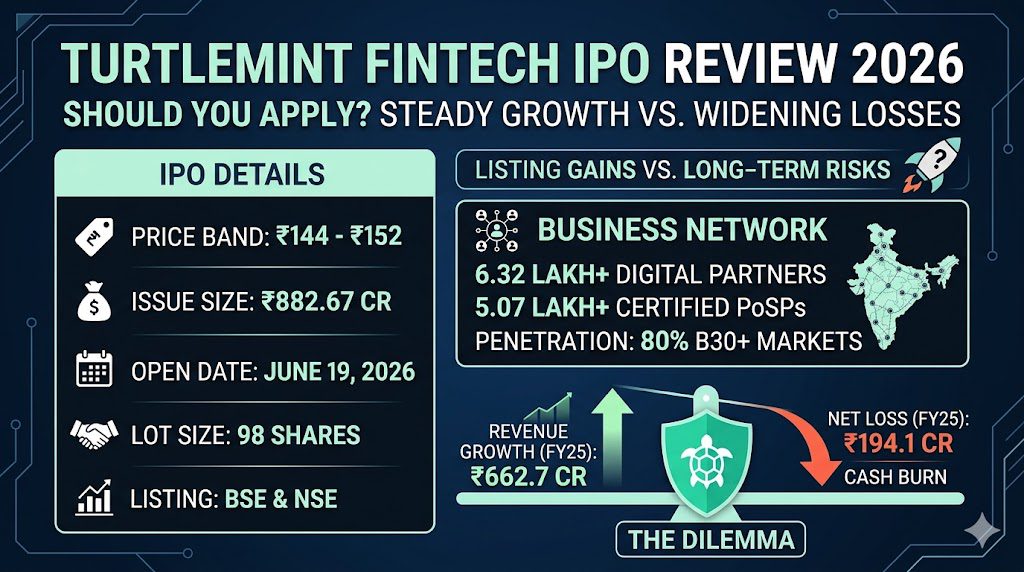
The Network Reach: As of late 2025, the company has expanded its footprint to cross over 6.32 lakh digital partners, including more than 5.07 lakh certified PoSPs. This network blankets approximately 19,171 pin codes, covering nearly 98% of India.
Deep Tier Penetration: Crucially, over 80% of its partner ecosystem resides in B30+ markets (cities outside the top 30 metro areas in India). This local presence drives 74.79% of its total platform premium volume, allowing the brand to tap into rural and semi-urban growth engines that traditional corporate agents find expensive to reach.
Diversification Beyond Commissions
While retail general insurance—specifically motor, health, and life policies—remains the bedrock of its corporate earnings, Turtlemint has systematically expanded its addressable market:
Turtlefin (Enterprise SaaS): A specialized software-as-a-service segment that offers customized, white-labeled insurance quoting, CRM, and policy tracking software to large banks, financial institutions, and corporate enterprises internationally.
Turtlemint Money: Launched to cross-sell additional wealth products, allowing its network of partners to distribute mutual funds, personal loans, and credit cards through the same underlying interface.
Core Fundamental Details & Financial Health
A deep dive into the financial statements submitted in the Red Herring Prospectus (RHP) reveals a classic hyper-growth trajectory balanced against intensive customer and partner acquisition costs.
Exponential Top-Line Expansion
Turtlemint has achieved monumental revenue scaling over the past three fiscal terms. The company’s revenue from operations surged from ₹419.91 crore in FY23 to a striking ₹662.71 crore in FY25. This scale reflects an increasing market share in distributed premiums, with the platform successfully facilitating more than 21.87 million insurance policies between April 2022 and December 2025.
The Profitability Hurdle
Despite the expanding top-line revenue, net profitability remains deeply deep in the red. Turtlemint has recorded continuous consolidated net losses due to heavy ongoing product development outlays and partner retention payouts.
FY23 Net Loss: -₹288.18 crore
FY24 Net Loss: -₹193.35 crore
FY25 Net Loss: -₹194.11 crore
9M ending Dec 31, 2025: Net loss stood at ₹187.39 crore, showing that the run-rate of expense burn has continued into the current fiscal stretch.
Operational Costs and Cash Flow
A vital point of concern for value-focused portfolios is the company’s operating cash position. For the nine-month period ending December 2025, the net cash flow from operating activities was negative at -₹175.31 crore. This is primarily because partner acquisition and support expenses consumed roughly 77.45% of total outlays during the same timeframe.
On the structural side, Turtlemint maintains a significant advantage: a completely debt-free balance sheet with zero long-term borrowings, ensuring that fresh capital raised via the public markets will not be diverted into debt service.
Key IPO Details & Vital Statistics
The Turtlemint IPO is a book-built issue looking to pool ₹882.67 crore from public, institutional, and high-net-worth investors. Below is a structured summary of the transactional components:
| IPO Parameter | Details and Allocation Metrics |
| Bidding Period | June 19, 2026 to June 23, 2026 |
| Price Band | ₹144 to ₹152 per equity share |
| Face Value | ₹1 per share |
| Total Issue Size | ₹882.67 Crore (5,80,70,398 Equity Shares) |
| Fresh Issue Portion | ₹660.72 Crore (New liquidity entering company reserves) |
| Offer for Sale (OFS) | ₹221.95 Crore (Existing venture backers exiting) |
| Minimum Lot Size | 98 Equity Shares |
| Minimum Retail Investment | ₹14,896 (Based on the upper price limit) |
| Institutional Allocation (QIB) | 75% of the net offer |
| Non-Institutional (NII/HNI) | 15% of the net offer |
| Retail Reservation | 10% of the net offer |
Planned Utilization of Fresh Capital
Of the ₹660.72 crore raised through the issuance of new equity, the corporate board has earmarked distinct allocations designed to steer the business toward operational self-sustainability:
Technology & Cloud Infrastructure: Allocation for upgrading server capabilities, advanced AI model integration, and core application uptime security.
Subsidiary Support (TIB): Injecting ₹128.64 crore into Turtlemint Insurance Broking Services to address working capital timing mismatches inherent in downstream insurer payout cycles.
Tech Team Salaries: Budgeting ₹193.04 crore to attract and retain specialized product developers, engineers, and platform designers over the medium term.
In-Depth IPO Analysis: Strengths vs. Risks
Major Strengths (The Bull Case)
Market Share Dominance: Turtlemint possesses a commanding 15.97% share of the total certified digital advisor network in India, making it an indispensable distribution pipeline for manufacturers.
Phygital Advantage in Rural India: Purely digital apps struggle to sell complex life and health policies without local human reassurance. Turtlemint’s local partners clear this hurdle efficiently.
Ecosystem Stickiness: By partnering with 45 established insurance enterprises, the platform displays deep network effects. As more customers join, more insurers list competitive rates, which in turn attracts more independent advisors.
Key Risks & Red Flags (The Bear Case)
Concentration Risk: The company exhibits high dependency on general insurance lines—specifically motor insurance, which historically accounts for more than 92% of premium volumes. Slowdowns in commercial vehicle sales or macroeconomic shocks directly pressure top-line fees.
Recent Consolidation Curve: Turtlemint acquired its primary broking engine, Turtlemint Insurance Broking Services (TIB), relatively recently in May 2024. Consequently, the company lacks an extended multi-year track record of consolidated financials under this streamlined structure.
Intense Industrial Rivalry: The enterprise battles scaled, deeply entrenched rivals such as PB Fintech (Policybazaar), alongside emerging insurtech pipelines backed by global venture pools.
Current Grey Market Premium (GMP) & Valuation Trends
In the unlisted grey market space, trends indicate a cautious yet optimistic sentiment among retail traders. As of the evening of June 18, 2026, the Grey Market Premium (GMP) for Turtlemint is hovering between ₹15 and ₹18 per share.
Against the upper price band of ₹152, this premium indicates a projected opening listing price of roughly ₹167 to ₹170, translating to a potential 10% to 12% short-term listing gain for early applicants.
Valuation Reality Check
Because Turtlemint’s net earnings are negative (with a negative EPS of ₹7.33 for FY25), traditional Price-to-Earnings (P/E) ratios cannot be calculated. On a Price-to-Sales (P/S) basis, the company commands a post-issue market capitalization of approximately ₹4,513 crore at the upper band. This implies a trailing P/S multiple of roughly 6.8x, which is relatively moderate compared to Policybazaar’s premium historical multiples, offering a fair entry price considering its revenue growth pace.
Expert View & Final Verdict: Buy, Wait, or Stay Away?
For High-Risk Investors and Listing Gain Seekers: BUY / APPLY WITH CAUTION
The moderate GMP band indicates that while a massive multi-bagger opening pop is unlikely, a stable 10% premium is achievable if Qualified Institutional Buyer (QIB) bid lines cross 5x on the secondary close day. High-risk profiles looking to play the long-term expansion of Indian technology platforms can safely allocate capital, provided they understand that near-term volatility is highly possible.
For Value Investors and Conservative Retainers: WAIT AND WATCH
If your personal portfolio mandates immediate positive cash flows and proven quarterly profitability, the strategic choice is to stay away during the IPO window. Investors should wait for two to three consecutive quarters post-listing to observe if the management successfully narrows its operational losses down toward a positive break-even threshold.
Data & Statistics Section
| Financial & Operational Metric | Value (As of FY25 / Dec 2025) | Source |
| Total Active Digital Partners | 6.32 Lakh+ Partners | Company RHP |
| Certified PoSP Advisors | 5.07 Lakh+ Advisors | Company RHP |
| FY25 Consolidated Revenue | ₹662.71 Crore | Audited Financials |
| FY25 Net Losses | ₹194.11 Crore | Audited Financials |
| B30+ Market Penetration Rate | 80.05% of Total Partners | Redseer Industry Report |
| Total Platform Premium Outlay | ₹10,066 Crore+ (Cumulative) | Company RHP |
| Total Long-term Debt | ₹0.00 (Debt-Free) | Company RHP |
Frequently Asked Questions (FAQ)
1. What is the official price band for the Turtlemint Fintech IPO?
The price band has been officially locked between ₹144 and ₹152 per equity share, with a face value of ₹1 per share.
2. When does the Turtlemint IPO open and close for subscription?
The issue opens for public bidding tomorrow, Friday, June 19, 2026, and closes for subscriptions on Tuesday, June 23, 2026.
3. What is the minimum lot size required for individual retail investors?
The minimum lot size is fixed at 98 shares. At the ceiling price of ₹152, this requires a minimum capital lock-in of ₹14,896 per application.
4. Is Turtlemint Fintech Solutions Ltd currently a profitable business?
No. While its operating revenue has grown to ₹662.71 crore in FY25, the company reported a net loss of ₹194.11 crore for the same period due to high operational burn rates.
5. Where will the shares of Turtlemint be officially listed?
The equity shares are scheduled to list on both major national exchanges in India: the National Stock Exchange (NSE) and the Bombay Stock Exchange (BSE).
6. Who are the primary book-running lead managers for this Mainboard public issue?
The issue is managed by a high-profile consortium including ICICI Securities Limited, Jefferies India Private Limited, JM Financial Limited, and Motilal Oswal Investment Advisors.
7. What percentage of the Turtlemint IPO is reserved for retail individual bids?
Because the public issue is brought under regulatory provisions governing fast-growing tech companies without immediate historical profit compliance, 75% is allocated to QIBs, 15% to NIIs, and 10% is reserved for retail buyers.
8. What is the expected tentative date for the listing of Turtlemint shares?
The basis of allotment will be wrapped up on June 24, 2026, and the shares are expected to officially commence trading on the stock exchanges on June 29, 2026.
Official Links & Resources
Official Corporate Website: https://www.turtlemint.com
Registrar Portal (Allotment Link): https://www.kfintech.com
Corporate Contact: The ORB Sahar, 4 and 4A, 1st Floor, A Wing, Marol Village, Andheri East, Mumbai 400 099, Maharashtra, India. (Email: companysecretary@turtlemint.com)