

✈️ Introduction: China’s Leap into the Future of Air Warfare
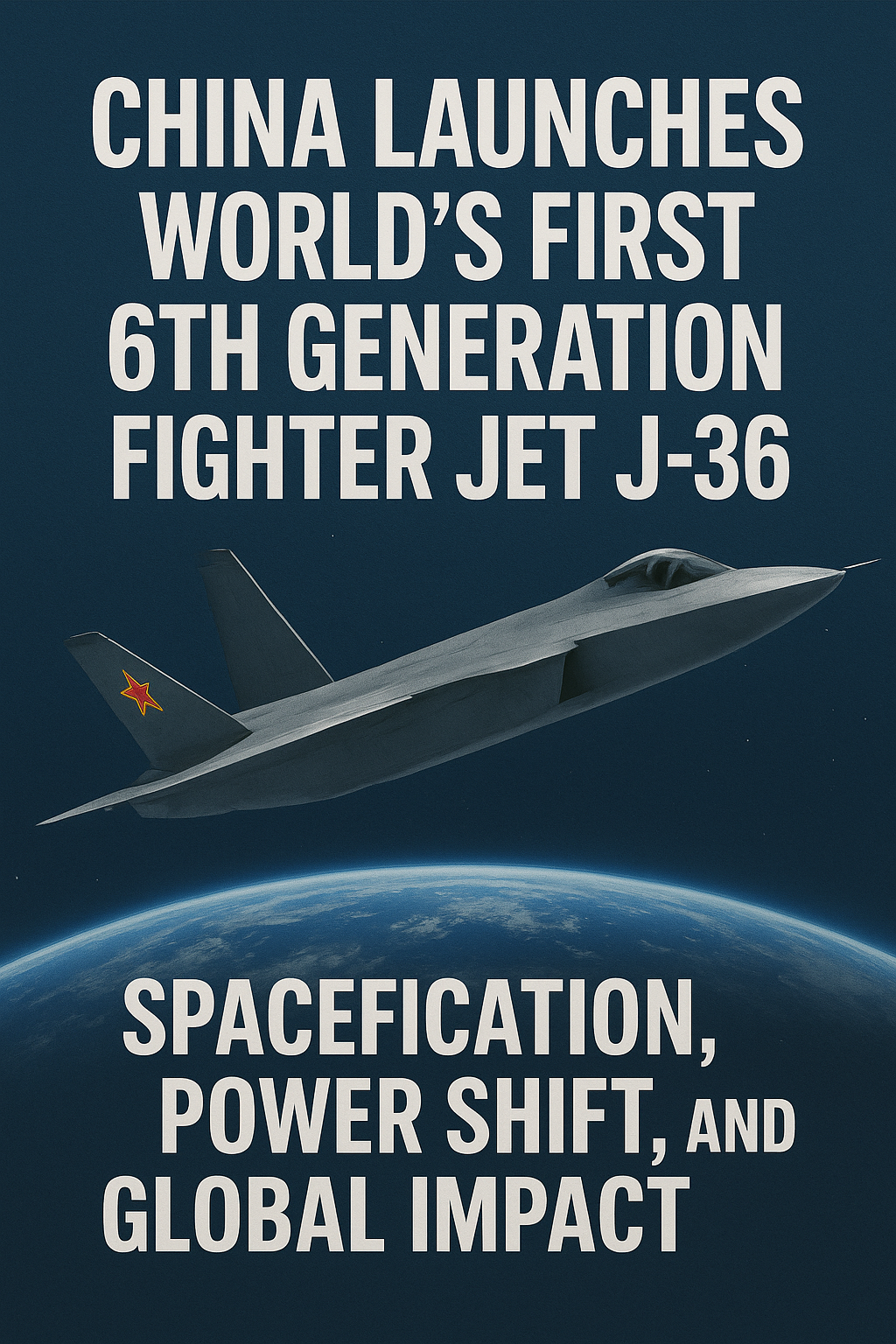
China has once again grabbed global attention by launching the J-36, claimed to be the world’s first sixth-generation stealth fighter jet. The aircraft, developed by Chengdu Aircraft Industry Group, marks a giant step for Beijing in its race to challenge American and Western air superiority.
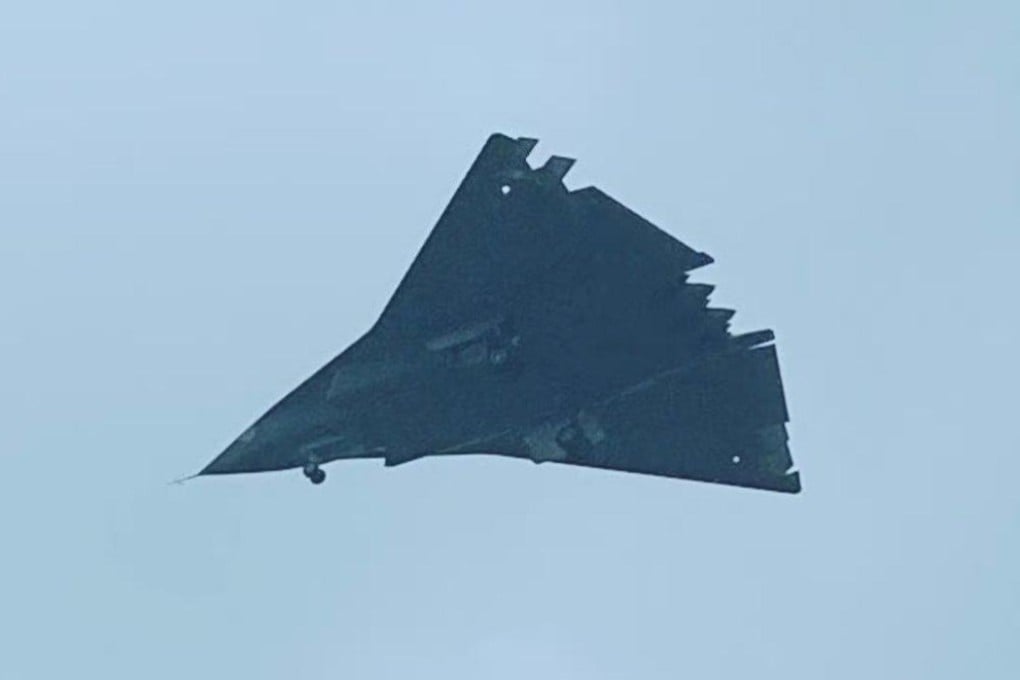
Videos of the J-36’s first test flight over Sichuan Province went viral, showing an unusual tailless, stealthy flying-wing design — something never seen before in any fighter jet. Defense experts call it a “quantum leap” that could reshape aerial warfare and global power equations.
🛰️ The “Spacefication” of J-36 — What Makes It Truly Next-Gen
Unlike existing fifth-generation fighters like the F-22 Raptor or the J-20, the J-36 has been designed with “spacefication” — an integration of space and air combat technologies.
Here’s what “spacefication” means in simple terms:
Space-linked Communication Systems: J-36 can connect directly with China’s military satellites, enabling real-time data sharing and command from space.
Near-Space Operation Capability: The fighter’s aerodynamic structure and trijet engine design reportedly allow it to fly at extreme altitudes — possibly near the edge of space.
AI-Driven Autonomy: The jet could fly semi-autonomously, coordinate drone swarms, and share battle data with unmanned systems.
Stealth Against Space Sensors: Its shape and material reportedly make it invisible not only to radar but also to infrared detection from satellites.
Energy & Laser-Ready: Military insiders hint that the J-36’s large internal power system might support directed-energy or laser-based weapons in the future.
In essence, the J-36 is not just a fighter jet — it’s a flying command center built to dominate both the atmosphere and near-space domains.
⚔️ J-36 vs Other Fighters: What Makes It Different?
When compared to other 5th-generation fighters, the J-36 shows a significant evolution in design philosophy.
| Fighter Jet | Country | Manufacturer | Generation | Key Features |
|---|---|---|---|---|
| J-36 (New) | China | Chengdu Aircraft Corp | 6th | Tailless stealth design, AI, satellite-linked, near-space capability |
| F-35 Lightning II | USA | Lockheed Martin | 5th | Multirole stealth jet, global network integration |
| F-22 Raptor | USA | Lockheed Martin | 5th | Air superiority, stealth dominance |
| Su-57 Felon | Russia | Sukhoi | 5th | Super maneuverable, stealth design |
| J-20 Mighty Dragon | China | Chengdu | 5th | Long-range stealth interceptor |
| Rafale | France | Dassault Aviation | 4.5th | Agile multirole, advanced avionics |
| Eurofighter Typhoon | EU (UK, DE, IT, ES) | Eurofighter GmbH | 4.5th | High agility, multirole capabilities |
| F-15EX Eagle II | USA | Boeing | 4.5th | High payload, speed, proven reliability |
| Tejas Mk-1A | India | HAL | 4th | Lightweight, indigenous multirole jet |
| KF-21 Boramae | South Korea | KAI | 4.5th | Semi-stealth multirole fighter |
✅ Where J-36 wins:
Next-gen stealth with no tail (ultra-low radar cross-section)
AI & space-enabled network control
Designed for manned-unmanned “loyal wingman” operations
Possibly longer range than F-22 or F-35
⚠️ Where it still lags:
Unknown combat record
Not yet operational or combat-tested
Unclear engine reliability and stealth material endurance

🌍 How J-36 Challenges American Dominance
For decades, the United States has been the uncontested air power leader, thanks to its F-22 and F-35 fleets. The J-36, however, signals a serious challenge to that dominance.
Tech Race Acceleration: The U.S. is still developing its own sixth-gen program, NGAD (Next Generation Air Dominance). China showing a flying prototype first is a geopolitical message — “We’re catching up fast.”
Strategic Deterrence: A stealth fighter capable of operating with satellite assistance threatens U.S. assets in the Pacific, especially around Taiwan and the South China Sea.
Psychological Warfare: Launching the J-36 so publicly boosts China’s global image as a tech-driven superpower, unsettling rivals and influencing defense markets.
Budgetary Impact: The Pentagon now faces added pressure to accelerate its NGAD funding and countermeasure research.
This shift is not just about one jet — it’s about who leads the next century’s skies.
🇮🇳 Deep Impact on India — Strategic and Economic Analysis
India finds itself right in the middle of this evolving aerial arms race. The launch of J-36 impacts India on multiple fronts — militarily, economically, and diplomatically.
1. Defense Strategy Recalibration
India will need to fast-track its own 5th and 6th generation programs like the AMCA (Advanced Medium Combat Aircraft) and Tejas Mk-2. The J-36’s range and stealth could pose challenges to Indian air surveillance in Ladakh and Arunachal sectors.
2. Boosting Alliances
India may deepen cooperation with the U.S., France, and Japan under frameworks like the Quad to access new radar, drone, and satellite tech. Closer strategic alignment could rebalance power in the Indo-Pacific.
3. Economic Ripple
If China gains export credibility for advanced fighter tech, it could eat into the global arms market — affecting pricing, defense imports, and even India’s indigenous aircraft exports in the long term.
4. Cyber & Space Integration
India’s Space Command and DRDO will now likely focus more on space-air coordination, anti-satellite (ASAT) defense, and AI-enabled air surveillance systems.
5. Rupee and Budgetary Impact
Increased defense procurement, especially from Western partners, could slightly pressure India’s fiscal balance — a short-term negative for the rupee but a long-term positive for self-reliance under Make in India Defence initiatives.
💥 Global Top 10 Fighter Jets in 2025 (Ranked for Performance & Influence)
| Rank | Fighter Jet | Country | Manufacturer |
|---|---|---|---|
| 1 | J-36 | China | Chengdu Aircraft Corp |
| 2 | F-35 Lightning II | USA | Lockheed Martin |
| 3 | F-22 Raptor | USA | Lockheed Martin |
| 4 | Su-57 Felon | Russia | Sukhoi |
| 5 | J-20 Mighty Dragon | China | Chengdu |
| 6 | Rafale | France | Dassault Aviation |
| 7 | Eurofighter Typhoon | EU | Consortium |
| 8 | F-15EX Eagle II | USA | Boeing |
| 9 | Tejas Mk-1A | India | HAL |
| 10 | KF-21 Boramae | South Korea | KAI |
🔎 Conclusion: The Dawn of the “Space-Air” Combat Era
The J-36 fighter jet is more than a new aircraft — it’s a strategic signal.
China wants the world to know it is ready to lead not just in trade or technology, but also in the next generation of warfare.
While it’s still in the testing phase, its space-linked systems, AI intelligence, and futuristic stealth make it a symbol of a shifting global order — where air dominance may no longer be an American monopoly.
For India, the J-36’s arrival is a wake-up call: to invest faster, innovate deeper, and build self-reliance in aerospace and defense.
For the rest of the world, it’s a clear sign that the 6th-generation fighter race has officially begun.




One thought on “🇨🇳 China Launches World’s First 6th Generation Fighter Jet J-36: Spacefication, Power Shift, and Global Impact”