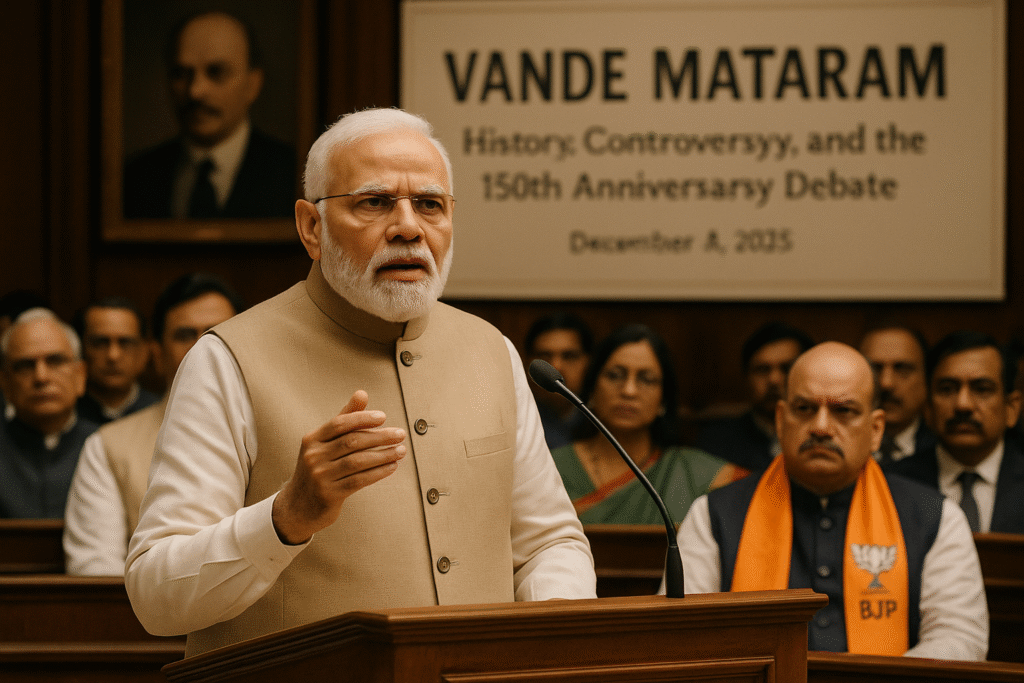
Vande Mataram at 150: History, Debate and Parliament’s Big Discussion Explained
As India marks 150 years of Vande Mataram, Parliament has opened a major debate that combines history, politics and national identity. What was meant to be a tribute to a patriotic song has quickly turned into one of the most discussed issues of the Winter Session 2025. With Prime Minister Narendra Modi initiating the conversation, both the government and the opposition are using this moment to revisit the decisions taken decades ago — especially the 1937 resolution and Jawaharlal Nehru’s stance in 1948.
This article breaks down the entire issue in simple language, looking at the song’s history, its controversies, and the political debate happening today.
150 Years of Vande Mataram: Why the Song Is Back in National Headlines
The immediate trigger for the discussion is the 150th anniversary of Vande Mataram, written by Bankim Chandra Chattopadhyay in 1875. For decades, the song has symbolized sacrifice and patriotism. It was sung in marches, protests, and public gatherings during the freedom struggle, making it one of India’s most cherished national symbols.
To mark the anniversary, the government scheduled a special discussion in both the Lok Sabha and Rajya Sabha. Prime Minister Modi opened the debate in the Lok Sabha on December 8, 2025. The moment quickly became political, with multiple parties seizing the opportunity to highlight different interpretations of the song’s history.
Why Vande Mataram Was Not Chosen as the National Anthem
A key question resurfacing in Parliament is why Vande Mataram was not selected as India’s National Anthem after Independence.
Nehru’s Concerns About Musical Suitability
Jawaharlal Nehru believed a National Anthem must be easy for orchestras, military bands and foreign audiences to perform. He felt Vande Mataram, although beautiful, was more emotional, slow and repetitive in tune. According to him, it reflected the pain and struggle of the freedom movement rather than the confidence of an independent nation.
Jana Gana Mana Was Seen as More Universal
Nehru argued that Jana Gana Mana had the right tone for a new nation — uplifting, solemn and musically adaptable. Yet he insisted that Vande Mataram would always remain India’s “premier national song,” carrying its own emotional and historical value.
This dual status is what India follows even today:
National Anthem: Jana Gana Mana
National Song: Vande Mataram
The 1937 Controversy: Why Certain Stanzas Were Removed

A central part of today’s debate is the 1937 Congress resolution. At that time, the party chose only the first two stanzas of Vande Mataram for national use.
Why Only Two Stanzas?
The later stanzas of the song contain references to Hindu goddesses like Durga, Lakshmi and Saraswati. While these are culturally meaningful to many Indians, they made some non-Hindu communities uncomfortable, especially when used in national or political functions.
Tagore’s Advice Was Crucial
Rabindranath Tagore reportedly advised the Congress that the first two stanzas were inclusive and poetic, describing the motherland without religious references. The later verses, he argued, were devotional and better suited for cultural, not national, settings.
Nehru Supported the Decision
Jawaharlal Nehru defended the move, saying it was not about “appeasement” but about unity — ensuring the freedom struggle included people of every community.
This decision remains a sensitive point even today, forming the heart of the renewed political argument.
BJP’s Stand: “The Song Was Divided and So Was the Nation”
Meesho IPO 2025 Explained: Price Band, Financials, Business Model & Expert Analysis click here
The BJP has used the 150th anniversary to sharply criticise the Congress’s historical handling of Vande Mataram. Prime Minister Narendra Modi said the 1937 decision to drop stanzas “tore the song apart” and planted the “seeds of division” that later contributed to partition politics.
Key Arguments from the BJP
Congress changed the song to satisfy communal demands.
Nehru compromised on national culture for political convenience.
The 1937 decision weakened national unity.
The ruling party argues that cultural pride should not be diluted, and national symbols should never be altered to appease any group.
Stay informed with SRVishwa
Congress’s Defense: “We Were Uniting India, Not Dividing It”
The Congress strongly disputes the BJP’s claims. Leader of Opposition Rahul Gandhi, Congress President Mallikarjun Kharge, and senior MPs like Priyanka Gandhi Vadra have offered a united rebuttal.
Congress’s Key Points
The 1937 decision was inclusive, not divisive.
It ensured all communities felt comfortable singing the national song.
The BJP and RSS had minimal role in the freedom struggle and therefore cannot rewrite history today.
Congress leaders also highlight that the first two stanzas — the part accepted in 1937 — are the ones most people sing even today at public ceremonies.
click here to visit the official site of Ministry of Parliamentry Affair
Winter Session Updates: Parliament Divided but Engaged
The Vande Mataram debate has dominated Day 6 of the 2025 Winter Session.
Lok Sabha
PM Modi opened the discussion.
Congress and INDIA bloc MPs responded sharply.
Later this week, the House will also discuss major election reforms.
Rajya Sabha
The Upper House will take up the Vande Mataram debate on December 9.
Key opposition and treasury speakers are expected to participate.
Other Topics in Parliament
Rising crime in Delhi
Sambhal law and order issue
Several urgent matters raised through motions
Still, the song’s anniversary remains the most widely covered issue of the week.
Why the Debate Still Matters Today
Official Website of Congres Partyclick here
The conversation around Vande Mataram goes much deeper than just history. It raises big questions about national identity, secularism, cultural heritage and how a diverse country defines patriotism.
A Question of Unity vs. Identity
One side argues the decisions of 1937 and 1948 were pragmatic choices aimed at unity.
The other side believes national pride should not be compromised for anyone’s sentiments.
Both positions come from different ideas of what India represents: a culturally rooted civilisation or a broad, inclusive republic.
Conclusion: A Song That Still Shapes India’s National Story
Official Website Of BJP click here
Even after 150 years, Vande Mataram continues to shape India’s politics and emotions. It remains a powerful symbol of patriotism — one that inspired freedom fighters and still stirs the hearts of millions.
India officially recognises both:
Jana Gana Mana as the National Anthem
Vande Mataram as the National Song
Despite political disagreements, the song’s essence remains unchanged: it celebrates the beauty, spirit and soul of India. The current debate shows how national symbols continue to evolve as new generations reinterpret old decisions.
As the Parliament debate continues, one thing is clear — Vande Mataram is not just a song from the past but an ongoing part of India’s identity and democratic conversation.