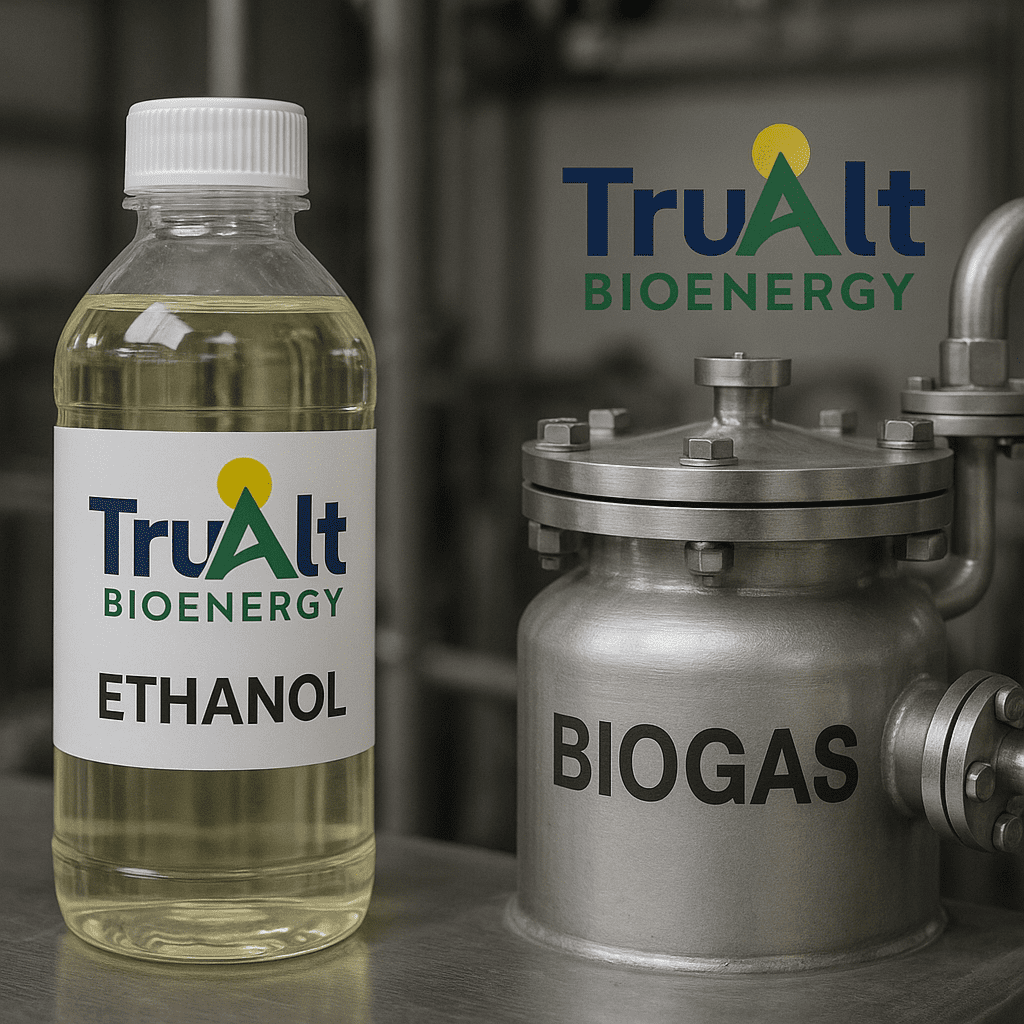
TruAlt Bioenergy Q2 FY2025-26 Results: Transition Quarter Sets Up Long-Term Growth
TruAlt Bioenergy Limited, one of India’s leading biofuel and renewable energy companies, announced its Q2 FY2025-26 results showcasing a strategic transition phase that prioritizes capacity expansion and process transformation over short-term profit optimization.
The company reported total income of ₹326.63 crore, compared to ₹404.83 crore in Q1 FY2025-26 and ₹1,968.53 crore in Q2 FY2024-25. While revenue fell year-on-year, this decline was expected due to planned commissioning shutdowns across multiple plants for dual-feed system conversion — a key strategic move aimed at enabling year-round operations and eliminating the seasonal dependence of sugar-based ethanol production.
Despite the revenue moderation, TruAlt Bioenergy reported a consolidated PAT of ₹146.64 crore, reversing its prior-year loss of ₹18.6 crore in Q2 FY2024-25 and significantly outperforming the modest ₹4.73 crore profit from Q1 FY2025-26.
📊 Quarterly Financial Comparison — TruAlt Bioenergy
| Parameter (₹ Crore) | Q2 FY2025-26 (Jul–Sep 2025) | Q1 FY2025-26 (Apr–Jun 2025) | Q2 FY2024-25 (Jul–Sep 2024) |
|---|---|---|---|
| Total Income / Revenue | 326.63 | 404.83 | 1,968.53 |
| EBITDA | (4.55) | 41.54 | 309.14 |
| EBITDA Margin (%) | –3.96% | 13.67% | 16.20% |
| PBT | (49.18) | 5.80 | 159.44 |
| PAT (Net Profit) | 146.64 | 4.73 | (18.60) |
| PAT Margin (%) | 7.45% | 1.45% | (4.60%) |
Source: TruAlt Bioenergy Q2 FY2025-26 investor presentation and regulatory filings (NSE, BSE).
Operational Performance: Transitioning for Long-Term Stability
The Q2 FY26 results need to be understood in the context of TruAlt Bioenergy’s ongoing transformation journey. The company is moving away from being a purely molasses-based ethanol producer to a multi-feed biofuel platform that can operate continuously across the year.
To achieve this, TruAlt temporarily shut down several units in Q2:
Unit 1, 2, and 4 were closed for dual-feed commissioning.
Unit 5 remained idle pending its final Consent to Operate (CTO) approval.
Once the dual-feed conversion is complete, the company expects to run its facilities for 330 days per year, up from the current ~140 operational days. This shift will stabilize revenue and reduce dependence on seasonal sugarcane feedstock availability.
Why the Profit Still Grew Despite Weak EBITDA
At first glance, the decline in EBITDA to a negative ₹4.55 crore may raise eyebrows. However, the bottom-line profitability improved significantly, with PAT surging to ₹146.6 crore. This was driven by lower finance costs, one-time adjustments, and increased efficiency in non-operational income segments.
The management highlighted that the temporary operational pauses affected topline performance but would ultimately enhance margins once all dual-feed units are online.
“FY2025-26 is a reset year for TruAlt Bioenergy — we are prioritizing sustainable capacity expansion, dual-feed commissioning, and backward integration for long-term gains over immediate profitability,” the company’s statement said.
Strategic Projects Powering Future Growth
1️⃣ Dual-Feed Conversion – A Structural Game Changer
Out of the company’s 2,000 KLPD total ethanol capacity, 1,300 KLPD (65%) is being converted to dual-feed mode. This enables TruAlt to use both sugarcane molasses and grain as feedstock, insulating operations from seasonal volatility.
The project, once fully commissioned, will:
Increase plant utilization to 90%+ year-round.
Lower per-liter production costs.
Improve gross margins through consistent feedstock availability.
2️⃣ Co-Product Monetization
TruAlt is also building monetization streams for co-products like food-grade CO₂ and DDGS (Distillers Dried Grains with Solubles), both of which command strong industrial demand. These co-products can boost revenue by up to 10–15% annually without additional feedstock input.
3️⃣ Compressed Biogas (CBG) and Sustainable Aviation Fuel (SAF)
The company has entered partnerships and MoUs to diversify into CBG and SAF— two high-growth renewable energy verticals aligned with India’s Net-Zero roadmap.
CBG Projects: Joint ventures with Sumitomo to set up three large CBG plants by FY2027.
SAF Project: A ₹2,250 crore ethanol-to-SAF plant under MoU with the Andhra Pradesh Economic Development Board (APEDB).
These projects are expected to start contributing to top-line growth by FY2026-27, making TruAlt one of the few integrated renewable fuel companies in India.
4️⃣ Retail Fuel Outlets
TruAlt has also announced plans to expand its retail footprint. The first phase includes the rollout of 13 biofuel retail outlets across Karnataka, with a medium-term goal of reaching 100 stations nationwide.
Management Guidance for H2 FY2025-26
The management expects performance to improve steadily over the next two quarters as dual-feed units return to full production. Key highlights from guidance include:
Revenue Growth: H2 FY26 revenue expected to grow 25–30% sequentially as plants stabilize.
EBITDA Recovery: Targeting a return to 10–12% EBITDA margins by Q4 FY26.
Capex Allocation: Focused on completing dual-feed projects and investing in renewable verticals.
Cash Flow Discipline: Working capital optimization and improved inventory turnover.
Sustainability Focus: Carbon capture integration and feedstock diversification under ESG roadmap.
Comparative Analysis: Q2 FY26 vs Q2 FY25 vs Q1 FY26
| Parameter | Observation |
|---|---|
| YoY (Q2 FY26 vs Q2 FY25) | Revenue dropped 83% due to planned shutdowns; PAT improved from a loss of ₹18.6 crore to a profit of ₹146.6 crore. |
| QoQ (Q2 FY26 vs Q1 FY26) | Revenue fell 19%, but PAT rose sharply from ₹4.7 crore to ₹146.6 crore due to cost rationalization and income from investments. |
| EBITDA Trend | Negative in Q2 due to downtime but expected to recover strongly post-commissioning. |
| Balance Sheet Strength | Lower leverage and steady net worth. |
Analyst View and Market Sentiment
Analysts covering TruAlt Bioenergy view FY2025-26 as a transformation year. The company’s strategy of prioritizing dual-feed conversion and renewable diversification is seen as a long-term positive, even though near-term results appear muted.
Market experts note that once capacity utilization rises to 90% and SAF/CBG projects start contributing, TruAlt’s EBITDA could expand to pre-FY25 levels.
“The operational reset is short-term pain for long-term gain. The company’s forward integration into SAF and CBG will open new revenue pools,” said a brokerage note.
Risks and Watchpoints
Execution Delays: Any delay in commissioning or CTO approvals could postpone revenue recovery.
Feedstock Volatility: Sustained availability of grains and molasses at stable prices is critical.
Capital Requirements: Large CAPEX for SAF and CBG ventures may affect short-term liquidity.
Regulatory Framework: Government pricing and subsidy policies for ethanol and biofuels could influence margins.
Conclusion: TruAlt Bioenergy’s Strategic Reset for Sustainable Growth
TruAlt Bioenergy’s Q2 FY2025-26 financial report paints a clear picture of a company in transition — willingly accepting a weaker quarter in exchange for a stronger, diversified, and future-ready operational model.
With revenue at ₹326.6 crore, PAT at ₹146.6 crore, and a multi-feed, multi-product roadmap under execution, TruAlt is positioning itself to emerge as one of India’s leading integrated biofuel and renewable energy players.
The focus on dual-feed flexibility, CO₂ recovery, CBG production, and SAF development shows a well-structured approach toward energy security and sustainability. As the transformation completes over the next 2–3 quarters, TruAlt’s performance is expected to stabilize, margins to normalize, and growth to accelerate — making it a long-term green energy story worth watching.